

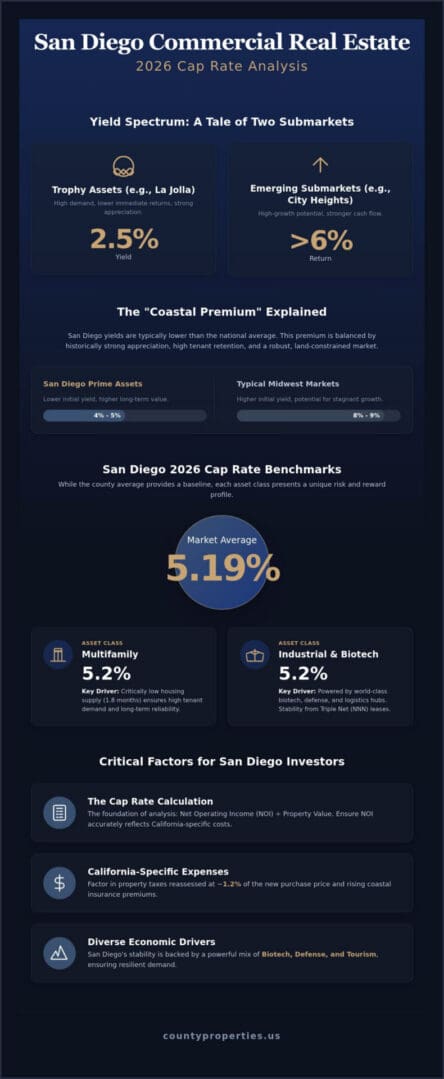
Did you know that while trophy assets in La Jolla are trading at yields as low as 2.5%, savvy investors are finding returns over 6% in emerging submarkets like City Heights? You’re likely looking at the San Diego horizon and feeling the weight of high entry costs, especially as 2026 interest rate shifts create a lingering sense of uncertainty. It’s a common concern to wonder if you’re overpaying in such a competitive coastal landscape, but you don’t have to navigate these high-stakes decisions alone. We understand that your investment isn’t just a transaction; it’s a vital step toward your long-term financial security and personal goals.
Identifying a good cap rate for commercial property in San Diego requires looking past the 5.19% market average to understand the specific risk-adjusted yields of each unique neighborhood. This guide provides you with the latest 2026 benchmarks for multifamily, industrial, and retail sectors across the region. You’ll discover which submarkets offer the strongest cash flow and learn how to pinpoint high-value opportunities that align with your financial vision. We’ll explore the data behind the current 5.2% industrial yields and 7.9% office benchmarks so you can move forward with total clarity. By the end, you’ll have the confidence to make a purchase decision that feels both secure and aspirational.
Key Takeaways
- Learn how San Diego’s high demand influences yield benchmarks and why historically lower cap rates can still represent a secure financial future.
- Discover what defines a good cap rate for commercial property in San Diego by comparing 2026 performance across multifamily, industrial, and retail assets.
- Pinpoint high-growth opportunities in emerging submarkets like City Heights and the South Bay to maximize your risk-adjusted returns.
- Master the relationship between interest rates and your investment spread to ensure you don’t overpay in a competitive coastal market.
- Benefit from a collaborative, service-centric approach that provides the localized data you need to navigate complex commercial transitions with confidence.
Understanding Cap Rates in the San Diego Commercial Market
A property’s Capitalization rate, or cap rate, is the ratio of Net Operating Income (NOI) to the property’s purchase price or current market value. It’s the most common way we measure the potential return on a real estate investment before considering debt. In a coastal powerhouse like San Diego, you’ll find that cap rates are often lower than national averages because high demand drives property values up. This creates an inverse relationship; as prices rise due to scarcity and desirability, the yield percentage naturally compresses. We’ve seen this play out over decades, where the stability of Southern California real estate attracts capital even when immediate cash flow seems leaner than in other regions.
Finding a good cap rate for commercial property in San Diego in 2026 requires a more nuanced perspective than simply chasing the highest possible number. With the market adjusting to new economic realities, a “good” return is no longer a static figure. It’s a reflection of submarket stability, asset quality, and your specific financial goals. We believe in looking at the complete picture to ensure your investment serves as a reliable anchor for your long-term wealth.
The Formula for San Diego Investors
Calculating your NOI correctly is the foundation of any successful purchase. In San Diego, you must account for California-specific expenses that can vary significantly from other states. Property taxes are a primary consideration; since they’re reassessed upon sale, your projections must reflect a rate of roughly 1.2% of the new purchase price rather than the seller’s current bill. You also need to factor in rising insurance premiums for coastal or high-fire-risk zones. A cap rate serves as a vital risk assessment tool that helps you determine if a property’s income justifies its price tag in a competitive environment.
Why San Diego Yields Differ from National Averages
You might see 8% or 9% yields in Midwest markets like Ohio or Indiana, but those higher numbers often come with stagnant growth and higher vacancy risks. San Diego investors typically accept a “Coastal Premium,” which often results in 4% to 5% yields for prime assets. This lower immediate cash flow is balanced by the region’s historical track record of strong appreciation and high tenant retention. You aren’t just buying a stream of income; you’re securing an asset in a land-constrained market backed by biotech, defense, and tourism. This balance between appreciation potential and immediate yield is what makes San Diego a preferred choice for those seeking reliability over speculative gains.
San Diego Cap Rate Benchmarks by Asset Class in 2026
You’ll find that 2026 has brought a distinct divergence in how different property types perform across the county. While the overall average sits near 5.19%, a good cap rate for commercial property in San Diego isn’t a one-size-fits-all metric. Each asset class carries its own risk profile and growth potential, requiring you to align your purchase with your specific tolerance for volatility. We’re here to help you decipher these benchmarks so you can make a choice that feels both secure and aspirational for your future.
Multifamily Stability in 2026
Multifamily remains the premier choice for investors seeking long-term reliability. With San Diego’s housing inventory stuck at a critically low 1.8 months of supply, rental demand is virtually guaranteed. Average cap rates for this sector are holding steady at 5.2%, though you’ll see a clear gap between Class A luxury builds and Class C value-add opportunities. If you’re also considering the residential market for your personal portfolio, our Buying a Home in Southern California: A Realistic 2026 Guide offers valuable context on local living trends. Before diving into specific deals, it’s helpful to review What is a cap rate? to ensure your income projections are based on solid fundamentals.
The Industrial and Biotech Surge
The industrial sector is currently a powerhouse driven by our region’s world-class biotech and logistics hubs. Average yields are currently matching multifamily at 5.2%, but the appeal here often lies in the stability of Triple Net (NNN) leases. In “Titan” submarkets like Otay Mesa or the Carlsbad biotech corridor, cap rates have compressed because investors value the creditworthiness of established corporate tenants. These properties often require less hands-on management, making them a favorite for those who value their time as much as their returns. It’s a sector where professional mastery of the local market truly pays off.
Retail and office assets now require a “risk premium” to attract capital in the current market. Retail properties average a 6.7% yield, while office spaces have climbed to 7.9% due to a county-wide vacancy rate of 18%. These higher returns reflect the additional effort and expertise required to maintain occupancy in a changing workplace landscape. To find the right balance between immediate yield and long-term growth, you can partner with a dependable guide who understands these shifting regional benchmarks.
Submarket Analysis: Where to Find Yield in San Diego County
Location is the primary driver of your potential return. In San Diego, we see a distinct “yield spread” between the coast and the interior. A good cap rate for commercial property in San Diego depends heavily on which side of the I-5 or I-15 you’re buying on. Coastal markets like La Jolla and Del Mar often see cap rates as low as 2.5% to 3.5%, whereas inland areas like Escondido or El Cajon offer spreads that are typically 100 to 150 basis points higher. Understanding these Factors Influencing Your Actual Return is essential for setting realistic expectations and ensuring your capital is positioned for both safety and growth.
Coastal vs. Inland Yield Spreads
Many of our clients prefer the security of coastal assets. While a 4% coastal cap might seem lean, the long-term appreciation and high tenant quality provide a sense of financial safety that’s hard to match. For investors who prioritize immediate cash flow over long-term equity gains, inland submarkets are the logical answer. You can explore broader regional growth patterns in our guide to the Southern California Housing Market: Forecast & Trends for 2026 to see how these inland communities are evolving. This geographic diversity allows us to tailor a strategy that matches your specific comfort level and financial aspirations.
Opportunity Zones and Emerging Neighborhoods
Finding a good cap rate for commercial property in San Diego often means looking at neighborhoods like City Heights, which currently offers yields around 6.3%. Barrio Logan is another highlight for yield seekers, with average returns near 5.8%. These areas are undergoing significant revitalization, offering “value-add” opportunities where you can renovate a Class C asset to raise your exit cap. We specialize in identifying these hidden gems. By focusing on areas with strong community roots and planned infrastructure improvements, we help you secure assets that have the potential to outperform the county average as the neighborhood matures.
Specific regional drivers also provide a floor for property values in certain submarkets. National City, with a 5.2% average cap, and Otay Mesa benefit from constant logistics demand and their proximity to the border. Our massive military presence stabilizes retail and multifamily demand near bases like Camp Pendleton and Miramar. Even the “Rancho Santa Fe effect” plays a role in the luxury commercial niche; while yields are tight, the sheer wealth concentration ensures these properties remain some of the most dependable in the region. We act as your seasoned mentor to help you navigate these local nuances with total confidence.
Critical Factors Influencing Your Actual Return
While a 5.2% yield might look like a good cap rate for commercial property in San Diego on paper, the numbers on a marketing flyer rarely tell the whole story. Your actual return is shaped by variables that sit outside the basic NOI calculation. We focus on helping you identify these hidden risks so you can feel secure in your financial safety. A property’s age, the creditworthiness of its tenants, and the specifics of its lease structures can either protect your wealth or erode it over time. We believe in taking a methodical approach to due diligence to ensure your investment serves as a reliable anchor for your long-term goals.
The Spread: Cap Rates vs. Financing Costs
In 2026, the relationship between cap rates and interest rates is the most critical variable for financed investors. Positive leverage occurs when the property’s cap rate is higher than your mortgage interest rate, which boosts your cash-on-cash return. If you’re looking at a 5.2% cap rate but your financing cost is 6.5%, you’re facing negative leverage. This doesn’t always mean a bad deal, but it does mean you’re banking heavily on rent growth or future appreciation. When evaluating a pro-forma cap rate, always use a realistic checklist to verify the seller’s claims:
- Compare pro-forma vacancy rates against San Diego’s current 18% office or 6.2% multifamily averages.
- Verify that property taxes reflect the post-sale reassessment of roughly 1.2%.
- Account for “reserve for replacement” funds to handle upcoming capital expenditures.
- Ensure management fees are included, even if you plan to manage the asset yourself initially.
Distressed Assets and Senior Living Niches
Specialized niches often offer yield profiles that differ from standard retail or industrial benchmarks. We’ve seen significant interest in senior-focused commercial properties as the region’s demographics shift. These assets require a deep understanding of specialized operational needs and regulatory environments. If you’re exploring this path, understanding What is a Senior Real Estate Specialist (SRES®) and Why Do You Need One? can provide clarity on the expertise required for these transitions. Additionally, high-yield seekers often look toward distressed assets or commercial short sales. Arnie Levine and our team have decades of experience in short sale and foreclosure prevention, allowing us to act as your seasoned mentor when navigating these complex, high-stakes opportunities.
If you’re looking for a dependable guide to evaluate these complex variables and secure a property that fits your financial vision, you can contact us today for expert buyer representation.
Partnering with County Properties for San Diego Investment Success
Navigating the complexities of 2026 yields requires more than just access to raw data. While platforms like Zillow or LoopNet provide a surface-level view of listings, they often lack the granular, localized insights that define a truly successful acquisition. Arnie Levine and the team at County Properties offer the boots-on-the-ground advocacy you need to verify if a listed yield actually represents a good cap rate for commercial property in San Diego. We believe in a collaborative approach that matches your specific financial aspirations with the current realities of the Southern California market, ensuring you move forward with total clarity and confidence.
Local Knowledge, Global Standards
As a seasoned veteran in the San Diego real estate fabric, we’ve navigated multiple market cycles over several decades. This historical perspective is vital when you’re trying to distinguish between a temporary market fluctuation and a long-term growth trend. Our expertise isn’t limited to a single asset class; we understand the deep synergies between residential shifts and commercial demand. For instance, a surge in local housing interest often signals a future rise in nearby retail and office needs. You can explore these broader connections in our comprehensive Commercial Real Estate Southern California: An Investor’s Guide. This dual-market mastery allows us to act as your dependable guide, whether you’re looking for buyer representation or preparing for a complex divestment.
Our service-oriented mentality extends beyond the simple transaction. We frequently assist families and seniors who are transitioning through significant life changes, such as divesting a long-held commercial asset to fund a senior real estate transition. We treat these high-stakes situations with the empathy and methodical care they deserve, positioning ourselves as your long-term professional ally rather than a high-pressure salesperson. We’re here to help you manage the legal and situational challenges that come with high-value property moves, ensuring your financial safety is always the top priority.
Getting Started with Your San Diego Search
The first step in our collaborative process is a professional consultation where we listen to your goals and risk tolerance. From there, we can provide a custom “Cap Rate Report” for your target neighborhood, featuring personalized submarket data that reflects actual closed deals rather than optimistic pro-formas. We’ll help you analyze the spread between financing costs and potential yields to ensure your purchase decision is grounded in logic and mastery. Whether you’re targeting a value-add multifamily project in City Heights or a stable NNN industrial asset in Otay Mesa, we’re ready to facilitate your progress. Securing your financial future in San Diego starts with a partnership built on trust, localized expertise, and a shared commitment to your long-term success.
Securing Your Financial Future in the San Diego Market
Identifying a good cap rate for commercial property in San Diego is about more than just numbers; it’s about aligning your investment with the unique pulse of Southern California. You’ve learned that while multifamily and industrial assets offer stability near 5.2%, the real value often lies in understanding the yield spreads between our coastal and inland submarkets. Success in 2026 requires a steady hand to navigate the critical relationship between cap rates and financing costs, ensuring your capital remains secure as you build long-term equity.
With over 30 years of Southern California real estate mastery and a specialized SRES® designation, Arnie Levine and our team act as your seasoned mentors. We don’t just provide data; we offer a collaborative, client-first service model designed to guide you through complex transitions with ease. Whether you’re entering the market for the first time or divesting a long-held asset, we’re here to ensure your journey is both positive and aspirational. Contact Arnie Levine and the County Properties team today for a professional San Diego commercial market analysis. We look forward to helping you achieve your significant life milestones and financial goals with total confidence.
Frequently Asked Questions
What is considered a good cap rate for a San Diego apartment building in 2026?
A 5.2% yield is generally considered a good cap rate for commercial property in San Diego multifamily assets right now. While Class A luxury builds in coastal pockets might dip toward 4%, Class C value-add opportunities in areas like City Heights can push toward 6%. Your choice should align with your need for immediate cash flow versus long-term appreciation. We help you evaluate these benchmarks to ensure your investment feels secure.
How do San Diego commercial cap rates compare to Los Angeles or Orange County?
San Diego historically offers slightly higher yields than Los Angeles or Orange County, making it a favorite for regional diversification. While all three markets command a coastal premium with compressed cap rates, San Diego’s unique mix of biotech and military stability often provides a more resilient floor for property values. This makes our local market an aspirational choice for investors who value financial safety alongside steady growth milestones.
Should I buy a property with a 3% cap rate if the location is “A+”?
A 3% cap rate in an A+ location like La Jolla or Del Mar is often a strategic move for wealth preservation. Investors accept these lower yields because the land is finite and the potential for long-term appreciation is exceptional. You’re trading immediate cash-on-cash returns for a reliable, trophy asset. We act as your dependable guide to determine if such a low yield fits your personal financial journey.
How does the current interest rate environment affect San Diego cap rates?
Interest rates directly impact your spread, which is the difference between your cap rate and your cost of debt. In 2026, if your loan rate exceeds your cap rate, you’re experiencing negative leverage. This requires a methodical look at rent growth projections to ensure the deal remains viable. We provide the expert analysis needed to help you navigate these complex financing challenges with total professional mastery.
What is the difference between a “going-in” cap rate and an “exit” cap rate?
The going-in cap rate is your initial yield based on the purchase price and current NOI. The exit cap rate is a projection of what the next buyer will pay when you sell the asset. A higher exit cap assumes the market has softened or the property has aged. We focus on collaborative success by helping you project realistic exit scenarios to protect your long-term financial security.
Can I find 7% cap rates anywhere in San Diego County?
You can find 7% cap rates in San Diego, but they typically appear in asset classes with higher perceived risk. Office properties currently average 7.9% yields, and some retail strip centers in inland submarkets like El Cajon reach these levels. These higher returns often reflect higher vacancy rates or shorter lease terms. We help you identify if these opportunities offer a healthy risk-adjusted yield for your portfolio.
How do property taxes in California affect my net operating income (NOI)?
In California, property taxes are reassessed upon a change of ownership, typically at roughly 1.2% of the new purchase price. This reassessment is often significantly higher than the seller’s current tax bill, which can drastically reduce your projected Net Operating Income. It’s a critical factor when determining a good cap rate for commercial property in San Diego. We ensure your pro-forma reflects these realistic, post-sale operating expenses.
What commercial asset class in San Diego has the highest cap rate right now?
The office sector currently holds the highest average cap rate in San Diego at 7.9%, followed closely by hotels at 7.5%. These elevated yields are a response to the 18% vacancy rate in office spaces and shifting workplace trends. While the returns are attractive, they require a more intensive management approach. We provide the seasoned mentorship you need to decide if these high-yield sectors align with your investment goals.