
Could a septic system complicate your home sale even when the county doesn’t require an inspection for every transaction? Understanding the San Diego County septic system regulations for selling a home starts with separating county compliance from buyer, lender, and escrow conditions. They’re related, but they aren’t the same.
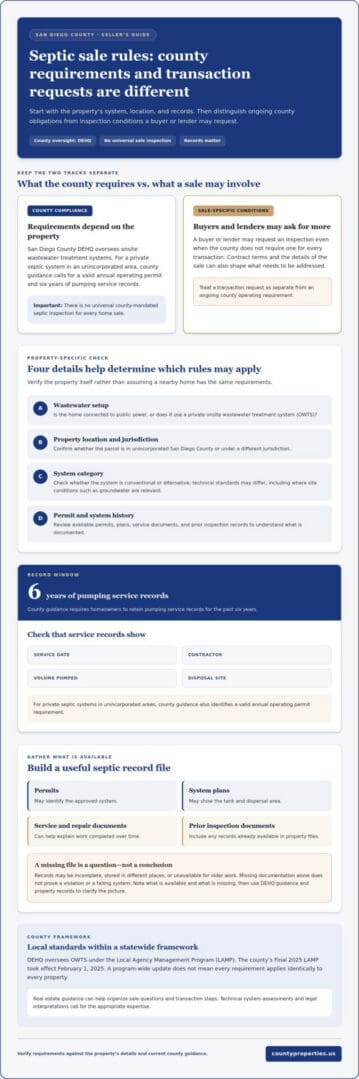
If you’re unsure which agency oversees your system or worried that missing records could slow escrow, preparation can make the process more manageable. The San Diego County Department of Environmental Health and Quality (DEHQ) handles county septic oversight. For homes with private septic systems in unincorporated areas, owners need a valid annual operating permit, and the county requires six years of pumping service records. Yet there’s no universal county-mandated septic inspection for every home sale; buyers and lenders may still request one.
This guide explains which records to gather, how to distinguish county requirements from transaction-specific requests, and what inspection findings may mean for negotiations. You’ll also learn where real estate guidance can help you organize sale questions and navigate discussions, and where technical evaluations or legal advice call for the appropriate expertise.
Key Takeaways
- Start by identifying whether your home uses public sewer or a private onsite wastewater treatment system, since that changes which septic questions may apply.
- Use the guide to understand how San Diego County septic system regulations for selling a home can vary by property details and current county guidance.
- Separate county requirements from buyer requests, lender conditions, and terms negotiated in the purchase contract.
- Prepare for listing by gathering available permits, system plans, service records, and prior inspection documents.
- Learn how to organize disclosures and negotiate inspection findings while recognizing when technical or legal expertise is needed.
What San Diego County sellers need to know about a septic system
Before you prepare a home for sale, establish how wastewater leaves the property. Some homes connect to a public sewer, while others treat wastewater onsite. That difference affects which records may exist, what county questions may apply, and what buyers or lenders may want to review. The property’s location, system type, and permit history help determine the next steps, so avoid assuming that one neighbor’s requirements apply to your home.
An onsite wastewater treatment system (OWTS) treats household wastewater on the property, while a public sewer connection carries it away through a shared sewer network. A septic tank is one component of many OWTS: wastewater flows into the tank, where solids settle before liquid moves to a soil dispersal area. For a general overview of the tank and its function, see What is a Septic Tank?
How to tell whether a home uses an onsite wastewater system
Start with clues, not assumptions. Look through past seller disclosures, property files, available permit records, and service documents for references to a septic tank, drainfield, or onsite wastewater system. A rural setting or visible tank access point may prompt questions, but neither proves the property’s wastewater setup.
System type and location matter. County rules may differ depending on whether the property has a conventional or alternative system and whether it is in an unincorporated area. The County of San Diego Department of Environmental Health and Quality (DEHQ) oversees OWTS and is an official source for county information and records. Use property-specific documents and county guidance to clarify what applies, rather than treating a clue as a compliance finding.
Why septic records matter when preparing to sell
Records help build a clearer picture for you and prospective buyers. A permit may identify the approved system; a plan may show the tank and dispersal area; and service or repair documents can explain work completed over time. Together, these details can help answer practical questions about system location, maintenance history, and whether prior work is documented.
A missing file is a question to resolve, not automatic proof of a violation or a failing system. Records may be incomplete, stored in different places, or unavailable for older work. Note what you have, identify what’s missing, and use DEHQ guidance to understand whether county records can help fill in the picture. A real estate professional can help organize sale questions and transaction steps, while technical system assessments and legal interpretations remain separate areas of expertise.
Septic preparation fits into the larger work of getting your home ready to market. The guide to selling a home in Southern California offers a broader look at planning a sale, while this section focuses on the wastewater details that can shape buyer questions. Once you’ve identified the likely system and gathered available clues, you’ll be better prepared to verify applicable requirements before listing.
Which San Diego County septic rules may apply to your property?
There isn’t one septic checklist that fits every San Diego County home. The applicable rules can depend on whether the property uses a private onsite wastewater treatment system, where it is located, what type of system is installed, and its permit history. To verify the rules for your sale, match the property’s location and system details to current county guidance and records rather than relying on a general checklist.
The County of San Diego Department of Environmental Health and Quality (DEHQ) oversees onsite wastewater treatment systems under its Local Agency Management Program (LAMP). The county’s Final 2025 LAMP took effect February 1, 2025. It sets local standards within California’s statewide framework, but a program-wide update doesn’t mean every requirement applies identically to every property.
How property location and system type can change requirements
Start by identifying the system category and the property’s jurisdiction. For example, county guidance states that homeowners in unincorporated San Diego County with a private septic system need a valid annual operating permit. A home connected to public sewer, or a property under a different jurisdiction, may raise different questions. Conventional and supplemental treatment systems may also have different technical standards, particularly where site conditions such as groundwater are relevant under county guidance.
Don’t infer a special rule from a neighborhood name or a nearby property’s setup. Confirm the parcel’s location and system classification through DEHQ records and property documents. If the record uses technical terms you don’t recognize, ask the county to clarify how its current requirements relate to that specific system.
How to verify permits, pumping records, and inspection triggers
Separate ongoing operating responsibilities from steps that may arise because of a sale. DEHQ guidance identifies an annual operating permit requirement for private septic systems in unincorporated areas and requires homeowners to retain pumping service records for the past six years. Those records should show the service date, contractor, volume pumped, and disposal site. Check the current county guidance and your property’s records to confirm how these obligations apply.
A sale does not automatically trigger a county inspection for every property. There is no universal county-mandated septic inspection for all San Diego County home sales, but a buyer, lender, or escrow process may request one. A property-specific permit or repair issue may create a separate county requirement, so confirm any trigger with DEHQ rather than assuming a buyer request is a county rule.
For an orderly review, compare the property’s records against these questions:
- Is the home connected to public sewer or served by a private system?
- What system type and permit status appear in county records?
- Do available pumping records cover the period required by current guidance?
- Is an inspection being requested by the county, buyer, lender, or contract?
Clear answers help you distinguish regulatory obligations from transaction conditions before they become escrow questions. A seller’s representative can help organize those questions and support negotiation, while DEHQ determines county requirements and technical professionals evaluate system condition. For guidance through the property-sale process, County Properties’ seller representation can help you coordinate the real estate steps.
Is septic certification required to sell a home in San Diego County?
There is no universal county-mandated septic inspection for every San Diego County home sale. That doesn’t mean an inspection or condition report won’t be part of your transaction. A buyer, lender, or purchase contract may call for one, and those requests have a different source from county rules. Before deciding whether a “septic certification” is required, identify who is asking for it and review the current requirements that apply to the property.
The term “certification” can be confusing. It generally refers to a report or letter from a private inspector describing the system’s condition at the time of inspection. It isn’t an official certification document issued by the county. The San Diego County septic system regulations for selling a home should therefore be considered separately from private requests and transaction terms.
County rules versus buyer, lender, and escrow requests
Each request has a different basis. County requirements come from applicable regulations and property-specific obligations. A buyer may request an inspection as part of due diligence. A lender may impose a condition for a particular loan or property, but lender requirements can vary. Escrow may help coordinate documents or timing, while the purchase agreement may spell out what the parties have agreed to provide or address.
The table separates these possible sources. A request in one category doesn’t establish a requirement in another.
| Source | What it may mean for the seller |
|---|---|
| County requirement | Check current County of San Diego guidance and property records for applicable permits, operating obligations, or other property-specific requirements. A buyer’s inspection request alone doesn’t make it a county mandate. |
| Buyer request | The buyer may ask for a separate septic inspection or report during due diligence. The scope and timing depend on the request and transaction. |
| Lender condition | A lender may require documentation or an inspection for a specific loan. Don’t assume one lender’s condition applies to all buyers or financing. |
| Negotiated contract term | The signed agreement may assign responsibility for inspections, repairs, or responses to findings. Review the actual language before drawing conclusions. |
What a septic inspection or certification may assess
An inspection may consider visible system components, reported operating concerns, available service or permit records, and signs of possible problems. The scope depends on the system, the inspector’s work, and the transaction’s requirements. A report captures observations at a particular time; it isn’t a blanket guarantee of future performance or proof of county approval.
Don’t assume every inspection includes pumping, hydraulic testing, or a pass-or-fail certification. Clarify the requested scope in the relevant transaction documents and distinguish a buyer’s preferred assessment from any county requirement. If a report identifies a concern, it can inform follow-up questions and negotiations, but one finding alone doesn’t determine whether the sale must proceed, pause, or end. Review the contract and applicable official requirements, and seek technical or legal expertise where the question calls for it.
How to prepare septic records and sale documents before listing
A focused records review before listing gives you time to clarify property details before buyer questions arrive. You don’t need to assume that every home has every document below. The goal is to collect what exists, identify what’s missing, and separate paperwork from any work that may be required after a county review, inspection, or agreement with a buyer.
A practical septic-document checklist for sellers
Work through this checklist in order, keeping digital or paper copies together. Add a note beside any item that’s unavailable or that doesn’t match another record.
- Gather permits and county correspondence. Look for available installation, repair, or modification permits, operating permit information if applicable, and letters or notices from the County of San Diego Department of Environmental Health and Quality (DEHQ).
- Locate system plans and diagrams. Collect as-built plans or other drawings that show the tank and dispersal area, if available. Note whether the records clearly correspond to the property and current system.
- Collect service and maintenance records. Bring together pumping receipts, maintenance notes, and invoices for past repairs or other work. These can help establish what was done and when.
- Include previous inspection reports. Save any septic evaluations or condition reports, along with supporting documents or follow-up records. Make a note of the inspection date and any recommendations that remain unresolved.
- Compare the paperwork. Check names, dates, system descriptions, and location details for gaps or inconsistencies. Write down specific questions rather than trying to interpret technical or regulatory language on your own.
Gather the documents you already have; don’t assume that missing paperwork automatically means work is required. A document checklist helps organize the sale, but it doesn’t determine whether a system needs inspection, repair, or county action.
What to do when records are missing or an inspection flags an issue
A gap in your file and a confirmed compliance problem are different things. If a plan or permit isn’t in your records, note that fact and ask DEHQ about available property files or current requirements. Keep a record of the response and any document or question still outstanding. Don’t describe an unverified assumption as a county finding.
If an inspection identifies a concern, preserve the report and its stated scope. The finding may lead to further technical review, repair discussions, or negotiations about the transaction. Its meaning depends on the system and circumstances; avoid making promises about cost, timing, or sale outcome before the relevant details are understood.
County requirements and technical evaluations should come from the appropriate sources. A seller’s representative can help you organize transaction questions and discuss how documented findings may affect negotiations. If you’re preparing to list, work with County Properties on your home sale and keep the real estate steps moving alongside your records review.
Selling a San Diego County home with a septic system: plan the next steps
A septic system doesn’t have to define your sale, but unanswered questions can make buyer conversations harder to manage. Keep the process orderly: identify the wastewater system, verify which county requirements apply, document what you know, disclose information as required, and negotiate any transaction terms with care. The San Diego County septic system regulations for selling a home depend on property details, current rules, and the agreements made during the sale.
Disclosure obligations depend on applicable law and the facts of the transaction. California Civil Code § 1102 requires sellers to disclose known material defects on the Transfer Disclosure Statement, including known septic problems where applicable. The precise obligations and any additional disclosures depend on the property and transaction documents. Treat this as a reason to be thorough, not as a substitute for legal advice. If you’re unsure how a disclosure obligation applies, seek legal guidance.
How septic information can shape buyer conversations
Organized records give buyers useful context about the system’s documented history, such as available permits, service visits, repairs, or earlier inspection findings. They may also help you respond more clearly when a buyer asks about the system’s location or past work. A missing record doesn’t, by itself, establish that a system is defective or out of compliance. Keep statements tied to what the documents show and what you know.
If an inspection identifies a concern, the report may lead to follow-up questions, a request for further review, or negotiations about repairs or other contract terms. It isn’t automatically a barrier to a sale, and it doesn’t guarantee a buyer will accept the system or agree to a particular resolution. The parties’ choices depend on the findings, applicable requirements, and their signed agreement.
How a real estate team can support the sale process
A real estate team can help you coordinate the property’s septic-related questions with the broader marketing and transaction timeline. County Properties provides seller representation and personalized guidance through sale steps, including organizing discussions and helping you navigate negotiations. The team does not conduct septic inspections, determine system condition, provide legal representation, or replace county guidance. For additional perspective on choosing representation, explore this guide to finding a real estate agent near you.
As you move forward, keep the roles clear: county officials address applicable county requirements, qualified technical professionals assess septic-system condition, and legal professionals advise on legal obligations. Your real estate representative helps coordinate transaction steps and discussions. If you’re ready to plan your sale with collaborative seller representation, talk with County Properties about selling your home.
Move forward with a clear, supported sale plan
Use the San Diego County septic system regulations for selling a home as a reason to build time for property questions into your sale plan. Decide early how you’ll coordinate real estate decisions with county guidance, technical findings, and any legal questions. Each has a different role, and knowing where to direct a question can help you make considered choices as the transaction develops.
Selling a home is a significant transition. You deserve steady guidance that respects your priorities and keeps decisions collaborative. County Properties has supported Southern California home sales since 1995, and founder Arnie Levine brings 36 years of regional real estate experience. The team provides personalized seller representation and helps you work through marketing, transaction steps, and negotiations. That guidance complements, but doesn’t replace, septic inspections, county determinations, or legal advice.
When you’re ready to plan your next move, talk with County Properties about selling your home. With a thoughtful plan and a dependable real estate partner, you can approach the sale with greater confidence and focus on what comes next.
Frequently Asked Questions
Can a buyer cancel a home purchase because of a septic inspection?
A buyer’s ability to cancel depends on the signed contract, any applicable contingencies, inspection findings, and governing rules. An inspection report alone doesn’t establish what options either party has or dictate the result. The San Diego County septic system regulations for selling a home address county requirements, while cancellation rights are a separate contract and legal question. Review the signed agreement with a qualified legal professional, and discuss transaction logistics with your real estate representative.
Does a septic inspection always include pumping the tank?
No. Pumping isn’t automatically part of every septic inspection. The inspection scope may differ based on the system, the inspector’s approach, and what the buyer, lender, or agreement requests. A request to pump for access or evaluation should be treated as a specified procedure, not evidence of a countywide rule. Before arranging work, clarify the written inspection scope and check with the relevant county office whether any separate property-specific requirement applies.
Can an older septic system still be part of a home sale?
Age alone doesn’t determine whether a septic system can be part of a home sale or meets current requirements. The system’s condition, available records, property location, applicable county standards, and transaction terms all matter. If the installation date is uncertain, compare available plans or permits with county property records, then seek a system-specific assessment when appropriate. Don’t rely on the system’s age alone to predict what the sale will require.
Will a septic system affect a home appraisal or loan approval?
It may, but appraisal treatment and loan approval don’t follow one rule for every property. The appraiser’s scope, loan program, lender’s underwriting conditions, property details, and system findings can all affect the review. If a lender asks for septic documentation, rely on that lender’s written condition and stated deadline. Keep it distinct from county requirements, and don’t treat general online descriptions of FHA, VA, or conventional loans as your specific approval criteria.
Who pays for a septic inspection during a home sale?
Responsibility for the inspection fee depends on the purchase agreement and negotiations; there isn’t one party who always pays in every transaction. The agreement may state who arranges or pays for an inspection, while repair or follow-up work can be addressed separately. Before scheduling, review the relevant clauses with your real estate representative so you understand what the parties agreed to and don’t confuse the inspection expense with the cost or responsibility for later work.
Does homeowners insurance cover septic-system repairs?
Coverage depends on your policy language, the cause of the damage, applicable exclusions, and the insurer’s claim decision. Don’t assume a maintenance issue or system failure is covered, and don’t rely on a general answer to determine coverage for your property. Review the relevant policy sections and contact your insurer with the details of the problem. Insurance questions are separate from county compliance obligations and septic-related terms in a home-sale contract.