

Southern California’s commercial landscape is as vast and diverse as its coastline-and for many investors, it can feel just as overwhelming. The sheer number of sub-markets, from the bustling hubs of Los Angeles to the thriving biotech corridors of San Diego, presents endless opportunity, but also significant risk. The fear of making a poor investment, getting tangled in complex lease agreements, or simply not understanding which property type fits your goals can be paralyzing. It’s a common challenge for those looking to enter the dynamic world of commercial real estate southern california.
This is where your journey toward clarity begins. Consider this guide your trusted partner, designed to cut through the noise and empower your decisions. We are here to help you move forward with confidence by providing a comprehensive roadmap. We will walk you through the key property types, help you identify which sub-markets align with your strategy, and provide a step-by-step understanding of the entire investment process. Let’s build your success in the SoCal market, together.
Decoding the Southern California Commercial Real Estate Landscape
Southern California stands as a global economic powerhouse, but to truly understand its commercial real estate market, you must see it not as a single entity, but as a dynamic collection of distinct sub-markets. Each county possesses a unique economic DNA, creating diverse opportunities for investors, developers, and businesses. The overall strength of the Southern California region is fueled by a powerful mix of industries, including:
- Logistics & Trade: Driven by the nation’s busiest port complex.
- Entertainment & Media: The global center for film, television, and digital content.
- Technology & Innovation: A thriving hub for tech, biotech, and aerospace.
- Tourism & Hospitality: World-famous attractions draw millions of visitors annually.
Navigating the landscape of commercial real estate southern california requires expert guidance and a deep understanding of these local nuances. Below, we break down the four key counties that define this vibrant region.
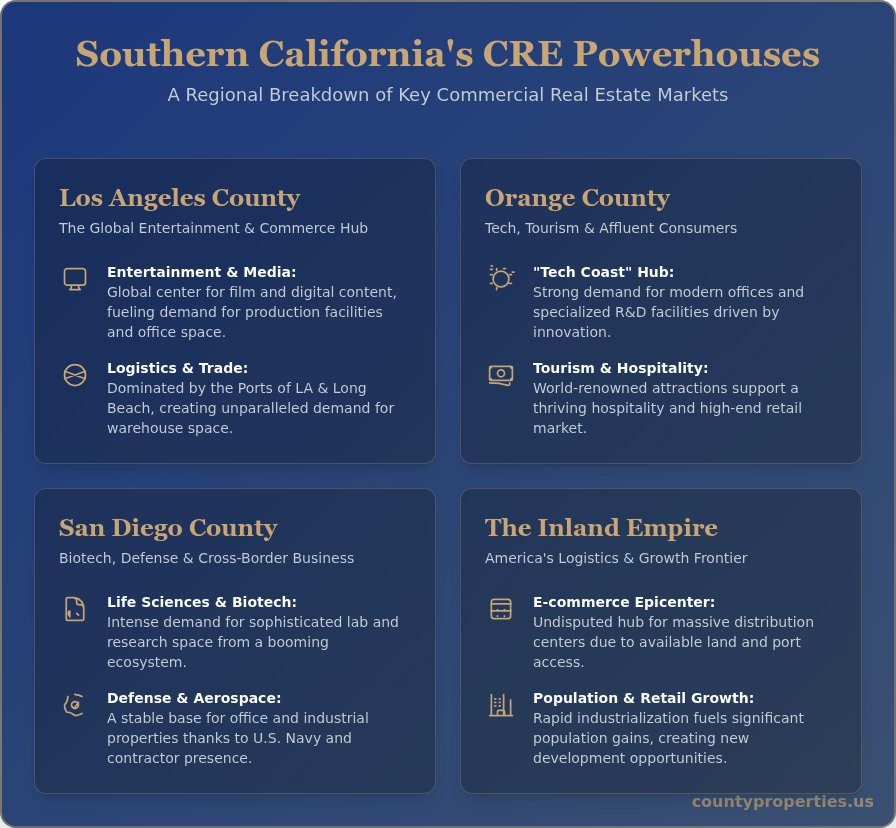
A visual overview of Southern California’s primary commercial real estate markets.
Los Angeles County: The Global Entertainment & Commerce Hub
As the region’s anchor, LA County is a core market defined by global demand. The entertainment industry fuels a constant need for media production facilities and corporate office space in areas like Hollywood and Burbank. Its industrial sector is dominated by the colossal Ports of Los Angeles and Long Beach, creating unparalleled demand for logistics and warehouse space. The county’s high-density urban environment also ensures a robust and ever-evolving retail market.
Orange County: Tech, Tourism, and Affluent Consumers
Known for its stability and high quality of life, Orange County is a magnet for innovation and investment. The “Tech Coast” drives strong demand for modern office buildings and specialized R&D facilities. Its world-renowned tourism sector, anchored by Disneyland and pristine beaches, supports a thriving hospitality and high-end retail market. For investors, OC represents a mature, high-value market with a reputation for consistent performance and long-term growth.
San Diego County: Biotech, Defense, and Cross-Border Business
San Diego’s commercial real estate market is powered by cutting-edge industries. A booming life sciences and biotech ecosystem creates intense demand for sophisticated lab and research space, particularly in hubs like Torrey Pines. The significant presence of the U.S. Navy and numerous defense contractors provides a stable base for office and industrial properties. Furthermore, its strategic border location fosters unique opportunities in cross-border trade and manufacturing.
The Inland Empire: America’s Logistics and Growth Frontier
Comprising Riverside and San Bernardino counties, the Inland Empire is the undisputed epicenter of America’s logistics and e-commerce boom. Companies flock here to build massive distribution centers, drawn by available land and strategic access to Southern California’s ports and population centers. This rapid industrial growth is fueling significant population gains, creating new and expanding opportunities for retail, healthcare, and multifamily development across the region.
A Deep Dive into SoCal’s Key Commercial Property Types
Navigating the dynamic landscape of commercial real estate southern california requires a clear understanding of the primary property types. Each category serves a distinct market function, involves different lease structures-from Triple Net (NNN) to Gross leases-and aligns with unique investment strategies. As your trusted partner, our goal is to provide the guidance you need to match the right property type with your specific business or financial objectives, ensuring your investment journey is a success.
Office Space: Adapting to the Future of Work
The office sector is categorized by quality into Class A (premium locations, modern amenities), Class B (well-maintained, slightly older), and Class C (functional, lower-cost). Post-pandemic, a “flight to quality” trend has seen tenants gravitate toward Class A properties that offer superior air quality and collaboration-focused designs. We are also seeing a growing demand for specialized assets like flexible co-working spaces and medical office buildings, which cater to the evolving needs of modern business and healthcare.
Industrial & Warehouse: The E-Commerce Backbone
Fueled by the explosive growth of online retail, the industrial sector is thriving. This category includes massive logistics facilities, advanced manufacturing plants, and crucial “last-mile” distribution centers designed for rapid delivery. The sector’s massive growth is a frequent topic for industry experts, including those at the leading commercial real estate trade association, NAIOP SoCal. Key physical attributes that determine a property’s value include clear height (vertical storage space), the number of dock-high doors, and the availability of secured yard space for truck and trailer parking.
Retail Properties: The Evolution to Experiential
Modern retail is less about products and more about experiences. While traditional properties like strip malls and community centers still dominate, the most successful tenants are often service-based or “experiential”-think fitness centers, upscale restaurants, and entertainment venues. Throughout market shifts, grocery-anchored shopping centers have proven remarkably resilient, as they provide essential services that consistently draw foot traffic and support surrounding businesses.
Multifamily & Apartment Buildings: A Resilient Investment
Multifamily properties are a cornerstone of real estate investment, prized for providing relatively stable cash flow. The persistent high demand for housing across Southern California makes this a popular and competitive asset class. When evaluating a multifamily opportunity, it is critical to analyze the unit mix (e.g., studios vs. two-bedrooms), the property’s location and accessibility, and the potential impact of local rent control ordinances on future revenue.
Current Market Trends & Future Outlook for SoCal CRE
Navigating the dynamic landscape of commercial real estate southern california requires more than just capital; it demands expert insight into the forces shaping the market. Understanding these current trends is the first step toward empowering you to make strategic decisions that align with your long-term investment or business goals. As your trusted partner, we’re here to provide the guidance you need to identify and act on emerging opportunities.
The market is currently defined by three pivotal shifts: the evolution of the workplace, a challenging interest rate environment, and a powerful push toward sustainability. Each presents unique challenges and significant potential for savvy investors and business owners.
The Impact of Hybrid Work on Office Demand
The rise of hybrid work has fundamentally altered the office sector. Companies are “right-sizing” their footprints, leading to a flight to quality. Demand is now centered on smaller, Class A spaces rich with modern amenities that foster collaboration and entice employees back to the office. This shift has created opportunities in two distinct areas: developing premium, experience-driven workspaces and the adaptive reuse of older Class B and C office buildings for conversion into residential, life science, or mixed-use properties.
Navigating Interest Rates and the Investment Climate
Elevated interest rates have tightened the lending environment, making financing more challenging and costly. This directly impacts property valuations and slows transaction velocity. However, this climate creates a distinct advantage for well-capitalized and cash buyers. With less competition from leveraged investors, those with available funds can negotiate favorable terms and acquire high-quality assets from sellers facing refinancing pressure. It’s a market that rewards patience and strategic, disciplined acquisitions.
Sustainability and Green Building Initiatives
Environmental, Social, and Governance (ESG) criteria are no longer a niche consideration; they are a core driver of value in the Southern California market. Driven by tenant demand and state regulations like California’s Title 24 Energy Code, green buildings offer tangible benefits:
- Lower Operating Costs: Energy-efficient systems reduce utility expenses for both owners and tenants.
- Premium Tenants: LEED-certified buildings attract and retain high-caliber corporate tenants.
- Future-Proofing Assets: Sustainable properties are better positioned to meet future regulations and maintain long-term value.
Investing in green features is a direct investment in the asset’s future profitability and marketability.
The Step-by-Step Process of Acquiring Commercial Property
Navigating the world of commercial real estate southern california can feel overwhelming, but a structured approach transforms this complex journey into a manageable process. For first-time buyers and lessees, this roadmap provides clarity and confidence. Think of it as your essential checklist for making a sound investment, with diligent research and expert guidance as your most valuable assets at every turn.
Phase 1: Strategy and Financing
A successful acquisition begins long before you view the first property. This initial phase is about building a strong foundation for your search. It’s where you align your business goals with your real estate needs to ensure every subsequent step is strategic and focused.
- Define Your Needs: Clearly outline your requirements for space, location, specific zoning, budget, and your ideal timeline.
- Engage an Expert Advisor: Partnering with a commercial real estate agent early provides invaluable market insights and access to off-market opportunities.
- Secure Your Finances: Get pre-approved for a commercial loan or prepare your proof of funds. This step is crucial for being seen as a serious buyer.
Phase 2: Search and Evaluation
With your strategy in place, the search begins. This phase is an active process of identifying potential properties and conducting initial analysis to see how they align with your goals. An experienced agent can significantly streamline this process, filtering options to save you time and effort.
- Conduct the Property Search: Leverage a combination of online listings and your agent’s professional network to identify suitable properties.
- Perform Site Visits: Walk through promising locations to assess their physical condition, accessibility, and neighborhood dynamics.
- Submit a Letter of Intent (LOI): Once you find a strong candidate, an LOI formally expresses your interest and outlines the preliminary terms of a potential deal.
Phase 3: Due Diligence and Closing
The due diligence phase is the most critical part of any transaction in commercial real estate. This is your opportunity to uncover any potential issues before you are legally bound to the purchase. Meticulous review is non-negotiable to protect your investment.
- Complete Property Inspections: Arrange for comprehensive physical, environmental, and zoning inspections to verify the property’s condition and compliance.
- Review All Documents: Scrutinize financial records, existing tenant leases, and title reports to ensure there are no hidden liabilities.
- Finalize and Close: Negotiate the final Purchase and Sale Agreement (PSA) with legal counsel and work with all parties to officially close the transaction.
The path to acquiring commercial property is intricate, with many details that demand professional oversight. Having a seasoned partner to guide you through each phase ensures a seamless and successful outcome. Let us be your trusted advisor on this important journey. Start your commercial property search with a trusted advisor.
Why a Trusted Local Partner is Your Greatest Asset
Navigating the dynamic landscape of commercial real estate southern california can be overwhelming. While large, national firms offer a broad reach, they often lack the granular, on-the-ground insight that defines a successful investment. This is where a dedicated, local partner becomes your most valuable asset. Our service-centric philosophy is built on a collaborative team concept, ensuring you receive personalized, step-by-step guidance. We’re not just here to close a deal; we are here to empower your journey and secure your long-term success.
The Advantage of Hyper-Local Market Knowledge
A local expert brings more than just listings; they bring relationships. We have access to off-market opportunities and a deep network of connections that national databases simply can’t replicate. Understanding San Diego’s nuanced zoning laws, anticipating upcoming development projects, and knowing the history of a property provides a critical negotiating advantage. This insider knowledge ensures you make informed decisions that protect and grow your investment.
A Partner Who Understands Your Business Goals
Your business is unique, and your commercial property should be a direct reflection of your strategic goals. We take the time to understand your specific operational needs, financial objectives, and vision for the future. Acting as a trusted advisor rather than just a transaction broker, we help you evaluate properties not just for what they are today, but for how they will serve your business for years to come, ensuring a truly synergistic match.
Building Your Team for a Successful Transaction
A successful commercial real estate transaction requires a team of reliable experts. An experienced local partner provides you with a pre-vetted network of trusted professionals, from diligent inspectors and specialized attorneys to reliable contractors and competitive lenders. This curated team works in concert to create a seamless process, saving you invaluable time, preventing costly mistakes, and reducing the stress associated with complex negotiations and due diligence.
Ultimately, choosing the right guide is the most critical step in your commercial real estate journey. A trusted local partner offers the perfect blend of market expertise, personalized strategy, and a robust professional network. Our commitment is to serve as your comprehensive resource, helping you achieve your goals with confidence. If you’re ready to take the next step, contact the team at County Properties for a personalized consultation.
Your Partner for Success in SoCal Commercial Real Estate
The landscape of commercial real estate southern california is filled with immense opportunity, but also complexity. From understanding its diverse property types to mastering the acquisition process, your success hinges on strategic insight and local knowledge. This is where a trusted guide becomes your greatest asset, transforming challenges into profitable ventures.
At County Properties, we bring over 36 years of dedicated experience to your corner. Our commitment is defined by a service-centric philosophy that puts your goals first, and our team possesses deep expertise in all commercial property types, ensuring you receive tailored, expert guidance every step of the way.
Ready to transform your investment vision into a tangible reality? Let’s discuss your commercial real estate goals. Contact our team for a consultation. Let’s build your Southern California legacy, together.
Frequently Asked Questions About San Diego Commercial Real Estate
What is the difference between leasing and buying commercial real estate?
Leasing offers flexibility and a lower initial capital outlay, making it ideal for new businesses or those needing adaptable space. It’s an operating expense. Buying, on the other hand, is a significant capital investment that builds equity and offers long-term stability and control over the property. Your decision depends entirely on your business’s financial situation, long-term goals, and need for flexibility. An expert can help guide you through this critical step in your journey.
How is commercial property valued differently than residential property?
Residential property is primarily valued using the sales comparison approach, looking at what similar homes have sold for. Commercial property valuation is business-focused, relying heavily on the income approach. This method calculates value based on the property’s Net Operating Income (NOI) and a market capitalization (cap) rate. Essentially, a commercial property’s worth is directly tied to its ability to generate revenue, making it a pure investment calculation.
What are the most common mistakes first-time commercial investors make?
First-time investors often make a few key errors. The most common include performing inadequate due diligence on the property’s condition and financials, underestimating ongoing expenses like maintenance and property management, and failing to partner with a real estate agent who specializes specifically in commercial transactions. Proper guidance from a seasoned professional is essential to avoid these costly mistakes and ensure the success of your investment from the start.
What is a ‘triple net’ (NNN) lease and how does it work?
A triple net (NNN) lease is a common agreement where the tenant is responsible for paying all major property expenses in addition to their base rent. These three “nets” are property taxes, building insurance, and common area maintenance (CAM). This structure is highly favored by landlords in commercial real estate southern california because it creates a predictable income stream with minimal management responsibility, making it a popular choice for single-tenant retail and industrial properties.
How long does a typical commercial real estate transaction take from start to finish?
Commercial real estate transactions are more complex than residential ones and typically take longer. From the initial offer to closing, the process can last anywhere from 60 to 120 days, and sometimes longer. This extended timeline accounts for more intensive due diligence periods, environmental site assessments, complex financing arrangements, and detailed lease reviews. Patience and thoroughness are key to navigating the process successfully and protecting your investment.
What kind of financing is available for commercial properties?
Several financing options exist for commercial properties. Traditional commercial mortgages from banks are common, as are government-backed loans like SBA 504 or 7(a) loans, which often have favorable terms. For more flexible or faster financing, investors might consider hard money loans from private lenders. In some cases, seller financing may also be an option. The best choice depends on your credit, the property type, and your overall investment strategy.