

What if a house flipper’s offer looks low, but the terms make it more attractive than a higher offer? If you’re wondering how to spot a lowball offer from a house flipper, look beyond the cash label. An as-is sale can offer convenience, but you still deserve a clear picture of your home’s likely market value and what you’d actually receive.
It’s reasonable to be cautious when an investor asks you to decide quickly or presents a price without explaining how it was calculated. Not every investor offer is unfair, but the price alone can’t tell you whether it fits your needs. Compare the written terms, the buyer’s ability to close, the proposed timing, and your estimated proceeds.
This article explains how to assess those details and compare a flipper’s proposal with other selling options, including a traditional sale. You’ll learn how seller representation and cash-offer facilitation can support a considered decision, so you can choose a path that works for your property, priorities, and circumstances.
Key Takeaways
- Learn how to spot a lowball offer from a house flipper by comparing its reasoning with credible information about your property and potential selling routes.
- Understand which costs and risks flippers may factor into an offer, and why those estimates aren’t verified facts about your home.
- Compare cash and agent-represented sales by looking beyond the headline price to repairs, contingencies, timing, certainty, and your responsibilities.
- Use a step-by-step review of the written offer to identify unclear or changing terms before deciding how to respond.
- See how seller representation and cash-offer facilitation can help you weigh options against your goals without rushing your decision.
Spotting Lowball House Flipper Offers: Warning Signs
A cash offer can be useful if you value a simpler sale or want to avoid preparing your home for the open market. But speed alone doesn’t prove the price is fair. To spot a lowball offer from a house flipper, check whether the proposed price is supported by credible information about your property and the terms of the transaction. House flipping generally involves buying a home, improving it, and reselling it, as outlined in What is house flipping?
A lowball offer isn’t simply an offer below your preferred price. It’s one that appears poorly supported when compared with relevant property information and the complete terms of the deal. Look for warning signs such as:
- An unexplained price: The buyer names a figure but doesn’t connect it to the home’s condition, comparable sales, or specific assumptions.
- Pressure to decide: You’re urged to sign before you’ve had time to review the complete offer or discuss your options with an adviser.
- Terms that change: The price or conditions shift after you’ve spent time considering the proposal, without a clear explanation.
- Unclear proof of funds: The buyer describes the offer as cash but doesn’t provide clear evidence that they can complete the purchase as proposed.
What makes a house flipper’s offer worth a closer look?
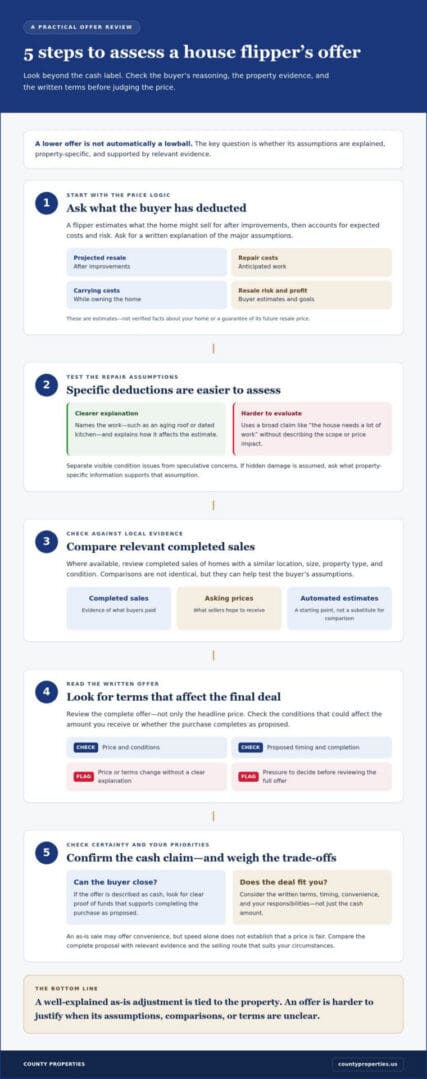
Ask whether you can follow the buyer’s reasoning from the property’s current condition to the proposed price. A credible explanation should identify relevant comparable sales and describe the assumptions behind any repair deductions. For example, if the buyer cites a dated bathroom or aging roof, the explanation should show how those items affect the estimate instead of simply labeling the entire home a major project.
Pressure is a separate concern. A buyer’s plan to renovate and resell doesn’t establish whether the offer is fair, and a quick closing doesn’t make an unsupported price stronger. Read every term, including conditions that could affect the final amount or completion. A clear, written offer gives you something concrete to assess.
Why a cash offer may be lower without being a lowball
A flipper may account for anticipated repairs, resale uncertainty, the time the property could take to sell, and the costs of holding it during that period. Those considerations can affect an investor’s price, but they’re estimates, not verified facts about your home or a promise of what it will resell for.
The explanation matters. A documented as-is adjustment identifies the work or risks being considered and makes the assumptions visible. A vague claim that “the house needs work,” with no detail about the scope or how it affects the offer, is harder to evaluate. Property condition and seller circumstances vary, so no single discount proves an offer is fair or unfair.
A legitimate as-is discount is explained and tied to the property. A low offer is difficult to justify against credible comparisons and clear terms. Assess the offer on that basis, not the buyer’s label or urgency.
Why house flippers discount homes, and how to test their reasoning
A flipper’s offer usually reflects more than the home’s current condition. The buyer estimates what the property might sell for after improvements, then subtracts anticipated repair costs, carrying costs while owning the home, resale risk, and a desired profit margin. Each part of that calculation depends on assumptions. An estimated resale price isn’t guaranteed, and a repair allowance isn’t automatically a verified assessment of your home.
Ask for a written explanation of the major deductions and assumptions behind the price. You don’t need to reconstruct the buyer’s entire business plan. You do need to see whether the proposed value and adjustments connect to evidence about your property, rather than a broad estimate that’s difficult to evaluate.
Which assumptions can make an offer seem unusually low?
Look closely at the proposed repair scope. A specific estimate might identify an aging roof or dated kitchen as an expected expense. A blanket statement that the home “needs a lot of work” gives you little basis for assessing the deduction. Separate visible condition issues from speculative concerns that haven’t been inspected. If the buyer assumes hidden damage, ask how that possibility affects the offer and whether the assumption is supported by property-specific information.
Also distinguish the buyer’s resale target from evidence of your home’s present value. The flipper may expect to sell after renovations at a particular price, but that projection doesn’t establish what your property is worth today. Request the reasoning behind both the projected resale value and the main deductions, then compare them with relevant local evidence.
How to check the offer against relevant property evidence
Where available, review recent completed sales of homes with a similar location, size, property type, and condition. The comparisons won’t be identical to your home, but they can help you spot when the buyer’s assumptions appear out of step with nearby transactions. An asking price shows what a seller hopes to receive, not what a buyer paid. Automated estimates can be a starting point, but they don’t replace a careful comparison of completed sales and property details.
For each major deduction, note the condition or cost being cited, the evidence supporting it, and how it affects the proposed price. If a large repair allowance is based on an unverified possibility, treat it differently from a clearly visible issue. You can also use HUD’s general guidance on home buying and selling as broader context while considering market value and your available routes.
For local context, the Southern California home-selling guide can help you think through the factors involved in selling in the region. A seller representative can help organize the buyer’s assumptions and compare the offer with your goals. To weigh a flipper’s proposal against other routes, compare your selling options with County Properties.
Compare a flipper’s offer with other selling options, not just the headline price
A useful comparison puts each selling route on the same footing. Look beyond the offer amount to what you may need to spend, what conditions apply, how much preparation the home needs, and what responsibilities remain yours. A lower headline offer may still fit if convenience or selling as-is matters most, but weigh that trade-off against your likely proceeds and priorities.
Estimated net proceeds means the amount you might retain after accounting for the offer or expected sale price, supported selling expenses, and preparation costs. It’s a comparison tool, not a promised final amount. Use the written terms and available information. Label costs or timing you can’t verify as unknown instead of treating them as zero.
| Selling route | Price and repairs | Conditions, timing, and certainty | Seller responsibilities |
|---|---|---|---|
| Cash sale to an investor | Offer may account for repairs or the home’s current condition. Compare the written price with the stated reasoning. | Review contingencies and proposed timing in the written offer. Cash alone doesn’t establish that closing is certain. | May involve less preparation, but you still need to review the terms and provide property information. |
| Agent-represented market sale | Price depends on buyer interest and the home’s presentation. Preparation or repairs may affect your costs and potential proceeds. | Marketing, showings, buyer financing, inspections, and other contingencies can affect timing and certainty. | Plan for agreed preparation, access for showings, and review of offers and conditions. |
| Agent-represented as-is sale | The home is marketed in its current condition, with price shaped by buyer interest and its condition. | Terms and timing depend on the offer received and its contingencies. | You may avoid some pre-sale work, while still coordinating the sale and evaluating offers. |
What belongs in a fair offer comparison?
Put each written price beside its material conditions. Include seller-paid items and preparation costs only when you have a reasonable basis for them. Don’t compare a firm written term with a verbal summary, and don’t assume an unknown expense won’t arise. A simple side-by-side worksheet helps show which differences are documented and which need clarification.
Which selling route fits your priorities?
If an as-is sale or speed is important, weigh the convenience against price, contingencies, and the buyer’s stated terms. If broader market exposure matters more, account for preparation, marketing, showings, and potential transaction conditions. Your priorities may include certainty, fewer disruptions, or the opportunity to reach more buyers. The Southern California housing-market outlook can add regional context, but your property and goals should guide the comparison.
When comparing a flipper’s offer with other selling options, consider the estimated net proceeds and responsibilities for each route, not just the top-line figures. A seller representative can help organize the options around your circumstances so your decision reflects the trade-offs that matter to you.
Responding to a Low House Flipper Offer Without Rushing
A low offer doesn’t require an immediate yes or no. Use a clear process to check what’s proposed, resolve gaps, and decide whether to negotiate, decline, or pursue another selling route. If you’ve signed an agreement, your next steps may depend on its terms. Get qualified legal advice for questions about your rights or contract interpretation.
- Organize the documents. Keep the complete written offer, any earlier versions, property information, and relevant sale comparisons together. Note when and how the buyer has changed a term.
- List your questions. Mark unclear language, deadlines, conditions, or deductions. Request the basis for significant price adjustments and supporting details in writing.
- Compare your options. Consider other possible sale routes alongside the flipper’s proposal, using the same priorities and available cost information.
- Decide how to respond. Once you understand the terms and trade-offs, consider negotiating, declining, or choosing another route, subject to any signed agreements.
For help organizing the terms and comparing paths, discuss your home-sale options with County Properties. Seller representation can help you assess an offer in light of your goals and circumstances.
Questions to resolve before accepting, countering, or declining
Read the entire written offer, not just the price summary. Identify deadlines, contingencies, deposit terms, expected closing arrangements, and who is responsible for any agreed work. If a deduction is substantial, ask what it covers and what information supports it. Record answers in writing so you can compare the actual proposal with other options instead of relying on a conversation that may leave important details unresolved.
How to keep a comparison organized
A simple table can make differences easier to see. Create one column for each offer or route, then record the amount, conditions, proposed timing, included costs, and open questions. Mark unknowns plainly. Add a note about what matters most to you, whether that’s certainty, convenience, price, or the ability to prepare the home. If you’re considering representation, this guide to finding a real estate agent can help you understand what to consider.
Use your comparison to check whether the offer meets your needs, not to pressure yourself into a quick choice. Assessing a house flipper’s offer is part of a larger decision: which selling path best balances price, conditions, timing, and your priorities?
How County Properties can help you evaluate a house-flipper offer
A house-flipper offer can raise practical questions about value, timing, and what happens next. County Properties represents sellers in Southern California, helping you consider an offer in the context of your property, priorities, and other possible selling routes.
Support for sellers weighing a cash offer
Seller representation gives you a partner to organize the information in front of you and consider how it fits your plans. Together, you can review the offer details, identify terms that need clarification, and weigh a cash offer against a sale exposed to the broader market. The comparison can account for preparation, conditions, timing, and your comfort with the responsibilities involved.
That guidance should be grounded in your circumstances, not a blanket promise that one route will produce a better result. You might value fewer preparations or a more direct process; another seller may prefer to explore market exposure. County Properties also facilitates cash offers, helping sellers consider that route. The aim is to make the options easier to understand so you can make a considered decision.
When you’re assessing a house-flipper offer, it helps to have someone focused on your interests review the proposal alongside your goals. A personalized discussion can help separate what the offer says from what remains uncertain, and clarify which questions matter before you decide how to proceed.
Guidance when financial or life circumstances add pressure
A home sale can feel especially difficult when financial strain, a major transition, or a tight personal deadline is involved. You deserve steady guidance, not added pressure. County Properties provides short-sale and foreclosure-prevention expertise for sellers facing relevant challenges, and can help you consider the housing decision in light of the circumstances you’re managing.
If foreclosure concerns are part of your situation, the California foreclosure-prevention guide offers information to help you understand steps that may be relevant. A guide can support your preparation, while a conversation about your situation can help focus on the real estate options and questions that matter to you.
Before settling on a path, gather the written offer and any information you’ve collected about the property or alternative sale routes. County Properties can work with you to organize the available details, discuss your priorities, and consider practical next steps. You remain in control of the decision, with a knowledgeable partner to help you weigh it.
Discuss your home-sale goals and next steps with County Properties to explore a path that fits your circumstances.
Choose a Next Step That Fits Your Priorities
Your next step can be a conversation, not a commitment to accept an offer. If your priorities or circumstances have shifted, bring them into the decision. Learning how to spot a lowball offer from a house flipper is ultimately about protecting your ability to choose, even when the decision feels time-sensitive.
Before you move forward, write down what a successful outcome would look like, what timing matters to you, and which questions remain unresolved. That gives you a clear starting point and keeps your needs at the center of the discussion.
County Properties provides seller representation in Southern California and facilitates cash offers, so you can explore a proposal alongside your plans. If financial pressure or a major transition is part of the picture, the team’s short-sale and foreclosure-prevention expertise may also be relevant. Your circumstances should guide the path you choose.
Explore a home-sale path with County Properties and take your next step with greater clarity and confidence.
Frequently Asked Questions
Is every cash offer from a house flipper a lowball offer?
No. A cash offer can be reasonable for a particular property and seller, even if it differs from what a fully prepared home might attract on the open market. The payment method alone doesn’t establish whether the price is fair. To assess a house flipper’s offer, look for a property-specific explanation and consider whether the buyer’s conditions and proposed process suit your needs.
Can a house flipper change the offer after inspecting the home?
A buyer may propose revised terms after an inspection, but an inspection doesn’t automatically determine what happens to an offer or an already signed agreement. The written document may describe inspection rights, deadlines, or ways either party can respond. Compare any revision with the original and ask what new information prompted the change. If you’ve signed or need to understand your contractual rights, consult a qualified real estate attorney.
What proof should I ask for before accepting a cash offer?
Ask for written evidence that the buyer has access to funds sufficient for the proposed purchase, such as a current verification letter from a financial institution. The amount and buyer details should correspond with the offer, while sensitive account information can remain protected. If the purchaser is an entity, make sure the written offer identifies the purchasing party clearly. Keep copies of the offer and supporting documents together for review.
Can I negotiate with a house flipper after receiving a low offer?
Yes, you can make a counteroffer or propose changes, provided your response fits any agreement you’ve already signed. Negotiation doesn’t have to focus only on price. You could address the inspection period, closing date, included items, or which party handles a specific task. Put proposed changes in writing and review the revised terms as a whole, since improving one part of an offer may affect another.
Should I get a home appraisal before responding to a flipper?
Not necessarily. An independent appraisal may be useful if your property is unusual, recent comparable sales are limited, or the buyer’s valuation differs sharply from other available evidence. For a more typical home, reviewing relevant completed sales with a real estate professional may help you decide whether an appraisal would add useful information. Consider what question you need answered before paying for an additional valuation.
What happens if a house flipper’s offer deadline is too short?
You can request more time in writing and explain that you need to review the complete offer before responding. The buyer may agree, decline, or maintain the deadline, so don’t assume an extension unless it’s confirmed. If the offer expires before you’re comfortable deciding, weigh that against your other options. If you’ve already signed something, get qualified legal advice before taking action.