

The arrival of a formal notice from your lender can feel overwhelming, triggering a wave of uncertainty and fear about the future of your home. The legal jargon, the strict deadlines-it’s enough to make anyone feel lost. But take a deep breath. Understanding the path to foreclosure prevention in California is the first, most powerful step you can take toward regaining control. You are not alone on this journey, and there are clear, reliable options available to you right now.
We created this guide to serve as your trusted partner through this challenging time. Here, you will find more than just information; you will find a clear, step-by-step plan. We will walk you through your rights as a California homeowner, explain every option from loan modification to a graceful exit, and guide you toward legitimate, local resources you can count on. Our commitment is to empower you with the knowledge and confidence to protect your family’s most important asset and navigate the path ahead.
Understanding the California Foreclosure Process: Key Stages and Timelines
Facing the possibility of foreclosure can be incredibly stressful, but knowledge is the first step toward empowerment. The process is governed by specific laws and timelines, and understanding them provides a clear roadmap for action. Our goal is to demystify these steps so you can see the opportunities available to you along the way.
California is primarily a non-judicial foreclosure state. This means the lender can foreclose on your home without filing a lawsuit or going to court, making the process faster than in other states. Knowing these stages is the foundation of effective foreclosure prevention california. At every point, you have rights and options, but the earlier you act, the more choices you will have.
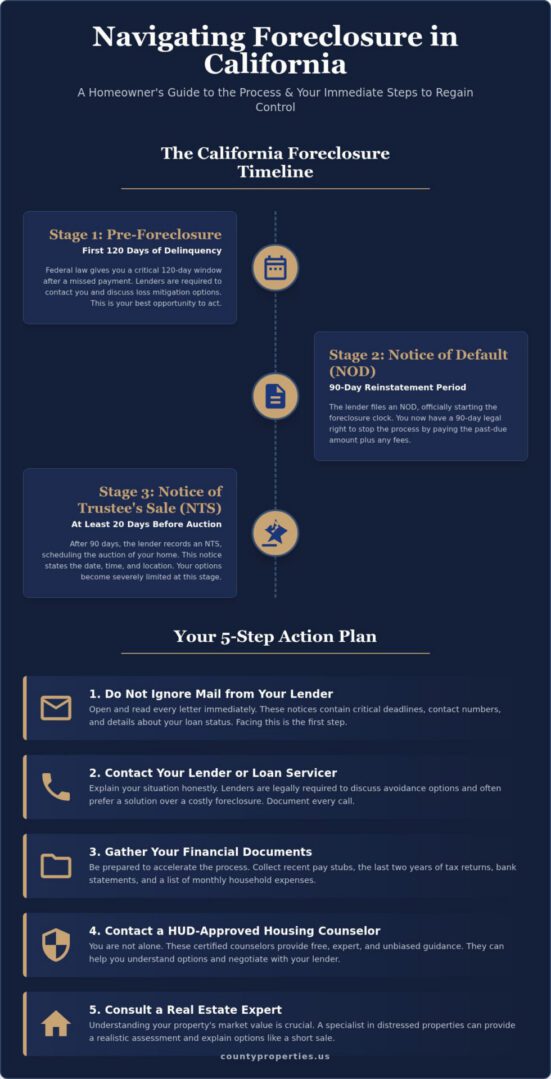
Stage 1: Missed Payments and Pre-Foreclosure
The journey begins after your first missed mortgage payment. Federal law generally prohibits lenders from starting foreclosure for the first 120 days of delinquency. During this critical pre-foreclosure period, your lender is required to contact you to discuss your situation and inform you about loss mitigation options, such as loan modification or forbearance. This is your most valuable window to communicate openly and seek a solution before the process becomes official.
Stage 2: The Notice of Default (NOD)
If the delinquency isn’t resolved, the lender will file a Notice of Default (NOD) with the County Recorder’s Office. This is a public document that officially starts the foreclosure clock in California. This formal step is a key part of Understanding the Foreclosure Process on a national level, but in California, it specifically triggers a 90-day “reinstatement period.” During these 90 days, you have the legal right to stop the foreclosure by paying the past-due amount, including any fees and penalties.
Stage 3: The Notice of Trustee’s Sale (NTS)
After the 90-day NOD period expires, the lender can schedule the sale of your home. They will record a Notice of Trustee’s Sale (NTS), which must be sent to you at least 20 days before the auction date. The NTS states the specific date, time, and location of the public auction where your property will be sold. While some options for foreclosure prevention california still exist, such as a short sale or bankruptcy, your choices become severely limited at this late stage.
Your Immediate Action Plan: 5 Steps to Take Right Now
Receiving a notice of default can be overwhelming, but this is the single most critical moment in your journey. Taking immediate, deliberate action is the key to regaining control and preserving your options. The steps you take in the next few days can significantly alter the outcome. Think of this not as a moment of panic, but as a call to action. Your swift response is your most powerful tool.
1. Do Not Ignore Mail from Your Lender
The single biggest mistake homeowners make is avoiding official communication. We understand the temptation to set it aside, but ignoring the problem will not make it go away. Open and read every letter from your lender or loan servicer immediately. These notices contain critical information, including official deadlines, contact numbers, and details about your loan status. Facing this information head-on is the first empowering step toward a solution.
2. Contact Your Lender or Loan Servicer
Pick up the phone and call the number on your mortgage statement. Explain your situation honestly and calmly. Lenders are legally required to discuss foreclosure avoidance options with you. They would often rather find a solution than go through the costly foreclosure process. When you call, be sure to document everything: the date, the name of the person you spoke with, and a summary of what was discussed. This log will be invaluable.
3. Gather Your Financial Documents
To explore any assistance program, you will need to present a clear picture of your finances. Being prepared will speed up the process immensely. Start gathering these essential documents now:
- Recent pay stubs (for all working household members)
- Last two years of tax returns
- Recent bank statements
- A simple list of your monthly household expenses
This preparation is a cornerstone of effective foreclosure prevention in California and shows your lender that you are serious about finding a workable solution.
4. Contact a HUD-Approved Housing Counselor
You do not have to navigate this alone. The U.S. Department of Housing and Urban Development (HUD) sponsors housing counseling agencies across the country that provide free, expert, and unbiased guidance. These certified counselors can help you understand your options, organize your finances, and even negotiate with your lender on your behalf. For a comprehensive overview and help finding a local expert, review the official HUD’s Guide to Avoiding Foreclosure.
5. Consult a Real Estate Expert
Understanding your property’s current market value is crucial. A real estate professional who specializes in distressed properties can provide a realistic assessment of your situation and explain options you may not be aware of, such as a short sale. An expert in foreclosure prevention California can evaluate your home’s equity and local market conditions to help you make an informed decision that best protects your financial future. As your trusted real estate partner, we are here to provide that guidance.
Keeping Your Home: Key Foreclosure Prevention Options
Facing the possibility of foreclosure is incredibly stressful, but it’s important to know that you have options. The most empowering step you can take is to communicate with your lender early and explore solutions designed to help you stay in your home. These arrangements are not guaranteed and always require your lender’s approval, but they are the cornerstone of effective foreclosure prevention california homeowners rely on. As your trusted real estate partner, we are here to help you understand these paths forward.
Loan Modification
A loan modification is often the most desirable long-term solution. This isn’t a temporary fix; it’s a permanent change to one or more terms of your original mortgage agreement. The goal is to make your monthly payment more affordable and sustainable. Common changes include lowering your interest rate, extending the loan term (e.g., from 30 to 40 years), or in some cases, reducing the principal balance you owe.
- Pro: Creates a permanently affordable monthly payment, allowing you to keep your home and regain financial stability.
- Con: The application process can be lengthy and requires significant documentation. Approval is not guaranteed.
Forbearance Agreement
Think of forbearance as a temporary pause button. If you’re facing a short-term financial hardship, like a sudden job loss or an unexpected medical emergency, your lender may agree to temporarily suspend or reduce your mortgage payments for a specific period. This provides immediate relief and gives you time to get back on your feet. It’s a critical tool for short-term crisis management.
- Pro: Provides immediate relief from payments during a temporary crisis, preventing default.
- Con: The missed payments are not forgiven. You must repay them later, typically through a lump sum, a repayment plan, or a loan modification.
Repayment Plan
A repayment plan is a straightforward strategy for when your financial hardship has been resolved, but you’ve fallen behind on payments. Under this agreement, you and your lender decide on a manageable timeframe to catch up. Each month, you will pay your regular mortgage payment plus an additional amount that goes toward the past-due balance until you are current again.
- Pro: A clear and structured way to resolve delinquency without altering the original terms of your loan.
- Con: Results in a temporarily higher monthly payment, which requires a stable income to manage successfully.
Understanding which of these options fits your unique situation is a vital part of the foreclosure prevention california process. A seasoned professional can provide the guidance you need to navigate these discussions with your lender and work toward the best possible outcome for your family.
Strategic Exits: Alternatives to Foreclosure That Protect Your Future
Sometimes, despite your best efforts, keeping your home is no longer a viable option. It’s crucial to understand that this is not a failure, but a strategic pivot. Choosing a proactive exit allows you to take control of the situation, protect your financial future, and avoid the lasting damage of a foreclosure on your credit report. These alternatives are key components of a comprehensive foreclosure prevention california strategy, empowering you to move forward with dignity and stability.
What is a Short Sale?
A short sale is an agreement with your lender to sell your home for less than the total mortgage balance owed. This collaborative solution allows you to sell the property on your own terms, avoiding the public and damaging process of a foreclosure auction. Successfully negotiating a short sale requires deep expertise and persistence, which is why partnering with a seasoned real estate professional is essential for navigating the complexities and achieving a positive outcome.
Deed in Lieu of Foreclosure
A Deed in Lieu of Foreclosure is an arrangement where you voluntarily transfer the title and ownership of your property directly to the lender. In return, the lender agrees to cancel your remaining mortgage debt. While this can be an effective way to walk away without a foreclosure judgment, lenders don’t always approve this option. It is typically considered only after other avenues, like a short sale, have been explored and proven unsuccessful.
Selling Your Home to a Cash Buyer
For many homeowners, the fastest and most certain path forward is selling to a cash buyer. This approach can halt a foreclosure in its tracks, often closing in a matter of days or weeks before an auction date is finalized. A quick cash sale allows you to resolve the debt swiftly, minimize credit damage compared to a foreclosure, and potentially walk away with remaining equity. It provides a clean break, empowering you to move on to your next chapter with confidence. As trusted experts in the San Diego area, we can guide you through this process. Contact us for a confidential evaluation of your options.
How to Find Legitimate Help and Avoid Foreclosure Scams in California
Facing foreclosure is an incredibly stressful journey, and that vulnerability can unfortunately attract predatory companies. These “foreclosure rescue” scams prey on fear, making lofty promises they can’t keep and often leaving homeowners in a worse financial position. Knowing how to spot these bad actors is the first step toward securing legitimate help for foreclosure prevention california.
Your home is your most significant asset. Protecting it means being vigilant and recognizing the red flags of a scam. Be wary of anyone who approaches you with unsolicited offers that seem too good to be true.
Common Foreclosure Rescue Scams
Scammers use high-pressure tactics to get you to act without thinking. Here are the most common warning signs to watch for:
- Large Upfront Fees: Legitimate counselors and advisors do not demand large payments before providing services. It is illegal in California for anyone offering mortgage relief services to charge upfront fees.
- Guarantees to Stop Your Foreclosure: No one can guarantee a specific outcome. Honest professionals will review your situation and explain your options, but they will never promise a guaranteed result.
- Advice to Stop Paying Your Mortgage: Never trust anyone who tells you to stop paying your lender and pay them instead. This is a direct path to foreclosure and will severely damage your credit.
- Pressure to Sign Over Your Deed: Never sign documents you don’t understand or feel pressured into signing. Some scams involve tricking you into signing over the title to your home with the false promise that you can rent it back and buy it later.
Where to Find Trustworthy Assistance
The good news is that there are many ethical and effective resources available to you. True guidance comes from verified, experienced professionals who empower you with knowledge, not false hope. Start your search here:
- HUD-Approved Housing Counselors: The U.S. Department of Housing and Urban Development (HUD) sponsors counseling agencies throughout California. Their services are free and they can help you understand your options and negotiate with your lender.
- Qualified Attorneys: For legal advice, consult an attorney specializing in real estate or bankruptcy. You can verify their credentials through The State Bar of California.
- Reputable Real Estate Agents: An experienced real estate agent with certifications like Seniors Real Estate Specialist (SRES) or Short Sales and Foreclosure Resource (SFR®) can provide invaluable market expertise and guidance on options like a short sale.
Navigating this process requires a partner you can count on. You need a team that prioritizes your financial security and provides clear, step-by-step guidance. Our team has proven experience helping homeowners in situations just like yours find the best possible path forward. We are committed to being your trusted real estate partner, offering the comprehensive support you need for effective foreclosure prevention california.
Navigate Your Next Steps with Confidence
Facing the threat of foreclosure can feel overwhelming, but as this guide has shown, you have more power than you think. The key takeaways are clear: understanding the foreclosure timeline gives you control, and taking immediate, informed action opens up numerous alternatives to losing your home. Successful foreclosure prevention in California hinges on proactively exploring every option available to you, from loan modifications to strategic property sales.
You do not have to navigate this journey alone. With over 36 years of real estate experience, our team at County Properties specializes in these exact challenges. As Certified Short Sale and Foreclosure Resource (SFR®) professionals, we are uniquely equipped to handle complex property situations with the expertise and compassion you deserve.
The most important step is the one you take right now. Facing foreclosure? Let’s confidentially review your options today.
Once the immediate crisis is managed, rebuilding your financial foundation is the next crucial step. For those interested in learning how property can be a tool for creating long-term stability, educational resources like Property-CEO provide training on investment strategies to secure your financial future.
Remember, a difficult chapter does not have to define your story. There is a path forward, and we are here to help you find it.
Frequently Asked Questions About Foreclosure in California
How long does the foreclosure process take in California?
In California, the non-judicial foreclosure process typically takes a minimum of about 120 days. The timeline begins after a homeowner is at least 120 days delinquent. The lender then records a Notice of Default, which starts a 90-day reinstatement period. Following this, a Notice of Trustee Sale is issued, which sets an auction date at least 20 days later. This timeline can be extended if the homeowner takes action to delay or stop the process.
Can I stop a foreclosure auction date once it’s set?
Yes, it is possible to stop a scheduled auction, but you must act quickly. Submitting a complete loan modification application at least five business days before the sale can halt the process. Other options include negotiating a short sale agreement with your lender, reinstating the loan by paying the past-due amount, or filing for bankruptcy. Swift action is the cornerstone of effective foreclosure prevention in California, so it is critical to explore your options with a professional immediately.
How badly will a foreclosure impact my credit score?
A foreclosure has a severe and long-lasting impact on your credit score. You can expect your score to drop by 100 to 150 points or more, depending on your credit history. This negative mark will remain on your credit report for seven years, making it difficult to qualify for new loans, credit cards, or even rental housing. While a short sale also damages your credit, it is often viewed slightly more favorably by lenders than a completed foreclosure.
What is the difference between pre-foreclosure and foreclosure?
Pre-foreclosure is the initial phase that begins after you miss mortgage payments but before legal proceedings are finalized. It starts when your lender files a Notice of Default, giving you a window to resolve the debt. This is the stage where you have the most options. Foreclosure is the formal legal process where the lender moves to repossess and sell the property at auction. Acting during pre-foreclosure is the key to avoiding the finality of foreclosure.
Do I have to pay taxes on forgiven debt after a short sale?
Often, you do not. Under the Mortgage Forgiveness Debt Relief Act, forgiven mortgage debt on a primary residence is typically excluded from federal taxable income. California law generally conforms to this federal exclusion for short sales. However, the laws are complex and depend on your specific financial situation, including the type of loan. It is essential to consult with a qualified tax professional to understand your potential liability and ensure you file your taxes correctly.
Can I file for bankruptcy to stop a foreclosure in California?
Yes, filing for bankruptcy can immediately stop a foreclosure. When you file, the court issues an “automatic stay,” which legally prohibits lenders from proceeding with the auction. A Chapter 13 bankruptcy allows you to create a repayment plan to catch up on missed payments over several years, while a Chapter 7 may only provide a temporary delay. This is a powerful tool for foreclosure prevention in California, but you should consult an attorney to discuss the long-term consequences.