
Did you know that by the end of 2024, the median price for local units rose 7.4%, making the search for a home a literal race against rising equity? If you’re scanning the current listings for san diego condos for sale, you’ve likely felt the pressure of fierce competition and rising costs. It’s common to feel overwhelmed by the 100 plus distinct neighborhoods or worried about the hidden fees tucked away in complex HOA documents. You deserve a home that enhances your lifestyle, not one that creates a surprise financial burden after you move in.
We believe your path to homeownership should be a rewarding journey, not a source of constant stress. Drawing on 36 years of local expertise, our team is here to provide the steady guidance you need to make a confident decision. This guide promises to simplify your search by highlighting the top neighborhoods for 2026 and explaining exactly how to calculate your total cost of ownership. We’ll preview the essential market trends, explain how to decode condo association fine print, and outline the steps for a seamless closing that protects your long-term financial security.
Key Takeaways
- Understand why condos are the premier entry point for the 2026 market and how the “lock-and-leave” trend is shaping modern lifestyles.
- Learn how to filter san diego condos for sale using the “Three Cs” framework to identify neighborhoods with the highest appreciation potential.
- Discover the hidden financial impact of HOA fees, Mello-Roos, and special assessments to ensure your monthly budget remains secure.
- Navigate the complexities of condo-specific financing, including how to identify “non-warrantable” buildings before you make an offer.
- Leverage over 36 years of Southern California market expertise to gain a competitive edge through a collaborative, team-based approach.
Navigating the San Diego Condo Market in 2026
San Diego is expensive. As we move through 2026, the local real estate landscape continues to reward buyers who prioritize strategy over speed. With the median price of detached single-family homes hovering near $1,150,000 as of early 2026, condos represent the most accessible entry point for first-time buyers and seasoned investors alike. High-rise developments and converted lofts provide a vital foothold in a market where land is at a premium. The San Diego condo market is a high-demand, inventory-constrained segment driven by coastal desirability.
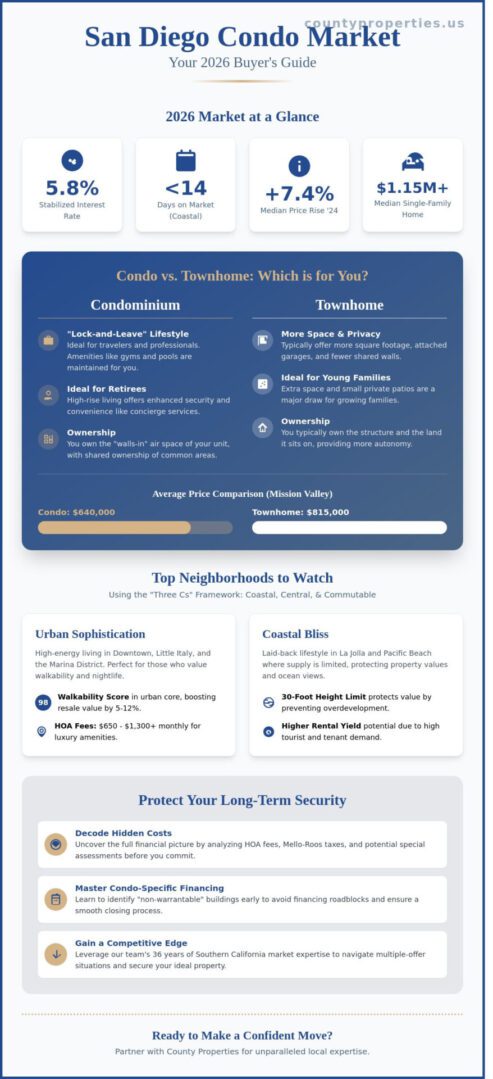
Current 2026 interest rate trends have stabilized around 5.8 percent, a welcome relief from the 7 percent peaks seen in previous years. This shift has finally started to unlock “bottled up” inventory, yet buyer competition remains fierce. You’ll find that san diego condos for sale often receive multiple offers within the first 14 days of listing, especially in coastal zones like La Jolla or Pacific Beach. While more units are hitting the market, the sheer volume of buyers entering the fray keeps prices resilient. It’s a fast-paced environment where having your financing pre-approved isn’t just a suggestion; it’s a requirement for success.
Why Condos are Dominating the SoCal Market
Modern professionals and retirees are trading yard work for “lock-and-leave” convenience. This lifestyle shift prioritizes proximity to urban hubs like Little Italy and the Gaslamp Quarter over suburban maintenance. High-density development in San Diego’s urban core has added over 3,200 units since 2024, yet demand still outpaces supply. Owners enjoy amenities like fitness centers and rooftop lounges without the headache of roof repairs or landscaping. For a deeper look at these regional shifts, review our Southern California housing market forecast to see how San Diego stacks up against neighboring counties.
Condos vs. Townhomes: Which is Right for You?
Understanding the legal boundaries of your purchase is essential for a secure investment. In a condo, you typically own the “walls-in” air space, while a townhome often includes the land beneath the unit and a small private patio. High-rise condos offer luxury perks like 24/7 security and concierge services that most suburban townhomes lack. Price points also vary significantly by neighborhood. In Mission Valley, townhomes averaged $815,000 in late 2025, while mid-tier san diego condos for sale in the same zip code started closer to $640,000. Consider these factors:
- HOA Fees: High-rise condos usually have higher monthly dues due to elevators and shared amenities.
- Privacy: Townhomes generally offer more vertical separation and fewer shared walls.
- Appreciation: Historically, townhomes in San Diego have appreciated slightly faster, but condos in prime urban cores offer higher rental yield potential.
We see a growing number of retirees choosing the security of high-rise living to ensure their homes are safe while they travel. Conversely, young families often lean toward townhomes for the extra square footage and attached garages. Whatever your preference, the 2026 market requires a nuanced approach to find the best value.
Top San Diego Neighborhoods for Condo Living
Finding the right spot for san diego condos for sale requires looking through the lens of the “Three Cs”: Coastal, Central, and Commutable. Your neighborhood choice dictates your daily lifestyle and your equity growth over the next decade. High walkability scores, like the 98 out of 100 found in parts of the urban core, often correlate with a 5% to 12% premium in resale value compared to car-dependent suburbs. Smart investors in 2026 are targeting “up-and-coming” pockets where infrastructure projects, such as the expanded trolley lines, are creating new transit-oriented hubs.
Urban Sophistication: Downtown and Little Italy
The Marina District offers a refined atmosphere with established luxury towers, while the historic Gaslamp Quarter provides immediate access to world-class entertainment. Little Italy remains the gold standard for walkable urban living. Its Saturday Mercato and high concentration of Michelin-recognized eateries drive constant tenant demand. If you’re looking here, expect high-rise HOA fees to range from $650 to over $1,300 monthly. These costs typically cover 24/7 concierge services and valet parking, which are essential amenities in these high-density blocks.
Coastal Bliss: La Jolla and Pacific Beach
Coastal inventory remains structurally limited by the 30-foot Coastal Height Limit. This 1972 regulation prevents massive high-rises from walling off the shoreline, which effectively protects your future ocean views and keeps supply low. You’ll find a mix of 1970s beachside complexes offering value-add potential and ultra-modern luxury lofts. For more context on navigating these competitive markets, read our guide on buying a home in Southern California.
Vibrant Culture: Hillcrest and North Park
The 92103 and 92104 zip codes are the heart of San Diego’s creative scene. Hillcrest features character-filled mid-century modern units, while North Park is seeing a surge in boutique “in-fill” builds. These areas often provide a significant price-per-square-foot advantage. Buyers can frequently save $175 to $225 per square foot compared to waterfront high-rises. It’s a top choice for local professionals who want a neighborhood with soul and a strong sense of community.
Selecting the right pocket involves balancing your commute with your weekend goals. Whether you want to wake up to crashing waves or the smell of fresh espresso, we can help you view current San Diego listings that align with your 2026 investment strategy. Our team focuses on identifying properties with the highest appreciation potential in these evolving urban villages.
Critical Factors When Evaluating San Diego Condos
Finding the right san diego condos for sale requires looking past the granite countertops and hardwood floors. You’re buying into a corporation as much as you’re buying a home. Monthly costs aren’t limited to your mortgage principal and interest. San Diego HOA fees typically range from $300 to over $1,000 depending on amenities. These fees cover everything from lobby security in East Village high-rises to pool maintenance in Mission Valley complexes. If a fee seems unusually low, it’s often a red flag that the association is deferring necessary maintenance.
Understanding your total tax burden is equally vital. Many newer developments, particularly in areas like Otay Ranch or parts of North County, carry Mello-Roos assessments. These are special taxes used to fund local infrastructure like schools and roads. They can add $200 to $600 to your monthly carrying costs. You should also verify the “view corridor” of the unit. In a dense market like Downtown, a “protected view” is a specific legal designation. If your window overlooks a parking lot or a low-rise warehouse, check the San Diego Downtown Community Plan. A 20-story tower could be permitted on that lot by 2027, instantly erasing your Pacific Ocean sunset and your property value.
The HOA Health Check: What to Look For
You must demand a copy of the most recent “Reserve Study” before your contingency period expires. This document reveals if the building has enough cash to handle major repairs. A healthy building maintains a “funded” level of 70% or higher. If the reserves are below 30%, you’re at high risk for a “special assessment.” These are one-time bills that can exceed $10,000 for a new roof or elevator modernization. Your due diligence should also include:
- Pending Litigation: If the HOA is suing the developer for construction defects, most traditional lenders won’t approve a loan.
- Short-Term Rental Bylaws: San Diego’s 2023 Short-Term Residential Occupancy (STRO) regulations are strict. Ensure the building’s CC&Rs don’t ban rentals shorter than 30 days if you plan to use the property as an investment.
- Pet Restrictions: Don’t assume your 60-pound Labrador is welcome; many buildings have weight limits or “aggressive breed” bans.
Parking and Storage: The Hidden San Diego Luxury
When comparing san diego condos for sale, parking configuration is a massive driver of resale value. Tandem parking, where one car is blocked by another, is common but less desirable. A side-by-side parking arrangement typically adds $15,000 to $25,000 to the unit’s market value. If you own an electric vehicle, check the infrastructure. Buildings constructed after the 2015 California Green Building Standards Code are more likely to have EV-ready conduit, while older 1980s complexes may require a $5,000 upgrade to your individual spot. Finally, look for deeded storage. In a high-density area like Little Italy, a private 4×6 storage cage is essential for holding surfboards and bikes that won’t fit in a 750-square-foot floor plan.
The Step-by-Step Guide to Purchasing a Condo
Buying a condominium involves layers of complexity that differ significantly from purchasing a single-family home. You aren’t just buying a living space; you’re entering into a legal and financial partnership with a Homeowners Association (HOA). As you evaluate san diego condos for sale, understanding the technical hurdles of the escrow process ensures you don’t lose your earnest money deposit or end up with an unfinanceable property.
Financing Your San Diego Condo
Lenders view condos as higher risk than detached houses. To secure a loan, the building itself must pass a review. Conventional loans require the project to be “warrantable,” meaning it meets Fannie Mae and Freddie Mac standards. If a single entity owns more than 20% of the units or if the HOA is involved in active litigation, the building becomes “non-warrantable.” In these cases, you might need a 25% down payment and a specialized portfolio lender.
- The Condo Questionnaire: This document is the heart of your loan approval. Lenders use it to check if HOA reserve funds are below the 30% threshold, which often triggers a loan denial.
- FHA vs. Conventional: FHA loans offer 3.5% down payments, but only for buildings on the approved HUD list. As of early 2026, many downtown San Diego high-rises have let their FHA certifications lapse.
- Down Payment Strategy: In competitive markets like Little Italy or North Park, offering a 20% down payment signals financial strength to sellers, even if you eventually use a lower-down-payment program.
The Contingency Period: Your Protection
California law provides specific safeguards for condo buyers. Under Civil Code Section 4525, sellers must provide a comprehensive package of HOA documents. You have a statutory 7-day right to review these papers. This is your window to look for “special assessments,” which are one-time fees for major repairs like roof replacements or elevator overhauls that can cost owners upwards of $10,000.
Your physical inspection should be a “walls-in” evaluation. While the HOA typically maintains the building’s exterior, you’re responsible for everything from the drywall inward. A specialized inspector will check the shut-off valves, water heater age, and the HVAC system, which is often located on a common area roof. Use the findings to negotiate repair credits. This period is also the time to consult an expert real estate agent guide to ensure your request for repairs is aggressive yet realistic for the 2026 market.
To help scope out potential renovations after your purchase, a detailed apartment renovation checklist from an architect can be invaluable. While the resource at martinbonauer.ch is based in Switzerland, it provides a thorough and universally applicable framework for planning such a project.
The final walkthrough occurs five days before closing. Don’t just check the appliances. Verify that the common areas haven’t sustained new damage and that the seller hasn’t left prohibited items in the storage lockers or deeded parking spaces. Successful closing on san diego condos for sale requires this level of diligence to avoid post-move-in surprises.
Why County Properties is Your San Diego Condo Partner
Arnie Levine has spent 36 years mastering the Southern California real estate landscape. Since the firm’s inception, he has rejected the traditional “lone wolf” agent model in favor of a collaborative team approach. When you work with us, you don’t just get a single agent; you get the collective intelligence and resources of our entire firm. This team concept ensures that every detail of your purchase is scrutinized by multiple experts, providing a level of oversight that individual agents simply can’t match. This is particularly vital when navigating the 2026 market for san diego condos for sale, where HOA complexities and building histories require a deep dive into the data.
Our commitment to your financial security is the heartbeat of our practice. We don’t view ourselves as salespeople; we are expert negotiators and fiduciaries. We protect your equity by analyzing the fiscal health of homeowners associations and evaluating long-term building maintenance schedules. For those looking to downsize, we offer specialized services for seniors. We understand that moving from a long-time family home into a condo is a major life transition. Our team provides the patience and technical knowledge needed to make that move seamless and stress-free.
- Expert Negotiation: We use 36 years of transaction data to ensure you never overpay for a property.
- HOA Scrutiny: Our team reviews years of board meeting minutes to spot potential special assessments before they happen.
- Collaborative Support: You have access to our entire staff for questions regarding legal disclosures, escrow, and inspections.
A Personalized Approach to the San Diego Search
Finding the right home goes beyond scrolling through public websites. We specialize in identifying “off-market” opportunities by leveraging our deep network of local property managers and past clients. This gives our buyers a distinct advantage in securing the best san diego condos for sale before they reach the general public. Our philosophy is service-centric, not transaction-centric. We focus on your long-term satisfaction rather than just closing a deal. If you’re a retiree or helping a family member transition, please review our senior real estate specialist guide to see how we tailor our search process for your specific needs.
Ready to Find Your Dream Condo?
We provide step-by-step guidance from your very first building tour until the moment the keys are in your hand. The 2026 market moves fast, but our structured process ensures you’re always one step ahead. We invite you to schedule a no-obligation consultation with Arnie Levine to discuss your goals and financial requirements. Explore our featured San Diego condo listings today and let us show you the County Properties difference.
Secure Your Future in the San Diego Skyline
The 2026 market offers unique opportunities for buyers who understand how to balance neighborhood trends with long term value. Success requires more than just browsing listings. It demands a deep dive into HOA health, specific building amenities, and evolving urban zoning laws. By identifying top neighborhoods and mastering the step by step purchasing process covered in this guide, you’re already ahead of the competition. As you explore the diverse inventory of san diego condos for sale, your success hinges on having a seasoned advocate by your side.
County Properties brings 36 years of local market experience to your search. We don’t just close deals. We operate as a collaborative team that puts your goals ahead of individual commissions. Our staff includes a specialized Senior Real Estate Specialist (SRES®) to ensure every transition, whether you’re downsizing or investing, is handled with expert care. Don’t navigate this complex landscape alone.
Start your San Diego condo search with the trusted experts at County Properties. We’re ready to help you turn your 2026 real estate goals into a reality.
Frequently Asked Questions
What are the average HOA fees for condos in San Diego?
Average HOA fees for San Diego condos for sale typically range from $450 to $1,200 per month. Luxury buildings in neighborhoods like Little Italy or the Marina District often see fees exceeding $1,500 because they provide 24 hour concierge services and rooftop pools. These costs cover exterior maintenance, insurance, and common area upkeep. It’s vital to review the budget to ensure the association maintains a 70% or higher reserve fund for future repairs.
Is it better to buy a condo or a house in San Diego for investment?
Choosing between a condo and a house depends on whether you prioritize cash flow or long term appreciation. Condos often provide higher rental yields, frequently hitting 4.5% in areas like Mission Valley. Single family homes generally see 2% to 3% higher annual appreciation over a ten year period. If you want lower maintenance and a turnkey rental, a condo is a strategic entry point for your 2026 investment portfolio. For those planning to lease their new property, you can learn more about Parkerson Property Management to see how professional services can streamline the process.
What is a “non-warrantable” condo and can I get a loan for one?
A non-warrantable condo is a unit that doesn’t meet Fannie Mae or Freddie Mac’s standard lending guidelines. This happens if one person owns more than 20% of the units or if commercial space exceeds 25% of the building’s total square footage. You can still get a loan through portfolio lenders or private banks. These institutions usually require a 20% to 25% down payment and charge slightly higher interest rates than traditional loans.
How do Mello-Roos taxes affect condo owners in San Diego?
Mello-Roos taxes are special assessments that fund local infrastructure like schools and roads in newer developments. In neighborhoods like Carmel Valley or Black Mountain Ranch, these can add $200 to $450 to your monthly carrying costs. These bonds typically last 20 to 40 years. It’s vital to check the specific tax rate for any of the San Diego condos for sale you’re considering to avoid unexpected monthly expenses.
Are there many pet-friendly condos in Downtown San Diego?
Approximately 85% of condo buildings in Downtown San Diego allow pets, though weight and breed restrictions vary by complex. Buildings like The Mark and Savina are known for being very pet friendly, offering on site dog runs and grooming stations. Most associations limit owners to two pets. You should always check the specific CC&Rs to see if there’s a 35 pound weight limit before you sign your purchase contract.
What should I look for in the HOA meeting minutes before buying?
You should look for mentions of “special assessments” or ongoing litigation in the last 12 months of HOA meeting minutes. If the board is discussing a $10,000 per unit roof repair that isn’t funded by reserves, you’ll be responsible for that cost after closing. Check for recurring complaints about security or plumbing issues. A healthy association should have a reserve study updated within the last 3 years showing adequate funding.
How much should I budget for closing costs on a San Diego condo?
Budget between 2% and 3% of the purchase price for closing costs on a San Diego condo. On an $800,000 unit, this equals $16,000 to $24,000 in additional funds. These fees cover title insurance, escrow services, and prepaid interest. If you’re buying in a brand new development, the developer might ask you to pay their portion of the transfer tax, which can add another 0.1% to your total cost.
Can I use my VA loan to buy a condo in San Diego?
You can use a VA loan to buy a condo as long as the complex is on the VA approved list. Currently, hundreds of San Diego developments are approved, but you must verify the status on the VA’s website before making an offer. If a building isn’t approved, your lender can submit a request for spot approval. This process can take 30 to 45 days, but it’s a powerful tool for zero down financing.