

A visible crack doesn’t automatically mean you should delay your sale to repair the foundation. If you’re weighing the question behind “fixing foundation before selling house San Diego,” start with evidence, not assumptions: some signs may be minor, while others warrant a closer assessment.
It’s understandable to worry that repairs could delay your listing or reduce your proceeds. Choosing between a repair, a buyer credit, and an as-is sale is easier when you understand the concern and have clear documentation. In California, selling as-is doesn’t remove the obligation to disclose known material defects, including foundation issues.
This guide explains what information can help you assess a foundation concern, how buyers may respond to findings and repair records, and what to weigh when comparing your sale options. County Properties has guided Southern California sellers since 1995. Our team can help you consider the foundation decision as part of your broader selling strategy, without rushing you toward a one-size-fits-all answer.
Key Takeaways
- Visible cracks, uneven floors, or sticking doors are clues to document, not proof of structural failure.
- Distinguish a general home inspection from a structural engineer’s assessment to understand what the findings do and don’t establish.
- For fixing foundation before selling house San Diego, compare repair, negotiation, and as-is options based on documentation, timing, buyer confidence, and your priorities.
- Organize existing records, professional findings, completed work, and unresolved questions before setting your sale strategy.
- Seller representation can help you weigh a foundation concern alongside pricing, market preparation, and the broader transaction.
Fixing a Foundation Before Selling a San Diego House: What Should You Check First?
Seeing a crack before listing can raise immediate questions about safety, repair costs, and whether you’ll need to postpone your sale. But a crack alone doesn’t establish that a foundation has failed. Its location, size, pattern, and changes over time matter, and different causes can produce similar visible signs. Approach fixing foundation before selling house San Diego by gathering clear observations before choosing a solution.
Keep two categories separate: what you can see and what a qualified professional has determined. A warning sign is an observation; a structural assessment is a professional evaluation of its significance. This distinction helps you avoid dismissing a developing concern or assuming the worst based on one symptom.
Which foundation warning signs matter when preparing to sell?
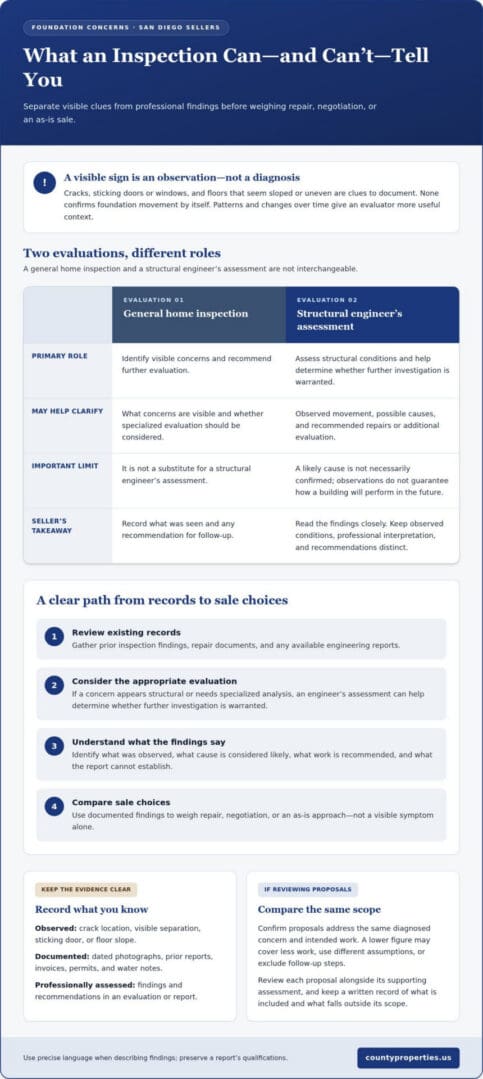
Look for patterns and change, not just isolated imperfections. Note whether cracks are recurring, widening, or appearing in several areas, and whether nearby surfaces are separating. Newly sticking doors or windows and floors that seem sloped or uneven are also worth recording. None confirms foundation movement by itself, but a combination of observations, especially if they change over time, gives an evaluator more useful context.
Include the home’s surroundings. San Diego’s varied soils, including expansive clay and sandy coastal soils, can behave differently as moisture conditions change. Extended dry periods followed by rain may affect soil moisture around a home, while poor drainage or grading that directs water toward the structure can provide relevant context. These details don’t prove a cause, but they can help frame an evaluation. For background on the discipline involved, see Structural Engineering Principles.
What should a San Diego seller document before listing?
Collect records in one place so you can distinguish what was observed, assessed, and repaired. Include previous inspection reports, repair invoices, permits, and any available engineering documents. If a prior repair was completed, keep its paperwork with the related observations rather than relying on memory to describe the work.
Photograph visible conditions from consistent angles, add the date, and record whether they seem different from earlier images. Keep brief notes on water intrusion, drainage patterns, or water events, including when and where you noticed them. Describe what happened without assigning an unverified cause. A damp area, for example, is an observation; it doesn’t establish that the foundation is responsible.
- Observed: Crack location, visible separation, sticking door, or floor slope.
- Documented: Dated photographs, prior reports, invoices, permits, and water notes.
- Professionally assessed: Findings and recommendations in an evaluation or report.
This organized record gives you a stronger starting point for deciding what to investigate and for discussing the concern as part of your sale preparations.
How a Foundation Inspection and Engineering Report Clarify the Repair
Once you’ve organized your observations and records, the next step is understanding what they establish. A general home inspection can identify visible concerns and recommend further evaluation, but it isn’t interchangeable with a structural engineer’s assessment. For sellers researching “fixing foundation before selling house San Diego,” this sequence can prevent premature decisions:
- Review existing records. Gather prior inspection findings, repair documents, and any available engineering reports so the home’s history is clear.
- Consider the appropriate evaluation. When a concern appears structural or needs specialized analysis, a structural engineer’s assessment can help determine whether further investigation is warranted.
- Understand the findings. Identify what was observed, what cause is considered likely, what work is recommended, and what the report cannot establish.
- Compare sale choices. Use the findings to weigh repair, negotiation, or an as-is approach rather than treating a visible symptom as a repair plan.
This process keeps the diagnosis separate from the sale decision. An engineer evaluates structural conditions; the seller considers how the documented findings fit the property’s preparation and transaction strategy.
What can a structural engineer’s report tell a home seller?
A report may describe observed movement, discuss likely causes, and recommend repairs or further evaluation. Read it closely to distinguish measured or observed conditions from professional interpretation. A likely cause isn’t necessarily confirmed, and a report’s observations don’t guarantee how a building will perform in the future. When summarizing findings for prospective buyers or transaction documents, use precise language and preserve the report’s qualifications instead of turning a recommendation into a promise.
How should sellers compare foundation repair proposals?
Compare proposals only after confirming they address the same diagnosed concern and intended scope. A lower figure may cover less work, rely on different assumptions, or exclude follow-up steps. Review each proposal alongside the supporting assessment, and keep a written record of what is included and what falls outside its scope.
- Scope: Which areas and conditions are addressed, and what work is proposed?
- Basis: Does the proposal refer to an engineering report or explain its assumptions?
- Materials and limits: What materials are specified, and what limitations or exclusions are stated?
- Project documentation: Are engineering plans, permits, inspections, or follow-up records addressed where applicable?
- Written terms: What documentation is provided after work, and what do any warranty terms say about transfer to a future owner?
Don’t assume a warranty transfers automatically. Treat transferability, coverage, and exclusions as terms of the specific written agreement. Permit and inspection requirements can depend on the work, so keep those details separate from the engineering diagnosis and avoid assuming a proposal resolves every local requirement.
With a report and comparable scopes in hand, you can discuss the sale paths with better context. County Properties provides personalized seller representation to help you consider how a foundation finding fits into your broader San Diego sale strategy.
Repair, Negotiate, or Sell As-Is: Which Foundation Option Fits Your Sale?
Once you understand the documented condition, compare how to handle it in the sale. Fixing foundation before selling house San Diego may be right for some sellers, but repair isn’t automatically the best financial choice. Work can involve scheduling and disruption, while leaving the issue for negotiation can bring uncertainty about buyer requests and transaction terms. An as-is sale is another path, not a way to erase known concerns.
Use the comparison below as a planning tool, not a prediction. Buyer response depends on the property, available findings, and the terms of an individual transaction.
| Consideration | Complete repairs before listing | Negotiate after findings | Market as-is |
|---|---|---|---|
| Timing | Work and related documentation may need to be completed before marketing. | Decisions happen during offer review or negotiations, which can affect the transaction schedule. | You can prepare to list without completing the work first, but the concern may arise during buyer review. |
| Upfront commitment | You take on the repair project and its associated decisions before the sale. | You wait for a specific request or offer term before deciding how to respond. | You avoid arranging pre-sale repairs, while accepting that buyers may account for the condition in their offers. |
| Buyer confidence | Clear findings and completion records may help explain what work was done. | Buyers can consider the professional findings alongside proposed transaction terms. | Buyers may have questions or seek their own evaluation; responses can vary. |
| Documentation and uncertainty | Keep the scope, invoices, and available closeout records together; past work doesn’t guarantee future performance. | Keep the assessment and agreed terms clear, while recognizing that parties may not agree. | Present known information accurately, and expect uncertainty about how buyers will assess the concern. |
When might completing foundation work make sense before listing?
Pre-listing work may suit you when an evaluation identifies a defined repair and you have the time and capacity to complete it. A clear scope, records of the work, and related documentation can help buyers understand what was addressed instead of relying on a vague claim that the foundation was “fixed.” Weigh those benefits against project disruption and timing. Repairing doesn’t guarantee a higher sale price or greater net proceeds, so compare the full commitment with other options.
When might negotiation or an as-is sale be worth considering?
If you don’t want to manage work before listing, you can consider responding to a buyer’s request through negotiated transaction terms, depending on the offer and your priorities. An as-is approach communicates that you aren’t planning to make repairs as part of the sale; it doesn’t remove applicable disclosure responsibilities for known material defects. For broader context on preparing and positioning your property, County Properties’ Southern California home-selling guide covers the wider selling process.
The practical choice comes down to verified condition, your priorities, the buyer’s response, and the terms on the table. Compare those factors together rather than assuming one path will always protect your proceeds or produce a smoother transaction.
A San Diego Seller’s Checklist for Managing Foundation Concerns
A well-organized file can make a foundation concern easier to discuss and help keep sale decisions grounded in what’s actually known. Use this sequence to move from records to a documented strategy, while allowing room for new findings or changes to your plans.
- Start with the records. Gather past inspection and engineering reports, repair invoices, permits, warranties, and completion documents. Keep originals and note which items describe completed work versus recommendations that are still outstanding.
- Separate the information. Sort your notes into known facts, professional findings, completed work, and unresolved questions. For example, keep your observation that a crack appeared in one category and an engineer’s conclusion about it in another.
- Preserve the source language. Keep complete reports, and don’t summarize technical conclusions more strongly than the documents support. A recommendation for further evaluation isn’t the same as a confirmed diagnosis or completed repair.
- Map the likely sequence. Set out assessment, decision-making, any planned work, collection of completion records, and listing preparation as separate milestones. Additional evaluation or a revised scope may change the order.
- Review disclosure considerations. California sellers generally have disclosure obligations concerning known material property conditions, and foundation concerns or past repairs may be relevant. Requirements depend on current rules and your circumstances; this checklist isn’t legal advice.
- Document your sale strategy. Record whether you plan to complete work, consider negotiated terms, or market the home as-is, along with the information supporting that decision and any outstanding questions.
What records should you prepare for prospective buyers?
Build a file that preserves the history, not just the latest report. Include inspection and engineering documents, invoices, permits, written warranty terms, and records showing work was completed. Keep recommendations that remain outstanding distinct from completed repairs. If you share a summary, use clear, factual wording and retain the original documents so readers can see the conclusions and limitations in context.
How can sellers plan around repair and listing timelines?
Work backward from your preferred listing window, but don’t assume an assessment or repair will fit a fixed turnaround. Leave flexibility for further evaluation, scope changes, or gathering project records. Broader market conditions can inform your planning, but they can’t guarantee a sale date; the San Diego housing market outlook provides regional context to consider alongside your own schedule.
A seller’s representative can help connect the foundation decision to the wider preparation and transaction plan. County Properties offers guidance on choosing seller representation. If you’re weighing fixing foundation before selling house San Diego, the linked guide can help you think through the broader sale strategy.
Sell a San Diego Home with Foundation Concerns: How County Properties Can Help
A foundation concern can affect more than one decision. You may be weighing whether to complete work, respond to buyer concerns during negotiations, or present the home as-is while planning your next move. County Properties helps you consider those choices as part of the entire sale, with guidance shaped around your priorities and the information available. We represent sellers; technical reports and repair scopes provide information about the property’s structural condition.
County Properties was established in 1995, and founder Arnie Levine brings 36 years of Southern California real-estate experience. That perspective informs a personalized, collaborative approach to the selling process. The goal is to help you make a considered plan, not to promise a particular price, buyer response, repair outcome, or closing date.
How seller representation can help you weigh your options
Seller representation connects the foundation question to your broader goals. Together, you can compare repair, negotiation, and as-is paths in light of your intended timing, tolerance for project coordination, and available documentation. Structural conclusions and recommendations come from the relevant inspection or engineering records; your real-estate strategy considers how those findings may shape property preparation, presentation, and transaction discussions.
This distinction matters. A report may describe a condition, while your sale plan determines how to account for it in marketing and negotiations. The team can help you organize priorities and consider the trade-offs without treating a technical recommendation as a guaranteed market result.
Plan your next step with County Properties
For a useful first conversation, bring together the details that shape your decision. You can share:
- Your preferred timing and any important move-related dates.
- Known observations and available inspection or engineering findings.
- Records of completed repairs, recommendations, and outstanding questions.
- Your priorities, such as minimizing pre-listing work or understanding possible negotiation paths.
This gives the team context to discuss your real-estate options and the next steps in preparing to sell. For questions about fixing foundation before selling house San Diego, County Properties can help you consider how the concern fits into your sale strategy. County Properties provides real-estate representation, not legal representation.
When you’re ready to discuss your home, your timeline, and the sale path that fits your priorities, talk with County Properties about selling your San Diego home.
Make Your Next Sale Decision with Confidence
You don’t have to settle every foundation question before taking a thoughtful next step. Start with the information you have, identify what still needs clarification, and consider how each decision fits your plans for the move. The goal isn’t to choose the most familiar option. It’s to choose a sale strategy that reflects your priorities and the available evidence.
If you’re still weighing fixing foundation before selling house San Diego, a conversation about your home and intended timing can help connect the property concern to the broader sale plan. County Properties offers personalized seller representation, and client testimonials highlight attentive service and smooth transaction experiences. You can bring your questions and discuss the path that feels practical for your circumstances, without pressure to make every decision at once.
Talk with County Properties about selling your San Diego home. A clear next step can make a complicated sale feel more manageable, and you can move forward with a plan built around your needs.
Frequently Asked Questions
Should I fix foundation problems before selling my house in San Diego?
Not necessarily. For fixing foundation before selling house San Diego, decide based on the evidence, your plans, and the terms you’re prepared to consider. For example, a seller with a defined repair recommendation and time to coordinate the work may choose a different path from someone with unresolved questions or a firm move date. Compare the practical effect of each option on your schedule and transaction, rather than assuming repairs will increase your net proceeds.
Can I sell a San Diego house with foundation problems as-is?
Yes, a seller may market a home as-is, but the label doesn’t replace applicable disclosure obligations or make a buyer accept the property’s condition. Keep descriptions factual: distinguish a visible condition from a professional conclusion, and don’t imply that no repair is needed unless documentation supports that statement. Disclosure requirements depend on current California rules and individual circumstances, so this article isn’t legal advice.
Does a home inspection prove that a foundation needs repair?
No. A home inspection may flag a condition, such as a crack or an uneven area, without determining its cause or specifying a structural repair. Read the wording carefully: “recommend further evaluation” is different from a finding that particular work is necessary. If a report raises structural questions, an engineering assessment may help clarify them. Keep the original inspection language available so you don’t overstate what it concluded.
Can foundation repair warranties transfer to a new owner?
Sometimes, but transfer depends on the written warranty’s terms. Before describing coverage to a buyer, review who is covered, whether transfer is allowed, what steps or notices are required, and which conditions are excluded. For example, a warranty might require a transfer request within a stated period. Don’t promise that coverage continues after closing unless the document says so; provide the complete written terms for accurate review.
Do foundation repairs in San Diego require permits?
Some work may require permits, but requirements can vary with the project and applicable local rules. The general label “foundation repair” isn’t enough to determine what applied to a specific job. For completed work, organize permits, approved plans, inspection records, and closeout documents if you have them. For proposed work, keep permit questions separate from the engineering diagnosis and avoid representing a permit as required or unnecessary without supporting information.
Can a foundation issue affect a buyer’s financing or insurance?
It can lead to additional review, but no single outcome applies to every property or buyer. A lender or insurer may consider the property, available reports, and its own criteria. For instance, a buyer may need to provide documentation as part of a separate review. Don’t promise that a repair or engineering report will secure approval. County Properties can guide the sale discussion, but lending and insurance decisions are made by the relevant companies.
Should I get an engineering report before listing a house with foundation cracks?
It may be useful if an existing report, buyer concern, or planned sale decision leaves an important structural question unanswered. Consider what decision the report would inform. For example, clearer information may help you assess a repair proposal or respond to a buyer’s question. Review the report’s scope and limitations, and don’t treat its conclusions as a guarantee of future performance, final repair costs, or a particular sale outcome.