

The biggest challenge of moving to San Diego from the Bay Area may not be finding a home. It’s making the housing decision fit your budget, work, and daily life while coordinating the sale or transition from your current home. The housing trade-offs may look different, but the right move depends on more than comparing prices.
If you’re weighing the change, you’re likely asking practical questions: Which San Diego area suits your lifestyle? Should you buy before selling, or plan the transition another way? How can you keep housing decisions and moving logistics in step? A clear sequence can make these choices easier to manage.
This 2026 guide helps you compare the Bay Area and San Diego, assess housing and lifestyle trade-offs, and build a relocation plan around realistic decision points. You’ll find ways to choose a community, coordinate a home sale and purchase, and organize your move. If your plans include downsizing or changing how you want to live, you’ll also find considerations for preparing for that next chapter.
Key Takeaways
- Think of moving to San Diego from the Bay Area as both a household relocation and a decision about how you want daily life to work.
- Compare housing options alongside commute patterns, outdoor routines, and nearby amenities to understand which trade-offs matter most to you.
- Break your relocation into stages, keeping housing decisions, move preparation, and arrival tasks organized separately.
- Build a San Diego community shortlist around your actual routine, including work destinations, services, recreation, housing needs, and support networks.
- Coordinate your home purchase or sale with a real estate guide who can help align housing decisions with your relocation plans.
Moving to San Diego from the Bay Area: What Changes First?
Leaving a familiar region involves more than packing a home. You’re also learning how a new city fits your work, relationships, routines, and expectations. Moving to San Diego from the Bay Area means choosing not only where to live, but how you want everyday life to work. Consider the destination before locking in a housing plan.
There’s no single Bay Area experience or San Diego lifestyle. Your day-to-day reality will depend on your job location, household needs, preferred pace, and chosen community. A broad overview of San Diego’s geography, climate, history, and economy can help frame your research; the San Diego Overview is a useful starting point. Then focus on the details that matter to your household.
Why Bay Area residents consider a San Diego move
Your reasons may include a change in work arrangements, closer family connections, a different climate, more suitable living space, or a lifestyle that better matches this stage of life. These are possibilities, not guarantees that one region will meet every household’s expectations. Write down what’s prompting your move, then rank your priorities.
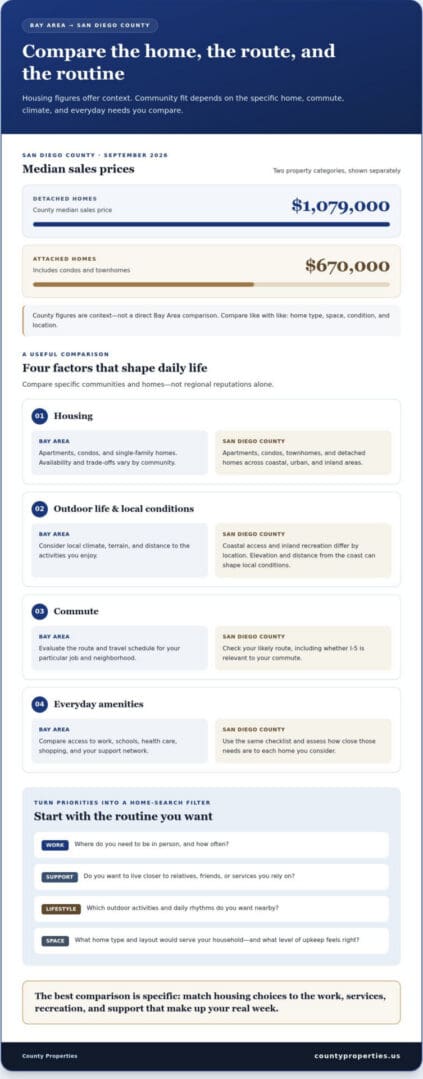
- Work: Where will you need to be in person, and how often?
- Family and support: Do you want to live closer to relatives, friends, or services you rely on?
- Climate and lifestyle: Which outdoor activities and daily rhythms do you want nearby?
- Space and housing: What home type and layout would serve your household?
This ranking gives your home search a practical filter. If access to work is essential, commute patterns may matter more than extra space. If support networks are a priority, proximity to family or community resources may guide your shortlist. Naming your reasons helps you make choices based on your actual needs rather than an idealized picture of either region.
What to compare before you commit
Compare routines, not just regional reputations. Think through a typical week: where you work, how you’ll get there, where you’ll shop, which appointments or services you need, and how you want to spend your free time. A neighborhood that looks appealing on a map may be less convenient if it makes the routines you value harder.
- Map likely work destinations and consider how often you’ll travel to them.
- Identify everyday needs, such as grocery shopping, health services, and schools if relevant.
- Consider recreation, social connections, and places you expect to visit regularly.
- Compare housing options against your space needs, budget, and preferred level of upkeep.
Separate broad impressions from neighborhood-level realities. San Diego’s climate and amenities vary across its communities, just as commute and housing choices differ across the Bay Area. Research specific areas and, where possible, experience their everyday conditions before deciding. Relocation readiness means finding a genuine fit between your lifestyle priorities and the housing choices available to you. That clarity makes it easier to plan the move and evaluate homes with confidence.
Bay Area vs. San Diego: Compare Housing, Climate, and Daily Life
A useful comparison goes beyond the city names. Both regions include different housing types, travel patterns, and local amenities, so your experience will depend on the specific communities you compare. San Diego County spans coastal, urban, and inland settings. A home near the coast and one farther inland can support different routines, just as a Bay Area address can mean very different access to work and services.
| Factor | Bay Area | San Diego County |
|---|---|---|
| Housing | Apartments, condos, and single-family homes; availability and trade-offs vary by community. | Apartments, condos, townhomes, and detached homes across coastal, urban, and inland areas. |
| Outdoor lifestyle | Consider the local climate, terrain, and distance to the activities you enjoy. | Coastal access and inland recreation differ by location; elevation and distance from the coast can shape local conditions. |
| Commute | Evaluate the route and travel schedule for your particular job and neighborhood. | Check your likely route, including whether I-5 is relevant to your commute, rather than assuming it will be. |
| Daily amenities | Compare access to work, schools, health care, shopping, and your support network. | Use the same checklist, and assess how close those needs are to each home you consider. |
How housing choices can differ by area
In San Diego County, September 2026 median sales prices were $1,079,000 for detached homes and $670,000 for attached homes, including condos and townhomes. These county figures offer context, not a direct Bay Area comparison. They cover different property categories and don’t establish what a comparable home costs in your current community. Compare like with like, including home type, space, condition, and location. For a closer look at the buying process, use this Southern California home-buying guide.
Before comparing individual properties, decide how much space you need, how much upkeep you’re comfortable managing, and which destinations should be close by. Those priorities can narrow the search and help you evaluate homes against the same criteria.
How climate and routine affect community fit
Coastal, inland, and higher-elevation communities can feel different, so don’t assume one description captures the county’s climate. Consider how a location works throughout your week: travel to work, schools or health care, access to recreation, and time with family or other support. A coastal setting, for example, may mean a different distance to an inland workplace, while an inland home may better suit other space or routine priorities.
As you plan moving to San Diego from the Bay Area, compare actual routes at the times you expect to travel. I-5 is one route to investigate if it serves your destination, not a commute everyone will share. If a San Diego home purchase is part of your plan, County Properties’ buyer representation can help you align the home search with your location and housing priorities.
Plan the Bay Area-to-San Diego Move in Clear Stages
A relocation is easier to coordinate when housing decisions and physical move preparations have their own place in the plan. Moving to San Diego from the Bay Area may involve a home sale, a purchase, changing household needs, and travel arrangements, but these steps don’t always move at the same pace. Build a flexible sequence, note what depends on what, and leave room for plans to shift.
Prepare before choosing dates
Start with a household inventory, not a calendar. Record what you’ll move, what you may sell or donate, and what the next home needs to support, including accessibility needs, pets, work-from-home arrangements, and essential services. Gather the documents and decisions you’ll need to organize for the housing transition, and consult the appropriate professionals for legal or tax questions.
Use a staged plan, then add dates
- Set priorities. Agree on the reasons for relocating, your household’s needs, and the location and home characteristics that matter most. Identify which decisions are essential and which can remain flexible.
- Map housing milestones. Outline the steps involved in selling your current home, if applicable, and buying or securing a home in San Diego. Record key transaction dates, expected possession, and any conditions that affect when you can occupy the new home.
- Choose a move window. Once you understand the housing sequence, organize physical move arrangements around likely dates. Track household commitments, work schedules, school considerations, and other obligations that could affect your availability.
- Prepare belongings and essentials. Sort items by what needs to travel, what can be handled separately, and what must be accessible during the transition. Keep important documents, medications, and daily necessities easy to locate rather than buried among packed belongings.
- Plan arrival and settling-in tasks. Make a first-days list for accessing the home, setting up essential services, and locating nearby everyday needs. Revisit the list as your move-in readiness becomes clearer.
Coordinate logistics with housing milestones
Possession and move-in readiness shape the household schedule. A signed transaction date doesn’t automatically mean the home is ready for your belongings, so track confirmed details separately from assumptions. Note dependencies, such as whether a Bay Area home sale affects your purchase plan or whether access to the San Diego home affects when you can arrange delivery.
Build schedule buffers around important transaction dates and family commitments. Identify a backup plan for delayed possession, a change in travel arrangements, or a gap between leaving one home and entering the next. A contingency doesn’t require predicting a problem; it gives you a considered next step if plans change. For broader context as you assess housing decisions, review the Southern California housing market outlook.
County Properties offers personalized, collaborative buyer and seller representation to help you coordinate real estate decisions during a relocation. Keep the housing plan and physical move plan connected but distinct, so each can adjust without losing sight of the overall transition.
Choose a San Diego Community That Fits Your Real Routine
A neighborhood can look ideal online and still make an ordinary weekday harder than it needs to be. Build your shortlist around the places you’ll go, the home you want to maintain, and the people and activities that matter to you. This needs-based approach gives you a consistent way to compare communities without relying on popularity or someone else’s idea of the “best” area.
Build a shortlist around work, family, and access
Start by mapping likely destinations: your workplace, schools, health care, regular errands, recreation, transit connections, and family or friends you expect to see often. Decide which trips need to be convenient and which can be occasional. Coastal, central, and inland locations can support different routines, so compare specific areas against your priorities instead of assuming one setting suits every household.
- Commute: Identify the routes and travel patterns you’d realistically use, including alternatives if your schedule changes.
- Essential services: Consider access to health care, schools, transit, and everyday shopping based on your household’s needs.
- Community life: Think about recreation, social connections, and how often you want to visit family or friends.
Use this repeatable process to narrow your choices:
- Choose your anchor destinations. Mark work, school, health care, and family locations on a map.
- Set practical limits. Decide what travel time, route complexity, or distance feels workable for regular trips.
- Compare candidate areas. Note housing types, nearby services, recreation, and transit access for each one.
- Test the routine. Visit in person at different times, including a regular weekday, or research remotely using current maps, transit information, and local resources.
- Review the trade-offs. Keep the areas that meet your essential needs, then compare what each asks you to compromise.
Conditions can differ by route and time of day. Treat a map as a starting point, then consider how a typical week would feel from each prospective home.
Match the home search to your next chapter
Community fit also depends on the home itself. Compare apartments, condos, and houses by the space you need, privacy, accessibility, and the upkeep you’re comfortable taking on. Downsizing may be part of a move for some households, while others may need room for family, work, or changing needs. If a senior’s housing transition is involved, this senior real estate transition guide can help frame the real estate decisions.
As you consider moving to San Diego from the Bay Area, write down your non-negotiables and flexible preferences before touring homes. County Properties provides personalized buyer representation to help connect your housing search with the community and routine you’re planning. Explore buyer representation with County Properties as you refine your shortlist.
Coordinate Your San Diego Home Purchase or Sale with County Properties
Buying or selling while relocating can make housing decisions feel tightly connected. Your preferred move window may depend on a sale, a purchase, or both, while the home you choose needs to fit the community and routine you’ve identified. County Properties provides personalized, collaborative buyer and seller representation in Southern California, helping you organize real estate decisions around your relocation priorities.
Arnie Levine and the team can help you keep the housing side of the transition in view as you consider your next steps. Representation does not remove the need to make careful decisions, but it gives you a real estate guide to help structure your search or sale and coordinate transaction-related considerations with your plans.
If you are buying a home in San Diego
Bring your community shortlist and household priorities into the home search. Share the features that matter, such as location, home type, accessibility, space, or upkeep, and use them to evaluate properties consistently. Buyer representation can help organize your questions, compare options, and keep track of decisions as you move through the transaction. For guidance on the representation relationship, explore this guide to finding a real estate agent.
A focused approach can be especially useful when you’re researching San Diego from another region. A collaborative real estate process helps connect what you’ve learned about neighborhoods to the homes in front of you, while keeping your move-related priorities part of the discussion.
If you are selling before or during the move
If your Bay Area home is part of the transition, plan its sale and the related real estate steps around your relocation goals. County Properties represents sellers in Southern California, helping them plan a property’s marketing and coordinate transaction steps. Sale timing and outcomes depend on the transaction and market conditions, so avoid building the entire physical move around an assumed closing date.
Keep key dates, dependencies, and household needs visible as plans develop. If the move also involves downsizing or a change in lifestyle needs, County Properties’ senior real estate transition expertise can bring those housing considerations into the conversation. This support is relevant when a senior’s next home, current property, or preferred living arrangement forms part of the transition, without assuming every move calls for downsizing.
For moving to San Diego from the Bay Area, a collaborative real estate guide can help you approach a San Diego purchase or sale as part of a larger life change. Share your priorities and questions with County Properties, then decide on a path that suits your household and housing goals. Talk with County Properties about your San Diego move.
Make Your Next Move with Confidence
As you prepare for moving to San Diego from the Bay Area, make decisions one at a time. You don’t need every detail settled today. Start with the choice that will shape the next one, and keep your long-term comfort and household needs at the center.
A trusted real estate relationship can help make the process more grounded. County Properties offers personalized buyer and seller representation in Southern California, with collaborative guidance led by Arnie Levine. If your plans include downsizing or a significant lifestyle change, the team’s senior real estate transition expertise can bring those needs into the housing conversation.
When you’re ready to discuss the real estate decisions ahead, connect with County Properties about your San Diego move. A thoughtful plan and the right guidance can help you approach this next chapter with clarity.
Frequently Asked Questions
Is San Diego more affordable than the Bay Area?
It depends on the specific homes and household expenses you compare. Look beyond regional averages: compare similar property types in the communities you’re considering, then account for ongoing costs such as utilities, transportation, and home maintenance. Use dated 2026 sources for market figures, since prices and expenses can change. A lower purchase price in one area doesn’t automatically mean a lower overall cost once your commute and daily needs are included.
How far is San Diego from the Bay Area by car?
The driving distance varies based on where you start in the Bay Area, where you’re headed in San Diego County, and which route you take. Travel time can also shift with traffic, road conditions, and stops, so one estimate won’t fit every trip. Check a current mapping service close to your departure date, and leave flexibility in your plans for this long-distance drive, especially if you’re traveling with children, pets, or a full vehicle.
Can I move to San Diego while keeping a Bay Area job?
Possibly, but it depends on your employer’s remote-work rules and how often you’re expected to be in the Bay Area. Confirm your work arrangement before choosing where to live, then consider the practical effect of required office visits on your schedule. For hybrid work, compare communities based on the routes you’d actually use and how often you’d travel. Don’t assume your role can be performed remotely without your employer’s approval.
What should I budget for when moving from the Bay Area to San Diego?
Your budget should reflect your household, property plans, and move arrangements rather than a generic online estimate. Account for housing, transportation of belongings, travel, possible temporary accommodation, and recurring expenses in the community you choose. Separate one-time relocation costs from costs you’ll carry month to month. Gather current estimates based on your specific needs, then revisit the budget if your home-sale or purchase plans change.
Is San Diego weather the same across the whole county?
No, local conditions can vary across coastal, central, and inland areas, and elevation can also influence what you experience. If climate is an important part of your decision, look up current local climate information for the specific communities on your shortlist. Consider the places where you’ll spend most of your time, not only the weather associated with San Diego in general. That can help set more realistic expectations before choosing a home.
Can I buy a San Diego home before selling my Bay Area home?
Some households consider buying first, while others sell first or coordinate both transactions. The suitable sequence depends on your finances, transaction details, and tolerance for overlapping housing commitments. Before making an offer, discuss the real estate timeline with your agent and review financing questions with an appropriate lending professional. Keep your expected sale and purchase dates distinct from confirmed dates, since either transaction may affect when you can make the next move.
What should I do first when planning a move to San Diego?
First, identify the main reason for your move and what you need your next home and routine to support. Then note any work, family, or personal commitments that could shape your location or timing. For moving to San Diego from the Bay Area, this gives you a useful basis for discussing housing options and deciding which questions need answers before you set a move date. Refine the plan as your circumstances become clearer.