

Did you know that a single commercial sale in 2026 can trigger a California tax rate as high as 13.3% on your capital gains? You’ve spent years building your portfolio’s value, and it’s natural to feel concerned about how shifting interest rates and strict new disclosure laws might impact your bottom line. When you’re selling commercial property southern california, the margin for error has never been thinner. You deserve a clear path forward that respects your hard work and secures your financial legacy.
We understand the weight of these high-stakes transitions. This guide provides a strategic roadmap to help you master the current market complexities and maximize your asset’s value. You’ll learn how to navigate the latest 2026 regulations, from digital image disclosures to pricing algorithm bans. We’ll also compare the speed of cash offer facilitation with the reach of traditional listings, giving you the tools to ensure a smooth, legally compliant closing that meets your long-term goals.
Key Takeaways
- Learn how to navigate the 2026 market landscape by understanding the relationship between current interest rates and CAP rates to determine your property’s true market worth.
- Discover whether a traditional listing or a rapid cash offer is the best path for selling commercial property southern california based on your specific financial goals and timeline.
- Master the complexities of California’s strict disclosure requirements and prepare a robust “Seller’s Package” to ensure a legally compliant and seamless closing.
- Leverage a collaborative, team-based approach to navigate high-stakes transitions, ensuring no detail is overlooked during the complex escrow process.
- Position your asset strategically to maximize ROI by identifying the right buyer profiles within a vast network of institutional and private investors.
The 2026 Southern California Commercial Real Estate Landscape
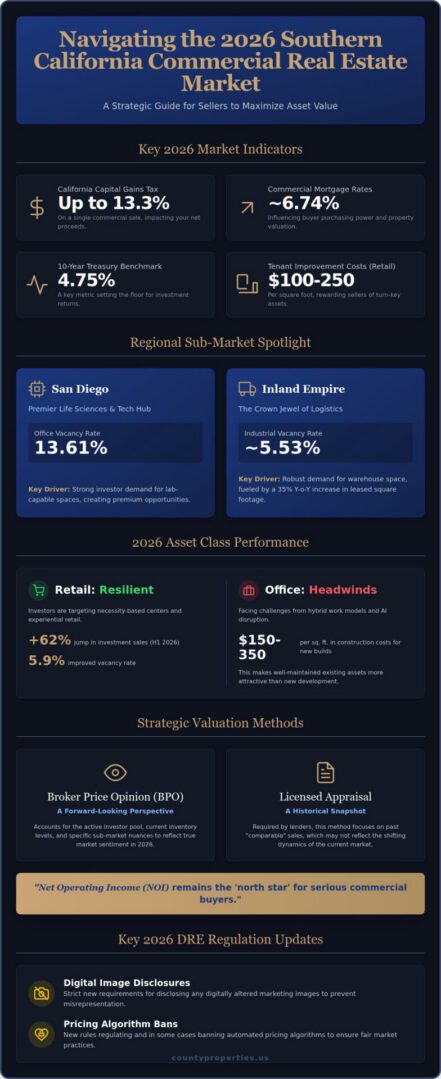
The Southern California market has entered a period of stabilization in 2026, though it’s a far cry from the predictable cycles of the past decade. Buyers and sellers are finally aligning on pricing expectations after years of adjustment. When you’re selling commercial property southern california, you’re operating in an environment where the 10-Year Treasury sits at 4.75% and conventional mortgage rates for retail or office assets hover around 6.74%. These figures directly influence your property’s valuation because they dictate the debt service coverage ratios that institutional buyers must maintain.
Success in this climate requires more than a generic listing. You need to understand how the flight to quality is reshaping investor appetites. High-quality, amenity-rich buildings are commanding premiums, while older, un-renovated assets face steeper discounts. We see a market that rewards sellers who present turn-key opportunities, especially as construction costs for tenant improvements in Southern California now range from $100 to $250 per square foot for retail spaces.
Regional Sub-market Performance
San Diego continues to benefit from its status as a premier life sciences and tech hub, even as its office vacancy rate reached 13.61% in early 2026. Investors remain hungry for lab-capable spaces, while the Inland Empire remains the crown jewel of logistics. With industrial vacancy rates in the region sitting near 5.53%, demand for warehouse space remains robust, driven by a 35% year-over-year increase in leased square footage. Regional nuances dictate your asking price because the buyer profile for a biotech facility in Torrey Pines is fundamentally different from a logistics provider in San Bernardino.
Asset Class Shifts in 2026
Retail has shown remarkable resilience, with investment sales jumping 62% in the first half of 2026. Investors are targeting necessity-based centers and experiential retail, where vacancy rates have improved to 5.9%. Conversely, the office sector faces headwinds from hybrid work models and the disruptive influence of AI on corporate space needs. If you are transitioning from residential investments, it’s vital to recognize that selling a home in southern california relies on emotional appeal and neighborhood comps, while commercial disposition is a cold calculation of Net Operating Income (NOI) and CAP rates.
Navigating these shifts requires a deep understanding of the California Department of Real Estate (DRE) regulations, which were updated in 2026 to include strict disclosures for digitally altered marketing images and new rules on pricing algorithms. You don’t have to face these complexities alone. Our collaborative team approach ensures that your asset is positioned accurately against these 2026 benchmarks, protecting your equity and ensuring a smooth transition to your next financial milestone.
Strategic Valuation: Determining the Real Market Worth of Your Asset
Determining the value of your property is the most critical step when selling commercial property southern california. While a licensed appraisal provides a historical snapshot required by lenders, a Broker Price Opinion (BPO) offers a forward-looking perspective. Appraisers focus on past “comparable” sales, but in a shifting 2026 market, those sales might not reflect current buyer sentiment. A BPO accounts for the active pool of investors, current inventory levels, and the specific nuances of your sub-market, such as the increased demand for lab space in San Diego versus warehouse expansion in the Inland Empire.
In today’s environment, we also weigh the replacement cost against the income approach. With 2026 construction costs for Southern California office buildings reaching between $150 and $350 per square foot, many existing assets are trading below their replacement value. This makes well-maintained properties highly attractive to institutional buyers who want to avoid the risks associated with new development. If you’re curious about how your specific asset compares to recent local benchmarks, you can request a professional equity analysis to see your property’s standing.
The Income Approach vs. Comparable Sales
Net Operating Income (NOI) remains the “north star” for serious commercial buyers. Unlike residential sales, which rely heavily on emotional appeal, commercial transactions are driven by the math of cash flow. We must adjust your valuation for current vacancy rates, which average around 13% for office spaces in Orange County and San Diego. We also evaluate tenant creditworthiness; a property anchored by a “triple-net” essential retailer is worth significantly more than one with short-term, local tenants. To calculate a basic CAP rate for a SoCal multi-family unit, simply divide the property’s annual Net Operating Income by its current market value or asking price.
Leveraging Market Analysis
Identifying the “highest and best use” can often uncover millions in hidden equity. For example, an underperforming retail strip in Los Angeles might be worth more as a candidate for a multi-family conversion, especially given California’s ongoing housing shortage. We carefully evaluate local zoning changes and future infrastructure projects, like the 2028 Olympic preparations, which can trigger sudden value spikes in specific neighborhoods.
Preparation also involves understanding the legalities of transferring business assets. Beyond the real estate itself, you must ensure compliance with state licensing and permit requirements if equipment or business operations are part of the sale. Consulting with a commercial real estate southern california expert helps you navigate these details, ensuring that your valuation reflects both the physical asset and the underlying business potential. This collaborative approach prevents money from being left on the table during the negotiation phase.
Traditional Listing vs. Cash Offers: Choosing Your Exit Strategy
Choosing the right exit strategy balances your need for liquidity with your desire to maximize return on investment. When you’re selling commercial property southern california, you’ll likely weigh a traditional market listing against a rapid cash offer. A traditional listing exposes your asset to the broadest possible pool of institutional and private buyers. This competition often yields a final sales price 15% to 20% higher than off-market bids. Conversely, a cash offer facilitation focuses on speed and certainty, often closing in as little as 30 days without the need for bank appraisals or lengthy finance contingencies.
Even in a fast-paced cash sale, you must remain compliant with California commercial property disclosure laws. These regulations require you to document material defects, natural hazards, and accessibility compliance regardless of the buyer’s professional status. For those who don’t need an immediate exit, a hybrid approach involving pocket listings can target specific investors in our network. This allows for a discreet transaction while still testing the market’s appetite for your specific asset class.
The 1031 Exchange Advantage
The 1031 Exchange is your most powerful tool for preserving wealth during a commercial transition. It lets you roll your sale proceeds into a new investment property without an immediate tax hit. You have exactly 45 days from the close of your sale to identify a replacement property and 180 days to finalize the purchase. You’ll need to hire a qualified intermediary before your escrow closes. If you take possession of the funds personally, the tax-free status evaporates instantly, leaving you responsible for significant state and federal capital gains taxes.
Exit Strategy Comparison
Determining which path aligns with your goals requires a clear look at your timeline and risk tolerance. We’ve categorized the primary differences to help you decide:
- Traditional Sale: Expect a 90 to 120-day timeline. This path involves extensive marketing, multiple property tours, and a rigorous due diligence period for the buyer.
- Cash Sale: Typically closes in 14 to 30 days. These are often “as-is” transactions with shorter inspection windows and no loan contingencies.
- Hybrid Strategy: Offers a middle ground by leveraging a deep network of SoCal investors for a targeted, semi-private sale.
Your choice should reflect your next milestone. If you’re retiring and buying a home in southern california, the higher proceeds of a traditional sale might be the priority. If you’re liquidating a partnership or preventing a foreclosure, the speed of a cash offer provides the security you need to move forward without delay.
Preparing for the Sale: Compliance, Disclosures, and Due Diligence
Selling commercial property southern california requires a proactive approach to documentation. You shouldn’t wait for an offer to arrive before you start gathering your records. Institutional buyers and sophisticated private investors perform “stress tests” on your asset’s history during their review. A complete “Seller’s Package” acts as a shield against price chipping during the escrow period. It demonstrates that you’re a seasoned professional who has maintained the property with care and transparency.
California’s disclosure environment is exceptionally rigorous. Beyond the common-law duty to reveal all known material facts, you must provide specific reports on natural hazard zones and seismic activity. If you’ve used digitally altered images in your marketing, a 2026 law requires a clear disclosure of those alterations. We also recommend commissioning a Phase I Environmental Site Assessment (ESA) early. This report identifies potential soil or groundwater contamination. Since most lenders won’t fund a deal without it; having a clean Phase I ready can shave weeks off your closing timeline.
The Due Diligence Checklist
Organizing your financial and legal data is a methodical process. Buyers will demand at least three years of profit and loss statements and tax returns. If your property has multiple tenants, you’ll need to prepare:
- Updated Rent Rolls: These should show current rates, lease expiration dates, and security deposits.
- Estoppel Certificates: These are signed statements from tenants verifying the terms of their lease.
- SNDAs: Subordination, Non-Disturbance, and Attornment Agreements are essential for protecting the lender’s and tenant’s interests.
- Permit History: You must provide proof that all past improvements were legally permitted and signed off by the local municipality.
Marketing Your Commercial Asset
Modern marketing for commercial assets has evolved. High-quality drone photography and 3D virtual tours are now standard for industrial sites or large retail centers. These tools allow global investors to tour your facility without leaving their office. We leverage targeted digital marketing to reach specific investor databases; this ensures your property is seen by those with the highest probability of closing. Collaborating with an experienced real estate agent near me ensures your marketing strategy is tailored to the specific demands of the SoCal commercial sector.
If you’re overwhelmed by the complexity of these requirements, our collaborative team can help you organize your records and mitigate risks before you hit the market. You can schedule a pre-sale compliance review to identify and fix any red flags that could stall your transaction.
Navigating Your Commercial Sale with County Properties
Selling commercial property southern california isn’t just a financial transaction; it’s a significant life transition that requires a steady, experienced hand. Arnie Levine and the County Properties team understand that your asset represents years of dedication and strategic planning. We don’t rely on high-pressure sales tactics or aggressive listing quotas. Instead, we act as seasoned mentors who guide you through every hurdle of the 2026 market. Our collaborative team approach ensures that multiple experts review your escrow file, so no detail, from seismic disclosures to 1031 exchange timelines, is ever overlooked.
We’ve spent decades building a deep network of private and institutional investors across the region. This localized knowledge in San Diego, combined with a broad Southern California reach, allows us to find the right buyer for your specific asset class. Whether you’re managing a medical office building or an industrial warehouse, we position your property to attract qualified offers that respect your equity. Our commitment to transparency and safety means you’ll always have a clear view of the process, allowing you to focus on your next professional or personal milestone with total peace of mind.
The County Properties Difference
Our firm operates on a philosophy of relational professionalism. We prioritize a service-first mentality that focuses on your long-term achievement rather than a quick commission. We’ve navigated multiple market cycles, giving us the perspective needed to solve complex problems before they stall your closing.
- Transition Expertise: We provide specialized support for business owners moving toward retirement, ensuring your exit strategy protects your legacy.
- Distressed Property Solutions: Our team excels at foreclosure prevention and short sale negotiations, offering a lifeline during difficult transitions.
- Collaborative Culture: You benefit from our collective knowledge rather than an individual broker’s limited perspective.
- Community Focus: Our deep roots in the regional fabric mean we understand the local zoning and economic shifts that impact your property’s value.
Your Next Steps to a Successful Sale
Securing your financial future starts with an accurate understanding of your property’s current standing in the 2026 landscape. We’re here to help you move from uncertainty to a confident, legally compliant closing that maximizes your return on investment.
- Request a Broker Price Opinion: Get a forward-looking valuation that accounts for current interest rates and CAP rate shifts.
- Develop a Custom Marketing Plan: We’ll create a strategy tailored to your asset class, utilizing high-quality digital tools and our private investor network.
- Confidential Consultation: Contact our team to discuss your specific goals and explore whether a traditional listing or a rapid cash offer facilitation is right for you.
You don’t have to navigate this complex regulatory environment alone. Let us act as your dependable guide and professional ally. When you’re ready to take the next step, our team is standing by to ensure your commercial sale is handled with the care and expertise you deserve.
Secure Your Financial Legacy in a Shifting Market
Success in the 2026 landscape requires a precise balance of market data and tactical timing. You’ve explored how to navigate the 13.3% tax environment, master strict disclosure laws, and choose the exit strategy that fits your unique timeline. Whether you’re targeting institutional buyers through a traditional listing or seeking the speed of a cash offer; your preparation today determines your ROI tomorrow.
Selling commercial property southern california involves high stakes and intricate legal hurdles. Led by Arnie Levine, a seasoned real estate veteran, our team specializes in complex transitions and senior real estate needs. We use a collaborative team approach to ensure your legal and financial safety while positioning your asset for its highest possible value. We focus on your goals to make sure the process is as smooth and reassuring as possible.
Partner with County Properties to maximize your commercial asset’s value today. You’ve worked hard to build your equity, and you deserve a professional ally who is committed to your success. We’re ready to help you move forward with confidence and achieve the milestone you’ve been working toward.
Frequently Asked Questions
How long does it typically take to sell commercial property in Southern California?
A traditional sale usually takes between 90 and 120 days to close once you identify a buyer. However, the average time on the market for Southern California industrial properties rose to 9.3 months in early 2026. If you require a faster exit, our cash offer facilitation can often condense this entire timeline to 30 days or less.
What are the common fees associated with selling a commercial building?
Sellers should budget between 6% and 10% of the final sales price for total closing costs. This includes real estate commissions, which average about 5.03% in California, and title insurance premiums. You’ll also be responsible for the statewide transfer tax of $1.10 per $1,000 of the sale price; though some cities like Los Angeles may charge additional local taxes.
Do I need to perform a Phase I Environmental assessment before listing?
You aren’t legally required to complete a Phase I assessment before listing, but most lenders won’t fund a buyer’s loan without one. Performing this study early demonstrates professional transparency and prevents unexpected environmental issues from killing your deal during escrow. It’s a proactive step that seasoned owners take to ensure a seamless transaction.
What is a 1031 Exchange and can I use it for my Southern California sale?
A 1031 Exchange is a tax-deferred strategy that lets you reinvest your sale proceeds into a new investment property. It’s a vital tool for selling commercial property southern california while preserving your hard-earned equity. To qualify, you must identify a replacement property within 45 days and close on that new asset within 180 days of your original sale.
How does the 2026 market affect the value of my office or retail space?
The 2026 market shows a split between asset classes, with office spaces seeing vacancy rates around 13% while retail vacancy has improved to 5.9%. Property values are currently tied to stabilized interest rates; which sit near 6.74% for conventional commercial mortgages. Retail assets anchored by essential services are commanding higher premiums than traditional office buildings in the current environment.
Can I sell my commercial property for cash if it has existing tenants?
Yes, you can sell your property for cash while tenants are in place. Many cash investors prefer income-producing assets because they offer immediate cash flow. You’ll simply need to provide updated rent rolls and signed estoppel certificates to verify the lease terms and security deposits during the buyer’s due diligence period.
What is the difference between a commercial real estate broker and a residential agent?
Commercial brokers focus on financial performance metrics like Net Operating Income (NOI) and CAP rates rather than emotional appeal. While a residential agent works with neighborhood home comps, a commercial expert navigates complex zoning laws and institutional buyer requirements. Our team provides the specialized mentorship needed to handle these high-stakes business transitions safely.
How can I avoid capital gains tax when selling my business property?
The most effective way to defer capital gains tax is through a 1031 Exchange. This is especially important in California, where capital gains are taxed as ordinary income at rates as high as 13.3%. By rolling your proceeds into a new investment through a qualified intermediary, you can keep your capital working for you instead of paying a large tax bill.