

In the San Diego real estate market of 2026, your tenant isn’t an obstacle to a successful sale; they’re a key variable in a strategic transition that requires a steady, expert hand. While many landlords feel trapped by the latest updates to the San Diego Tenant Protection Ordinance, selling a tenant occupied property in San Diego can be a seamless process when you prioritize collaboration over conflict. You’re likely concerned that the mandatory 120-day notice requirement or relocation assistance payments of up to three months’ rent for seniors will diminish your bottom line or scare away traditional buyers.
It’s completely normal to feel overwhelmed by the shifting legal landscape and the looming fear of a no-fault eviction lawsuit. We agree that the complexity of modern rental laws makes the selling process feel like a minefield. This guide will show you how to protect your investment, maintain full legal compliance, and unlock your property’s maximum market value. We will preview the current 8.2% rent cap, the nuances of AB 1482, and specific strategies for securing tenant cooperation during showings so you can transition to your next chapter with total confidence.
Key Takeaways
- Master the hierarchy between California’s AB 1482 and the local San Diego Tenant Protection Ordinance to ensure your transaction remains fully compliant with 2026 regulations.
- Understand the specific “Just Cause” requirements that apply when selling a tenant occupied property in San Diego to avoid the legal pitfalls of improper no-fault evictions.
- Evaluate the financial impact of below-market rents on your property valuation and learn how to position your listing to attract both seasoned investors and owner-occupants.
- Implement a collaborative “carrot” approach to property showings by using financial incentives that encourage tenant cooperation and maintain market-ready conditions.
- Identify the most profitable path for your unique situation, whether you choose to deliver the property vacant or sell with a stable, income-producing tenant in place.
Navigating San Diego Tenant Protection Laws in 2026
Success in the Southern California real estate market requires a deep understanding of the regulatory framework governing your investment. Understanding the foundation of U.S. Landlord-Tenant Law is the first step toward a compliant sale. In San Diego, landlords must manage a dual-layered legal system where the local Tenant Protection Ordinance (TPO) often provides stricter safeguards than the statewide California Tenant Protection Act (AB 1482). The San Diego Housing Commission provides oversight for these local rules, ensuring that every “No-Fault” termination follows a specific legal path.
You must recognize that simply wanting to sell your home does not constitute “Just Cause” for eviction under 2026 standards. If your property is covered by these protections, the tenancy can only be terminated for specific reasons like owner move-in or a complete withdrawal of the unit from the rental market. When selling a tenant occupied property in San Diego, you are often selling the lease along with the real estate. This makes the cooperation of your current residents a vital component of your financial outcome.
The 2026 Tenant Protection Ordinance (TPO) Update
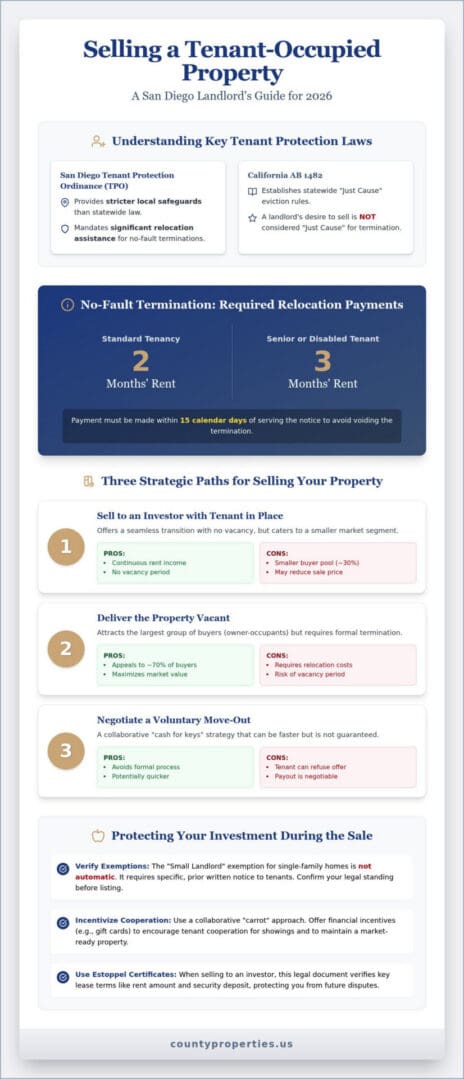
The City of San Diego’s current ordinance significantly increases the financial responsibility of landlords during a sale. For any no-fault termination, you are required to provide relocation assistance. As of 2026, the standard rate is two months of the tenant’s actual rent. If your tenant is a senior citizen or has a qualifying disability, this requirement increases to three months of rent. You must pay this amount within 15 days of serving the notice, or you risk voiding the entire termination process. Every notice to quit must also include specific disclosures regarding the tenant’s rights under the San Diego Municipal Code.
Exemptions and the ‘Small Landlord’ Clause
Not every property is subject to these restrictive termination rules. Many single-family homes and condos are exempt if they are “separately alienable” from any other dwelling unit and are not owned by a real estate investment trust (REIT) or corporation. However, this exemption is not automatic. To maintain this status, you must have provided your tenants with specific written notice language at the start of their tenancy or by a legally mandated deadline. Because the rules for exemption verification are so technical, securing professional seller representation is essential to confirm your legal standing before you list the home. We help you verify that your paperwork is in order so you don’t face unexpected legal challenges mid-escrow.
The Three Strategic Paths for Selling with Tenants
When you decide it’s time to move on from a rental investment, your choice of strategy will dictate your final net proceeds and the stress levels involved in the transaction. You must align your decision with current Southern California housing market trends, which currently show a strong preference for properties ready for immediate move-in. However, selling a tenant occupied property in San Diego doesn’t have to be a choice between a legal headache and a low sale price. There are three primary routes you can take to reach your goals.
Most landlords choose between selling to an investor who assumes the existing lease, attempting to deliver the property vacant for an owner-occupant, or negotiating a voluntary move-out agreement. Each path has unique legal requirements under the California Tenant Protection Act (AB 1482). Selecting the right one requires a balance between your timeline, your financial needs, and your willingness to manage tenant relations during the listing period.
Selling Tenant-Occupied to an Investor
This path offers the least resistance regarding tenant relations. You avoid vacancy periods, and the property continues to generate income throughout the escrow process. The main trade-off is a significantly smaller buyer pool. Industry data suggests that roughly 30% of San Diego buyers are looking for rental investments, while the majority are searching for primary residences. To protect your interests, you must utilize Estoppel Certificates. These documents verify the security deposit amount, current rent, and lease terms, preventing future disputes between the new owner and the resident. If you’re unsure how to position your rental for an investor, our team provides expert seller representation to help you highlight the asset’s performance.
The ‘Cash for Keys’ Negotiation Framework
When you need to attract owner-occupant buyers who often pay higher prices, a voluntary buyout is a powerful tool. You must approach these negotiations with extreme care to avoid any actions that could be interpreted as tenant harassment. In San Diego’s 2026 climate, a successful buyout typically involves a payment that covers moving costs and the security deposit for a new unit. You should calculate the value of a vacant home versus an occupied one. Often, the increase in sale price far outweighs the cost of the buyout. Always document these agreements in writing, clearly stating that the tenant is vacating voluntarily in exchange for compensation. This ensures the agreement is binding and provides a clear paper trail for the buyer’s lender.
Impact on Market Value and the San Diego Buyer Pool
The presence of a tenant significantly alters the marketability of your asset. While a vacant home is a blank canvas for a family’s dreams, an occupied property is viewed through the lens of existing obligations. When selling a tenant occupied property in San Diego, you must recognize that your buyer pool is essentially split into two camps: owner-occupants and investors. Each group evaluates your home using different criteria, and the “deliverability” of the property often dictates the final sales price.
Owner-occupants, particularly those utilizing FHA or VA financing, are often forced to skip tenant-occupied listings. These loan programs typically require the buyer to move into the home within 60 days of closing. If your tenant has several months left on a fixed-term lease, you’ve effectively eliminated the largest segment of the San Diego market. This lack of competition can lead to lower offers and a longer time on the market. Seeking expert advice on selling with tenants is vital to help you navigate these valuation hurdles before you set your listing price.
Owner-Occupant vs. Investor Pricing
In high-demand neighborhoods like Hillcrest or La Jolla, a “vacant premium” often exists. This is the price difference between a home that is move-in ready and one that comes with a lease. With 2026 interest rates remaining a primary concern for buyers, many are unwilling to take on the risk of a non-cooperative tenant or the wait time for a lease to expire. Investors, on the other hand, focus on the “Below-Market Rent” trap. If your property’s rent is significantly lower than current market rates due to the 8.2% cap on increases, an investor will likely lower their offer to ensure the property meets their required capitalization rate. Utilizing specialized real estate services can help you identify which buyer profile will provide the highest return on your specific investment.
The Cost of Non-Cooperation
Tenant cooperation is a measurable financial asset. When a tenant limits showing windows to a few hours a week, your Days on Market (DOM) will inevitably climb. This extended timeline often signals to buyers that they have more room to negotiate, leading to “low-ball” offers. Furthermore, if a tenant neglects daily maintenance or allows clutter to accumulate, it can negatively impact the appraisal. Appraisers are human; a poorly maintained interior can lead to a more conservative valuation. A professional agent acts as a strategic buffer between the owner’s financial goals and the tenant’s right to quiet enjoyment. By managing these relationships with empathy and professionalism, we ensure your property presents its best possible self to every potential buyer.
The Art of the Showing: Incentivizing Tenant Cooperation
While California Civil Code 1954 gives you the legal right to enter a rental for showings with a 24-hour written notice, relying solely on the letter of the law is often a recipe for a difficult escrow. When selling a tenant occupied property in San Diego, the way your tenant presents the home can be the difference between a top-tier offer and a pass from a qualified buyer. A cooperative tenant ensures the lights are on, the dishes are put away, and the property smells fresh. Conversely, a tenant who feels ignored may leave the unit in disarray, effectively sabotaging your market value.
Strategic scheduling is your first tool for success. Instead of requesting sporadic entry throughout the week, we recommend establishing “Showing Blocks.” Concentrating all walkthroughs into a specific four-hour window on a Saturday or Sunday minimizes the disruption to your tenant’s daily life. This respectful approach often yields better results than a constant stream of individual appointments. To further enhance the property’s appeal, consider providing a professional cleaning service or a small staging subsidy to help the tenant maintain a “show-ready” environment during the listing period.
Creating a Win-Win Incentive Program
A “carrot” approach is almost always more effective than a “stick” strategy. We’ve found that offering a small rent credit for every successful, clean showing encourages tenants to take pride in the home’s appearance during the sale process. You might also provide gift cards to local San Diego restaurants to encourage tenants to leave the house during open houses. This gives potential buyers the freedom to explore the space without feeling like they’re intruding. For tenants planning to move, a strong letter of recommendation for their next landlord can be a powerful motivator that costs you nothing but a few minutes of your time.
Managing Hostile Tenants
Despite your best efforts, some situations require a more delicate touch. If a tenant refuses entry despite receiving a legal notice, you must tread carefully to avoid violating their right to “Quiet Enjoyment,” which can lead to significant legal liabilities. Tensions often run high during property sales, especially for long-term residents facing a difficult life transition. This is where the experience of a seasoned real estate agent near you becomes invaluable. A professional buffer can de-escalate these situations by listening to the tenant’s concerns and finding a middle ground that respects their rights while advancing your sale goals. Connect with our team for expert seller representation that prioritizes collaborative success and protects your investment from unnecessary conflict.
Why County Properties is Your Steadfast Ally in Tenant Sales
Arnie Levine and the team at County Properties have spent decades refining the process of selling a tenant occupied property in San Diego. We believe that a successful transaction is built on the foundation of mutual respect and clear communication. Unlike high-pressure firms that focus solely on the numbers, we prioritize the human element of every real estate transition. This collaborative approach ensures that your tenants feel heard and respected, which directly correlates to a smoother escrow and a higher final sale price. We act as your seasoned guide, navigating the technical hurdles of 2026 regulations while protecting your financial interests.
Our localized, community-focused strategy covers every San Diego neighborhood. We understand that a rental in Chula Vista requires a different marketing lens than a multi-family unit in North Park. By leveraging our deep historical roots in Southern California, we provide a level of insight that newer agencies simply cannot match. We don’t just see a property; we see a significant life milestone that deserves a methodical and supportive approach.
Senior Real Estate Mastery
For many of our clients, a rental property represents a lifetime of hard work and a primary source of retirement income. Transitioning out of property management can be emotionally complex, especially for senior landlords who have maintained long-term relationships with their tenants. We specialize in “Downsizing with Dignity,” providing tailored solutions that respect the history of the property while securing your financial future. Our team often acts as a central coordinator, working with heirs, family members, and legal representatives in multi-state probate situations to ensure every detail is handled with professional care. We help you navigate these high-stakes transitions with empathy and precision.
A Comprehensive Marketing Program
Selling an occupied home requires a specialized marketing lens. We position tenant-occupied homes to attract high-value investors who appreciate the value of a stable, income-producing asset. Our commitment to clear communication extends to your tenants as well. By keeping them informed of every step, we reduce anxiety and foster the cooperation necessary for a successful sale. If a situation becomes untenable, our cash offer facilitation serves as a reliable “Plan B,” providing a path to a rapid closing without the need for public showings or extensive repairs. Contact County Properties for a tailored tenant-sale strategy today to begin your next chapter with confidence and professional support.
Take the Next Step Toward a Successful Property Transition
You now have a strategic roadmap to navigate the complexities of the 2026 real estate landscape. Successfully selling a tenant occupied property in San Diego requires a delicate balance of legal precision and empathetic communication. By understanding the hierarchy of local ordinances and utilizing collaborative incentive programs, you protect your investment while honoring tenant rights. Whether you choose to target high-value investors or negotiate a voluntary move-out agreement, your strategy should always prioritize financial safety and professional compliance.
As SRES® Certified Specialists with over 30 years of Southern California expertise, we understand the emotional and legal weight of these transitions. Our team also serves as Short Sale and Foreclosure Prevention Experts, offering a comprehensive suite of services for any situational challenge. We’re committed to your long-term success and peace of mind.
Request a Professional Consultation for Your Tenant-Occupied Property today. We are here to act as your dependable guide, ensuring your sale is handled with the mastery and care it deserves. You don’t have to navigate these complex waters alone; let’s achieve your goals together.
Frequently Asked Questions
Can I evict a tenant in San Diego just because I want to sell my house?
No, you cannot evict a tenant simply because you intend to sell the property. Under the San Diego Tenant Protection Ordinance and California state law, selling a home is not considered a “just cause” for termination of a tenancy. You must either sell the property with the tenant in place or negotiate a voluntary move-out agreement. This ensures the tenant’s right to stable housing remains protected while you navigate your financial transition.
How much relocation assistance do I have to pay a tenant in San Diego in 2026?
In 2026, the City of San Diego requires relocation assistance equivalent to two months of the tenant’s current rent for standard no-fault terminations. If your tenant is a senior citizen or has a qualifying disability, this requirement increases to three months of rent. You must provide this payment within 15 days of serving the notice to quit. Failing to meet this timeline can void the termination process and lead to costly legal delays.
Do I have to give 24 or 48 hours’ notice for showings in California?
You must provide a minimum of 24 hours’ notice before any showing in California. Once you have delivered a written 120-day notice of your intent to sell, you or your agent can provide a 24-hour verbal notice for specific walkthroughs. This requirement, codified in California Civil Code 1954, balances your need to market the home with the tenant’s right to quiet enjoyment of their living space.
What happens if my tenant has a fixed-term lease that hasn’t expired?
A fixed-term lease remains in effect and survives the sale of the property. When selling a tenant occupied property in San Diego, the buyer inherits the lease and becomes the new landlord under the same terms. You cannot terminate a fixed-term lease early just to facilitate a sale unless the tenant voluntarily agrees to a buyout. This is why many sellers target investors when a lease has significant time remaining.
Does the San Diego Tenant Protection Ordinance apply to single-family homes?
The ordinance applies to most residential units, but many single-family homes are exempt if they meet specific criteria. To maintain an exemption, the property cannot be owned by a corporation or REIT, and you must have provided the tenant with a specific legal disclosure notice. Because these rules are highly technical, we recommend professional verification to ensure you don’t inadvertently lose your exempt status before listing the home.
Can a buyer back out of a sale if they find out the tenant won’t leave?
Yes, a buyer can typically back out if the purchase agreement stipulates that the property must be delivered vacant. Most residential contracts include a contingency for the condition of the property at close of escrow. If a tenant refuses to vacate as agreed, it can lead to a breach of contract and a cancelled sale. We help you manage these risks by securing binding, written agreements with tenants well before the closing date.
Is it better to sell a rental property vacant or occupied in San Diego?
Selling a property vacant is generally better for maximizing the sale price because it attracts owner-occupant buyers who pay a “vacant premium.” These buyers often use FHA or VA financing which requires them to move in shortly after closing. However, selling a tenant occupied property in San Diego can be beneficial if you want to avoid a lapse in rental income or if the property is a high-performing asset for an investor.
What is ‘Cash for Keys’ and is it legal in San Diego?
“Cash for Keys” is a legal, voluntary agreement where a landlord pays a tenant a negotiated sum to vacate the property by a specific date. This strategy is an effective way to deliver a vacant home to a buyer without a protracted legal battle. It is perfectly legal in San Diego as long as the agreement is mutual and you avoid any actions that could be construed as tenant harassment or coercion.