

In the high-stakes California market of 2026, a successful commercial sale isn’t won at the closing table; it’s won during the pre-listing audit of your physical, financial, and regulatory compliance. You’ve worked hard to build equity in your asset, yet the thought of learning how to sell commercial property in California while managing high capital gains taxes and complex seismic disclosures can feel overwhelming. It’s natural to want a partner who understands the specialized nuances of your specific asset class and the emotional weight of such a significant transition.
We understand that you’re looking for more than just a transaction; you’re seeking a clean, legally compliant exit that maximizes your return on investment. This strategic guide provides a clear, expert-led roadmap to help you optimize your cap rate and secure a seamless 1031 exchange. We will explore the essential steps to manage 2026’s updated disclosure laws, from AI-altered image requirements to federal reporting for all-cash transactions, ensuring you move toward your next milestone with absolute confidence and financial security.
Key Takeaways
- Gain a clear understanding of the 2026 Southern California market to align your pricing with current interest rates and cap rate shifts.
- Identify high-impact physical repairs and organize a comprehensive financial audit to prevent surprises during the buyer’s inspection.
- Navigate the complexities of how to sell commercial property in California by mastering 2026 disclosure laws and environmental site assessments.
- Develop a targeted marketing strategy that positions your asset in front of institutional investors and qualified 1031 exchange syndicates.
- Ensure a seamless closing by managing the escrow process and title requirements for a secure transition to your next investment milestone.
Understanding the California Commercial Market and Valuation in 2026
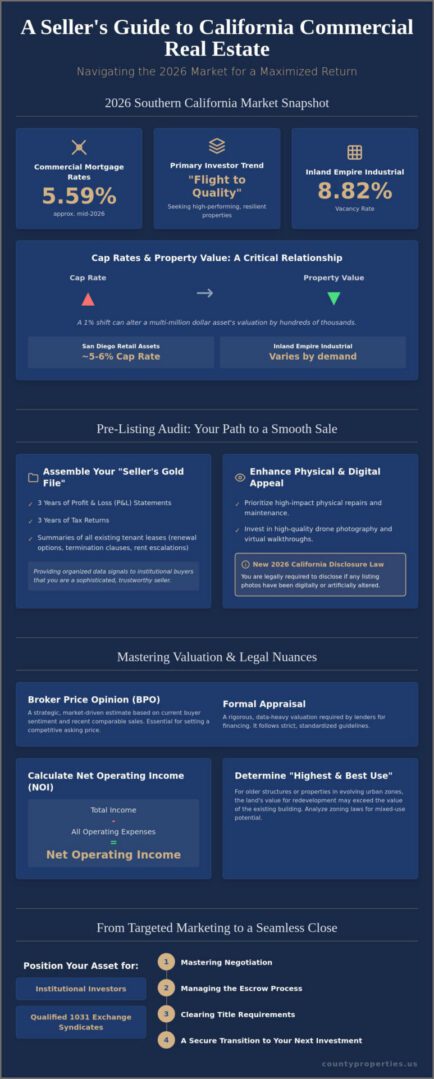
Success in the 2026 market begins with a clear-eyed look at the data. Learning how to sell commercial property in California requires an understanding of a landscape that’s finally begun to stabilize after years of interest rate volatility. Southern California, stretching from the tech hubs of San Diego to the established retail corridors of Orange County, is currently defined by a “flight to quality.” Investors aren’t just looking for any asset; they’re seeking high-performing, resilient properties that can weather shifting economic cycles. With commercial mortgage rates hovering around 5.59% as of mid-2026, buyers are more disciplined than ever in their underwriting.
You’ll find that residential and commercial sectors are deeply intertwined. As you track Southern California housing market trends, you’ll notice that residential growth often precedes a surge in demand for local retail and medical office space. When a neighborhood sees an influx of new residents, the commercial value of nearby assets naturally climbs. To navigate these shifts, it’s helpful to consult the California Department of Real Estate (DRE) for the latest regulatory updates that might impact your specific region.
Before you list, you must distinguish between an “opinion of value” and a formal appraisal. A Broker Price Opinion offers a strategic, market-driven estimate based on current buyer sentiment and recent local activity. In contrast, a formal appraisal is a rigorous, data-heavy document required by lenders. Both are essential, but they serve different roles in your journey toward a successful closing.
Determining Your Property’s Market Value
To find your asset’s true worth, start with a meticulous audit of your Net Operating Income (NOI). You should calculate this by subtracting all operating expenses, including maintenance and insurance, from your total income. In the San Diego region, compare your property against recent sales in your specific asset class. If you own an older structure in an urban zone, consider its “highest and best use.” Sometimes, the land’s value for redevelopment exceeds the value of the existing building, especially in areas where zoning laws have recently shifted to allow for mixed-use projects.
The Impact of Cap Rates on Your Asking Price
Capitalization rates, or cap rates, have an inverse relationship with property value; as cap rates rise, property values typically fall. In 2026, regional benchmarks vary significantly. San Diego retail assets might see cap rates around 5% to 6%, while Inland Empire industrial properties may command different figures due to an 8.82% vacancy rate. A 1% shift in the market cap rate can swing the valuation of a multi-million dollar asset by hundreds of thousands of dollars, potentially erasing years of equity if your timing is off. We focus on helping you find the “sweet spot” where your price reflects both the asset’s current performance and its future potential.
Preparing Your Asset: Physical Upgrades and Financial Audits
Preparation is your strongest negotiation tool. Understanding how to sell commercial property in California requires looking beyond the surface level of the building; it demands a proactive approach to transparency. Before you even think about placing a sign on the lot, you should assemble what we call a ‘Seller’s Gold File.’ This folder should contain three years of profit and loss (P&L) statements and tax returns. Institutional investors and 1031 exchange buyers crave predictability. When you provide organized financial data upfront, you signal that you’re a sophisticated, trustworthy seller. It’s also vital to summarize all existing tenant leases. You’ll need to clearly document renewal options, termination clauses, and any upcoming rent escalations to provide a clear picture of future cash flow.
Digital curb appeal has become just as important as physical maintenance. In 2026, high-quality drone photography and virtual walkthroughs are standard expectations for serious buyers. However, you must stay compliant with the official DRE website guidelines regarding listing presentations. As of January 1, 2026, California law requires you to disclose if any listing photos have been digitally or artificially altered. We recommend focusing on authentic, high-resolution imagery that showcases the property’s potential without misleading the marketplace. Our team specializes in seller representation that balances marketing impact with strict legal compliance.
Maximizing Value Through Strategic Improvements
Focus your budget on high-ROI repairs that reduce a buyer’s ‘risk’ credits. Prioritize major systems like HVAC units and roofing, as these are the first items a buyer’s inspector will flag. ADA compliance is another critical area; addressing accessibility issues now prevents a buyer from demanding massive price reductions later. Don’t forget the power of first impressions. Fresh landscaping, updated exterior signage, and modern LED lighting can significantly improve the perceived value of the asset. Finally, document exactly which fixtures and equipment are included in the sale to avoid disputes during the escrow process.
The Financial Audit: Preparing the Books
A clean title is the backbone of a successful closing. You should verify all utility costs and property tax assessments for the current year to ensure your NOI calculations are bulletproof. Review your property management contracts to see if they can be easily transferred or if they need to be terminated upon the sale. It’s also wise to clear up any minor liens or encumbrances early. Taking these steps now ensures that the title search doesn’t stall your progress when you’re finally ready to sign the deed. By handling these details today, you protect your equity and ensure a much smoother transition tomorrow.
Navigating California’s Regulatory and Legal Requirements
California’s regulatory environment is famously rigorous; however, it shouldn’t be a barrier to your success. Navigating the legal path of how to sell commercial property in California requires staying ahead of evolving mandates that shift every year. In 2026, sellers must be particularly mindful of new federal reporting rules for certain non-financed real estate transactions involving entities like LLCs or trusts, which took effect on March 1. Additionally, a new law requires you to disclose any knowledge of tobacco or nicotine residue on the property, often referred to as thirdhand smoke. For a deeper dive into regional specifics, our commercial real estate Southern California guide offers tailored compliance tips for local investors.
Transparency is your best defense against future litigation. While it’s tempting to rush toward a listing, taking the time to secure a Natural Hazard Disclosure (NHD) report ensures you meet state requirements regarding flood, fire, and seismic risks. We believe that a well-informed seller is a protected seller. By addressing these legal hurdles before they become obstacles, you maintain control of the narrative and keep the closing process on track.
Environmental and Seismic Disclosures
The Alquist-Priolo Earthquake Fault Zoning Act is a cornerstone of California real estate law. You must disclose if your property sits within a designated fault zone to ensure the buyer understands the geological risks. For older Southern California buildings, asbestos and lead-paint disclosures are vital legal protections for both parties. If your property historically housed automotive or industrial uses, you bear the responsibility of documenting any underground storage tanks (USTs). A Phase I Environmental Site Assessment (ESA) is the standard tool for identifying these soil or groundwater issues early, preventing a deal from collapsing during the buyer’s due diligence.
The Commercial Purchase Agreement (CPA)
The Commercial Purchase Agreement (CPA) acts as the blueprint for your transaction. It defines the due diligence periods where the buyer investigates the asset and sets the timeline for contingency removals and earnest money deposits. While many sellers rely on ‘As-Is’ clauses, these don’t provide a blanket shield against failing to disclose material facts that you knew or should have known. California courts often look past ‘As-Is’ language if a seller was negligent in their disclosures. For those selling a business along with the real estate, reviewing the California DRE Business Opportunity Sales documentation is essential for understanding agency relationships and tax provisions. In California contracts, the ‘Time is of the Essence’ clause means that failing to meet a specific deadline can result in a legal breach or the immediate termination of the agreement.
Marketing Strategy and Managing the Negotiation Process
Marketing your asset requires more than a simple listing; it demands a strategic approach to finding the right buyer profile. Whether your property appeals to institutional investors, owner-users, or 1031 exchange syndicates, your outreach must be targeted. We leverage the broad reach of the MLS alongside specialized commercial platforms to ensure your property reaches the most qualified eyes. Understanding how to sell commercial property in California means recognizing that the highest bidder isn’t always the best bidder. You need a buyer who understands the local landscape and has the financial strength to cross the finish line.
Your Offering Memorandum (OM) serves as the definitive story of your property’s value. It shouldn’t just list square footage and current rents. It should highlight future potential, such as upcoming rent escalations or the possibility of adaptive reuse. By painting a picture of the property’s upside, you attract investors looking for long-term growth. If you’re ready to build a custom marketing plan for your asset, our team provides comprehensive seller representation tailored to your financial goals.
Targeting 1031 Exchange Buyers
1031 exchange buyers are often your most motivated prospects. Because they’re working within a strict 45-day identification window, they’re frequently willing to pay a premium for a certain and quick close. We structure your marketing timeline to align with these windows, highlighting the property’s passive income potential to attract out-of-state investors looking for a safe California harbor. These buyers aren’t just looking for a building; they’re looking for a solution to their tax deferral needs, which gives you significant leverage during the initial offer phase.
Negotiation Tactics for Maximum ROI
When you receive multiple offers, use ‘best and final’ rounds to drive competition. This process allows you to compare price alongside the certainty of closing. We always vet buyer proof of funds and lender pre-approval letters before granting exclusivity. In a market where benchmark commercial rates hover around 5.59%, a buyer’s financing strength is just as important as the purchase price. For entrepreneurs and business owners who need to secure additional capital or explore flexible non-bank financing options through Online Pôžičky, you can click here. We’ll help you counter-offer strategically, ensuring you protect your ROI without alienating your strongest potential partner. Price is only one factor; the terms of the deal often determine whether you reach the closing table successfully.
Closing the Deal and Planning Your Next Move
The escrow process is where your strategic preparation finally pays off. Mastering how to sell commercial property in California concludes with a meticulous settlement phase that ensures all financial and legal obligations are met with precision. During this period, you’ll work closely with an escrow officer to handle title insurance, prorated property taxes, and the distribution of collected rents. It’s vital to ensure your final closing statement reflects every agreed-upon credit and expense. For many owners, this sale represents a significant life milestone rather than a mere transaction. If you’re managing this process as part of a retirement plan or for a family trust, it’s helpful to consult a senior real estate specialist who understands the unique emotional and tax-related stakes involved in estate transitions.
We believe that a clean closing is the foundation for your next chapter. By staying organized through the final weeks of escrow, you protect your equity and ensure that the transfer of ownership is as seamless as possible. This is the time to finalize the transition of property management and ensure all tenant communications are handled with professional care. Your reputation as a seller is built on how well you manage these final details.
Executing a 1031 Tax-Deferred Exchange
A successful sale often leads to your next big opportunity. If you intend to reinvest your proceeds, a 1031 exchange is an essential tool to defer capital gains taxes and build long-term wealth. However, you must adhere to strict IRS timelines to qualify. You have exactly 45 days from the close of escrow to identify potential replacement properties and 180 days to complete the purchase. You’re required to use a Qualified Intermediary (QI) to hold the sale proceeds; if you take physical possession of the funds, you’ll lose the tax-deferral status. The ‘Like-Kind’ requirement is quite flexible, allowing you to trade an industrial warehouse for a multi-family complex or a retail center for a medical office, provided both are held for investment.
Final Steps: Handover and Transition
The execution of the final deed marks the official transfer of your asset’s legacy. To ensure a professional handover, we recommend creating a comprehensive transition folder for the buyer. This should include keys, security codes, equipment warranties, and a list of trusted maintenance vendors. You must also ensure that all tenant security deposits are legally transferred or credited to the buyer in the final settlement. Once the sale is complete, you can connect with an expert real estate agent near you to begin identifying your next high-performing asset. We’re here to act as your dependable guide through every market cycle, ensuring your financial safety and continued growth.
Secure Your Legacy with a Strategic California Sale
Selling a high-value asset in 2026 requires more than just a listing; it demands a comprehensive strategy that addresses physical, financial, and regulatory compliance before the first offer arrives. By auditing your Net Operating Income and staying ahead of new disclosure laws, you’ve already taken the first steps toward a successful closing. You’ve learned how to sell commercial property in California by prioritizing transparency and targeting motivated 1031 exchange buyers who value certainty and speed.
You don’t have to navigate these complex market cycles alone. Arnie Levine and the team at County Properties offer a collaborative, expert-led approach to maximizing your asset’s valuation while handling the sensitive emotional and financial stakes of senior transitions and complex estates. We act as your dependable guide to ensure your financial safety and the fulfillment of your long-term goals. Partner with County Properties for an expert-led commercial sale to secure the clean, legally compliant exit you deserve. Your next successful investment chapter starts with a partner you can trust.
Frequently Asked Questions
How long does it typically take to sell commercial property in California?
On average, it takes six to twelve months to complete a commercial sale. This timeline depends on your asset class and current 2026 interest rate conditions. Industrial properties in high-demand areas like Los Angeles often close faster than specialized office spaces. Your preparation during the pre-listing phase significantly impacts how quickly you move from the initial marketing to a successful close.
What are the standard broker commission rates for commercial sales in San Diego?
Broker commissions in San Diego generally range from 4% to 6% of the final sale price. While the average total real estate commission in California is approximately 5.47% in 2026, these rates are negotiable and aren’t set by law. Typically, the fee is split between the listing broker and the buyer’s representative. For specialized assets like restaurants and bars, platforms like Restaurant For Sale Marketplace offer Success-based brokerage commissions to ensure their financial interests are fully aligned with the sale outcome. Investing in expert representation ensures your property receives maximum exposure to qualified institutional and private investors.
Do I need to provide a residential-style TDS for a commercial sale in California?
You aren’t required to provide a residential-style Transfer Disclosure Statement (TDS) for commercial assets. The TDS is specifically mandated for residential properties with one to four units. Commercial transactions rely on more comprehensive disclosures, such as Natural Hazard Disclosure reports and detailed lease summaries. Understanding how to sell commercial property in California means knowing which specific forms protect you from liability while meeting the buyer’s data needs.
What is a Phase I Environmental Site Assessment and who pays for it?
A Phase I Environmental Site Assessment (ESA) is a study that identifies potential soil or groundwater contamination based on a property’s historical use. The buyer typically pays for this as part of their due diligence period. However, we often suggest that sellers order an assessment early to identify and address any issues before they become deal-breakers during escrow. This proactive approach builds trust and ensures a much smoother closing.
Can I sell my commercial property if it currently has tenants with long-term leases?
You can absolutely sell a property with long-term tenants in place. In fact, stable, creditworthy tenants often make your property more attractive to 1031 exchange buyers who are seeking passive income. The existing leases remain in effect and transfer to the new owner upon the close of escrow. We focus on auditing these leases early to ensure all renewal options and rent escalations are clearly documented for prospective bidders.
What are the tax implications of selling commercial real estate in California in 2026?
Selling commercial real estate in 2026 involves federal and state capital gains taxes. California treats these gains as ordinary income, which can lead to a high tax burden for unprepared sellers. You should also account for the state transfer tax of $1.10 per $1,000 of the sale price. Many of our clients utilize a 1031 exchange to defer these liabilities and transition their equity into new high-performing assets.
How do I handle a tenant who refuses to sign an estoppel certificate?
If a tenant refuses to sign an estoppel certificate, you should first review the default provisions in their lease agreement. Most commercial leases legally require tenants to provide these statements within a specific timeframe. If they remain uncooperative, you may need to provide a “Seller’s Estoppel” to the buyer, though this is often less desirable for lenders. We help you manage these interpersonal challenges with a methodical, service-oriented approach.
What is the difference between a commercial broker and a residential real estate agent?
Commercial brokers specialize in ROI, cap rates, and complex zoning laws, while residential agents focus on lifestyle needs and emotional value. Commercial transactions are data-driven and involve longer due diligence periods and more rigorous financial audits. You deserve a partner who understands the specialized nuances of your asset class. Our team brings the seasoned expertise needed to navigate high-stakes commercial transitions with absolute confidence.