

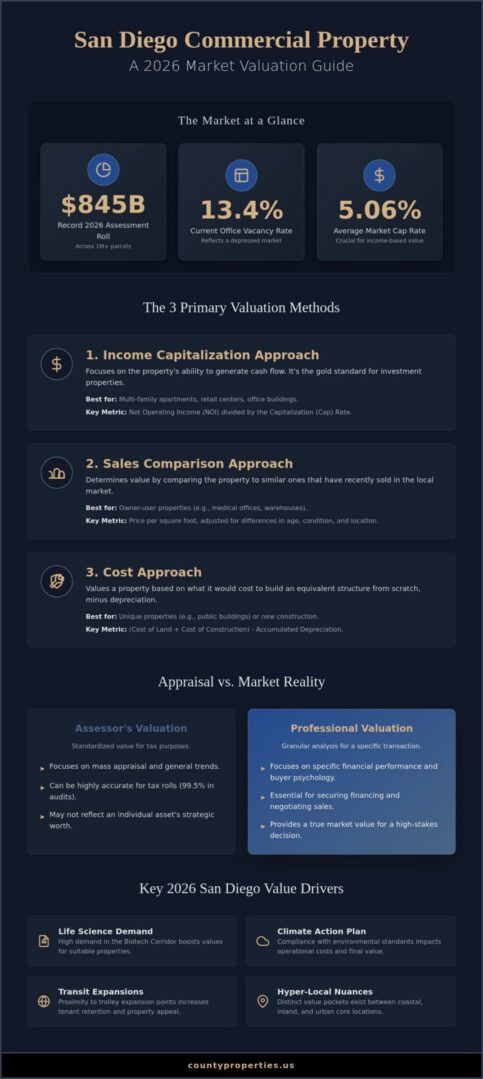
Did you know that San Diego’s 2026 assessment roll reached a record $845 billion, even as local officials describe the current commercial climate as a depressed market? It’s often frustrating to see a massive gap between a standard bank appraisal and what a buyer is actually willing to pay for your specific asset. You’ve likely felt the pressure of shifting zoning laws and the 13.4% office vacancy rate, wondering how these factors truly impact your commercial property valuation in San Diego. We understand that your property isn’t just a set of numbers; it’s a vital part of your long-term financial legacy.
We’re here to act as your dependable guide through these complexities. This guide will help you master the latest valuation methodologies and explain how current average cap rates of 5.06% influence your property’s strategic worth. You’ll gain a realistic expectation of your value and a clear roadmap for increasing that figure before you decide to sell. By the end of this article, you’ll have the professional clarity needed to navigate the 2026 market with total peace of mind.
Key Takeaways
- Learn how to distinguish between the Income Capitalization and Sales Comparison approaches to select the most accurate methodology for your specific asset.
- Identify the hyper-local 2026 market drivers, including life science demand in the Biotech Corridor and transit expansions, that are currently shifting values.
- Master the complexities of commercial property valuation San Diego to ensure you don’t rely on outdated appraisals or inaccurate automated models.
- Discover actionable strategies to improve your property’s financial standing and physical appeal before initiating a high-stakes sale.
- Understand how professional seller representation bridges the gap between technical data and local buyer psychology to maximize your final exit price.
Understanding Commercial Property Valuation in San Diego
Commercial property valuation in San Diego is more than just a calculation of square footage and location. It’s the methodical process of determining the economic value of an investment property by analyzing its unique physical characteristics and financial performance. You should view it as a strategic blend of current income potential and future market risk. Unlike residential sales where you might look at three similar houses on the same block, commercial assets are valued based on their ability to generate revenue and the stability of that cash flow over time. This distinction is vital because a property’s worth is directly tied to the health of the businesses operating within its walls.
The San Diego County Assessor recently completed the 2026 Assessment Roll, reaching a record value of $845 billion across more than one million parcels. While the Assessor’s office focuses on tax assessments and has been recognized for 99.5% accuracy in state audits, a private professional valuation provides the granular detail you need for a specific sale or acquisition. Experts typically utilize the Three Primary Methods of Commercial Valuation to provide a comprehensive look at an asset’s worth. This professional approach is necessary because the Assessor’s office has noted a depressed commercial market in 2026, which may not align with the specific strategic worth of your high-performing office or retail space.
Why a Professional Valuation is Critical in 2026
You are operating in a post-inflationary interest rate environment that has redefined what constitutes a viable deal in Southern California. Securing financing for a new acquisition or refinancing existing debt requires a commercial property valuation San Diego that reflects today’s 5.06% average cap rates rather than the optimistic numbers of years past. Whether you are liquidating a diverse portfolio or selling a home in Southern California alongside your commercial holdings, you need a firm baseline to negotiate with confidence. A precise valuation protects your equity from being eroded by market uncertainty.
The San Diego Context: Beyond the Numbers
San Diego’s geography creates distinct value pockets that a generic automated model will likely miss. Coastal properties command different premiums than inland industrial spaces, yet both are increasingly subject to the city’s rigorous Climate Action Plan. Compliance with these environmental standards can significantly impact your operational costs and your property’s final value. Incorporating renewable energy through SolarPorts Development is an increasingly popular strategy for owners to offset these costs and improve their valuation. Even in industrial hubs like Kearny Mesa, the “neighborhood feel” and proximity to the San Diego Trolley expansion points play a massive role in tenant retention. We look at these hyper-local nuances to ensure your valuation reflects the reality of the San Diego street corner.
The Three Primary Methods of Commercial Valuation
When you’re determining the worth of an asset, you’ll encounter three distinct paths. Professional appraisers don’t just pick one at random. They analyze the property’s specific use to decide which method carries the most weight. For a comprehensive commercial property valuation San Diego, the reconciliation of these three approaches ensures your asking price aligns with current investor appetite. Each method provides a different lens through which to view your property’s potential in the 2026 market.
Income Capitalization: Calculating the Cap Rate
This is the gold standard for multi-family apartments and retail centers. It focuses entirely on the property’s ability to generate cash. We calculate the Net Operating Income (NOI) by subtracting operating expenses from the total income. In 2026, you must account for rising California utility and insurance costs, which can significantly squeeze your NOI. With average San Diego cap rates hovering around 5.06%, even a small dip in income can lead to a large drop in valuation. While direct capitalization provides a snapshot based on one year’s income, a Discounted Cash Flow (DCF) analysis acts like a movie, projecting performance over a five to ten year hold period.
Sales Comparison: Finding Real-World Benchmarks
Owner-user properties, like a medical office in Hillcrest or a warehouse in Otay Mesa, often rely on the sales comparison approach. We look for “arm’s length” transactions in the San Diego MLS where neither party was under duress. It’s vital to adjust for property age and condition. A 2025 transaction might seem relevant, but it often reflects a different interest rate environment. For a truly accurate 2026 valuation, we prioritize the most recent data points that reflect today’s tenant leverage and 13.4% office vacancy rates. If you’re unsure how your building stacks up against recent sales, partnering with a local real estate expert can provide the clarity you need.
The Cost Approach and Reconciliation
The cost approach is typically reserved for unique assets or brand new construction in growing areas like Chula Vista. It estimates what it would cost to replace the building from scratch, minus depreciation, plus the land value. You can find detailed breakdowns of these construction costs in San Diego County’s official valuation data. Finally, the appraiser “reconciles” these figures. They don’t just average them. They might give 80% weight to the income approach for a shopping center and only 10% to the cost approach. This weighted average creates a final value that reflects how a 2026 buyer will actually view your investment.
San Diego Market Drivers Influencing Value in 2026
San Diego isn’t a monolith. Your asset’s worth is heavily dictated by hyper-local economic engines and shifting municipal priorities. While the broader 2026 assessment roll shows record numbers, the real story lies in how specific neighborhoods are outperforming others. Understanding these drivers allows you to determine the value of your property with a level of precision that standard appraisals often miss. In today’s market, proximity to innovation and transit is no longer a luxury; it’s the primary anchor for a competitive commercial property valuation San Diego.
The “Biotech Corridor” remains the region’s most powerful value multiplier. In Sorrento Valley and UTC, the demand for specialized life science infrastructure continues to inflate valuations, as these properties require technical build-outs that standard office spaces can’t match. Similarly, San Diego’s “Complete Communities” initiative has fundamentally changed the math for land use. By allowing for increased density near transit hubs, the city has created value spikes for older properties located near San Diego Trolley expansion points. Even in retail, we’re seeing a clear divide. Traditional strip centers are facing pressure, while mixed-use developments in North Park that blend residential with boutique commercial space are commanding significant premiums.
Industrial Resilience in San Diego County
Warehouse space in Otay Mesa continues to be a high-value asset in 2026, driven by the steady flow of cross-border commerce. We’re seeing a massive premium placed on “last-mile” delivery hubs located near the I-15 and I-5 corridors, where logistics companies are desperate for proximity to the city’s 1.39 million residents. In San Diego, the persistent scarcity of available land creates an inverse relationship between industrial vacancy rates and property valuations; as vacancy drops, the competition for the remaining square footage drives values significantly higher. This makes industrial assets some of the most dependable performers in your portfolio.
The Office Market Evolution
The office sector is currently defined by a “flight to quality.” In Downtown San Diego, Class A buildings with modern amenities and high environmental compliance are maintaining their worth, while Class B spaces are seeing a decline in demand. This shift has opened a new door for adaptive reuse. We are increasingly valuing older office buildings based on their potential for residential conversion rather than their current lease income. With the office vacancy rate sitting at 13.4% in the second quarter of 2026, identifying which buildings can successfully pivot to housing is a critical component of a modern valuation strategy.
Common Pitfalls: Why Appraised Value Isn’t Always Market Reality
An appraisal is a snapshot of the past, not a crystal ball for your 2026 exit strategy. One of the most frequent hurdles we see is the “Lag Effect.” Because appraisals rely on historical data, they often fail to capture immediate shifts in a “depressed” commercial market or the sudden value spikes in the Biotech Corridor mentioned earlier. Relying solely on a bank-ordered report can leave you unprepared for the actual buyer psychology you’ll face at the negotiating table. A formal report might say one thing, but the market’s pulse often dictates another.
Automated valuation models (AVMs) are another common trap for owners. While these tools offer speed, they can’t see the corrosion on a rooftop HVAC unit caused by San Diego’s salt air or understand the “As-Is” versus “Prospective” value of a property after specific tenant improvements. These technical nuances are why a generic commercial property valuation San Diego often misses the mark. If you’re looking for a realistic assessment that goes beyond a basic spreadsheet, let our team provide a comprehensive market analysis tailored to your specific asset.
The Subjectivity of Risk
Risk is in the eye of the beholder. A Triple Net (NNN) lease with a high-credit tenant like a national healthcare provider carries far less risk than a local startup, which drastically affects the cap rate applied to your property. Two different appraisers can walk through the same Gaslamp Quarter building and arrive at different numbers based on their individual perception of market stability. We bridge this gap by highlighting your property’s specific strengths to minimize perceived risk for potential buyers, ensuring the numbers reflect your asset’s true potential.
California-Specific Valuation Hurdles
You also have to contend with unique local requirements that directly impact your bottom line. Factoring in California property tax rates and the long-term implications of Proposition 13 is essential for any buyer’s cash flow projections. Beyond taxes, bank-ordered valuations will scrutinize Phase I and II environmental site assessments. In older San Diego districts, seismic retrofitting requirements can be a significant deduction from your gross property value. Addressing these hurdles early ensures your valuation remains a tool for success rather than a surprise during the escrow process.
Strategic Valuation: Maximizing Your Exit with County Properties
A technical report tells you what a property is worth on paper, but it doesn’t tell you how a buyer will react to your asking price. At County Properties, we bridge the gap between technical data and tactical marketing. Our approach to commercial property valuation San Diego is rooted in the Arnie Levine philosophy: use the numbers as a foundation for aggressive yet realistic positioning. We don’t just hand you a static document. We use our deep-rooted regional connections to validate our findings with real-world buyer feedback, ensuring your property is positioned to stand out in a competitive market.
Our extensive commercial real estate Southern California expertise allows us to identify the “hidden” value drivers that standard appraisers might overlook. Whether it’s the future potential of a life science conversion or the specific impact of a transit expansion, we translate these factors into a compelling narrative for buyers. This collaborative, team-based ethos ensures that every commercial property valuation San Diego we provide is backed by historical longevity and a deep understanding of local market cycles. We don’t just estimate value; we build the strategy to capture it.
The County Properties Difference
We prioritize your financial safety and long-term goals through a service-centric model that emphasizes reliability. High-stakes transitions, such as senior real estate moves or navigating distressed asset sales, require more than just a broker. They require a dependable guide. We treat your property with the empathy it deserves, creating comprehensive marketing programs that justify a premium valuation to the right pool of buyers. By focusing on the “why” behind the numbers, we help you achieve the significant life milestones you’ve worked decades to reach.
Next Steps for San Diego Property Owners
Preparing for a successful sale starts with organized documentation. You should begin by gathering current rent rolls, three years of profit and loss statements, and a detailed list of recent capital improvements. While a formal bank appraisal is often required for financing, many owners find that a Broker Price Opinion (BPO) offers a more agile and realistic view of current buyer sentiment. We recommend starting with a BPO to test your property’s potential against the 2026 market drivers we’ve discussed throughout this guide.
If you’re ready to move beyond confusion and gain a clear understanding of your asset’s strategic worth, we’re here to help. Contact Arnie Levine today for a confidential consultation on your property’s 2026 value and discover how we can maximize your final exit price.
Take Command of Your Commercial Asset’s Worth
Navigating the 2026 market doesn’t have to be a source of uncertainty. You now understand how to leverage specialized income capitalization methods and how hyper-local drivers, such as transit expansions in North Park, shift the ground beneath your feet. By avoiding common pitfalls like the “lag effect” and addressing deferred maintenance early, you position your property for a successful transition. Achieving a precise commercial property valuation San Diego is the first step toward securing your long-term financial legacy.
Our team, led by San Diego expert Arnie Levine, is ready to act as your dependable guide. We specialize in Southern California commercial market trends and pride ourselves on a collaborative, client-first approach to every complex transaction. We’ll help you turn a static valuation into a dynamic marketing program that captures the attention of high-value buyers. Your goals are our priority, and we’re committed to your success.
Don’t leave your property’s future to chance. Request Your Strategic Market Valuation from County Properties to gain the clarity you need. We look forward to helping you achieve your next significant milestone with confidence.
Frequently Asked Questions
How much does a commercial property appraisal cost in San Diego in 2026?
Costs for a commercial appraisal depend heavily on the property’s size, its specific use, and the complexity of the report required. A specialized life science facility in UTC will require a different level of analysis than a small retail building in El Cajon. Because these are formal, certified documents, prices reflect the depth of research needed to meet USPAP standards. It’s best to request quotes from several local appraisers to understand the current market rate for your asset class.
How long does the valuation process typically take for a San Diego office building?
The valuation process typically takes between two and four weeks to complete from the initial site visit to the final report delivery. This timeline allows for a thorough inspection, verification of rent rolls, and an analysis of comparable sales in the region. If your building has complex lease structures or requires a detailed Discounted Cash Flow analysis, you should plan for the longer end of that window. Starting early ensures your commercial property valuation San Diego is ready before you hit the market.
What is the difference between an appraisal and a Broker Price Opinion (BPO)?
An appraisal is a formal, certified valuation performed by a licensed appraiser, while a Broker Price Opinion is a strategic estimate provided by a real estate professional. Lenders require appraisals for financing because they follow strict regulatory guidelines. In contrast, we use BPOs to integrate real-time buyer psychology and the most recent market trends. A BPO is often a more agile tool for sellers who want to set an aggressive yet realistic listing price based on current demand.
How do San Diego’s specific zoning laws affect my commercial property’s value?
Zoning laws can significantly increase your property’s worth by allowing for higher density or more profitable use cases. Initiatives like “Complete Communities” create value spikes for properties located near transit hubs by opening the door for future redevelopment. Understanding these local regulations is a core part of a modern commercial property valuation San Diego. It’s the difference between valuing a building for its current state and identifying its future potential as a mixed-use or high-density residential site.
Can I use my property’s tax assessed value as a guide for its market value?
No, you shouldn’t rely on the tax assessed value to determine what your property is worth in a sale. The San Diego County 2026 Assessment Roll reached a record $845 billion, but these figures are for tax purposes and often lag behind the actual market. Market value is what a buyer is willing to pay today, which is influenced by current interest rates and the 5.06% average cap rate. You need a professional analysis to find your property’s true strategic worth.
What documents should I have ready for a commercial valuation in California?
You should prepare a comprehensive package that includes three years of profit and loss statements, current rent rolls, and a detailed list of capital improvements. It’s also helpful to have any existing environmental site assessments, such as Phase I or II reports, and your most recent property tax bills ready. Having these organized documents shows your professional mastery. It also helps the appraiser or broker provide a more accurate and defensible valuation of your Southern California asset.
How does the biotech industry in San Diego impact general industrial property values?
The biotech industry drives up general industrial values by creating a persistent scarcity of available land and warehouse space. As traditional industrial buildings in Sorrento Valley and UTC are converted into high-value lab spaces, the remaining inventory for standard logistics and manufacturing becomes more expensive. This “Biotech Corridor” effect ripples across the county, increasing the price per square foot for “last-mile” delivery hubs as logistics companies compete for the limited space near the I-15 and I-5 corridors.
What happens if my property’s appraisal comes in lower than the agreed-upon sale price?
You have several paths to keep the transaction moving forward if an appraisal comes in low. You can work with your representative to file an appraisal rebuttal if there are errors in the report, or the buyer can choose to cover the gap with a larger down payment. In many cases, we help facilitate a collaborative renegotiation of the sale price to find a solution that works for both parties. Our goal is to act as your dependable guide during these high-stakes moments.