

What if your family home wasn’t just a collection of memories, but the strategic key to a vibrant, secure future in a premium San Diego care community? With the average monthly cost of assisted living in California reaching $7,000 in 2026, it’s natural to feel a sense of urgency. You’ve spent decades building equity in your Southern California property, yet the thought of navigating complex real estate laws while downsizing a lifetime of memories can feel like an immense weight.
We believe that selling house to pay for assisted living california should be a step toward peace of mind rather than a source of stress. You’ll learn how to leverage your home equity to fund high-quality care while ensuring your transition is handled with the dignity you deserve. This guide provides a clear roadmap through the latest 2026 market trends, explains how Proposition 19 can protect your tax base, and outlines a methodical approach to a successful move. Our goal is to help you move forward with the confidence that your financial legacy and personal comfort are both well protected.
Key Takeaways
- Compare the long-term financial benefits of selling versus renting your property to determine which path provides the most sustainable income for your care.
- Learn the essential steps for selling house to pay for assisted living california while maximizing your primary residence capital gains tax exclusions.
- Explore immediate liquidity options like bridge loans and cash offer facilitation to cover upfront community entrance fees before your home sale closes.
- Understand how a professional home valuation helps you establish a realistic long-term care budget and navigate complex Medi-Cal eligibility requirements.
- Discover why partnering with a Senior Real Estate Specialist (SRES®) ensures a collaborative, low-stress transition for you and your family.
Evaluating Assisted Living Costs and Your Home Equity Potential in 2026
Understanding what is assisted living starts with recognizing it as a comprehensive lifestyle choice that provides housing, personal care, and support services. In Southern California, this transition often represents a significant financial commitment. For many families, the process of selling house to pay for assisted living california is the most logical path because it unlocks the wealth stored in a property that no longer serves their daily needs. Your family home carries deep emotional weight, but it also holds the financial power to secure the high-quality care you deserve. Balancing the memories of the past with the requirements of the future is a delicate journey that requires a dependable guide.
The Real Cost of Care in San Diego
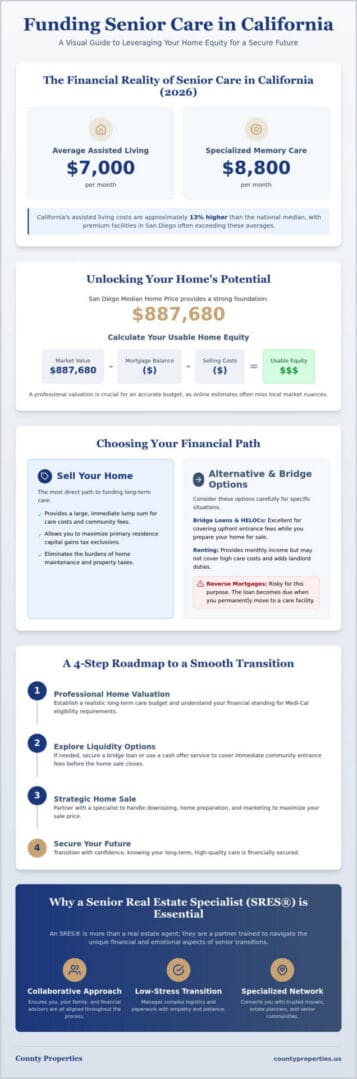
As of August 2026, the statewide average for assisted living in California has reached approximately $7,000 per month. This is roughly 13% higher than the national median, reflecting the premium nature of care in the Golden State. In coastal regions like San Diego, premium facilities often exceed this median due to high demand and localized labor costs. If memory care is required, families should prepare for costs closer to $8,800 monthly. There’s a stark gap between typical Social Security benefits and these actual expenses. Waiting to tap into your home’s equity can lead to a financial crunch, forcing families to make rushed decisions under pressure. By acting proactively, you maintain control over your choices and your dignity.
Calculating Your Usable Home Equity
Determining your budget starts with a clear-eyed look at your property’s value. You can use a simple formula: current market value minus your remaining mortgage balance and estimated selling costs. While online tools like Zillow provide a starting point, they often fail to account for the specific nuances of the 2026 Southern California market, where inventory levels and buyer dynamics shift rapidly. A professional valuation from a Senior Real Estate Specialist provides the accuracy needed for a long-term care plan. Home equity is the sleeping giant of a senior’s retirement portfolio. San Diego homeowners are uniquely positioned because median home prices remain high, often hovering near $887,680, which provides a substantial foundation for a comfortable transition into a senior community. Leveraging this asset through the process of selling house to pay for assisted living california allows you to prioritize your health and well-being without exhausting other liquid savings.
Financial Bridges: Reverse Mortgages, HELOCs, and Bridge Loans
Financing a senior living transition often requires immediate liquidity that your monthly income simply cannot provide. While your home equity is likely your largest asset, accessing it through debt requires a clear understanding of 2026 market conditions. With 30-year fixed mortgage rates in California averaging 6.82%, the cost of borrowing has stabilized compared to recent years, but it still demands a methodical approach to ensure your financial safety. You must weigh the speed of access against the long-term impact on your estate.
Is a Reverse Mortgage Practical for a Move?
A Home Equity Conversion Mortgage (HECM) allows you to access cash without making monthly mortgage payments as long as you live in the property. Understanding Reverse Mortgages is essential because these products have a strict primary residence rule. If you move into a care facility permanently, the loan usually becomes due and payable within one year. This makes the HECM a risky tool for those already committed to selling house to pay for assisted living california in the near term. It is often more cost-effective to proceed with a direct sale rather than accruing the high upfront fees and compounding interest associated with these specialized loans.
HELOCs as an Emergency Care Fund
A Home Equity Line of Credit (HELOC) acts as a flexible reservoir of funds you can draw from as needed. It’s particularly useful for covering entrance fees or the initial months of care while you prepare your home for the market. Lenders still require proof of income and a solid credit profile, which can be a hurdle for seniors relying solely on Social Security or modest pensions. If your plan involves moving to a smaller, more manageable residence after the sale, consult our Buying a Home in Southern California: A Realistic 2026 Guide to understand how current 15-year fixed rates of 6.30% might affect your next chapter. While a HELOC provides a temporary safety net, it’s a debt-based solution that may not be as efficient as a well-timed sale.
For families facing an immediate need for care, senior-specific bridge loans offer a way to buy time. These loans are designed to be repaid the moment your property sells, allowing you to secure a spot in a preferred community without waiting for a traditional closing. However, these short-term options often carry higher interest rates than standard mortgages. If you find the debt and interest rates of 2026 overwhelming, you might consider cash offer facilitation as a way to access your equity rapidly and with total certainty. This approach simplifies the process of selling house to pay for assisted living california by removing the uncertainties of traditional financing and long escrow periods.
The Strategic Choice: Selling vs. Renting Your Home for Care Income
Deciding whether to liquidate your most valuable asset or convert it into a rental property is a pivotal financial crossroad. While the prospect of monthly cash flow is attractive, the logistical and legal realities in the Golden State often make selling house to pay for assisted living california the more sustainable choice for long-term care. You must weigh the simplicity of a lump sum against the ongoing responsibilities of property management in a highly regulated environment. For many seniors, the peace of mind that comes with a fully funded care plan outweighs the potential returns of a rental portfolio.
Selling for Total Care Funding
Liquidating your property offers a clean break and immediate access to the significant equity you’ve built over decades. In the current Southern California housing market, median prices remain robust at approximately $887,680. A single sale in San Diego or Los Angeles can fund several years of high-end care, removing the anxiety of market fluctuations. One of the most critical advantages of selling is the primary residence capital gains tax exclusion. If you’ve lived in the home for two of the last five years, you can exclude up to $250,000 of gains as an individual or $500,000 as a married couple. This tax benefit often disappears if the home is converted to a rental for an extended period. A Southern California sale often funds years of high-end care without the need for additional outside income. Following a proven strategy for selling a home in Southern California ensures you capture the maximum value while the market remains balanced.
The Reality of California Rental Laws
Choosing to be a landlord in 2026 involves navigating some of the most complex tenant protection laws in the country. Property management fees typically consume 8% to 12% of your gross rent; that doesn’t include the cost of emergency repairs or mandatory upgrades. For a senior focusing on their health, managing a middle-of-the-night plumbing crisis is an unnecessary burden. There’s also the risk of vacancy. While San Diego vacancy rates are currently below 5%, even a two-month gap in tenants can completely disrupt your ability to pay assisted living invoices. You can find more detail on the local investment climate in our guide to Commercial Real Estate Southern California. Ultimately, the process of selling house to pay for assisted living california provides a level of financial certainty that a rental property simply cannot match.
Navigating the Real Estate Transition: A Step-by-Step Guide for Seniors
The transition from a long-time family home to a senior living community is as much an emotional journey as it is a financial one. Successfully selling house to pay for assisted living california requires a structured approach that respects your history while securing your future comfort. You shouldn’t have to manage this burden alone. By following a methodical roadmap, you can replace anxiety with a sense of professional mastery over your situation. This process begins with clear data and ends with a dignified arrival at your new community.
- Professional Valuation: Obtain a precise market analysis to establish your care budget. This replaces online guesswork with a reliable financial foundation.
- Financial Consultation: Speak with a qualified advisor about Medi-Cal eligibility and asset protection. California’s rules on primary residences are specialized; professional guidance ensures you don’t inadvertently disqualify yourself from essential benefits.
- Downsizing Strategy: Identify what is essential for your new lifestyle and what can be passed on to family. Starting this early prevents last-minute panic.
- Partner with an SRES®: Work with a Senior Real Estate Specialist who understands the unique pacing and sensitivity required for this specific demographic.
- Coordinated Closing: Align your sale date with your community move-in to maintain a steady flow of funds and avoid the need for temporary housing.
Downsizing and Preparing the Home
Handling decades of personal property often leads to emotional exhaustion and burnout. Professional senior move managers in San Diego specialize in the “Downsizing with Dignity” process. They help you sort belongings, coordinate estate sales, and arrange for donations or shipping to family members. This methodical assistance allows you to focus on your health rather than the physical stress of packing boxes. By delegating these tasks to experienced veterans, you ensure your legacy is handled with care and respect.
Coordinating the Timeline
Timing the market sale with your facility entrance is a high-stakes balancing act. If you move before the sale, you may face the stress of double payments for the vacant home and the new community. If you wait too long, you might lose your spot in a preferred San Diego facility. If you need to move quickly but your home isn’t market-ready, cash offer facilitation can bridge this gap by providing immediate liquidity. This ensures you have the entrance fees ready exactly when a room becomes available, allowing for a seamless handover to your new care team. This collaborative approach minimizes the risk of a financial crunch during a high-stakes life transition.
Why a Senior Real Estate Specialist (SRES®) is Essential for This Journey
Navigating the complexities of a senior move requires more than just a real estate agent; it requires a specialized advocate. A Senior Real Estate Specialist (SRES®) is a professional who has completed extensive training in the financial and emotional challenges seniors face during major transitions. Unlike traditional agents who focus on high-volume sales, an SRES® understands that selling house to pay for assisted living california is often a sensitive family decision involving tax implications, estate planning, and long-term care needs. Arnie Levine and the team at County Properties act as a steady, guiding presence, ensuring that every step is handled with the patience and expertise you deserve.
Our collaborative approach is designed to reduce the burden on you and your loved ones. We work closely with family members, elder law attorneys, and care managers to ensure the timing and financial outcomes align perfectly with your care goals. This team-based ethos ensures that no detail is overlooked, from protecting your equity to coordinating a move that fits your health requirements. We prioritize your needs over a quick commission, providing a level of service that traditional real estate models simply don’t offer.
Beyond the Transaction: A Holistic Partnership
Our approach is built on a foundation of relational professionalism. We don’t just list a property; we facilitate a life change. This involves handling the heavy lifting of the transition, from coordinating necessary repairs to managing the complex paperwork required for California real estate transactions. Our deep-rooted connection to the San Diego community allows us to provide local insights that generalists often miss. By choosing an ally over a high-pressure salesperson, you prioritize your financial safety and emotional well-being. We believe that selling house to pay for assisted living california should be a methodical, supportive process that honors your past while securing your future.
Taking the Next Step with Confidence
Peace of mind comes from knowing you have a well-executed plan in place. Your home equity isn’t just a number on a balance sheet; it’s a powerful tool designed to serve your quality of life and provide the comfort you’ve earned. Whether you are ready to move next month or are simply exploring your options for the future, a personalized consultation can clarify your path forward. We provide the expert guidance needed to turn your property’s value into a secure, dignified future in the community of your choice. You’ve spent a lifetime building your legacy; we’re here to ensure it supports you when you need it most. We invite you to reach out and discover how a committed professional relationship can make this transition your most successful move yet.
Your Future Secured: Moving Forward with Confidence
Navigating the complexities of senior care requires a clear strategy and a dependable ally. You’ve learned that your home equity is a vital asset, capable of providing the financial security needed for premium care in San Diego. By leveraging turn-key solutions and understanding localized market trends, you can ensure your transition is both methodical and dignified. This journey is about more than a property sale; it’s about ensuring your quality of life for years to come.
Arnie Levine and the team at County Properties specialize in these high-stakes life changes. As a Senior Real Estate Specialist (SRES®), Arnie provides the expert guidance necessary for selling house to pay for assisted living california while protecting your financial interests. We focus on a collaborative approach, working with your family and advisors to create a seamless handover. Our expertise in San Diego senior transitions ensures you have a steady, guiding presence at every turn.
You don’t have to face this journey alone. Your home is a tool designed to support your well-being, and we’re here to help you unlock its full potential. Schedule a Compassionate Senior Transition Consultation with County Properties today to explore your options. You’ve spent a lifetime building your legacy; it’s time to let it provide the comfort and care you truly deserve.
Frequently Asked Questions
Can I keep my home and still use its equity for assisted living?
You can certainly retain ownership while accessing equity through a Home Equity Line of Credit (HELOC) or a bridge loan. These financial tools allow you to draw funds for care expenses while keeping the property as an investment or family legacy. However, these options require monthly interest payments and specific income qualifications. For many families, this is a short-term solution used while preparing for the eventual process of selling house to pay for assisted living california.
Will selling my home affect my Medi-Cal eligibility in California?
Selling your home converts an exempt asset into a countable one, which may impact your Medi-Cal eligibility. While your primary residence is generally protected while you live in it, the cash proceeds from a sale are viewed as liquid assets. It’s vital to consult with an elder law attorney or a financial advisor specializing in California regulations. They can help you structure the sale proceeds to preserve your eligibility for state-funded long-term care benefits.
What is the fastest way to get cash from my home for a facility entrance fee?
Cash offer facilitation is the most efficient method to secure immediate liquidity for community entrance fees. Unlike traditional sales that rely on buyer financing and long escrow periods, a cash offer can close in as little as 10 to 14 days. This speed is essential when a preferred San Diego facility has limited availability. County Properties specializes in coordinating these rapid transactions, ensuring you have the necessary funds exactly when your room becomes available.
Is a reverse mortgage a good idea if I am moving to a nursing home?
A reverse mortgage is generally not recommended if you are moving permanently to a nursing home or assisted living community. These loans require the borrower to occupy the property as their primary residence. If you move out for more than 12 consecutive months, the loan typically becomes due and payable immediately. In most cases, proceeding directly with selling house to pay for assisted living california is a more cost-effective and less complicated financial strategy.
How much does it cost to hire a Senior Real Estate Specialist (SRES®)?
Hiring a Senior Real Estate Specialist typically follows the standard commission structure of the real estate industry, where fees are paid from the proceeds of the home sale. You don’t pay out-of-pocket for these specialized services upfront. The value of an SRES® lies in their ability to manage the entire transition, from downsizing logistics to coordinating with family attorneys. This turn-key support often results in a higher net sale price and a significantly lower stress level.
Can I use home equity to pay for in-home care instead of assisted living?
Yes, you can utilize your home equity to fund in-home care services, allowing you to age in place. A reverse mortgage is a common tool for this specific goal because it provides a monthly payment or a line of credit without requiring immediate repayment as long as you live in the home. This approach preserves your independence while ensuring you have the professional support needed to manage daily activities safely within your own San Diego residence.
What happens to my property taxes if I rent out my home to pay for care?
Renting out your home generally keeps your current property tax base, but you may lose certain benefits like the $7,000 Homeowners’ Exemption. Additionally, if you eventually decide to sell, you might lose the ability to use Proposition 19 to transfer your tax base to a new property. California’s tax laws are complex; converting a primary residence into a rental can have long-term consequences for your estate. Always review these implications with a tax professional before signing a lease.
Should I sell my house as-is to a cash buyer for senior care funds?
Selling as-is to a cash buyer is an excellent option if the property needs significant repairs or if you need to move quickly. It eliminates the stress of renovations, staging, and repeated showings, which can be overwhelming for seniors. While the offer price might be lower than a traditional market sale, the lack of repair costs and commissions often results in a comparable net gain. This path offers the certainty and speed required for immediate care transitions.