

What if the most significant financial transaction of your life didn’t have to be the most stressful one? For many homeowners in Southern California, the thought of listing a property in 2026 brings up a wave of anxiety about everything from 7.35 percent mortgage rates to the emotional toll of sorting through a lifetime of belongings. You deserve a clear path forward that protects your equity and your sanity. That’s why we’ve developed a comprehensive peace of mind home selling checklist to help you navigate this transition with the confidence of a seasoned professional.
It’s completely normal to feel overwhelmed by the shifting market or the new California disclosure requirements, such as reporting vaping history or providing balcony inspection reports. You want a process that feels predictable and transparent, ensuring you don’t leave money on the table or face unexpected legal liabilities after the keys change hands. This guide provides a step-by-step strategy to streamline your sale, manage new FinCEN reporting rules, and maximize your financial return. By the time you’re finished reading, you’ll have a reliable roadmap to turn a complex process into a rewarding life milestone.
Key Takeaways
- Secure your financial foundation by organizing mortgage payoffs and property records before you list to avoid late-stage legal surprises.
- Learn how to distinguish high-ROI property improvements from simple cosmetic touch-ups to maximize your return without unnecessary spending.
- Utilize our peace of mind home selling checklist to master complex Southern California disclosures and protect yourself from future liability.
- Discover a collaborative marketing approach that attracts qualified buyers while maintaining your daily routine and personal privacy.
- Master the final escrow hurdles by responding effectively to inspections and administrative requests for a seamless transfer of ownership.
Phase 1: Financial and Legal Foundations for a Secure Sale
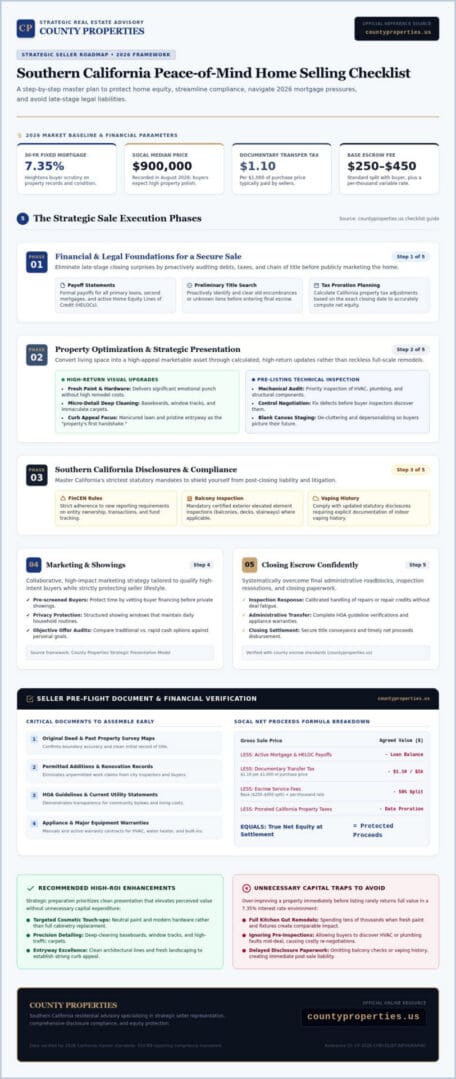
Selling your home isn’t just about the lawn sign; it’s about the paperwork. Establishing financial clarity before you list is the first step in our peace of mind home selling checklist. You need to know exactly where you stand with your lender to avoid surprises at the closing table. In the current 2026 climate, where 30-year fixed mortgage rates sit around 7.35 percent, buyers are more discerning than ever. They’ll scrutinize every document you provide, so having your house in order legally is just as important as having it in order physically.
Request a formal payoff statement for all current mortgages. This includes second mortgages or home equity lines of credit. It’s also vital to review your local property tax obligations. In California, taxes are typically prorated based on the date of sale, so having an accurate picture of your current payments ensures your closing statement is correct. Being proactive here transforms a potentially stressful transaction into a reassured milestone.
Document Collection and Title Verification
Gathering your records now prevents the frantic search that often happens during escrow. You’ll want to organize your files systematically to help potential buyers feel secure in their purchase. Locating your original purchase documentation, deed, and past property survey maps early shows you’re a prepared and reliable seller. You should also gather:
- Recent utility bills and a complete set of HOA guidelines.
- Relevant equipment warranties or manuals for HVAC and appliances.
- Records of any major renovations or permitted additions.
Proactively running a preliminary title search is a strategic move. It allows you to identify and resolve unexpected liens or old encumbrances before they jeopardize the overall real estate transaction. If a title issue exists, it’s much easier to fix it now than when you’re ten days away from a scheduled closing date.
Estimating Net Proceeds and Tax Implications
You shouldn’t have to guess what you’ll walk away with after the sale. Start by subtracting your remaining loan balances from the expected sale price. Remember to factor in standard transaction fees. In Southern California, sellers often pay a documentary transfer tax of $1.10 per $1,000 of the sale price. Escrow fees are usually split between the buyer and seller, often involving a base fee between $250 and $450, plus a per-thousand rate.
Understanding these numbers helps you plan your next move with total confidence. It’s also wise to consult a professional regarding the southern california housing market forecast trends for 2026 to time your financial transitions accurately. Knowing whether prices are expected to climb or stabilize helps you decide if traditional seller representation or a rapid cash offer facilitation fits your personal goals best.
Phase 2: Property Optimization and Strategic Presentation
Once you’ve secured your financial foundations, it’s time to shift focus to the physical property. A vital part of any peace of mind home selling checklist is transitioning your living space from a personal sanctuary into a marketable asset. This requires an objective walkthrough to identify which updates actually drive value. You shouldn’t spend thousands on a full kitchen remodel if a fresh coat of paint and new hardware would achieve a similar emotional impact for buyers. In a market where the Southern California median home price reached $900,000 in August 2026, buyers expect a level of polish that justifies their investment.
Start with a deep-cleaning strategy that covers often-overlooked areas. Baseboards, window tracks, and carpets should be spotless. Curb appeal acts as the property’s first handshake; a manicured lawn and a clean entryway create an immediate positive impression. De-cluttering and depersonalizing are equally essential. You’re not just cleaning; you’re creating a blank canvas that allows potential buyers to visualize their own future in the space. If you’re feeling overwhelmed by the physical preparation, our team can provide a personalized property assessment to help you focus your efforts where they matter most.
The Pre-Listing Inspection and Repair Strategy
A pre-listing inspection is a powerful tool for maintaining control over the sale. It uncovers structural or mechanical issues before a buyer’s inspector finds them, which prevents stressful renegotiations later. You should prioritize major systems like HVAC, plumbing, and roofing over minor cosmetic flaws. While you prepare, remember that keeping detailed records of these repairs is essential for following the tax rules for selling a home, especially when calculating your cost basis for capital gains exclusions. Drafting a clear disclosure statement early builds trust and protects you from future liability.
Staging and Maximizing Visual Appeal
Staging is about optimizing traffic flow and highlighting architectural strengths. Apply a fresh coat of neutral paint to brighten rooms and widen the spatial perception. In 2026, digital presence is everything. Most buyers decide to visit a property based on what they see on their screens. Utilizing professional photography and virtual tours ensures your home dominates digital platforms. High-quality visuals capture the light and space in a way that standard smartphone photos simply cannot, making it a non-negotiable step for any seller seeking a premium return.
Phase 3: Navigating Southern California Disclosures and Compliance
Transparency acts as your greatest legal shield when transferring property rights in California. A critical component of any peace of mind home selling checklist is ensuring you fulfill every statutory obligation to avoid post-sale litigation. In our state, the burden of disclosure rests heavily on the seller. You must inform the buyer of any material fact that could affect the property’s value or desirability. This includes new 2026 requirements, such as disclosing residue from smoking or vaping tobacco products on the premises. Being thorough now prevents a buyer from claiming they were misled after the close of escrow.
Disclose everything. It’s the safest path. Even if you are selling the property “as-is,” you aren’t exempt from these requirements. For a comprehensive understanding of these requirements, you can review California’s mandatory disclosure laws as outlined by the Department of Real Estate. This proactive approach fosters trust with qualified buyers and keeps the transaction moving toward a successful conclusion.
Mastering the Transfer Disclosure Statement (TDS)
The Transfer Disclosure Statement (TDS) is the cornerstone of your legal paperwork. You must document past water damage, structural repairs, or even neighborhood noise issues with total honesty. If you’ve had a leak in the past, describe the repair clearly. Don’t leave room for interpretation. A single sentence summarizing your disclosure obligations can protect you against post-sale legal disputes. Remember, buyers in California have a three-year statute of limitations to file a lawsuit over a seller’s failure to disclose a known defect. Your honesty is your best insurance policy.
Environmental and Local Municipal Mandates
Southern California’s unique geography requires specific environmental reports. You must secure a certified Natural Hazard Disclosure (NHD) report. This document verifies if your property sits within earthquake fault zones, seismic hazard areas, or high-risk wildland fire zones. Beyond state laws, local San Diego municipal requirements often mandate water-conserving plumbing fixtures and specific smoke detector placements. You must also ensure water heaters are properly braced and anchored according to safety codes. Reviewing specific local neighborhood guidelines when selling a home in southern california will help you guarantee seamless transaction compliance.
Finally, address any unpermitted work or structural additions with complete transparency. If you added a deck or finished a basement without a permit, you must document this for the buyer. Hidden issues often surface during the buyer’s inspection, and discovering them late can lead to escrow delays or price renegotiations. By documenting these additions early, you maintain control of the narrative and protect your financial interests throughout the sale.
Phase 4: Marketing, Showings, and Offer Evaluation
Launching your home onto the market requires a strategic approach that balances maximum exposure with your personal comfort. A modern digital marketing campaign must target highly qualified buyers across multiple channels, ensuring your property catches the eye of serious prospects. However, inviting the public into your home can easily disrupt your daily life. An essential part of your peace of mind home selling checklist involves establishing clear boundary rules for showings. By controlling how and when buyers tour your property, you protect your schedule and your sanity while keeping the momentum of the sale moving forward.
When the offers begin to arrive, evaluating them requires a calm, analytical mindset. A high purchase price is attractive, but the fine print dictates the actual success of the transaction. You must look closely at contingency terms, buyer financing strength, and the net financial return after closing costs. Formulating a strategic negotiation plan allows you to handle counteroffers professionally without emotional stress. If you want a seasoned professional to manage these high-stakes negotiations on your behalf, you can connect with us for dedicated Seller Representation services today.
Managing Showings with Minimal Disruption
Maintaining control of your living space during active listing periods is entirely possible with the right systems. You don’t have to abandon your routine for every showing request. Implementing structured logistics ensures safety and convenience:
- Utilize secure electronic lockboxes to track and control licensed agent access efficiently, ensuring you know exactly who enters your home and when.
- Create a rapid-response cleaning checklist for short-notice showing requests, focusing on high-impact areas like countertops and entryways, or check out Omni Cleaning Solutions to handle professional upkeep throughout the listing period.
- Plan comfortable off-site activities for family members and pets during open house events to remove your loved ones from a stressful environment.
Analyzing the Fine Print of an Offer
Vetting incoming bids protects you from a transaction collapsing mid-escrow. Look past the initial purchase price to scrutinize loan pre-approval letters and verified proof of funds. In 2026, elevated mortgage rates mean buyer qualification is more fragile than in previous years. You must carefully assess the timeline and safety risk of appraisal, inspection, and financing contingencies. To understand how these elements impact your final bottom line, consulting an expert real estate agent near me provides the clarity you need. Comparing traditional market offers against alternative methods ensures you choose the path that aligns perfectly with your financial milestones.
Phase 5: Closing Escrow with Absolute Confidence
The home stretch of a real estate sale requires a final burst of organized effort. Escrow acts as the neutral ground where all financial and legal threads are tied together. To navigate this phase successfully, you must remain highly responsive to your escrow officer. Delays often happen because of simple administrative oversights; treat every request for information as a priority. This vigilance is the final pillar of your peace of mind home selling checklist, ensuring that your equity is protected right up to the moment of transfer.
The Escrow Timeline and Final Walkthrough
Strictly monitoring contingency removal dates is essential. You want to ensure the buyer remains contractually committed as the closing date approaches. During this time, you must maintain the property in the exact condition promised. If you agreed to specific repairs after the inspection phase mentioned earlier, keep all receipts organized. You’ll need to deliver these to the buyer before their final walkthrough to prove the work was completed by qualified professionals.
- Ensure all utilities remain on until the day of closing to allow for a proper inspection of systems.
- Compile a “house binder” with spare keys, garage door openers, and any remaining appliance manuals.
- Perform a final sweep of the property to ensure no personal items or debris are left behind.
Signing and Moving On
Review your final Closing Disclosure document with a critical eye. You should confirm that all financial figures, including the escrow fees and transfer taxes discussed in Phase 1, align with your previous estimates. Errors are rare but possible; catching them early prevents funding delays. Schedule your signing appointment well in advance, whether you’re using a mobile notary or visiting the escrow office in person. You’ll need valid government-issued identification and clear wire transfer instructions to receive your proceeds securely.
Transitioning to your next lifestyle chapter should be a moment of celebration, not exhaustion. By following your peace of mind home selling checklist to the very end, you ensure a clean break and a joyful start to your future. If you’re navigating a complex transition, such as a senior real estate move, having a dedicated professional ally to coordinate these final logistics provides the ultimate layer of security. You’ve done the heavy lifting; now it’s time to enjoy the financial return on your investment.
Take the Next Step Toward Your Successful Sale
You’ve now seen how systematic preparation transforms a daunting real estate transaction into a predictable, reassured milestone. From establishing a firm financial foundation to navigating the rigorous California disclosure requirements, every step you take builds a safer path to the closing table. Utilizing this peace of mind home selling checklist ensures you aren’t just listing a property; you’re protecting your hard-earned equity and your personal well-being during a significant life transition.
You don’t have to manage these complex logistics alone. Arnie Levine and the team at County Properties provide personalized, service-centric guidance that handles the heavy lifting for you. Whether you require turn-key solutions for a senior real estate transition or a comprehensive marketing program designed to maximize Southern California property values, we act as your dependable guide. Success is within reach when you have a seasoned, collaborative partner by your side. Connect with County Properties for a stress-free home sale today and start your next chapter with total certainty.
Frequently Asked Questions
What is the single most important step for peace of mind when selling a house?
Selecting a dependable, experienced guide who understands the localized market is the most vital step. This professional acts as a steady mentor, handling the heavy lifting and legal complexities so you don’t have to worry. Whether you are selling in California or working with regional specialists like Lisa Hansen Realtor in the Twin Cities, a collaborative approach ensures that your financial interests are protected while minimizing disruption to your daily routine. This is the foundational element of any effective peace of mind home selling checklist that leads to success.
How long does the escrow process typically take in Southern California?
While every transaction varies, a typical escrow period in the Southern California region ranges from 30 to 45 days. This timeframe allows for necessary inspections, appraisal reports, and the buyer’s loan funding process. If you are dealing with unique situations like a short sale or a senior transition, the timeline might adjust. Staying responsive to administrative requests from your escrow officer is the best way to ensure a timely and successful closing.
Do I have to disclose past repairs if the issue is completely fixed?
Yes, you must disclose any material facts regarding past repairs, even if the problem is resolved. California law requires transparency about the property’s history to protect both parties. Documenting a leak that was professionally repaired three years ago builds trust with potential buyers and serves as a legal shield against future claims. Being honest about the home’s history is a critical step in maintaining a secure and legally compliant sale.
What happens if my home appraises for less than the agreed contract price?
An appraisal gap occurs when the bank’s valuation is lower than the purchase price, often requiring a strategic negotiation. You might ask the buyer to cover the difference in cash, lower your asking price, or meet in the middle. In a market with elevated interest rates, these discrepancies are common. Having a seasoned professional ally helps you navigate these hurdles calmly, ensuring the transaction stays on track without compromising your financial goals.
How can seniors make the home selling and downsizing process less stressful?
Seniors benefit most from turn-key lifestyle solutions that address both the emotional and logistical aspects of moving. We specialize in senior real estate transitions, offering methodical assistance with decluttering decades of belongings and coordinating all move-out details. By partnering with a compassionate guide who understands the evolving needs of older clients, you can transform a complex downsizing project into a positive, manageable milestone for your family and your future.
Can I sell my house quickly for cash if the traditional checklist feels too overwhelming?
You certainly can through our cash offer facilitation service, which is designed for unique or urgent situations. If the traditional market preparation and showing schedule feel too burdensome, a rapid cash offer provides a streamlined alternative. This path eliminates the need for public showings and extensive repairs; it offers a predictable and transparent exit strategy for homeowners who prioritize speed and convenience over traditional market exposure in the current landscape.
What are the hidden costs of selling a home that I should prepare for?
Beyond agent commissions, you should budget for documentary transfer taxes, escrow fees, and mandatory reports like the Natural Hazard Disclosure. In Southern California, sellers typically pay $1.10 per $1,000 of the sale price in transfer taxes. You might also encounter costs for required municipal retrofitting, such as water heater bracing or smoke detector compliance. Planning for these expenses early in your peace of mind home selling checklist prevents financial surprises at the closing table.