

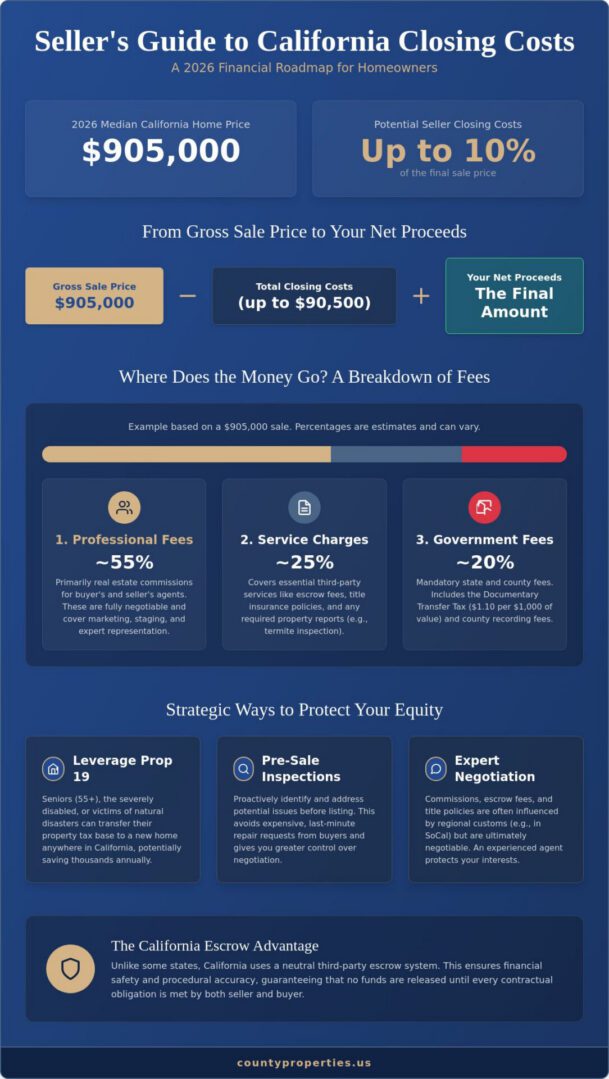
With the median home price in California reaching $905,000 in 2026, many homeowners are surprised to learn that total closing costs for seller in California can consume up to 10% of the final sale price. You’ve worked hard to build equity in your property, and it’s natural to worry that hidden fees or complex tax laws might eat into your retirement savings or your next investment. You deserve to know exactly where every dollar goes before you sign the final paperwork.
We understand that navigating the specific customs of Southern California real estate can feel overwhelming, especially with recent updates to recording fees and Prop 19 rules. This guide provides the clarity you need to calculate your true net proceeds with absolute confidence. We’ll explore the breakdown of commissions, transfer taxes, and escrow fees while sharing strategies to help you maximize your return. By the end of this article, you’ll have a structured roadmap for your 2026 sale, supported by the expertise of a team that views your financial safety as our highest priority.
Key Takeaways
- Define the critical difference between your gross sale price and your actual net proceeds to establish a realistic financial baseline for your next chapter.
- Gain a clear understanding of the standard closing costs for seller in California, including the documentary transfer tax and the transparent, negotiable commission structures of 2026.
- Discover how hyper-local customs in Southern California influence who pays for escrow and title fees, and learn how these traditions serve as a starting point for strategic negotiation.
- Identify actionable ways to protect your equity, such as leveraging Prop 19 tax portability for seniors and using pre-sale inspections to avoid expensive last-minute repair credits.
- Partner with an experienced guide like Arnie Levine to ensure every line item on your final Closing Disclosure is managed with precision, transparency, and care.
Understanding Seller Closing Costs in the 2026 California Market
Selling your home represents a major life milestone, but the final check you receive at the end of the process often differs from the number you saw on the initial purchase agreement. Understanding Seller Closing Costs is essential for any homeowner who wants to plan their financial future with precision. In the simplest terms, closing costs are the collective sum of professional fees, government taxes, and administrative charges paid to finalize a real estate transaction. In the current 2026 market, these expenses require closer scrutiny than ever before because California’s high property values and evolving state regulations directly impact your bottom line.
While many sellers focus solely on the high demand for West Coast real estate, the reality of closing costs for seller in California involves navigating a complex web of regional customs and statutory requirements. Some of these costs are fixed by law, such as county transfer taxes, while others are service-based and open to negotiation. Having a steady guide to help you distinguish between the two is what ensures your equity remains protected during the transition to your next lifestyle.
The Difference Between Gross Sale Price and Net Proceeds
It’s easy to get caught up in the excitement of a high “sold” price on the MLS, but that figure represents your gross sale price, not your take-home pay. Your net proceeds are the actual funds that hit your bank account after all obligations are satisfied. You can think of these expenses as three distinct buckets:
- Professional Fees: This includes the real estate commissions for both the listing side and the buyer’s representation, which remain a primary point of negotiation in 2026.
- Government Taxes and Recording: These are mandatory fees paid to the state and county to legally transfer the title.
- Service Charges: These cover essential third-party reports, escrow services, and title insurance policies that verify the property is ready for a clean transfer.
Our team at County Properties focuses on providing a transparent, line-item view of these buckets early in the process. This collaborative approach removes the fear of hidden fees and allows you to move forward with a clear, realistic expectation of your financial outcome.
Why California Closing Costs Differ from Other States
California operates under a unique set of rules that often surprise those moving from out of state. For instance, the Documentary Transfer Tax is a standard statewide rate of $1.10 per $1,000 of property value, but many charter cities add their own additional layers. Additionally, while some states rely on attorneys to lead the closing process, California utilizes a neutral third-party system. The California Escrow Process acts as a neutral third-party system designed for financial safety and procedural accuracy. This structure ensures that no funds are released until every contractual obligation is met, providing a layer of security that is vital in high-stakes transactions.
A Detailed Breakdown of California Seller Fees and Taxes
Professional fees represent the most substantial portion of your expenses. While commissions are fully negotiable since the 2024 NAR settlement, they typically cover the heavy lifting of a sale. This includes professional staging, high-end digital marketing, and the high-level negotiation required to secure top dollar. For families managing a senior’s transition, the value of a Senior Real Estate Specialist (SRES®) is immeasurable. These veterans handle the emotional and logistical complexities of downsizing with a level of care that goes beyond a standard transaction. You can learn more about this specialized process in our ultimate guide to selling a home in Southern California.
Real Estate Commissions and Professional Fees
Marketing a home in 2026 requires more than a sign in the yard. Your professional fees fund a collaborative team effort that includes professional photography, virtual tours, and targeted outreach to qualified buyers. These services are designed to create competition, which often results in a higher final price that offsets the cost of the commission. By choosing an experienced partner, you aren’t just paying for a listing; you’re investing in a strategy to maximize your net proceeds.
Government Taxes and Recording Fees
Government levies are another unavoidable reality. The state of California mandates a Documentary Transfer Tax at a rate of $1.10 for every $1,000 of the property’s value. If you sell a home at the 2026 median price of $905,000, this tax alone totals $995.50. However, certain charter cities in Southern California may impose additional local transfer taxes. You also need to account for updated 2026 recording fees. The base fee for the first page of a deed is generally $15 to $20, and most transactions include a $75 “Building Homes and Jobs Act” fee. Your escrow officer will also calculate prorated property taxes to ensure you only pay for the exact days you owned the home.
Title Insurance and Escrow Services
Financial safety is anchored by title insurance and escrow services. As the seller, you typically provide the “Owner’s Title Policy.” This policy acts as a guarantee that the buyer is receiving a title free of liens or legal disputes. While the buyer usually pays for their “Lender’s Title Policy,” regional customs in Southern California often place the cost of the Owner’s Policy on the seller. Escrow fees cover the neutral third party that manages the exchange of funds. In 2026, these fees often consist of a base charge between $250 and $450 plus a small percentage of the purchase price. This covers essential administrative tasks like wire transfers, courier charges, and the secure handling of sensitive paperwork.
Managing these details alone is daunting. If you’d like a clear breakdown of your estimated net proceeds, our team is ready to help you plan with certainty.
The “Who Pays What” Question: California Regional Customs
One of the most confusing aspects of real estate in the Golden State is that there’s no single law dictating who pays for specific fees. Instead, the allocation of closing costs for seller in California often follows long-standing regional traditions. While everything is technically negotiable, understanding these local customs gives you a significant advantage when reviewing an offer. If you aren’t familiar with these unwritten rules, you might accidentally leave money on the table or stall a deal over a standard expense that the other party expected you to cover.
Southern California vs. Northern California Traditions
The divide between Northern and Southern California extends right to the closing table. In Southern California, it’s customary for the seller to pay for the owner’s title insurance policy. Conversely, in many Northern California counties, the buyer often picks up this tab. This regional nuance is just one part of the Complete Guide to California Seller Closing Costs that savvy homeowners use to prepare their financial plans. In San Diego County, escrow fees are typically split 50/50 between the buyer and the seller, while county transfer taxes remain a seller-paid item by tradition.
Negotiating Closing Costs in a Shifting Market
Market conditions in 2026 play a pivotal role in how these costs are distributed. In a seller’s market, you have more leverage to ask the buyer to cover fees that are traditionally yours. However, if the market leans toward buyers, you might encounter requests for “Seller Concessions.” This is when a seller agrees to pay a portion of the buyer’s closing costs to make the deal more attractive. Understanding your current leverage is vital, so we recommend reviewing our forecast of the 2026 Southern California housing market before finalizing your pricing strategy.
Negotiation isn’t just about the big numbers. Sometimes, offering a credit for repairs instead of fixing them yourself can save you time and administrative headaches. Our team acts as your advocate, helping you decide when to stand firm on regional customs and when to offer a strategic credit to keep the transaction moving toward a successful close. Ultimately, managing the closing costs for seller in California is about balance, ensuring you protect your equity while still providing a clear path for a qualified buyer to cross the finish line.
Strategic Ways to Minimize Your Closing Expenses
Protecting your hard-earned equity requires more than just finding a buyer. It demands a proactive strategy to reduce the closing costs for seller in California before you ever open escrow. Many homeowners assume these fees are set in stone, but several key expenses can be managed or avoided entirely with the right preparation. By taking control of the process early, you ensure that more of your home’s value stays in your pocket for your next chapter.
One of the most effective tools at your disposal is a pre-sale inspection. While it requires a small upfront investment, it prevents a buyer from discovering a major issue during their own inspection and demanding an inflated repair credit. When you know the condition of your home beforehand, you can either fix the issues on your own terms or price the home accurately to reflect its current state. This proactive step effectively neutralizes a buyer’s negotiation leverage during the sensitive contingency period.
Managing Prorated Property Taxes and Liens
Property taxes in California are paid in arrears, which often creates confusion at the closing table. Depending on the time of year you sell, you’ll either receive a credit for taxes you’ve already paid or see a debit for the portion of the tax year you occupied the home. It’s also vital to clear any outstanding mechanic’s liens or HOA dues before going to market, as these administrative hurdles can delay your closing and lead to additional interest charges. For older homeowners, Prop 19 offers a significant advantage by allowing you to port your tax basis to a new primary residence, potentially saving thousands in future costs in the 2026 market.
Avoiding Unnecessary Repairs and Concessions
A common dilemma is whether to invest in major upgrades or sell the property “As-Is.” In many cases, expensive renovations don’t provide a dollar-for-dollar return on your net proceeds. Selling “As-Is” can be a superior strategy, especially when paired with a detailed equity analysis to determine the most profitable path forward. For those who want to bypass the traditional market entirely, our cash offer facilitation allows you to avoid repair costs and many standard service fees, though this route typically results in a lower gross price.
Choosing the right partner is essential for these high-stakes decisions. You can learn more about finding a professional who prioritizes your bottom line in our guide on how to find the best real estate agent. An expert agent acts as your final line of defense, meticulously reviewing the Closing Disclosure to spot “junk fees” from home warranty companies or administrative errors that could quietly erode your proceeds. We’re here to ensure every line item is accurate and every opportunity for savings is explored.
Navigating the Final Escrow with County Properties
The final stage of your real estate journey centers on the Closing Disclosure (CD), a document that summarizes every financial detail of your transaction. While this paperwork can appear dense and intimidating, our team at County Properties treats it as a tool for total transparency. We take a collaborative approach to managing the CD, sitting down with you to review each line item to ensure accuracy and clarity. By the time you reach the signing table, you’ll have a logical, structured understanding of your closing costs for seller in California, leaving no room for last-minute surprises or financial uncertainty.
Arnie Levine acts as a steady guide throughout this complex escrow process, drawing on decades of experience in the San Diego market to protect your interests. We don’t just hand you a stack of papers; we act as your advocate, communicating directly with escrow officers and title companies to verify that every credit, debit, and fee aligns with your original agreement. This meticulous oversight is part of our commitment to professional mastery and your long-term financial safety.
This commitment to protection should follow you into your next investment; for those seeking to secure their new assets with reliable coverage, you can discover SI Insurance to explore comprehensive options that provide peace of mind.
Specialized Support for Seniors and Distressed Sales
High-stakes personal transitions require a higher level of empathy and specialized knowledge. For homeowners navigating a move to a senior living community or a smaller residence, the SRES® (Senior Real Estate Specialist) advantage is a vital asset. We understand the specific tax implications of Prop 19 and the logistical hurdles of downsizing, ensuring these factors are accounted for in your final proceeds. If you’re facing a distressed sale, our expertise in short sale and foreclosure prevention becomes your primary defense. In many short sale scenarios, the closing costs for seller in California are actually paid by the lender, a nuance we handle with compassionate negotiation to help you achieve a clean break and a fresh start.
Your Path to a Seamless Southern California Closing
The journey from your initial listing to the final wire transfer of funds should be characterized by optimism and achievement. Our process is designed to be turn-key, moving you methodically through the following milestones:
- Final Review: A line-by-line audit of your Closing Disclosure to catch errors.
- Document Execution: Secure, guided signing of final transfer documents.
- Fund Verification: Ensuring the prompt and accurate transfer of your net proceeds.
- Lifestyle Transition: Finalizing the logistical details so you can move forward with confidence.
We invite you to reach out for a complimentary consultation to estimate your specific 2026 net proceeds. Our team is ready to provide the expert guidance and interpersonal connection you deserve during this significant life milestone. Let us handle the complexities of the paperwork so you can focus on the possibilities of your next chapter.
Secure Your Equity and Move Forward with Confidence
You now have a clear, structured roadmap for calculating your take-home pay from your 2026 sale. By recognizing the vital difference between gross sale price and actual net proceeds, you can plan your next move with absolute certainty. It is important to remember that the closing costs for seller in California are not merely fixed expenses; they are strategic variables that can be managed through expert negotiation and deep local knowledge. Whether you are leveraging Prop 19 tax portability or navigating the unique escrow customs of San Diego, the right preparation protects your hard-earned equity.
Arnie Levine and the County Properties team offer over 30 years of Southern California real estate expertise to ensure your transition is seamless. As a certified Senior Real Estate Specialist (SRES®) with a dedicated short sale and foreclosure prevention team, we provide the steady guidance you need during high-stakes milestones. We act as your reliable professional ally, turning complex paperwork into a clear path toward your long-term goals.
Get a Personalized Net Proceeds Estimate from Arnie Levine Today
Frequently Asked Questions
How much are seller closing costs in California on average?
Total closing costs for seller in California typically range from 6% to 10% of the final sale price when including real estate commissions. For a home sold at the 2026 median price of $905,000, this equates to a range between $54,300 and $90,500. Non-commission expenses, such as taxes and service fees, generally account for 2% to 3% of that total. These figures vary based on your specific county and the final terms of your negotiation.
Does the seller pay for the buyer’s title insurance in Southern California?
Yes, regional custom in Southern California usually dictates that the seller pays for the buyer’s Owner’s Title Insurance policy. This policy acts as a guarantee that the title is clean and free of undisclosed liens or legal disputes. While this is a standard expectation in San Diego and Los Angeles, it remains a negotiable item in your purchase agreement. Northern California traditions differ, often placing this cost on the buyer.
Can I deduct closing costs from my 2026 taxes?
Most closing costs aren’t directly deductible on your 2026 income taxes as an annual expense, but they are used to reduce your capital gains tax liability. You can add legitimate sales expenses, such as commissions and transfer taxes, to your cost basis or subtract them from the gross sale price. This adjustment lowers your taxable gain, which is a vital strategy for protecting your retirement savings during a high-stakes transition.
What is the Documentary Transfer Tax in San Diego County?
The Documentary Transfer Tax in San Diego County follows the California statewide rate of $1.10 for every $1,000 of the property’s value. For example, a home valued at $1,000,000 would incur a $1,100 tax at the time of sale. While this is the standard county rate, some specific charter cities may have additional local levies. Your escrow officer will provide a precise calculation based on your property’s exact location.
How are prorated property taxes calculated at closing?
Prorated property taxes are calculated by dividing your annual tax bill by 365 days to determine a daily rate. The escrow company then credits or debits you based on the exact date the title transfers to the buyer. If you’ve prepaid your taxes for the full year, you’ll receive a credit from the buyer for the days you no longer own the home. This ensures you only pay for the period you occupied the property.
Is the real estate commission negotiable in California?
Real estate commissions in California are fully negotiable and are not set by law or any industry standard. Following the 2024 NAR settlement, transparency in these negotiations has increased significantly for everyone involved. You have the right to discuss and agree upon the professional fees for your listing representation and any compensation offered to the buyer’s representative. This flexibility allows you to align professional services with your specific financial goals.
What happens if the buyer asks for a closing cost credit after the inspection?
If a buyer requests a closing cost credit after an inspection, you have the option to accept, decline, or negotiate a different amount. Many sellers prefer offering a financial credit rather than performing repairs themselves because it simplifies the timeline and reduces administrative stress. This credit is simply deducted from your net proceeds at the close of escrow, allowing the buyer to handle the repairs after the sale is finalized.
Who pays the escrow fees in a California real estate transaction?
Escrow fees are negotiable, but the standard custom in San Diego and much of Southern California is a 50/50 split between the buyer and the seller. These fees cover the neutral third party that manages the funds and legal documents. In many Northern California counties, it’s more common for the buyer to pay the entire fee. These regional unwritten rules serve as a starting point for negotiations rather than a legal requirement.