

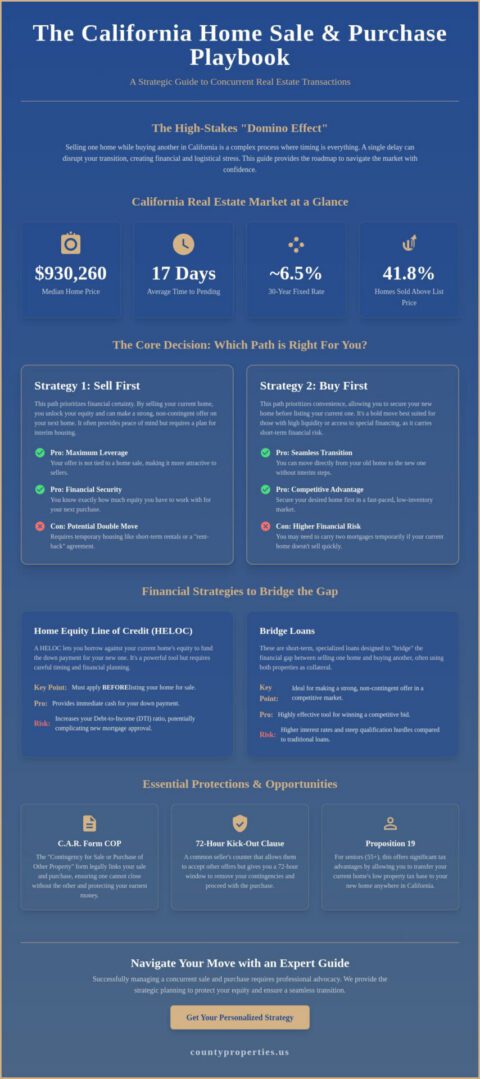
Successfully closing on two homes at once in California isn’t a matter of luck; it’s a “legal dance” won through strategic contract contingencies. You likely feel the pressure of the “domino effect,” fearing that a single delay could leave you temporarily homeless or burdened by two monthly payments. With the median home price reaching $930,260 and inventory remaining scarce, the stakes for your financial security have never been higher. Learning how to sell a house and buy another at the same time in California requires a blend of precise timing and expert advocacy.
This guide explores the essential logistics of concurrent transactions, from utilizing the latest June 2026 C.A.R. contract updates to managing financing in a 6.5% interest rate environment. We’ll help you master the process so you can move with confidence and achieve a seamless transition to your next chapter. By the end of this article, you’ll have the professional roadmap needed to handle the complex legal protections that keep your equity safe throughout the escrow period.
Key Takeaways
- Evaluate specialized financial tools like HELOCs and bridge loans to bridge the gap between your current equity and your next down payment.
- Master the use of C.A.R. Form COP to legally link your transactions, providing the security you need to move forward without fear.
- Explore how Proposition 19 offers unique tax advantages for seniors, turning a complex move into a significant financial milestone.
- Implement a methodical step-by-step timeline on how to sell a house and buy another at the same time in California to ensure a seamless transition.
- Protect your interests by understanding the “72-Hour Kick-Out Clause” and how it impacts your standing in a competitive escrow process.
The California Buy-Sell Dilemma: Identifying Your Best Path
The Southern California housing market is currently defined by a significant inventory crunch. A “lock-in effect” keeps many sellers on the sidelines; this limits choices for everyone. In May 2026, the median home price in California reached $930,260, with homes going pending in just 17 days. This fast-paced environment makes timing critical. You must decide whether to secure your next home first or liquidate your current asset to strengthen your financial position. California’s high property values often dictate which path is financially feasible for you. Understanding the real estate transaction process is the first step in learning how to sell a house and buy another at the same time in California.
Deciding on a strategy requires a hard look at your current equity and liquidity. If you’ve lived in your home for several years, you’ve likely seen substantial growth in value. This equity is your greatest tool, but accessing it requires careful planning. In a market where 41.8% of homes sold above list price in April 2026, competition is fierce. You aren’t just competing on price; you’re competing on terms. Sellers prefer offers that are clean and certain. This reality forces many homeowners to choose between the safety of selling first and the convenience of buying first.
Evaluating the “Sell First” Scenario
Choosing to sell first gives you immense negotiating leverage. You aren’t tied to a home sale contingency; sellers often view those as a significant risk. This path requires a solid plan for temporary housing. In San Diego, short-term rentals or “rent-back” agreements can bridge the gap while you hunt. While moving twice is physically demanding, the financial peace of mind is often worth the extra effort.
Evaluating the “Buy First” Scenario
Purchasing your next home before selling the current one allows for a direct move. This strategy is most feasible if you have high liquidity or access to specialized bridge financing. It’s a bold move that helps you secure a property in a competitive market. You must be prepared to carry two mortgages if your original home doesn’t sell instantly. In California’s high-value market, this exposure can create significant financial strain.
Choosing the right path involves more than just looking at bank statements; it requires a deep understanding of how to sell a house and buy another at the same time in California while navigating local competition. Your decision will depend on your risk tolerance and the specific demand in your neighborhood. We act as your dependable guide, helping you weigh these options to ensure your transition is both successful and secure.
Financial Strategies for Funding Your Next California Home
Funding a move while your equity remains locked in your current residence is often the primary hurdle for homeowners. In June 2026, with 30-year fixed mortgage rates hovering around 6.5%, the cost of borrowing requires a methodical approach. You need a strategy that provides liquidity without compromising your long-term financial safety. Many Californians utilize specialized tools to manage the transition, but each carries specific risks that demand professional oversight. Understanding these options is vital when learning how to sell a house and buy another at the same time in California.
The HELOC Strategy: Pros and Cons
A Home Equity Line of Credit (HELOC) allows you to tap into your current home’s value to fund a down payment on the next property. You must apply for a HELOC before you list your home for sale. Most lenders will immediately deny a line of credit once they see an active listing on the MLS. While this provides immediate cash, it also increases your debt-to-income (DTI) ratio. In a state where the median home price is $930,260, a high DTI can make qualifying for your new mortgage significantly more difficult. The interest-only trap occurs when homeowners focus solely on the lower monthly payment during the transition and ignore the looming principal balloon that could jeopardize their financial safety.
Bridge Loans and Private Money
Bridge loans are short-term, higher-interest loans designed specifically to “bridge” the gap between two transactions. These loans often utilize cross-collateralization, where the lender uses both your current home and your new purchase as security. While convenient, the qualification hurdles are steep. Traditional banks often have rigid requirements, leading many to seek specialized real estate investment lenders who offer more flexibility at a higher cost. These loans are effective for winning a home in a competitive market, but they require a clear exit strategy to avoid excessive interest expenses.
- 401(k) Loans: Borrowing against your retirement account can provide quick, penalty-free cash for a down payment, provided you pay it back within the required timeframe.
- Gift Funds: Leveraging financial assistance from family members can strengthen your offer without increasing your debt load.
- Cash Offer Facilitation: Modern platforms can buy your next home on your behalf, allowing you to move in before your current home even hits the market.
As your dependable real estate guides, we help you analyze these financial paths to ensure your equity remains protected throughout the move. Beyond loans, you can also explore 401(k) withdrawals or traditional gift funds to bridge the gap. Each method has a direct impact on your “domino effect” timeline. Choosing the wrong financial tool can lead to the “stale listing” risk mentioned previously, where your current home sits on the market while you carry the weight of dual obligations. Mastering how to sell a house and buy another at the same time in California means aligning your budget with the fast-moving reality of the local market.
Mastering California Real Estate Contingencies (CAR Forms)
Navigating the legal paperwork is where your concurrent move truly takes shape. California real estate contracts offer specific safeguards that allow you to synchronize your sale and purchase with professional precision. Understanding these forms is the key to knowing how to sell a house and buy another at the same time in California without risking your earnest money or your peace of mind. The California Association of Realtors (C.A.R.) released updated versions of several key forms in June 2026, making it even more important to have an expert guide who understands the latest legal revisions.
Form COP: Selling Your Current Home
When you find your dream home before selling your current one, you will likely use Form COP, the “Contingency for Sale of Buyer’s Property.” This form breaks the process into three distinct stages: entering the contract, finding a buyer for your home, and closing escrow. While some general advice suggests contingencies make your offer weaker, a contingent offer is often accepted if the buyer’s home is already in escrow. To keep your purchase alive even if your first sale falls through, we often recommend identifying backup buyers immediately. This proactive strategy shows the seller that you are a prepared professional who has planned for every scenario.
The 72-Hour Kick-Out Clause is a common feature you must manage within these agreements. It allows the seller to keep their home on the market while they wait for your home to sell. If they receive a superior, non-contingent offer, you generally have just 72 hours to remove your sale contingency or lose the property. Managing this narrow window requires a collaborative team that can move quickly to secure your interests and protect your deposit.
Form SPRP: Protecting You as the Seller
On the other side of the transaction, Form SPRP (Seller’s Purchase of Replacement Property) acts as your primary safety net. It allows you to list your home while retaining the “Seller Right to Cancel” if you cannot find a suitable new house within a negotiated timeframe. You can set a specific deadline for the “Selection of a Replacement Home,” which buys you the time needed to shop without the pressure of an immediate move-out date.
By aligning the closing dates of both escrows through this specific form, you ensure a seamless transition from one front door to the next. You don’t have to worry about being forced to sell if your next house isn’t ready. Mastering these contingencies is a fundamental part of how to sell a house and buy another at the same time in California, turning a high-stakes transition into a managed and successful life milestone.
Executing the Move: A Step-by-Step Tactical Timeline
Moving from one home to the next requires a synchronized calendar. You should begin with pre-listing preparations for your current home while simultaneously securing a pre-approval for the new purchase. This dual-track approach ensures you’re ready to act the moment an offer arrives. In May 2026, the median days to pending was just 17 days, so you must be prepared to move quickly. Once your home is listed with a “Seller Replacement Property” contingency, you can pivot to aggressive home hunting. This specific order protects your interests and helps you understand how to sell a house and buy another at the same time in California.
As you move into the middle stage, you’ll coordinate inspections and appraisals for both properties at once. This period is often the most intense. Your agent will manage a master timeline to track both sets of contingencies. A concurrent closing is the final goal; this is where funds move directly from your buyer’s escrow into your purchase escrow. This technical maneuver eliminates the need for you to temporarily hold millions in equity, ensuring financial security throughout the transition.
Managing the “Domino Effect” in Escrow
Communication between two different escrow companies is the primary failure point in concurrent transactions. If your buyer’s financing fails at the last minute, it can trigger a collapse of your purchase. We act as your dependable guide to monitor these links constantly. By maintaining a master timeline, we ensure every appraisal and inspection happens on schedule to prevent a single delay from derailing your entire move. If you’re ready to begin this process, our team provides the expert Seller Representation needed to sync these complex dates.
The Seller Rent-Back Agreement (SIP Form)
The “Seller in Possession” (SIP) agreement is a vital tool for those who need a buffer. This form allows you to remain in your home for up to 29 days after the close of escrow. It provides the extra time needed to finish packing or wait for your new home to be professionally cleaned. In a seller’s market, you might negotiate a “free” rent-back, though per-diem rates based on the buyer’s new mortgage costs are more common. It’s important to distinguish between a SIP and a Residential Lease After Sale (RLAS). A SIP is for stays under 30 days, while an RLAS is required for longer periods to comply with California’s tenant protection laws. Using these forms correctly is a hallmark of mastering how to sell a house and buy another at the same time in California.
Navigating the Transition with County Properties
Managing a concurrent transaction requires more than just a real estate license; it demands a collaborative team approach that handles every moving part under one roof. While our focus is California, this standard of professional excellence is also found with Team239, which specializes in residential and new construction deals in Southwest Florida. We act as your seasoned mentor, coordinating your sale and purchase with a level of precision that solo agents often struggle to maintain. By centralizing the process, we eliminate the communication gaps that lead to the “domino effect” failures discussed previously. Our localized knowledge in San Diego ensures you have access to a vetted network of bridge lenders and cash-offer partners, giving you the flexibility to move on your own terms. Mastering how to sell a house and buy another at the same time in California is a complex achievement, and we’re here to ensure your equity remains secure.
Prop 19 and Senior Real Estate Transitions
For homeowners aged 55 and older, California offers a significant financial advantage through Proposition 19. This law allows you to transfer your original property tax base to a new primary residence anywhere in the state, regardless of the new home’s value. This can result in massive annual savings, turning a downsize into a powerful financial milestone. As a Senior Real Estate Specialist, we coordinate the entire turn-key transition. We handle the logistics of the sale while you focus on the excitement of your next chapter. We also stay informed on legislative shifts, such as SB 566, which proposes increasing homeowners’ property tax exemptions for seniors beginning in the 2026-27 fiscal year.
Your Southern California Real Estate Ally
Local expertise is vital for timing your move in a market where inventory remains historically low. Our deep-rooted connection to San Diego neighborhoods allows us to predict market rhythms that generic national sites miss. When selling a home in Southern California, you need a strategy that accounts for the 17-day median time to pending. We employ a “Reassurance First” philosophy, meaning we prioritize your emotional and financial safety before diving into the technical details. We handle the heavy lifting of contract negotiations and escrow coordination so you can focus on the milestone of your new front door. Learning how to sell a house and buy another at the same time in California doesn’t have to be a source of anxiety when you have a dependable guide by your side.
Contact County Properties for a personalized move-up strategy session today to see how we can make your next transition seamless and successful.
Taking the Next Step Toward Your New Front Door
Moving into a new home while selling your current one is a significant life milestone that requires meticulous planning and expert execution. You’ve learned that success depends on more than just market conditions; it’s about leveraging strategic contract contingencies like Form COP and SPRP to protect your equity. Whether you’re utilizing a bridge loan or benefiting from the tax advantages of Proposition 19, your financial security remains the top priority. Mastering the logistics of how to sell a house and buy another at the same time in California is entirely possible when you have a seasoned partner to manage the “domino effect” of concurrent escrows.
Our team, led by Arnie Levine, brings decades of Southern California expertise to every transaction. As SRES® certified specialists, we take pride in guiding seniors and families through these high-stakes transitions with care and professional mastery. We’ve built a proven track record of coordinating complex closings so you can focus on your future rather than the paperwork. You don’t have to navigate this transition alone. Plan your seamless move with County Properties and take the first step toward a successful, stress-free relocation today. We’re ready to act as your dependable guide and ensure your next move is your best move.
Frequently Asked Questions
Can I buy a house in California contingent on selling mine?
Yes, you can buy a house contingent on selling yours by utilizing C.A.R. Form COP, the “Contingency for Sale of Buyer’s Property.” This document legally links your purchase to the successful sale of your current residence. While these offers are more complex, sellers in a balanced market often accept them if your home is already in escrow with a solid buyer.
What is a bridge loan and how much does it cost in California?
A bridge loan is a short-term financing tool that allows you to access the equity in your current home to fund the down payment on your next residence. These loans typically carry higher interest rates and fees than traditional 30-year mortgages, which averaged around 6.5% in June 2026. They’re designed as a temporary solution until your original home closes and you can pay off the debt.
How does the “kick-out clause” work in a real estate contract?
The “kick-out clause” allows a seller to continue marketing their property to other buyers while your contingent offer is in place. If the seller receives a non-contingent offer, you’re typically given a 72-hour window to either remove your contingencies or cancel the contract. This clause balances the seller’s need for certainty with your need for a replacement home.
What is CAR Form SPRP and how does it protect me?
CAR Form SPRP stands for “Seller’s Purchase of Replacement Property,” and it protects you by making the sale of your home contingent on you finding a new one. It gives you a negotiated period to identify and enter escrow on a new house. If you can’t find a suitable home within that timeframe, you have the legal right to cancel the sale of your current property without penalty.
Can I stay in my house after I sell it while I wait for my new home to close?
You can stay in your home after the sale closes by negotiating a “Seller in Possession” (SIP) agreement. This form allows you to remain in the property for up to 29 days after escrow closes, often through a rent-back arrangement. For stays longer than 30 days, California law requires a more formal Residential Lease After Sale agreement to protect both parties’ rights.
How do I avoid paying two mortgages at once?
You can avoid paying two mortgages by coordinating a concurrent closing where the sale of your old home and the purchase of your new one happen on the same day. This strategy is a central part of how to sell a house and buy another at the same time in California. By syncing these dates, the proceeds from your sale immediately pay off your old loan and fund the new one.
What is the most common reason concurrent closings fail in San Diego?
The primary reason concurrent closings fail in San Diego is a breakdown in communication between the two separate escrow companies involved. A single delay in a buyer’s appraisal or a late loan approval can trigger a domino effect that derails both transactions. Having a collaborative team to monitor every milestone is essential to keep the process on track and secure.
How does Prop 19 help me buy a new house in California?
Prop 19 allows homeowners aged 55 and older to transfer their current property tax base to a new primary residence anywhere in California. This is particularly beneficial when you’re figuring out how to sell a house and buy another at the same time in California because it can save you thousands in annual taxes. You can even move to a more expensive home and still retain a significant portion of your original tax savings.