

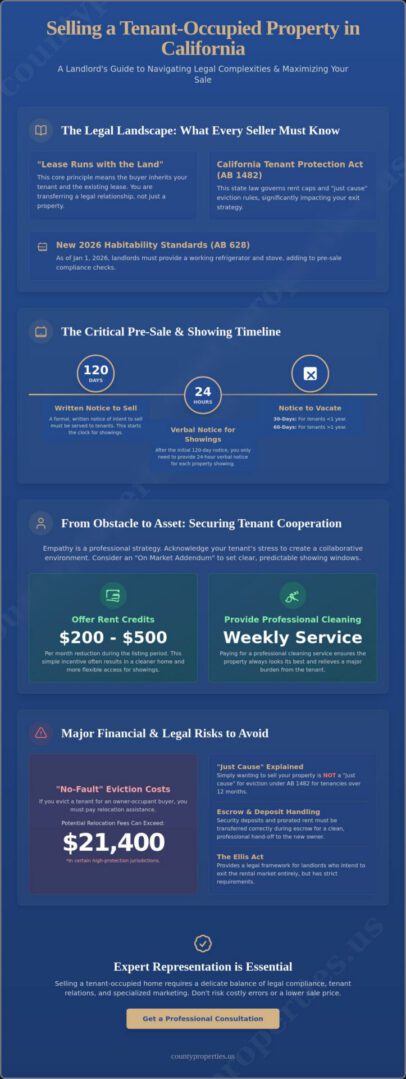
What if your tenant wasn’t an obstacle to your sale, but actually your most valuable asset in securing a higher offer? Many landlords feel a surge of anxiety when they think about selling a house with tenants in California. You’re likely worried about the complexities of the Tenant Protection Act, the fear of sabotaged showings, or the risk of expensive relocation fees that can exceed $21,400 in certain local jurisdictions. It’s a high-stakes transition, and feeling protective of your investment is completely natural.
We promise to guide you through this process with clarity and professional mastery. You’ll learn how to navigate the latest 2026 legal landscape, including the new habitability standards under Assembly Bill 628 and specific notice requirements for showings, so you can sell for top dollar without compromising your tenant relationships. This guide provides a clear roadmap through the 120-day notice rules, proven strategies for incentivizing tenant cooperation, and the essential steps for a seamless security deposit transfer during escrow.
Key Takeaways
- Master the “lease runs with the land” principle and see how 2026 updates to the California Tenant Protection Act affect your specific exit strategy.
- Discover how empathy and strategic financial incentives can transform a potentially difficult tenant into a helpful partner during the showing process.
- Learn the specialized marketing techniques required when selling a house with tenants in California to attract high-value offers from both investors and owner-occupants.
- Navigate the financial complexities of escrow by correctly handling security deposit transfers and rent prorations for a clean professional hand-off.
- Understand why expert representation is essential for managing the delicate balance between strict legal compliance and maximizing your final sale price.
Understanding California Tenant Rights and the 2026 Legal Landscape
The most fundamental rule you’ll encounter is that a lease agreement “runs with the land.” This legal principle ensures that the tenant’s contract survives the transfer of ownership; the buyer simply becomes the new landlord. When you’re selling a house with tenants in California, you aren’t just selling a building; you’re transferring a legal relationship. This is especially true under the California Tenant Protection Act (AB 1482), which has seen significant updates as we move through 2026.
As of January 1, 2026, landlords must meet stricter habitability standards, including the mandatory provision of a working refrigerator and stove under Assembly Bill 628. If your property is in San Diego, you must also account for local ordinances that often provide protections even more robust than state law. A month-to-month tenant who has lived in the home for over a year requires a 60-day notice to vacate, while those there for less than a year only require 30 days. However, if the lease is a fixed-term agreement, the tenant generally has the right to stay until the term expires, regardless of the sale.
The 120-Day Notice of Intent to Sell
Before your property ever appears on the MLS, you must establish a clear paper trail. Under California Civil Code §1954, a landlord must provide tenants with a 120-day written notice of their intent to sell the property before any showings can commence. Once this initial notice is properly served, you only need to provide a 24-hour verbal notice for subsequent showings. Serving this notice correctly is vital; any technical error can reset your timeline and delay your closing, impacting your financial goals.
Just Cause Eviction Protections
Terminating a tenancy isn’t as simple as wanting to sell. For most tenancies that have lasted longer than 12 months, “just cause” is required to end the lease. Selling the property is not considered a “just cause” for eviction under AB 1482. If you need to clear the property for an owner-occupant buyer, you may trigger a “no-fault” just cause eviction, which requires paying relocation assistance. In some high-protection areas, these relocation fees can exceed $21,400 for an improper process. For those navigating the added stress of foreclosure prevention in California, these tenant rights remain a priority. Owners intending to exit the rental market entirely might look to the Ellis Act, which offers a specific legal framework to withdraw your property from the rental market. Successfully selling a house with tenants in California requires a collaborative mindset to ensure you don’t face legal pushback that could derail your escrow.
Strategies for Securing Tenant Cooperation During Showings
A successful sale often hinges on the person currently living in the home. When you’re selling a house with tenants in California, empathy isn’t just a soft skill; it’s a professional strategy. Your tenants are facing the stress of displacement and the uncertainty of a new housing search. By acknowledging their situation and treating them as partners rather than obstacles, you create a collaborative environment that encourages them to keep the property show-ready and welcoming for potential buyers.
While California law requires a 24-hour verbal notice for showings after the initial 120-day notice is served, relying solely on legal minimums can lead to friction. Instead, many seasoned landlords use an “On Market Addendum.” This document sets clear boundaries by outlining specific showing windows and communication preferences, providing the tenant with a sense of control and predictability. For more detailed guidance on state-wide regulations, the official California Landlord-Tenant Issues resource offers a comprehensive overview of the protections you must respect during this process.
Incentivizing the Presentation
Cooperation is much easier to secure when there’s a clear benefit for the resident. We’ve found that small gestures lead to significant results. Consider these high-impact incentives:
- Rent Credits: Offering a temporary rent reduction of $200 to $500 per month during the listing period often results in a significantly cleaner home and more flexible access.
- Professional Cleaning: Paying for a weekly professional cleaning service ensures the property looks its best while relieving the tenant of the burden of constant upkeep.
- The “Mini-Holiday”: Provide gift cards to a local San Diego cafe or a park pass. This encourages tenants to comfortably vacate during open houses, allowing buyers to view the home without feeling like intruders.
The “Cash for Keys” Negotiation
Sometimes, delivering a vacant property is the most effective way to maximize your return, especially if you’re targeting owner-occupant buyers. A voluntary “Cash for Keys” agreement allows you to negotiate a move-out date in exchange for a financial incentive. This agreement must be legally binding and clearly state that the property will be delivered “broom-clean” and free of debris. This strategy is particularly useful when you need to align with a specific selling a home in southern california timeline. If you feel overwhelmed by these complex negotiations, seeking professional seller representation can provide the steady, expert guidance needed to handle these high-stakes conversations with care and precision.
Marketing a Tenant-Occupied Property for Maximum Value
Visual marketing is your first hurdle. While you have the legal right to enter for photography and showings under California Civil Code § 1954, respecting tenant privacy is essential for maintaining the rapport established in earlier stages. Consider using virtual staging or high-quality 3D tours that highlight the floor plan while minimizing the focus on the tenant’s personal belongings. This professional courtesy prevents friction and keeps the resident cooperative throughout the listing period.
To build ultimate buyer confidence, utilize an Estoppel Certificate. This document, signed by the tenant, confirms the current rent, security deposit amount, and lease terms. It acts as a “truth-check” for the buyer, preventing disputes after the sale and proving that the rental relationship is stable and transparent. A clean Estoppel Certificate often leads to higher offers because it removes the “unknown” variables that often scare away cautious buyers.
Positioning for Investors
Positioning for Owner-Occupants
If your target is a family looking for their own residence, transparency is your best tool. Disclose the lease expiration date and any potential “owner move-in” eviction requirements immediately to avoid fallout during the inspection period. Managing expectations regarding the actual close-of-escrow and move-in dates is critical, as many buyers have strict timelines for their own relocation. Finding an experienced real estate agent near me who has a proven track record in rental sales is vital. They’ll know how to navigate the delicate balance of marketing a home that isn’t yet vacant while still showcasing its potential for a new family.
Navigating Escrow: Security Deposits and Prorated Rent
Escrow represents the final financial bridge when selling a house with tenants in California. This phase requires meticulous accounting to ensure a clean hand-off between you and the buyer. Unlike a standard residential sale, a tenant-occupied closing involves the transfer of existing contracts and held funds. Precision here prevents post-closing disputes and reinforces your reputation as a professional and reliable seller. You must account for every dollar of the tenant’s money to ensure all parties exit the transaction satisfied.
The final walkthrough presents unique challenges when a resident is still in place. While you’re responsible for the home’s condition up until the close of escrow, the tenant remains responsible for any damage they cause beyond normal wear and tear. It’s essential to compare the property’s current state against the original move-in inspection report. If the tenant owns specific fixtures or appliances, such as a high-end refrigerator or a portable dishwasher, ensure these are explicitly excluded from the sale in the purchase agreement to avoid confusion on closing day.
The Legal Transfer of Deposits
California law is strict regarding the treatment of security deposits during a change of ownership. You must transfer the entire deposit amount, less any lawful deductions, directly to the new owner through the escrow process. Once the sale is finalized, you’re legally required to provide the tenant with a written notice. This document must include:
- The name, address, and telephone number of the new owner.
- The specific amount of the security deposit being transferred.
- A statement that the new owner has assumed full responsibility for the funds.
Failure to handle this transfer correctly can leave you personally liable for the deposit, even after you no longer own the property. Handling this “financial hand-off” with professional mastery ensures a smooth transition for everyone involved.
Disclosing the Rental Agreement
Transparency is the foundation of a successful buying a home in southern california experience for the person taking over your property. You must provide the buyer with the full, unredacted lease agreement along with any addendums. If you’ve made verbal “handshake” modifications, such as allowing a pet or adjusting a utility payment, these must be documented in writing before the close of escrow. Buyers need to know exactly what they’re inheriting to manage the property effectively from day one. If you’re concerned about the complexities of these financial disclosures, our team provides expert seller representation to ensure every detail is handled with care and legal precision.
Prorating rent is another critical escrow task. If your sale closes on the 10th of the month, you’re entitled to the first 10 days of rent, while the buyer receives the remaining portion. Escrow officers typically handle these calculations, but verifying the math yourself protects your bottom line. Clear communication regarding these prorations prevents confusion and ensures you receive your fair share of the final month’s income.
Why Expert Representation Matters for Complex Rental Sales
Selling a house with tenants in California involves more than just signing papers. It’s about managing a human relationship through a period of intense change. Legal knowledge is a requirement, but emotional and relational intelligence is what truly secures a successful closing. Arnie Levine’s collaborative approach avoids the combative nature of traditional real estate. We believe that a tenant who feels respected is a tenant who helps you reach your financial goals. By positioning ourselves as a steady, guiding presence, we help you avoid the “stress-tax”—that invisible cost of anxiety and lost time that comes with unmanaged conflict.
The regulatory climate in 2026 is complex. With local San Diego ordinances evolving alongside state-wide protections, having a partner who understands the regional fabric is essential. We act as your dependable guide, ensuring you don’t just comply with the law but thrive within it. Our team brings decades of historical longevity to the table, allowing us to navigate various market cycles with a sense of certainty. We prioritize your financial safety while maintaining the empathy needed to keep every party focused on a positive outcome.
A Compassionate Approach to Senior Real Estate
For many older landlords, selling a rental property is the first step toward a significant life milestone, such as downsizing or moving closer to family. This transition can be physically and emotionally demanding, especially when managing inherited properties or long-term residents who feel like family. We offer tailored solutions that minimize strain. By working with a senior real estate specialist, you gain an ally who understands the specialized financial and emotional needs of this demographic. We handle the heavy lifting, from tenant negotiations to coordinating with estate planners, so you can focus on your next chapter with optimism and achievement.
The County Properties Commitment
Our “Service-First” philosophy ensures that your needs always come before the transaction. We aren’t just here to list a property; we’re here to facilitate your progress. While we specialize in comprehensive seller representation, we also understand that a traditional market sale isn’t always the right fit for every situation. In cases where speed and certainty are paramount, we can facilitate rapid cash offers to provide you with an immediate exit strategy. We invite you to schedule a consultation with our team to evaluate your rental property’s market value and explore a customized plan that honors your goals. Let us show you how a committed professional relationship can turn a complex sale into a successful achievement.
Secure Your Investment and Your Peace of Mind
You’ve seen how selling a house with tenants in California doesn’t have to be a legal minefield or a source of constant anxiety. By prioritizing clear communication, respecting 2026 habitability standards, and managing the financial hand-off of security deposits with precision, you position yourself for a premium offer. A cooperative tenant is your best marketing asset; a transparent escrow process is your final step toward a successful achievement.
Navigating these high-stakes transitions requires a partner who understands the regional fabric of Southern California. Led by Arnie Levine, a seasoned veteran in both residential and commercial investment properties, our team provides the professional mastery you deserve. Whether you’re a family managing an inheritance or an older landlord utilizing our specialized Senior Real Estate Services for a seamless transition, we act as your dependable guide.
Let Arnie Levine guide you through your tenant-occupied sale; contact County Properties today.
Your next chapter is waiting. We’re here to ensure you reach it with total confidence and financial safety.
Frequently Asked Questions
Can I evict my tenant just to sell my house in California?
No, simply wanting to sell your property is not considered a “just cause” for eviction under the California Tenant Protection Act (AB 1482). The buyer typically inherits the existing lease and becomes the new landlord. An exception applies if the buyer intends to move into the home as their primary residence, which triggers a specific “owner move-in” eviction process requiring proper notice and relocation assistance.
How much notice do I need to give my tenant for a showing in San Diego?
You must first serve a written 120-day notice of your intent to sell the property. After this initial period begins, California law allows you to provide a 24-hour verbal notice for subsequent showings during normal business hours. San Diego landlords should ensure this communication is documented to avoid disputes, as local ordinances are strictly enforced to protect resident privacy.
What happens to the security deposit when I sell the rental property?
You must transfer the tenant’s security deposit to the new owner through the escrow process. Once the sale is finalized, you’re legally required to notify the tenant in writing about the transfer. This notice must include the new owner’s name, address, and telephone number, confirming that the new owner is now responsible for the eventual return of those funds.
Do I have to pay my tenant to move out if I am selling?
You’re only legally required to pay relocation fees if you’re performing a “no-fault” just cause eviction, such as an owner move-in. In these cases, the payment is typically equal to one month’s rent. However, many sellers choose a voluntary “Cash for Keys” agreement to encourage a tenant to vacate early, which can make the home more appealing to buyers who aren’t investors.
Can the tenant refuse to allow photos of the home for the listing?
Tenants generally cannot refuse entry for photography if you provide the legal 24-hour notice, but they can request that you don’t photograph their private possessions. We find that using 3D tours or virtual staging is a professional way to respect their privacy while still showcasing the home’s potential. A collaborative approach usually prevents the friction that leads to a refusal of access.
Is it better to sell a house vacant or with tenants in California?
The answer depends on your target audience. Selling a house with tenants in California is highly attractive to investors who value immediate cash flow and a “turn-key” rental history. If you’re targeting families who want to move in immediately, a vacant delivery is often better and can sometimes command a higher price from buyers who don’t want to manage a transition.
What is an Estoppel Certificate and why do I need one?
An Estoppel Certificate is a legal document signed by the tenant that confirms the current rent, lease terms, and security deposit amount. It prevents the tenant from later claiming they had a verbal agreement for lower rent or different terms. Buyers and lenders rely on this document to verify the property’s income and ensure the existing rental relationship is transparent and stable.
How does AB 1482 affect my ability to sell my house in 2026?
AB 1482 means that most tenants who have lived in the property for more than 12 months have “just cause” protections, making it difficult to deliver a vacant home. In 2026, you must also comply with updated habitability standards, such as providing a stove and refrigerator, before the sale. Expert representation is essential to ensure you meet these legal obligations while still securing a top-dollar offer.