
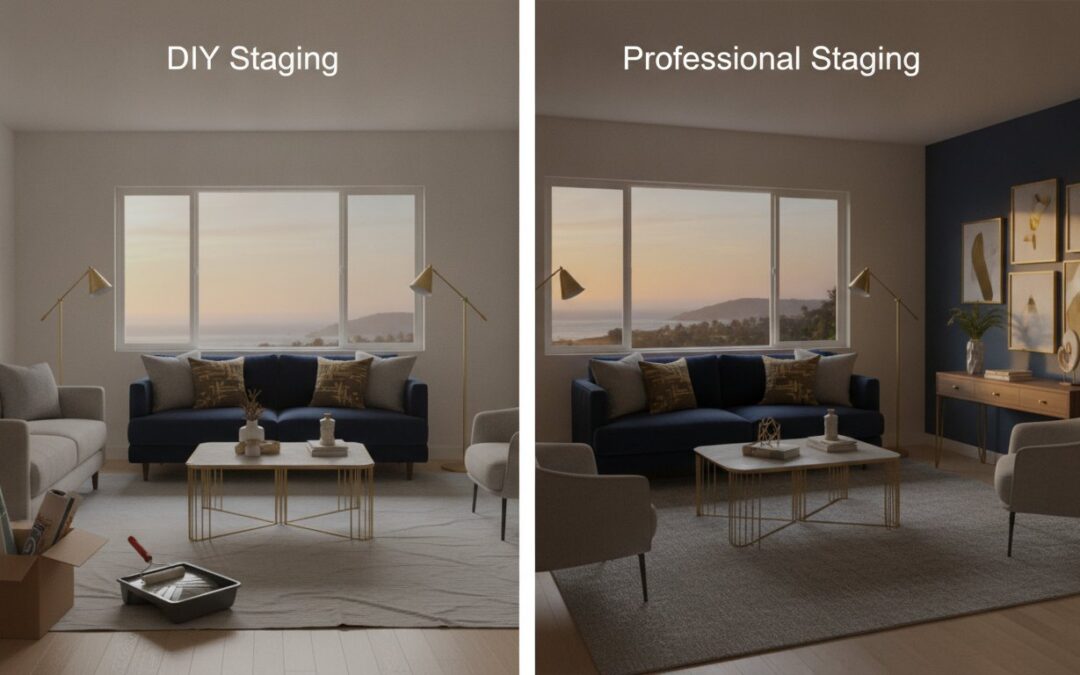
Current market data reveals that 85% of staged homes in 2026 sell for 5% to 23% over their listing price, making your presentation strategy a high-stakes financial decision. As you prepare to list your Southern California property, the choice between DIY home staging vs professional staging often brings up concerns about physical labor and the fear of leaving money on the table. It’s completely normal to feel overwhelmed by the process or confused about which specific upgrades will actually attract today’s more deliberate buyers. You’re looking for a result that honors your home’s value while ensuring a smooth, stress-free transition to your next milestone.
We’re here to act as your dependable guide during this significant life change. You’ll discover whether a hands-on DIY approach or a professional staging investment will net you the highest return on your specific home sale. We’ll provide a clear comparison of the costs and benefits, focusing on 2026 trends like minimalist palettes and natural elements. This overview will give you the certainty you need to choose a path that leads to a faster sale and a final offer price that justifies your investment.
Key Takeaways
- Identify why the “move-in ready” designation is the most valuable asset for capturing the attention of deliberate 2026 homebuyers.
- Navigate the financial trade-offs of DIY home staging vs professional staging by assessing your specific property value and neighborhood demand.
- Streamline your preparation process by using a strategic decision framework to determine if your timeline requires a 48-hour professional setup.
- Learn how specialized inventory and demographic targeting can create an aspirational “Luxury Effect” that justifies a higher final offer price.
- Explore supportive methods for senior real estate transitions that ensure the staging and downsizing process remains a positive and dignified experience.
Understanding Home Staging: A Strategic Marketing Tool for 2026
To successfully navigate the Southern California real estate market, you must transition your mindset from homeowner to product manager. Your property is no longer just a sanctuary of personal memories; it’s a high-value asset competing in a crowded digital marketplace. The debate over DIY home staging vs professional staging begins with a fundamental shift in perspective. You’re not just “cleaning up” to sell. You’re engaging in a strategic marketing process designed to showcase your property’s potential.
At its core, understanding what is home staging involves the art of depersonalizing and optimizing a space to appeal to the widest possible demographic. The 2026 buyer is deliberate and comparison-driven. They aren’t looking for a project; they’re looking for a lifestyle. The label “move-in ready” has become the most valuable currency in our current market. While decorating is the act of personalizing a space to suit your own tastes, staging is the tactical removal of those personal markers to allow a buyer to visualize their own life within your walls.
The ROI of First Impressions
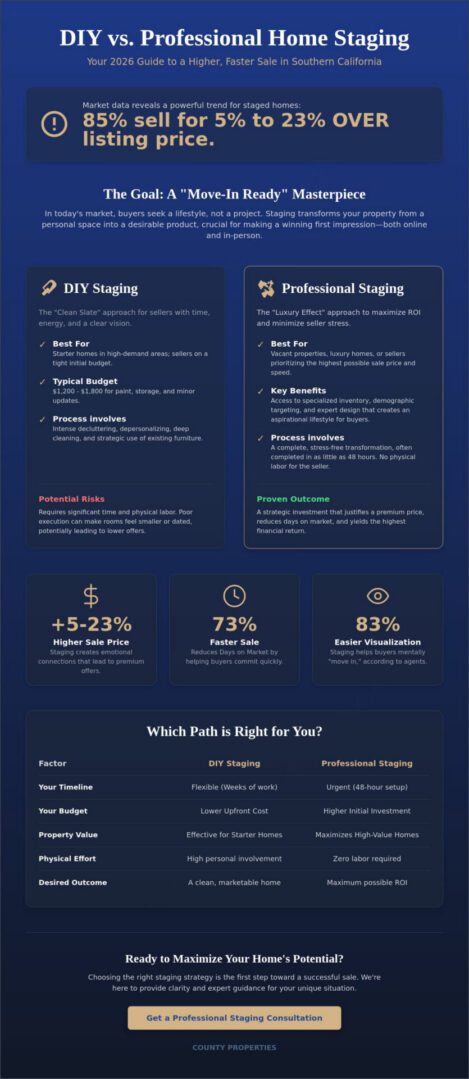
In the fast-paced Southern California market, you have roughly 15 seconds to capture a buyer’s interest. That window applies to the first moment they step through your front door and the first few seconds they spend scrolling through a listing. The financial impact is measurable. Data from 2026 shows that 85% of staged homes sell for 5% to 23% over their listing price. Beyond the final offer, staging is a powerful tool for reducing Days on Market (DOM). According to AI Architectures, staged homes can sell up to 73% faster than their non-staged counterparts. Whether you ultimately choose DIY home staging vs professional staging, the goal remains the same: creating a neutral, aspirational environment that justifies a premium price.
Staging in the Digital Era
Today, your first showing doesn’t happen at an open house. It happens on a smartphone screen. Professional photography is a requirement, but even the best lens can’t fix a cluttered or poorly arranged room. Staging serves as the essential foundation for your digital presence. High-quality staging drives social media engagement and increases the likelihood of your listing going viral within local community groups. As 3D tours and virtual walkthroughs become standard, every corner of your home is under a microscope. Physical staging ensures that these immersive digital experiences feel warm and inviting rather than cold or chaotic. By preparing the physical space first, you ensure your digital marketing efforts reach their full potential.
The Case for DIY Staging: When to Take the Reins
According to the latest home staging statistics, 83% of buyers’ agents report that staging makes it easier for clients to visualize a property as their future home. While you save on professional fees, don’t overlook the hidden costs of the DIY route. A comfortable DIY home staging budget in 2026 typically ranges between $1,200 and $1,800. These funds cover storage units, neutral paint, and updated light fixtures. The labor is intense, and if the execution is poor, you risk making the home look smaller or dated, which can lead to lower offers.
The DIY Staging Checklist
To maximize your efforts, focus on the high-impact areas that buyers prioritize most: the living room, primary bedroom, and kitchen. Use these essential steps to refresh your space:
- Neutralize the Palette: Apply fresh coats of warm, neutral colors like muted sage green or creamy white to create a sense of calm.
- Maximize Natural Light: Remove heavy drapes and clean every window to ensure the Southern California sunshine fills the rooms.
- Depersonalize Aggressively: Pack away family photos, trophies, and religious items to keep the focus on the architecture.
- Curb Appeal: Refresh the front door with a bold, inviting color and ensure the landscaping is tidy and well-watered.
Avoiding “Homeowner Blindness”
It’s difficult to see your own home’s flaws after years of residency. “Homeowner blindness” is a common hurdle where sellers overlook stained carpets, outdated hardware, or awkward furniture layouts. To combat this, get an objective third-party opinion from a friend or a neighbor before your first showing. If you find yourself struggling to see the space through a buyer’s eyes, obtaining expert seller representation can provide the professional perspective needed to ensure your DIY efforts truly add value.
Professional Staging: When the Investment Pays Off
While DIY efforts provide a solid baseline for many properties, high-value homes in Southern California often require the sophisticated touch of an expert. When you weigh the choice between DIY home staging vs professional staging, the decision usually pivots on your target sale price and the complexity of the property’s architectural layout. Professional stagers act as strategic partners who understand the nuances of the 2026 market. They don’t just move furniture; they engineer an environment designed to trigger an emotional response from high-intent buyers.
Empty houses present a unique challenge that DIY efforts rarely solve effectively. Paradoxically, vacant rooms often appear smaller than those with furniture because buyers lack a reference point for scale. A professional stager solves this “Empty Home” problem by installing curated pieces that define the function of each space. In competitive neighborhoods across San Diego County, the “Luxury Effect” is essential. It’s about creating a cohesive, high-end narrative that justifies a top-tier listing price and distinguishes your property from standard listings.
The Professional Stager’s Toolkit
Professional stagers bring an extensive warehouse of inventory that far exceeds what most homeowners can source. They use color theory and lighting techniques to create emotional warmth, which is vital in the 2026 market where buyers are more deliberate. The National Association of REALTORS® 2025 Profile of Home Staging highlights that nearly half of buyers’ agents believe staging has a positive effect on a home’s value. Beyond furniture, these experts use strategic space planning to solve awkward layouts, ensuring every square foot contributes to the home’s perceived value.
Staging for Specific Demographics
Effective staging is an exercise in demographic targeting. A professional will tailor a home’s aesthetic differently for a young professional in Hillcrest than for a family looking in Rancho Santa Fe. Lifestyle staging focuses on the specific aspirations of the likely buyer pool, creating a story for the home that resonates with their personal goals. Professional stagers often utilize subtle scents like white tea or citrus and soft, ambient music to subconsciously build an emotional bond between the buyer and the property.
Ultimately, a professional staging fee is a strategic investment rather than a simple cost. It’s often significantly less than the first price reduction you might face if the home sits on the market for several months. When comparing DIY home staging vs professional staging, remember that the goal is to maximize your net return. By investing in professional services early, you protect your equity and project an image of a well-maintained, premium property that buyers are eager to secure.
The Decision Framework: DIY or Professional?
Choosing the right path requires an objective look at your property’s specific needs, especially for those navigating significant life transitions like downsizing. When you evaluate DIY home staging vs professional staging, the decision often hinges on two critical factors: your target sale price and your available timeline. While a comprehensive DIY project can take several weeks to execute properly, professional teams can often transform a space in as little as 48 hours. This time difference is vital if you need to list quickly to catch a specific market window. You should also analyze the local competition. Take a moment to view the other houses for sale near me to see the standard of presentation in your neighborhood. If every comparable home is professionally staged, a DIY effort might make your property look less desirable by comparison.
For those on a tighter budget, a middle-ground strategy exists. You can hire a professional for a one-time consultation. They provide a detailed roadmap of repairs and furniture placement, which you then execute yourself. This approach combines expert knowledge with your own sweat equity, allowing you to maintain control while benefiting from a seasoned perspective. It’s a methodical way to ensure your efforts are focused on the areas that truly matter to 2026 buyers.
When DIY is Sufficient
DIY staging is often a wise choice for properties in the starter home price bracket, especially if you already own modern, neutral furniture. If you have a high level of design aesthetic and the free time to manage deep cleaning and minor repairs, you can achieve excellent results. In ultra-hot markets where inventory is historically low, the return on professional staging may diminish, as buyers are often willing to overlook minor presentation flaws to secure a home. In these cases, the choice between DIY home staging vs professional staging leans toward the hands-on approach to save on upfront costs.
When Professional Staging is Non-Negotiable
There are scenarios where professional intervention is a requirement for financial success. Vacant properties are the primary candidate; they feel cold and lack the sense of scale that helps a buyer understand how a room functions. Luxury listings also demand a professional touch. High-end buyers expect a specific lifestyle aesthetic that reflects the home’s premium price. Additionally, if your home has an outdated or awkward layout, a pro uses visual correction techniques to redirect a buyer’s focus toward the property’s best features.
Whether you’re navigating a complex downsizing process or simply looking to maximize your equity, we’re here to help you make the most informed choice for your future. If you’re ready to discuss a tailored strategy for your property, contact us today for professional seller representation.
How County Properties Maximizes Your Home’s Potential
Navigating the choice between DIY home staging vs professional staging is simpler when you have a seasoned professional by your side. We act as your dependable ally, ensuring every decision you make aligns with your long-term financial goals. Our collaborative approach to selling a home in Southern California integrates staging as a core pillar of our marketing strategy. We don’t just list your property; we curate an experience for potential buyers that begins the moment they view your photos online. By leveraging our deep-rooted local network of trusted professional stagers and contractors, we ensure your home meets the high expectations of the 2026 market without you having to manage the logistics alone.
We understand that preparing a home for sale is about more than just aesthetics. It’s about a significant life milestone. Our team focuses on strategic marketing integration, using the visual appeal created through staging to fuel a comprehensive sales program that targets high-intent buyers. This methodical process ensures that your home stands out in San Diego County, leading to a faster sale and a more favorable final offer.
The County Properties Advantage
- Objective Expert Eye: We identify the specific improvements that offer the highest return on investment, saving you from unnecessary expenses.
- Service-Centric Guidance: Our relationship is built on trust and transparency, not high-pressure sales tactics.
- Financial Safety: We help you navigate complex market cycles with confidence, protecting your equity at every turn.
Navigating Your Transition
For those entering a new chapter, such as downsizing or moving to a senior living community, the process requires a specialized touch. Our senior real estate specialists provide tailored solutions that make the transition dignified and stress-free. We handle the heavy lifting of the staging process, from coordinating furniture rentals to managing minor cosmetic refreshes. This allows you to focus on the personal aspects of your move while we ensure your property is market-ready. When considering DIY home staging vs professional staging, remember that you don’t have to carry the burden of preparation yourself. Contact us today for a personalized consultation on your home’s market readiness and discover how we can facilitate your successful sale.
Securing Your Financial Future in the 2026 Market
Your home’s presentation is the most powerful lever you have to influence a buyer’s decision and protect your equity. Whether you choose DIY home staging vs professional staging, the goal is to present a “move-in ready” lifestyle that justifies a premium price in a competitive market. You’ve learned that while DIY efforts can save on upfront costs for starter homes, professional staging provides the strategic targeting and high-end inventory necessary for luxury listings and vacant properties. This choice isn’t just about furniture; it’s about ensuring a seamless, successful transition to your next chapter.
Led by Arnie Levine, a seasoned veteran in Southern California real estate, our team provides specialized expertise in senior transitions and high-stakes sales. We take a collaborative, service-first approach to seller representation, acting as your dependable guide through every market cycle. You don’t have to navigate these complex decisions alone. Maximize your home’s value with a professional consultation from County Properties. We’re committed to helping you achieve a result that fulfills your long-term goals. Your bright future starts with a home that truly shines.
Frequently Asked Questions
Is home staging worth it in a seller’s market?
Yes, staging remains a vital strategic investment even when inventory is low. While a home might sell regardless, staging is what drives the final offer price 5% to 23% above the listing price according to 2026 market data. It creates an emotional connection that pushes buyers to bid more aggressively to secure the property before someone else does.
How much does professional home staging typically cost in Southern California?
Staging costs vary based on the home’s size and the number of rooms furnished. National data from 2026 indicates an average investment of $1,849, though high-end properties in Southern California often require more extensive setups. Most professionals suggest budgeting between 1% and 2% of your home’s target sale price to ensure the presentation matches the expectations of a deliberate buyer pool.
Can I stay in my house while it is professionally staged?
You can certainly remain in your home during the sales process through what’s known as occupied staging. In this scenario, a professional works with your existing furniture and supplements it with modern accessories to refresh the aesthetic. It requires a commitment to maintaining a showroom level of cleanliness for every showing, but it allows for a more comfortable transition during the sale.
What are the most important rooms to stage when selling a house?
Does staging a home actually increase the appraisal value?
Staging doesn’t directly change the technical appraisal value, which is based on square footage and comparable sales. However, it significantly increases the perceived value for buyers. By securing a higher final offer price through better presentation, you help establish a stronger market value for your property and set a new benchmark for future neighborhood comps.
How long does the home staging process usually take?
A professional team can typically complete a full installation within 48 hours once the initial consultation is finished. In contrast, the timeline for DIY home staging vs professional staging often stretches into several weeks for homeowners managing the labor and furniture sourcing themselves. Speed is a major advantage of professional services when you need to list during a specific market window.
Can a real estate agent help me find a stager or provide DIY advice?
An experienced real estate agent acts as your primary resource for both professional referrals and DIY guidance. We maintain a curated network of vetted stagers and contractors who understand the specific tastes of Southern California buyers. We also provide objective, expert advice on which minor repairs will offer the highest return on your investment before you hit the market.
What is virtual staging and is it as effective as physical staging?
Virtual staging uses digital software to add furniture to listing photos, making it an excellent tool for driving online clicks. It’s highly cost-effective, often costing less than a dollar per image in 2026. While it helps buyers visualize the space online, physical staging is still considered superior for creating a lasting emotional bond during the actual in-person walkthrough.