

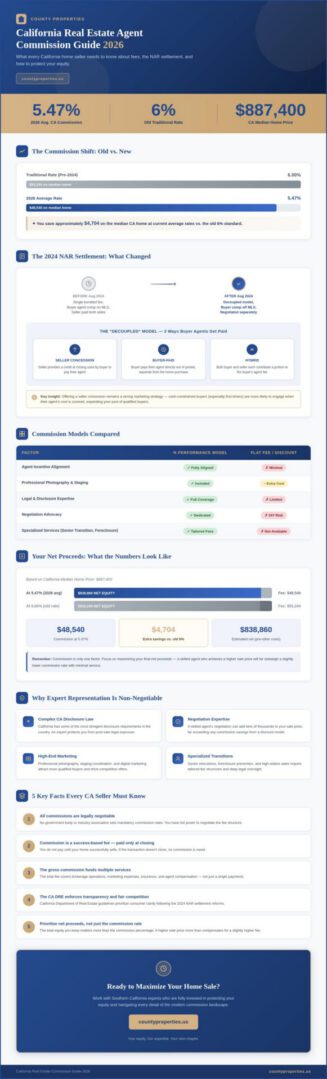
Did you know that the traditional 6% fee has officially become a relic of the past in the Golden State? As of June 2026, the average real estate agent commission California homeowners pay has settled at 5.47%, signaling a new era of transparency and negotiation. You’ve likely heard various stories about the 2024 NAR settlement and may feel uncertain about who is responsible for the buyer’s agent fee. It’s natural to feel protective of your equity, especially in a high-value market where the median home price has reached $887,400. You want to ensure you aren’t overpaying while still securing the expert support your home sale requires.
We believe that your move should be a source of optimism rather than anxiety. You deserve a seasoned partner who treats your financial safety as a top priority. This guide provides the professional clarity you need to manage the current commission landscape with confidence. We’ll break down the specific costs you can expect, explain the legal shifts in compensation rules, and show you how to maximize your final net proceeds. By understanding these modern standards, you can move toward your next life milestone with the peace of mind that comes from a well-managed, expert transaction.
Key Takeaways
- Learn why the traditional 6% fee is no longer the default and how the 2026 average of 5.47% reflects a more negotiable and transparent market.
- Understand the “decoupled” commission model following the 2024 NAR settlement, which gives you greater flexibility in how buyer agent compensation is handled.
- Discover how to focus on your final net proceeds rather than just the real estate agent commission California, ensuring you prioritize the total equity you keep.
- Get a step-by-step approach to negotiating professional fees while maintaining access to high-quality marketing and expert legal protection.
- Explore why professional representation is vital for navigating complex California disclosures and protecting yourself from potential post-sale legal challenges.
Understanding California Real Estate Commissions in 2026
You’ve likely spent years building equity in your home. When it’s time to sell, understanding how that equity is distributed is vital for your financial security. A real estate commission is essentially a success-based fee. You only pay for the professional services provided once your home sale is finalized at the closing table. In the current 2026 market, the average real estate agent commission California sellers encounter is approximately 5.47%. This figure reflects the specialized labor required to manage complex transactions in a state where the median home price has climbed to $887,400.
It’s a common misconception that these fees are set in stone. By law, all commissions are negotiable. No government agency or industry association dictates what you must pay. This flexibility allows you to choose a service level that matches your specific goals. While the total fee is what you see on your closing statement, it represents the gross commission. Real estate agent commissions are first paid to the brokerage, which then covers operational costs, marketing expenses, and insurance before the individual agent receives their portion.
The Anatomy of a Commission Split
The total fee is typically managed by the “Broker of Record” for each firm involved. Historically, this fee was split between the listing brokerage and the buyer’s brokerage. In 2026, while the mechanics have evolved, the collaborative nature of the industry remains. The listing brokerage uses their portion to cover professional photography, staging coordination, and high-end digital marketing. The buyer’s brokerage brings qualified, vetted purchasers to the table. Specialized expertise, such as managing a senior transition or a high-stakes foreclosure prevention, often involves a more tailored fee structure to account for the increased legal and logistical oversight required.
Performance-Based vs. Flat Fee Models
Most California sellers prefer a percentage-based model because it creates a shared mission. When your agent’s compensation is tied to the final sale price, their incentive to negotiate the highest possible value for your home is perfectly aligned with your own. Some “discount” or flat-fee models exist; however, they often come with significant trade-offs in service. In a market as legally complex as Southern California, sacrificing expert representation to save a small percentage can lead to costly errors or missed opportunities during the negotiation phase. We believe your home’s value is best protected by a dedicated partner who is fully invested in your success.
Who Pays the Realtor Fees? Post-NAR Settlement Realities
The real estate industry underwent a fundamental shift in August 2024. Before this date, you likely expected to pay a single fee that was split between both agents. Today, the 2026 market operates under a “decoupled” model. This means the real estate agent commission California sellers pay is negotiated separately from any compensation offered to the buyer’s side. You’re no longer required to offer a blanket commission to attract interest; instead, you have the flexibility to decide how much, if any, you want to contribute to the buyer’s professional costs.
The NAR settlement removed the requirement to display buyer agent compensation on the Multiple Listing Service (MLS). This change was designed to foster transparency. It ensures that every party knows exactly who they’re paying and what services they’re receiving. According to guidelines monitored by the California Department of Real Estate (DRE), these rules prioritize consumer clarity and fair competition. When discussing the real estate agent commission California homeowners should expect, transparency is the new standard.
Currently, buyer agents are compensated in three primary ways:
- Seller Concessions: You agree to provide a credit at closing that the buyer uses to pay their agent.
- Buyer-Paid: The purchaser pays their professional representative directly out of pocket.
- Hybrid Agreements: A combination where both parties contribute to the buyer’s agent’s fee.
Offering a concession remains a powerful marketing strategy. Many buyers, especially first-time owners, are cash-constrained after making a down payment. If you cover this cost, your home becomes accessible to a much larger pool of qualified purchasers. This often leads to more competitive offers and a faster sale.
The Role of Seller Concessions
Using seller credits to cover agent fees is a strategic choice. While it reduces your gross sale price on paper, it often sparks bidding wars that drive the final number higher. You should always focus on your “Net to Seller” rather than the initial offer price. In modern practice, the California Association of REALTORS (CAR) forms now include specific checkboxes and addenda to clearly outline these concessions within the purchase agreement.
Navigating Buyer Broker Agreements
Sellers should understand that all buyers must now sign a written agreement before touring homes. This contract specifies exactly what their agent will be paid. These agreements prevent “surprise” fees during escrow and ensure everyone is aligned on costs from day one. If you’re looking for a partner to help you navigate these new disclosures, our team provides expert seller representation to protect your interests and your equity.
Calculating Your Net Proceeds: Commission vs. Final Sale Price
While it’s natural to focus on the percentage you pay at the end of a transaction, your ultimate goal is the “walk-away” number. This is your net proceeds. It represents the actual cash you receive after all expenses are settled. In a high-value market like California, where the median sale price reached $887,400 in May 2026, even a small increase in your final sale price can significantly outweigh the cost of professional fees. You should prioritize the total equity you retain rather than focusing solely on the real estate agent commission California standard.
The math is simple but impactful. If an expert negotiator secures a sale price just 3% higher than a discount brokerage might achieve, that additional $26,000 often covers a large portion of the total commission. Research from the National Association of Realtors indicates that homes sold with professional assistance typically sell for nearly $100,000 more than those sold by owners. Understanding the California real estate commission rules helps you see these fees as a strategic investment in your home’s final value. Market timing also plays a crucial role; selling during a peak period can boost your proceeds far more than any commission discount ever could.
The Value of Expert Negotiation
Professional marketing does more than just list your home; it creates an environment of competition. When you receive multiple offers, you gain the leverage needed to negotiate better terms and a higher price. This is especially true when working with a senior real estate specialist who understands the unique financial and emotional needs of long-term homeowners. A “stale” listing that sits on the market for 60 days often requires a price cut that is far more expensive than a full-service commission. We focus on getting your home sold quickly and for the best possible price to protect your hard-earned equity.
Closing Cost Breakdown for San Diego Homeowners
Beyond the real estate agent commission California sellers pay, you must account for several other closing costs. In San Diego, these typically include:
- County Transfer Taxes: These are usually $1.10 per $1,000 of the sale price.
- Escrow Fees: These cover the neutral third party that manages the exchange of funds and documents for your financial safety.
- Title Insurance: This protects the new owner and is a standard seller expense in Southern California.
You will receive a “Final Settlement Statement” at the end of your transaction. This document provides a transparent, line-by-line breakdown of every dollar spent. Reviewing this statement with your agent ensures there are no surprises and that your net proceeds are exactly what you expected.
Negotiating Commission Rates Without Sacrificing Service
While we’ve established that the average real estate agent commission California sellers pay is 5.47%, it’s essential to remember that this fee is a starting point for a conversation. You have the right to negotiate a rate that reflects the specific needs of your transaction. However, the most successful sellers don’t just ask for a lower number; they negotiate for the highest level of service that will ultimately protect their equity. You can use the following framework to ensure you’re getting a fair deal without compromising on the quality of your representation.
- Step 1: Research the local market. Before your first meeting, review the Southern California housing market to understand current demand. In a seller’s market with low inventory, you may have more leverage to discuss fee structures.
- Step 2: Review the marketing plan first. Don’t discuss the commission until you’ve seen the agent’s comprehensive marketing strategy. You need to know exactly what you’re paying for before you can determine if the fee is appropriate.
- Step 3: Evaluate specialized expertise. If you’re managing a senior real estate transition or a complex commercial sale, the value of an experienced veteran far outweighs a small commission discount. Specialized knowledge prevents legal errors that could cost you thousands later.
- Step 4: Inquire about variable rates. Ask your agent if they offer a “Variable Rate” commission. This is a common arrangement where the total fee is reduced if the listing agent also brings the buyer to the table, as the total brokerage costs are lower.
- Step 5: Document everything. Ensure every agreed-upon term is clearly written into the Listing Agreement. Verbal promises don’t offer the legal protection you need during a high-stakes sale.
What to Look for in a Full-Service Listing
A true full-service partnership should include a suite of modern tools designed to showcase your home’s best features. In 2026, professional photography, high-definition 3D virtual tours, and expert staging advice are non-negotiable requirements for a successful sale. A robust digital marketing strategy ensures your property reaches qualified buyers across multiple platforms. We’ve seen that a “discount” fee often leads to “discount” exposure, which can result in your home sitting on the market and losing its initial momentum.
Questions to Ask During the Listing Presentation
- How do you handle buyer agent compensation in your listings given the recent legal shifts?
- What is your specific track record for sale-to-list price ratio in San Diego over the last 12 months?
- Can you provide a professional home valuation backed by recent comparable sales before we sign?
You deserve a partner who is transparent about their value and dedicated to your success. If you’re ready to discuss a tailored plan for your home, our team provides expert seller representation designed to maximize your final sale price.
Why Professional Representation Matters for Southern California Sellers
Selling a home in the Golden State involves far more than a simple exchange of keys. It is a high-stakes legal process. California has some of the most rigorous disclosure requirements in the country. A single oversight in your Transfer Disclosure Statement or Natural Hazard Disclosure can expose you to expensive post-sale lawsuits. While the real estate agent commission California sellers pay covers marketing, its most vital component is risk mitigation. We act as your protective shield, ensuring every document is executed with precision to safeguard your proceeds long after the transaction is complete.
The 2026 market demands a level of expertise that goes beyond a standard listing. High-value transactions in San Diego require a seasoned negotiator who understands the nuances of local demand and buyer psychology. We provide an essential emotional buffer during high-stakes transitions, such as downsizing a family home or managing a probate sale. By handling the difficult conversations and technical hurdles, we allow you to focus on your next life milestone with a sense of optimism and achievement.
Specialized Support for Seniors and Distressed Sales
Certain situations require a deeper level of care and specialized knowledge. Senior relocations often involve unique financial hurdles, such as coordinating move logistics or understanding the tax implications of a property transfer. Similarly, homeowners facing financial hardship need a strategist. Specialized services like foreclosure prevention require expert intervention to protect your credit and financial future through dedicated lender negotiations. Fiduciary duty is the legal obligation of an agent to act solely in the best interest of their client, and it serves as the cornerstone of professional representation.
The County Properties Advantage
Our team operates under Arnie Levine’s foundational philosophy: “Service First, Results Always.” We’ve spent decades building a reputation for reliability and professional mastery within the San Diego community. We don’t view ourselves as just agents; we’re your long-term professional allies. Our deep-rooted connection to the regional market allows us to position your home effectively against the competition, ensuring you don’t just sell, but you sell for the best possible price. We believe in a collaborative approach that puts your needs at the center of every decision we make.
Ready to maximize your home’s value? Contact County Properties today for a personalized consultation and let us guide you through your next transition with the care and expertise you deserve.
Take Control of Your Home Sale with Confidence
You’ve seen how the 2026 landscape has evolved into a more transparent and negotiable environment. By focusing on your final net proceeds and utilizing strategic seller concessions, you can attract the right buyers while protecting your hard-earned equity. Understanding the nuances of the real estate agent commission California homeowners pay is just the first step in a successful transition. Whether you’re navigating a complex senior move or a high-stakes short sale, the right guidance ensures you don’t leave money at the closing table.
At County Properties, we specialize in providing turn-key solutions for sellers facing significant life changes. Led by seasoned expert Arnie Levine, our team holds the specialized SRES® (Senior Real Estate Specialist) designation to offer the methodical support you deserve. We’re committed to a service-first approach that prioritizes your financial safety and long-term goals. You don’t have to navigate these legal complexities alone. Maximize your equity with a trustworthy partner—Contact County Properties today for a personalized consultation. Your next chapter is waiting, and we’re here to ensure it starts on the strongest possible financial footing.
Frequently Asked Questions
Is the 6% commission still standard in California in 2026?
No, the traditional 6% fee is no longer the default standard for home sales. Current 2026 market data shows that the average total commission in California has settled around 5.47%. This shift reflects a more competitive environment where fees are openly negotiated based on the specific services provided and the complexity of the transaction.
Do buyers pay their own real estate agent commission now?
Buyers are now primarily responsible for their own agent’s compensation through written agreements signed before they begin their home search. However, many sellers still choose to offer a concession or credit at closing to cover these costs. This strategy keeps the home accessible to a wider pool of qualified buyers who may be cash-constrained after their down payment.
Can I negotiate the commission rate with my listing agent?
Yes, you have the legal right to negotiate the real estate agent commission California professionals charge for their services. Since there is no law setting a fixed rate, you can discuss fee structures that align with your home’s value and the marketing support you require. We recommend focusing on the value and legal protection the agent provides rather than just the lowest percentage.
What is a “Variable Rate” commission in a listing agreement?
A variable rate commission is a specific clause that reduces the total fee if the listing agent also represents the buyer or if no other agent is involved. Because the brokerage doesn’t have to split the commission with an outside firm, they pass those savings on to you. This arrangement must be clearly disclosed in the listing agreement to ensure transparency for all parties.
Are real estate commissions tax-deductible for California home sellers?
While commissions aren’t a direct deduction from your personal income tax, they are considered a selling expense that reduces your capital gains. By including the real estate agent commission California fee in your closing costs, you lower the “net sales price” of your home. This can significantly reduce the amount of capital gains tax you might owe. You should always consult with a tax professional for your specific situation.
What happens if I sell my house without a realtor in California?
Selling your home without professional representation, often called “For Sale By Owner,” places the entire burden of California’s complex legal disclosures on your shoulders. You become personally liable for any errors or omissions in the paperwork, which increases your risk of post-sale lawsuits. Statistics also show that unrepresented sellers typically net less money than those who use a seasoned negotiator to drive up the sale price.
How does the NAR settlement affect me as a seller in San Diego?
The NAR settlement changed how buyer agent compensation is handled on the San Diego MLS. You are no longer permitted to advertise a set commission for the buyer’s agent through the listing service. This change encourages direct negotiation and ensures that any compensation you offer is a transparent part of the purchase offer rather than a hidden requirement of the listing.
What is included in a typical full-service commission fee?
A full-service fee covers an extensive range of professional tasks designed to maximize your home’s value. This typically includes high-end photography, 3D virtual tours, staging advice, and a targeted digital marketing campaign. Beyond marketing, your agent manages the legal disclosures, coordinates with escrow and title companies, and provides the expert negotiation skills needed to navigate the neutral market conditions seen in 2026.