

Did you know that when you sell your home in 2026, the total closing costs can consume as much as 10% of your final sale price? It’s a sobering figure that often catches even seasoned homeowners off guard, especially when commissions and complex tax withholdings start to eat into your expected profit. You’ve spent years building equity and making memories in your home, so it’s completely understandable that you’d feel protective of your financial legacy. Truly understanding seller closing costs in California is the first step toward securing the successful, stress-free transition you deserve.
We believe that clarity is the foundation of confidence. You shouldn’t have to guess how much of your profit you’ll actually keep or worry about unexpected surprises like Cal-FIRPTA withholdings and fluctuating county transfer taxes. This guide provides a clear, line-item breakdown of every fee you’ll face, from escrow costs to the latest commission trends. We’ll also share professional strategies to help you maximize your net proceeds and master the legal complexities of a California sale. By the time you finish reading, you’ll have a reliable roadmap to protect your equity and achieve your long-term financial goals.
Key Takeaways
- Plan your financial future with confidence by learning why total closing costs in 2026 typically range between 6% and 10% of your home’s final sale price.
- Protect your equity by understanding seller closing costs in California, including the specific line items like escrow fees and title insurance that vary significantly between Northern and Southern California.
- Navigate complex tax requirements with ease, specifically the Cal-FIRPTA withholding rules that could otherwise result in unexpected deductions from your net proceeds.
- Discover strategic methods to maximize your profit, such as tracking home improvements to adjust your tax basis and utilizing expert negotiation for commission structures.
- Leverage localized insights into San Diego and Rancho Santa Fe market dynamics to ensure your high-stakes transaction is both legally secure and financially optimized.
The Reality of Seller Closing Costs in California: What to Expect in 2026
Selling a home represents the fulfillment of a major life milestone. It’s a time of transition that requires both emotional readiness and financial precision. Seller closing costs are the cumulative sum of fees, taxes, and professional commissions required to legally transfer property ownership. While every transaction involves a buyer and a seller, understanding seller closing costs in California is particularly important because the seller traditionally bears the majority of these expenses. You’ve worked hard to build equity in your property, and seeing a clear picture of these costs is the first step toward protecting that investment.
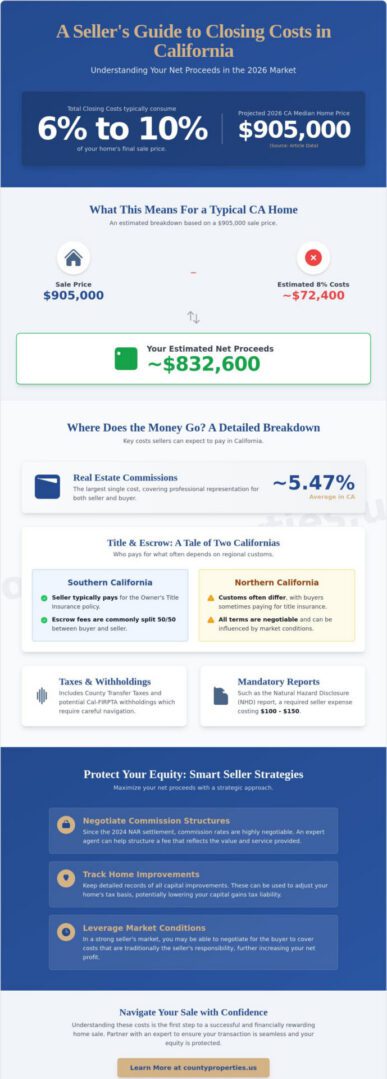
The 2026 market context adds another layer of importance to your financial planning. With the projected median home price in California reaching approximately $905,000, percentage-based fees can have a substantial impact on your equity. In high-value regions like Rancho Santa Fe or San Diego, these costs scale upward with your property value. You need a steadfast partner who acts as a seasoned guide, ensuring that every dollar is accounted for and your financial legacy is protected. By preparing for these costs now, you position yourself for a successful and predictable closing process.
Why Closing Costs Matter for Your Net Proceeds
It’s easy to get caught up in the excitement of a high offer, but the gross sale price is only half of the story. Understanding Closing Costs early in the process helps you avoid the “sticker shock” that often occurs at the escrow table. By calculating these expenses ahead of time, you gain a clear picture of your actual profit. Net Proceeds are the final amount a seller receives after all liens, commissions, and closing costs are deducted. Knowing this number allows you to plan your next move with total confidence, whether you’re downsizing or moving into your dream home.
Who Pays What? The California Custom
While everything in a real estate contract is technically negotiable, California has established regional customs for who pays specific fees. When selling a home in Southern California, you’ll find unique expectations that differ from the northern parts of the state. For instance, Southern California sellers traditionally pay for the owner’s title insurance policy and split escrow fees with the buyer. These customs act as a baseline for negotiations rather than a rigid rule.
The balance of power between a “buyer’s market” and a “seller’s market” also influences these decisions. In a competitive market, you may find buyers willing to take on costs traditionally assigned to the seller to make their offer more attractive. In a slower market, you might choose to pay more of these fees or offer credits to secure a reliable buyer. Your professional team will help you navigate these nuances to ensure a seamless and financially secure sale that honors the value of your home.
Breaking Down the Line Items: Common Fees and Commissions
Clarity is the foundation of a secure transaction. When you’re understanding seller closing costs in California, it helps to view the final settlement statement as a series of specific, manageable line items rather than one large, mysterious figure. In the 2026 market, average seller closing costs, excluding commissions, typically range between 2.71% and 2.73% of the sale price. However, California’s unique regulatory environment requires specific disclosures, such as the Natural Hazard Disclosure (NHD) report. This report, which usually costs between $100 and $150, is a mandatory seller expense that informs the buyer about potential flood, fire, or seismic risks associated with the property’s location.
Real Estate Commissions and Professional Representation
Professional commissions represent the largest portion of your closing costs, but they also fund the expertise required to navigate a high-stakes sale. As of 2026, the average real estate commission in California is approximately 5.47%. Following the 2024 NAR settlement, these fees are highly negotiable and are often split between the listing agent and the buyer’s agent. This investment covers comprehensive marketing, legal compliance, and the expert negotiation needed to protect your equity. Finding an expert real estate agent near me is essential to ensure these terms are structured in your favor. Partnering with a dedicated professional ensures these details are handled with precision; consider how our team can support your goals at countyproperties.us.
Title, Escrow, and Administrative Fees
Escrow and title services act as the protective framework for your transaction. The escrow company serves as a neutral third party, holding funds and documents until all contractual conditions are met. In Southern California, it’s customary for the seller to pay for the owner’s title insurance policy, which typically costs between 0.5% and 1% of the purchase price. This policy protects the buyer from future claims against the title. You should also stay vigilant regarding administrative “junk fees” that can appear on your closing statement. While small individually, charges for wire transfers, courier services, and document preparation can add hundreds of dollars to your final bill if not monitored closely.
County and City Transfer Taxes
Transfer taxes are state or local fees imposed on the transfer of real property title. Most California counties charge a base documentary transfer tax of $0.55 per $500 of property value. However, certain “Charter Cities” impose additional municipal taxes that can significantly impact your bottom line. For example, as of July 1, 2026, the city of Los Angeles imposes a tax rate of 4.45% on properties sold for over $5,400,000, jumping to 5.95% for those at $10,900,000 and above. You must also comply with the California Real Estate Withholding Requirements, which may require a 3.33% withholding of the gross sales price as a prepayment of state income taxes. Understanding these regional variations ensures you aren’t surprised by local tax obligations during the final days of your sale.
Navigating California Tax Withholding and Capital Gains
Taxes represent the most complex layer of any real estate transaction. While commissions and escrow fees are visible from the start, tax obligations often feel like a moving target. Understanding seller closing costs in California requires a deep dive into how the state treats your profits. Unlike many other states that offer preferential rates for long-term gains, California taxes capital gains as ordinary income. These rates are progressive, ranging from 1% to 13.3%. This top rate includes a 1% Mental Health Services Tax on income exceeding $1 million, making strategic planning essential for high-value San Diego and Rancho Santa Fe properties.
The 3.33% California Withholding Rule
One of the most significant surprises for sellers is the mandatory state withholding. California law typically requires escrow to withhold 3.33% of the gross sales price. This isn’t your final tax bill; it’s a prepayment toward your state income tax liability. You can find detailed guidance on the official California real estate withholding rules to see how this applies to your specific situation. There are several common exemptions to this rule:
- The property is your primary residence.
- The total sales price is $100,000 or less.
- The seller is transferring the property at a financial loss.
- The transaction is part of a tax-deferred 1031 exchange.
If you qualify for an exemption, you must complete Form 593 to document your eligibility before the close of escrow. Because these regulations are technical and carry significant financial weight, we always recommend consulting a qualified tax professional alongside your real estate team to ensure your filings are accurate and your equity is protected.
Property Tax Proration and Prop 19
You’re responsible for property taxes up to the day you sign over the title. In California, where the average property tax rate is approximately 0.70% of the assessed value, these prorated amounts are calculated during the escrow process. If you’ve already prepaid your taxes for the current cycle, you’ll receive a credit from the buyer. If taxes are due, the amount is deducted from your proceeds. For homeowners over 55, Prop 19 offers a unique opportunity to preserve your financial legacy by allowing you to transfer your current property tax basis to a new primary residence anywhere in California. A senior real estate specialist can help coordinate these complex moves, ensuring you maximize the benefits of Prop 19 while navigating the sale of your current home.
Don’t forget the federal side of the equation. The IRS allows an exclusion of up to $250,000 in capital gains for single filers and $500,000 for married couples filing jointly on their primary residence. To qualify, you must have owned and lived in the home for at least two of the five years before the sale. While this exclusion is a powerful tool for wealth preservation, it only applies to federal taxes. California’s treatment of these gains as ordinary income remains a critical factor in determining your final net proceeds.
Strategic Ways to Reduce Your Closing Costs and Protect Your Equity
Protecting your equity requires a proactive approach rather than a passive acceptance of fees. While some taxes are statutory, many elements of your final settlement are subject to negotiation and strategic planning. Understanding seller closing costs in California allows you to identify where you can advocate for your own financial interests. By managing your property’s history and your transaction’s timing, you can significantly reduce the financial burden of the sale and keep more of your hard-earned profit. We view our role as a steadfast partner in this process, ensuring you have the tools to make informed, high-stakes decisions.
Maximizing Your Adjusted Basis
Your adjusted basis is one of the most effective tools for wealth preservation. It represents the total investment in your home, which tax authorities use to calculate your taxable gain. By increasing this basis, you effectively lower the profit amount subject to capital gains tax. This is why keeping detailed receipts for every major project over the years is a master move for long-term homeowners. You must distinguish between routine repairs and capital improvements to maximize this benefit. Repairs maintain the home’s current condition; improvements add value or prolong the property’s life.
Consider these common capital improvements that can be added to your basis:
- Installing a complete new roof or a modern HVAC system.
- Executing a full kitchen or bathroom remodel.
- Adding square footage, such as a guest house or a sunroom.
- Upgrading to energy-efficient windows or solar panels.
- Major landscaping overhauls or new fencing.
Negotiating Credits and Repairs
The inspection period is often a point of high stress for sellers. Buyers frequently request a “Seller Credit” to cover their own closing costs or demand extensive repairs before the deal closes. You have the right to say “no” to unreasonable requests, especially if your home was already priced to reflect its current condition. A professional valuation ensures you set a strategic price that absorbs potential concessions without compromising your net profit. This is particularly important for seniors who are counting on every dollar of their equity for their next life transition.
Timing also plays a subtle but important role in your final proceeds. Closing at the end of a month can minimize the daily interest you owe on your mortgage payoff. Staying mindful of tax cycles ensures you don’t overpay on prorated property taxes. Finding a team that prioritizes your financial security over a quick transaction makes all the difference. If you’re ready to build a strategic plan for your home sale, connect with our experienced team today. We focus on your personal journey, ensuring your transition is as profitable as it is seamless.
Partnering with a Southern California Expert for a Seamless Sale
Selling a home in high-value enclaves like Rancho Santa Fe or San Diego requires more than just a standard listing; it demands a sophisticated financial strategy. In a 2026 market where the median home price has climbed to approximately $905,000, the stakes for your equity have never been higher. Understanding seller closing costs in California is the first step, but applying that knowledge to your specific property requires a seasoned mentor. You need a partner who understands that these numbers represent your hard-earned wealth and your future security. We provide the expert oversight necessary to ensure your transaction is both legally sound and financially optimized.
The County Properties Collaborative Approach
Our team, led by Arnie Levine, operates on a foundational belief that the client’s needs must always come before a transaction. We’ve built our reputation as a reliable professional ally by departing from the high-pressure tactics common in the industry. Instead, we offer a methodical, service-oriented approach that prioritizes your personal journey and long-term milestones. This is especially vital when considering the latest Southern California housing market trends, which influence how we position your home to attract the most qualified buyers.
We specialize in providing turn-key solutions for those facing complex life transitions. Whether you’re focused on a Senior Real Estate Transition or navigating a difficult financial situation, we act as your dependable guide. Our collaborative ethos means you aren’t just hiring an agent; you’re gaining a team of experienced veterans who value internal cooperation and client-first outcomes. We handle the heavy lifting of legal compliance and market analysis so you can focus on your next chapter with total peace of mind.
Your Next Steps Toward a Successful Closing
A successful sale begins with a clear understanding of your property’s current value and the specific costs associated with your area. You shouldn’t have to guess about your net proceeds or worry about hidden fees during the final days of escrow. We encourage you to start with a professional home valuation to set a strategic price that accounts for all regional taxes and commissions. This proactive step ensures you enter the market with a “tax-ready” mindset and a clear roadmap for your equity.
Your financial legacy is too important to leave to chance. By partnering with a team that views your success as a shared professional obligation, you gain the confidence to make high-stakes decisions with ease. We invite you to contact County Properties for a personalized seller closing cost estimate today. Let’s work together to protect your equity and ensure your California home sale is a rewarding achievement that supports your future goals.
Secure Your Financial Legacy and Maximize Your Sale
Mastering the details of your final settlement statement is more than just a financial exercise; it’s about protecting the years of hard work you’ve invested in your home. By understanding seller closing costs in California, you move from a place of uncertainty to one of professional command. You now have the knowledge to navigate complex FTB withholdings, negotiate commission structures, and maximize your adjusted basis through careful documentation of home improvements. These strategic steps ensure that your equity remains where it belongs: in your pocket.
You don’t have to manage these high-stakes decisions alone. With decades of experience in the San Diego market, our team provides the seasoned guidance you need for a seamless transition. As specialized Senior Real Estate Specialists (SRES®), we’re committed to a collaborative, service-centric experience that honors your personal goals and long-term security. We invite you to request a professional home valuation and net proceeds estimate from County Properties today. Let’s work together to ensure your home sale is a rewarding milestone that paves the way for your next great achievement.
Frequently Asked Questions
What is the average seller closing cost percentage in California for 2026?
Total seller closing costs in California for 2026 typically range from 6% to 10% of the final sale price when including real estate commissions. If you exclude commissions, the average cost falls between 2.71% and 2.73%. These figures account for title insurance, escrow fees, and various transfer taxes. Understanding seller closing costs in California early in your journey ensures you can plan your next life transition with financial certainty and peace of mind.
Who pays for the escrow fees in Southern California home sales?
Escrow fees in Southern California are traditionally split equally between the buyer and the seller. While this is the local custom, all closing costs remain negotiable within the purchase agreement. A typical residential transaction in 2026 sees escrow fees ranging from $1,500 to $2,500. Your professional team will act as a dependable guide to ensure these costs are handled fairly and reflect current regional standards for your community.
Does California have a state-level capital gains tax on home sales?
California does not have a separate preferential rate for capital gains; instead, it taxes these profits as ordinary income. These rates are progressive and currently range from 1% to 13.3%, which includes a 1% Mental Health Services Tax on income exceeding $1 million. This makes careful financial planning essential for high-value sales. We recommend consulting with a tax professional to determine how these ordinary income rates will impact your specific net proceeds.
What is the California 3.33% withholding rule, and can I avoid it?
The California 3.33% withholding rule is a mandatory prepayment of state income taxes collected by escrow at the time of sale. You can often avoid this withholding if the property was your primary residence or if you’re selling the home at a financial loss. To claim an exemption, you must complete Form 593 before the transaction closes. This process ensures the Franchise Tax Board receives estimated taxes due on the transaction while protecting your immediate cash flow.
Are real estate agent commissions negotiable in California?
Real estate commissions in California are fully negotiable and typically range between 4% and 6% of the sale price. As of 2026, the statewide average is approximately 5.47%, reflecting the high level of professional service provided in our complex market. You have the right to discuss and structure these fees with your listing agent. This ensures they align with your financial goals and the comprehensive marketing support your unique property requires for a successful sale.
How does Prop 19 affect my property taxes when I sell my home?
Prop 19 allows homeowners who are 55 or older, or those with severe disabilities, to transfer their current property tax basis to a new primary residence anywhere in California. This can result in significant long-term savings if your new home has a higher market value than your previous one. By utilizing this benefit, you can transition into a home that better fits your current lifestyle without facing a substantial increase in your annual property tax obligation.
Can I deduct home improvements from my capital gains tax when I sell?
You can use capital improvements to increase your property’s adjusted basis, which effectively lowers the amount of profit subject to capital gains tax. Understanding seller closing costs in California involves distinguishing between routine repairs and major upgrades like a new roof or kitchen remodel. Keeping detailed receipts for these projects is a master move for wealth preservation. These documented investments directly protect your equity by reducing your total taxable gain at the time of sale.
What are the typical transfer taxes in San Diego County?
San Diego County imposes a documentary transfer tax at a rate of $1.10 per $1,000 of the property’s value. This is equivalent to $0.55 for every $500 of the final sale price. Most cities within the county follow this standard rate, though it’s always wise to verify if your specific municipality has additional Charter City taxes. These fees are a standard part of the title transfer process and are traditionally paid by the seller in our region.