

The highest purchase price on your home might actually be the riskiest offer on the table. With local detached housing inventory sitting tight at 2.3 months of supply, competitive bidding is frequent, leaving many homeowners wondering how to handle multiple offers in San Diego without watching their transaction unravel weeks later. It’s completely natural to feel anxious when you’re suddenly sorting through competing loan types, tight contingency deadlines, and buyer requests for closing credits while planning your own family’s next move.
You deserve a dependable, methodical process that turns buyer competition into genuine peace of mind rather than mounting stress. In this guide, you’ll master a seasoned strategic framework to evaluate critical contract terms, counter prospective buyers safely under California real estate rules, and safeguard your hard-earned equity. We’ll explore how to build a structured decision matrix, leverage buyer competition to eliminate costly repair surprises, and navigate escrow smoothly to maximize your final net proceeds.
Key Takeaways
- Calculate true net proceeds rather than chasing headline purchase prices, accounting for buyer concessions and broker compensation adjustments before committing.
- Discover how to handle multiple offers in San Diego by applying a structured five-point evaluation matrix that balances loan viability, earnest deposit security, and closing schedules.
- Master California’s four strategic response paths, including how to counter several prospective buyers at once without triggering accidental binding agreements.
- Neutralize appraisal shortfall risks and aggressive repair renegotiations early by structuring clear appraisal gap guarantees and compressed inspection windows.
- Secure a formalized back-up contract to maintain strong negotiating leverage and keep your primary buyer committed throughout the entire escrow process.
Understanding the San Diego Multiple-Offer Market Dynamics
Receiving multiple purchase contracts simultaneously creates an exhilarating milestone, yet it introduces significant legal and financial complexity. A true multiple-offer scenario occurs when two or more qualified buyers submit formal California Residential Purchase Agreements (RPAs) before you have accepted a bid. Navigating this environment requires looking past emotional excitement. Learning how to handle multiple offers in San Diego demands that you look beyond surface numbers to evaluate loan viability, deposit security, and closing reliability.
Headline price represents only one component of an enforceable contract. A record-setting dollar figure means very little if the buyer cannot complete their financing or renegotiates the terms mid-transaction. As a seller, your focus must center on legal certainty and financial execution from day one.
Why Multiple Offers Happen Across San Diego Neighborhoods
Intense bidding wars across San Diego County stem directly from chronic supply shortages colliding with deep buyer pools. In August 2026, countywide inventory sat at just 2.9 months of supply, while detached single-family residences remained constrained at 2.3 months. When desirable properties hit the market in competitive school districts and established suburbs, weekend open houses routinely yield half a dozen offers. To understand how regional supply pressures influence buyer behavior, review our analysis in the Southern California Housing Market: Forecast & Trends for 2026.
Top-Line Price Versus Net Proceeds: The Critical Distinction
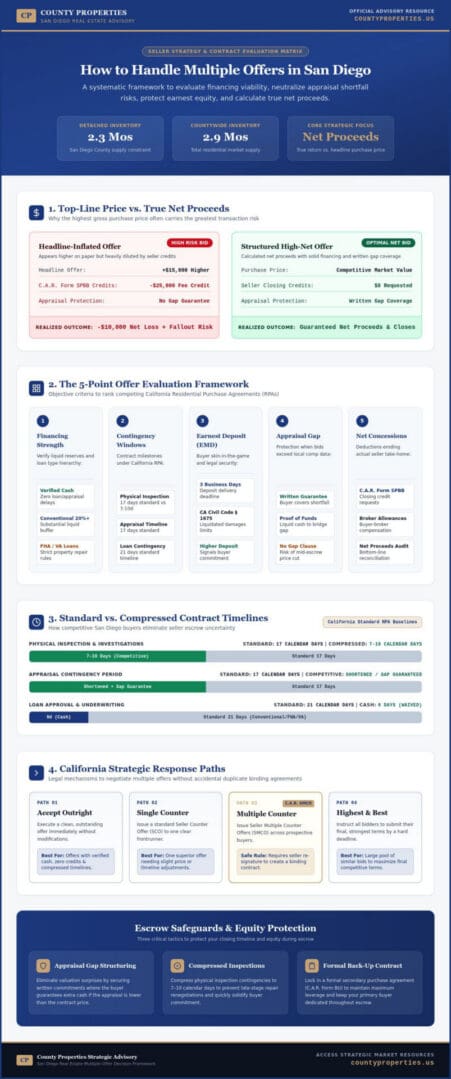
A sky-high offer accompanied by an unstable loan frequently falls apart during appraisal or loan underwriting. Sophisticated sellers evaluate each proposal through the lens of net proceeds rather than gross numbers. Buyer requests for closing credits, repair concessions, and buyer-broker compensation allowances directly diminish your final takeaway.
When comparing competing purchase terms, consider these vital variables:
- Financing Strength: A verified cash offer or a conventional loan backed by 20% down payment carries substantially less fallout risk than high-leverage financing.
- Contract Concessions: Check California Association of Realtors (C.A.R.) Form SPBB requests. An offer that looks $15,000 higher might request $25,000 in fee credits, lowering your actual net return.
- Appraisal Coverage: When buyers push prices well above historical neighborhood comps, ensure they include written appraisal gap guarantees to cover potential valuation shortfalls.
The strongest offer balances acceptable net proceeds with rock-solid execution. Mastering how to handle multiple offers in San Diego means partnering with a steady, veteran advisor who can separate speculative bids from dependable buyers, guiding you safely to the closing table.
The 5-Point Offer Evaluation Framework for Homeowners
Evaluating competing bids demands an objective, standardized matrix that weighs transaction risk directly against the headline price. When you examine incoming contracts side by side, sorting proposals across five core criteria eliminates guesswork and emotional bias. For a comprehensive walkthrough of preparing your property before review day, consult our resource on Selling a Home in Southern California: The Ultimate Guide.
Financing Strength: Cash, Conventional, and Government-Backed Loans
Cash purchases eliminate appraisal hurdles and loan approval delays entirely, providing maximum closing reliability. Conventional loans backed by substantial down payments of 20% or more also offer steady security, proving the buyer possesses liquid reserves to solve minor underwriting hiccups. In contrast, FHA and VA financing involve strict property condition guidelines that can require unexpected, seller-funded repairs before closing. Always insist on cross-checking verified bank statements and speaking directly with the buyer’s loan officer. If you are also lining up financing for your next home purchase or navigating non-traditional lending requirements, discover LoansByJB (The Nuhome Team) to see how specialized mortgage advisors structure complex loan scenarios.
Contingency Periods and Earnest Money Deposits
Standard California Residential Purchase Agreements establish 17 calendar days for physical inspections and appraisals, alongside 21 days for loan approval. Motivated buyers regularly compress these timelines to 7 or 10 days to stand out from the pack. Pay close attention to the earnest money deposit (EMD) delivered into escrow within three business days. Under California Civil Code § 1675, residential liquidated damages are capped at 3% of the purchase price, making a full 3% deposit the gold standard for protecting your equity if a buyer walks away after releasing contingencies.
Appraisal Gap Guarantees and Seller Leasebacks
Mastering how to handle multiple offers in San Diego requires anticipating valuation shortfalls whenever competitive bidding pushes prices above neighborhood comps. A written appraisal gap guarantee commits the buyer to cover a specific cash difference out of pocket if the property doesn’t appraise at the contract figure. Meanwhile, a negotiated seller license-to-remain agreement grants temporary post-close occupancy, giving you the time needed to coordinate your next move without frantic relocation pressure. If you want experienced eyes reviewing these intricate clauses, you can connect with County Properties for dedicated seller guidance.
How to Respond to Multiple Offers: 4 Proven Strategies
Receiving several bids gives you significant leverage, but California contract law requires careful handling. One careless counteroffer can accidentally bind you to sell to two separate parties at the same time. Knowing how to handle multiple offers in San Diego means selecting a response strategy that preserves buyer enthusiasm while protecting your legal position.
Strategy 1: Accept the Cleanest, Strongest Offer Outright
If a buyer presents exceptional pricing, waives major contingencies, and provides rock-solid proof of funds, signing immediately might be your wisest path. An outright acceptance eliminates unnecessary haggling and removes the risk of market fatigue. The moment you execute and deliver that California Residential Purchase Agreement, you secure a legally binding escrow and release all other prospective bidders.
Strategy 2: Counter One Buyer While Holding Others in Reserve
When one proposal stands head and shoulders above the rest except for a minor timeline or price adjustment, you can issue a standard Seller Counter Offer (C.A.R. Form SCO). This grants that specific buyer an exclusive window to accept. Keep in mind that while you negotiate exclusively with them, other prospective buyers may move on to alternate properties. If they accept your counter within the deadline, you are contractually bound.
Strategy 3: Issue California Multiple Counter Offers (C.A.R. Form SMCO)
Sellers often prefer countering two or more prospective buyers simultaneously on customized terms. Using C.A.R. Form SMCO protects you from accidental double-contracting:
- No Automatic Contract: A buyer’s signature accepting your terms does not form an agreement.
- Seller Confirmation: You retain final authority to review accepted counters, sign Paragraph 8, and deliver the finalized agreement to your chosen buyer.
This approach fosters healthy competition while keeping control squarely in your hands.
Strategy 4: Call for Highest and Best Final Offers
If several proposals arrive in a tight cluster, your representative can establish a formal deadline for all parties to submit their ultimate terms. This tactic creates intense competitive urgency, prompting buyers to eliminate contingencies and offer their maximum price. However, aggressive buyers sometimes push back against blind bidding wars, choosing to withdraw instead of guessing what rivals will submit. Determining how to handle multiple offers in San Diego comes down to weighing these psychological dynamics alongside your personal timeline.
Navigating Contingency Risks, Appraisals, and Legal Pitfalls
Managing multiple purchase contracts extends far beyond the initial selection process into active escrow management. Securing an accepted offer simply marks the beginning of contractual performance. Truly understanding how to handle multiple offers in San Diego requires anticipating post-acceptance negotiations, shielding your net equity against repair clawbacks, and keeping your transaction completely compliant with state Fair Housing mandates. For deeper insights into vetting professional representation to guide you through these risks, read our guide on How to Find the Best Real Estate Agent Near You: A Complete Guide.
Handling Low Appraisals and Inspection Repair Demands
A common pitfall in hot seller markets involves buyers who bid aggressively over asking price simply to win the contract, only to demand steep price cuts during physical inspections. In August 2026, San Diego detached homes commanded a median price of $1,120,000, creating an environment where appraisal shortfalls easily arise if competing bids outpace comparable sales.
Protecting yourself against these second-round negotiations requires specific contractual safeguards upfront:
- Defined Appraisal Caps: Require buyers to specify in writing the exact dollar cushion they will pay above appraised value to prevent an automatic price renegotiation.
- Pre-Agreed Repair Limits: Counter offers with explicit terms stating the property is offered as-is, limiting inspection requests strictly to major health and safety items.
- Documented Backup Security: Having a qualified secondary buyer on deck gives you the leverage to reject unreasonable repair credits outright.
The Legal Danger of Buyer Love Letters in California
Prospective purchasers frequently submit emotional, handwritten letters accompanied by family photos to persuade home sellers. While these letters seem harmless, they represent a significant legal liability under California and federal Fair Housing laws. These letters almost always reveal protected demographic characteristics such as race, familial status, religion, marital status, or national origin.
Relying on personal appeals exposes sellers to serious claims of unconscious discrimination from unselected applicants. Professional listing representation requires instructing buyer agents upfront that personal letters will not be delivered or reviewed. Every proposal must be evaluated purely on its financial viability, loan strength, and contract contingencies. If you need trusted advocacy to safeguard your transaction and protect your proceeds, contact County Properties for experienced seller representation.
Selecting Your Winning Contract and Transitioning to Escrow
Final contract selection represents an artful balance between verified purchasing power, realistic closing schedules, and your personal moving needs. While gross numbers catch initial attention, experienced sellers know the winning bid is the one that crosses the finish line on agreed terms. When you master how to handle multiple offers in San Diego, you safeguard your equity while ensuring a seamless handoff to local title and escrow officers. For sellers who are coordinating a relocation or planning to reinvest their proceeds, consulting an experienced agency like Jamoka Properties can provide valuable guidance when buying, selling, or investing in residential real estate.
Clear, professional communication with non-selected agents is equally critical. Delivering prompt, courteous updates preserves goodwill across the brokerage community. If your primary transaction encounters unexpected loan underwriting obstacles, those secondary channels remain open and receptive.
Securing a Back-Up Offer with California Form BUO
Never let qualified, enthusiastic runner-up buyers walk away empty-handed. Utilizing California Association of Realtors (C.A.R.) Form BUO (Back-Up Offer Addendum) allows you to lock in an alternate contract while keeping your primary escrow active. This legal instrument establishes an enforceable secondary position that activates if the primary buyer cancels.
Formalizing a back-up agreement provides several strategic advantages:
- Inspection Leverage: Primary buyers negotiate repair credits far more reasonably when they know another vetted purchaser is waiting in the wings.
- Seamless Continuation: If the primary buyer defaults, you avoid the stigma of a public “back on market” MLS status change by immediately activating your back-up escrow.
- Financial Security: You lock in an agreed price and timeline with the secondary buyer, eliminating the need to re-market your home from scratch.
Partnering with County Properties for Expert Listing Advocacy
Steering through competing contracts, compressed contingency windows, and dense California purchase documents requires a dependable, seasoned ally. Led by industry veteran Arnie Levine, County Properties provides dedicated seller representation across Southern California communities. We evaluate each multi-offer variable cleanly, giving you the clarity needed to make confident, profitable decisions.
Our collaborative approach shields you from predatory renegotiation tactics while keeping your transition on schedule. Whether you’re managing a senior downsizing transition or selling a longtime family property, we bring decades of transaction mastery to protect your net proceeds. Take the guesswork out of how to handle multiple offers in San Diego by partnering with the trusted professionals at County Properties.
Take Command of Your San Diego Sale with Strategic Clarity
Achieving an exceptional sale outcome goes beyond celebrating an impressive headline number. True success means analyzing net proceeds after buyer credits, locking down appraisal gap coverage, and keeping prospective buyers accountable through structured back-up contracts. When you understand how to handle multiple offers in San Diego, you transform high-stakes bidding friction into genuine financial security.
You don’t have to navigate these complex contracts alone. With decades of seasoned listing and negotiation experience in Southern California real estate, our team brings steady guidance to every milestone. We specialize in managing intricate escrow timelines, competitive multi-offer negotiations, and delicate senior downsizing transitions. When you are ready to protect your investment and move forward with absolute confidence, partner with County Properties to maximize your listing equity. Your next chapter begins with the right advocate in your corner.
Frequently Asked Questions
Can a seller counter more than one offer at a time in California?
Yes, a seller can legally counter multiple buyers simultaneously using California Association of Realtors (C.A.R.) Form SMCO. This form prevents you from being contractually bound until you review all signed buyer responses and execute the final confirmation in Paragraph 8. Issuing multiple standard counteroffers without Form SMCO creates severe legal risks, potentially binding you to sell your property to two separate buyers at the same time.
What is the difference between a counter-offer and a multiple counter-offer?
A standard Seller Counter Offer (Form SCO) becomes a legally binding agreement the moment that single buyer signs and returns it. In contrast, a Multiple Counter Offer (Form SMCO) is simply an invitation for several prospective buyers to accept your proposed terms. If several buyers accept, you select the best submission, sign the final confirmation step, and deliver it back to create a contract. That distinction is fundamental when learning how to handle multiple offers in San Diego.
Do I have to accept the highest monetary offer on my home?
No, you are never legally obligated to choose the offer with the highest purchase price. Sellers regularly select proposals with slightly lower headline figures if they feature all-cash funding, shorter inspection timelines, waived contingencies, or larger earnest money deposits. Your goal centers on maximizing net financial proceeds while ensuring closing certainty. An inflated bid that carries weak financing or aggressive credit demands often produces a worse financial outcome.
What happens if the home appraises lower than the winning multiple-offer price?
If the appraisal falls short and the contract retains an appraisal contingency, the buyer can request a price reduction, bring extra cash, or cancel the deal. However, if your agent negotiated an appraisal gap clause upfront, the buyer must cover the agreed difference out of pocket. Without gap coverage, you can either renegotiate the price, split the shortfall, or cancel escrow and turn to an active back-up offer.
Are buyer love letters illegal in California real estate transactions?
Buyer love letters are not explicitly illegal under California law, but standard real estate guidelines strongly discourage them. These letters typically reveal protected demographic details such as religion, race, familial status, or marital status. Choosing or rejecting an offer based on these personal characteristics exposes you to severe liability under federal and state Fair Housing laws. Experienced listing advisors recommend rejecting personal letters entirely and evaluating proposals solely on contractual merit.
Can I keep backup offers active after going into escrow?
Yes, you can accept and maintain formal back-up offers while your primary escrow remains active. Using C.A.R. Form BUO, you establish an enforceable contract that automatically elevates the secondary buyer into the primary position if the initial transaction collapses. This practice gives you immense peace of mind and preserves your negotiation leverage during inspection reviews. Knowing how to handle multiple offers in San Diego means always having a solid backup plan.
How long do buyers have to respond to a multiple counter-offer?
Buyers have until the deadline specified in Paragraph 4 of C.A.R. Form SMCO to deliver their signed acceptance. If no specific expiration time is written into the document, the California standard default is three calendar days after the seller delivers the counteroffer. Sellers can customize this window to 24 or 48 hours to accelerate negotiations and keep competitive momentum alive among competing bidders.