

Ending a professional relationship with your Realtor isn’t a personal failure; it’s a strategic business decision designed to protect your largest financial asset. It’s completely natural to feel a sense of anxiety about the potential legal fallout or the risk of losing a buyer while managing the complexities of the 2026 housing market. You might be worried about “procuring cause” disputes or feel overwhelmed by the latest C.A.R. legal forms. Learning how to fire your real estate agent in California is the first step toward regaining control of your home sale and finding a partner who truly prioritizes your needs.
We understand that you’re looking for a clean break that preserves your financial safety and peace of mind. In this guide, you’ll learn the precise legal steps and professional protocols required to terminate your current agreement safely and confidently. We’ll walk you through the nuances of the mandatory 30 day notice periods, the 90 day limit on buyer-broker agreements, and how to avoid costly commission disputes. This article provides a clear roadmap to transition from a stagnant relationship to a successful, collaborative partnership that helps you achieve your significant life milestones.
Key Takeaways
- Master the legal nuances of the fiduciary bond and learn why most agency terminations are actually the dissolution of a bilateral contract under California Civil Code.
- Discover the exact steps for how to fire your real estate agent in California through a structured process of documenting grievances and requesting a formal Mutual Release.
- Gain clarity on the specific 2026 contractual requirements for Residential Listing Agreements and Buyer Representation forms to ensure your exit is legally sound.
- Identify warning signs of a failing relationship, ranging from persistent poor communication to unethical disclosure practices, before they impact your financial safety.
- Prepare for a successful transition by learning how to interview your next partner and finding a collaborative team that values your long-term aspirations.
Understanding Your Rights: Can You Fire Your Real Estate Agent in California?
You have the absolute right to professional representation that aligns with your financial goals and personal values. Under the California Civil Code, the relationship between a homeowner and a licensee is defined as a fiduciary bond. This isn’t just a casual business arrangement; it’s a high-stakes legal connection where the agent is bound to act in your best interest above all else. When you seek to understand how to fire your real estate agent in California, you’re essentially examining the legal pathways to terminate a bilateral contract that isn’t serving its intended purpose.
The 2026 consumer protection standards have reinforced these rights. These regulations ensure that you aren’t trapped in an unproductive partnership. Understanding the broader real estate transaction process helps you see why these legal safeguards exist. Most importantly, you must recognize that your contract is typically with the brokerage, not the individual agent. If your relationship with a specific person has soured, you often have the option to request a different representative from the same firm before pursuing a full contract cancellation.
The Fiduciary Duty of a California Agent
Your agent owes you three primary duties: loyalty, confidentiality, and full disclosure. These aren’t suggestions; they are mandates. If an agent fails to disclose a material fact about a property or shares your private financial motivations with a third party without consent, they’ve breached their duty. Such a breach provides strong legal grounds for immediate termination. You should refer back to the “Agency Disclosure” form you signed at the start of your journey, which outlines these professional obligations in detail.
At-Will vs. Contractual Relationships
There’s a significant difference between an informal working relationship and a formal C.A.R. agreement. If you haven’t signed a Residential Listing Agreement or a Buyer Representation form, you’re generally in an “at-will” situation and can move on at any time. However, if you are buying a home in Southern California, you’re now navigating a landscape where written representation is a legal prerequisite for property tours. As of January 1, 2026, these buyer-broker agreements are limited to a maximum of 90 days. This shift ensures that you aren’t bound to a single partner for an indefinite period, allowing you to reassess your needs frequently. Knowing how to fire your real estate agent in California involves reviewing these specific dates to determine if your contract is still enforceable or if it has naturally expired under these new consumer-centric laws.
Reviewing the Paperwork: California Listing and Buyer Agreements
To successfully navigate how to fire your real estate agent in California, you must first understand the specific 2026 California Association of Realtors (C.A.R.) forms that govern your relationship. For sellers, the Residential Listing Agreement (RLA) is the standard document that creates an exclusive right to sell. For buyers, the Buyer Representation and Broker Compensation (BRBC) agreement is now mandatory before viewing any property. Both documents are legally binding; however, they contain specific provisions for termination that protect your interests as a consumer.
The standard 2026 C.A.R. forms include a clear termination clause, typically found in the “Cancellation of Listing” or “Termination of Representation” sections. This clause outlines the notice requirements, which usually involve a 30 day written notification for exclusive buyer agreements. Understanding the duties of a real estate broker is essential here. If those professional duties aren’t being met, the contract terms often provide a path for dissolution. If you’re feeling stuck in an unproductive agreement, seeking professional seller representation can help you review these documents with a fresh perspective.
The “Safety Clause” and Commission Protection
Even after a successful termination, a “Safety Clause” or “Protection Period” often remains in effect for 30 to 90 days. This provision ensures the original broker receives credit if you sell your home to a buyer they introduced during the contract term. When selling a home in Southern California, it’s vital to request a written list of “excluded buyers” from your former agent within five days of cancellation. This documentation prevents you from being caught in a double commission trap where both the old and new brokerages claim payment for the same sale.
The Danger of “Procuring Cause” in California
The concept of “procuring cause” is a common source of anxiety during an agent transition. It refers to the agent whose actions set in motion an uninterrupted chain of events that resulted in the sale. If you fire an agent after they’ve already shown you a specific property, they may still have a legal claim to the commission for that house.
To move forward safely, consider these strategies:
- Document everything: Keep a log of every home toured and every offer submitted with your previous agent.
- Notify your new partner: Always provide your new agent with a comprehensive list of every property you viewed with your previous representative.
- Handle mid-escrow splits carefully: Firing an agent while under contract for a specific home requires a formal “Mutual Release” to avoid litigation.
This transparency allows your new team to handle negotiations carefully and protects your financial security during the transition. By following these protocols, you ensure your next move is built on a foundation of clarity and professional trust.
Valid Reasons to Terminate Your Real Estate Relationship
Deciding how to fire your real estate agent in California often comes down to a fundamental breakdown in trust or performance. While the law provides a framework for termination, your decision is usually rooted in practical frustrations that hinder your progress. In the fast-paced San Diego market, poor communication remains the most cited reason for client dissatisfaction. If your agent takes days to return a text or misses critical offer deadlines, they aren’t just being rude; they’re jeopardizing your financial security.
Unethical behavior is another non-negotiable ground for termination. This includes mishandling dual agency or failing to provide required disclosures. The California Real Estate Law book for 2026 outlines strict standards for transparency that every licensee must follow. If you suspect your agent is putting their commission ahead of your best interests, you have a professional obligation to protect yourself. Additionally, a lack of local expertise can be a dealbreaker. An agent who doesn’t understand the specific zoning nuances or market shifts in Southern California neighborhoods can’t provide the expert guidance you deserve.
Finally, your agent’s skills must align with your specific life stage. If you’re an older adult planning a major transition, working with a senior real estate specialist is essential. If your current partner lacks this specialized training, they may struggle to manage the emotional and logistical complexities of your move.
Marketing Failures for Sellers
In 2026, a “lazy listing” is a recipe for a stagnant property. If your home’s online presence features low-quality photos, missing MLS data, or lacks the mandatory disclosures for digitally altered images, your agent is failing you. Modern real estate success requires a sophisticated mix of digital marketing and social media strategy. You should also expect consistent transparency regarding showing feedback. If your agent isn’t providing data-driven insights into market shifts, it’s time to find a partner who utilizes every tool available to secure your sale.
Specialized Situations: Seniors and Distressed Properties
High-stakes transitions require more than just a standard sales approach. If you’re facing a difficult financial situation, you need an agent who understands the methodical steps of foreclosure prevention in California. These cases involve complex legal timelines and sensitive negotiations with lenders. Similarly, seniors moving to assisted living or downsizing need a “turn-key” service that manages every detail with compassion. If your agent seems overwhelmed by these specialized requirements, it’s a clear sign that you need a more experienced and dependable guide to lead the way.
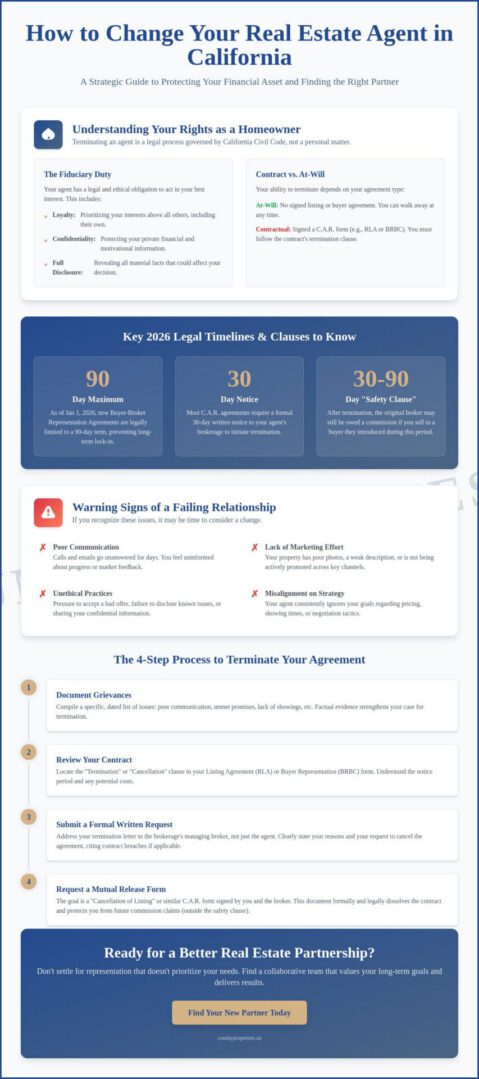
The Step-by-Step Process to Terminate an Agency Contract in California
Moving from a state of frustration to a clean legal break requires a methodical and documented approach. While the emotional weight of a failing partnership can be heavy, the actual process of how to fire your real estate agent in California is governed by specific professional protocols. By following a structured sequence, you protect your financial interests and ensure that your transition to a more compatible partner is seamless and legally sound.
- Step 1: Document your grievances. Before initiating a conversation, compile a clear log of missed deadlines, failed communications, or marketing errors. Concrete examples with specific dates provide the necessary leverage if a dispute arises.
- Step 2: Request a formal meeting. Contact your agent to discuss a “Mutual Release.” In many cases, a professional will recognize the mismatch and agree to part ways amicably to preserve their reputation.
- Step 3: Escalate to the Managing Broker. If the individual agent refuses to release you from the contract, contact the brokerage leadership. Your agreement is legally with the firm, not the person.
- Step 4: Execute C.A.R. Form COL or MT. Use the “Cancellation of Listing” (COL) form for sellers or a “Modification of Terms” (MT) to officially end or alter the relationship.
- Step 5: Secure written confirmation. Ensure you receive a signed copy of the termination from the broker. Without this, the contract remains technically active.
Communicating with the Managing Broker
It’s a common misconception that you’re tied exclusively to one person. Since your contract is technically with the brokerage, the Managing Broker has the authority to reassign you to a different agent within the same firm. This is often the path of least resistance, as it avoids commission disputes while providing you with a fresh start. When you contact the broker, remain professional and focused on the facts.
A simple email template might look like this: “Dear [Broker Name], I am writing to formally request a release from my representation agreement with [Agent Name], effective [Date]. Due to [Specific Reason], I believe a different approach is necessary to reach my goals. I am open to discussing a reassignment within your firm or a full mutual release.” If you’re ready for a partner who prioritizes your success, you can connect with our expert team for a confidential consultation.
Handling the “Mutual Release” and Potential Fees
Securing a clean break sometimes involves negotiating the reimbursement of out-of-pocket marketing expenses. If your agent has already paid for professional staging, high-end photography, or specialized 2026 digital disclosures, they may ask for these costs to be covered before signing the “Cancellation of Listing” (COL) form.
While paying these fees might feel frustrating, it’s often a small price for the freedom to move forward without legal friction. Involving a real estate attorney is usually overkill unless there’s a significant breach of contract or a high-value commission at stake. Most disputes are resolved through the brokerage’s internal mediation or by simply providing the required 30 day written notice. By focusing on a “Mutual Release,” you ensure that both parties can move on with their professional integrity intact.
Moving Forward: How to Transition to a Better Real Estate Partner
Once you’ve successfully navigated the technical steps of how to fire your real estate agent in California, you’ve cleared the path for a more productive and supportive partnership. This transition is your opportunity to reset your expectations and align yourself with a professional who views your success as a shared victory. Finding a new representative isn’t just about finding a salesperson; it’s about securing a dependable guide who understands the specific nuances of the Southern California housing market as it stands in 2026.
Questions to Ask Your New Agent
- What is your specific experience with my property type? Whether you’re selling a family home or managing a senior transition, your agent must have a documented track record in that niche.
- What are your “guaranteed response” times? Communication breakdowns are the leading cause of termination. Ensure your new agent has a clear, written policy for returning calls and texts.
- Can you provide recent client success stories? Verify their reputation by looking for real estate agent near me reviews that highlight reliability and financial safety.
- How do you handle transitions from previous agents? A seasoned professional will know how to manage “safety clause” lists and procuring cause issues with professional courtesy.
The County Properties Difference
At County Properties, we believe that your real estate journey should be defined by optimism and achievement, not anxiety. Arnie Levine and our dedicated team employ a “client-first” philosophy that serves as the central anchor of our identity. We specialize in navigating the most difficult life transitions, including senior real estate moves and foreclosure prevention, with a level of expertise that only comes from decades of experience.
We understand the stress involved in learning how to fire your real estate agent in California, and we’re here to make the next chapter effortless. Our collaborative approach ensures that you’re never dependent on a single person’s schedule. Instead, you’re supported by a close-knit group of professionals committed to your long-term goals. We handle every transition with legal diligence, ensuring that your previous contractual obligations are respected while we work aggressively to secure your future success.
Take Control of Your Real Estate Journey
You deserve a professional partnership built on transparency and mutual respect. Understanding how to fire your real estate agent in California isn’t about creating conflict; it’s about exercising your rights under the California Civil Code to ensure your financial safety. By reviewing your 2026 C.A.R. forms and following a methodical termination process, you can move away from stagnation and toward a successful closing. Your contract is a bilateral agreement designed to protect your interests as much as the broker’s.
At County Properties, we offer the expert guidance you need to navigate these transitions with confidence. Led by Arnie Levine, a seasoned Senior Real Estate Specialist (SRES®), our team specializes in Southern California residential and commercial sales. We provide supportive assistance for complex situations, including foreclosure prevention and short sales, ensuring you have a dependable guide by your side at every step. Experience a higher standard of service—Contact County Properties for a confidential consultation. Your next chapter in the California market starts with a partner who truly prioritizes your personal goals and long-term success.
Frequently Asked Questions
Can I fire my realtor after signing a 6-month listing agreement?
Yes, you can terminate a six-month listing agreement, but you must follow the cancellation procedures outlined in your contract. Most standard C.A.R. forms allow for termination if the agent isn’t meeting their fiduciary duties. You should document any performance failures and request a formal release in writing. While the contract is binding, brokers often prefer an amicable split over a forced, unproductive relationship.
Do I have to pay my real estate agent if I cancel the contract?
You typically don’t owe a full commission unless a sale is completed, but you may be responsible for specific marketing reimbursements. Some agreements include a clause requiring you to pay back costs for professional photography or staging if you cancel early. Review your specific contract to see if these fees were waived or if they become due upon your request for termination.
What happens if I fire my agent while we are under contract/in escrow?
Firing an agent during escrow is a high-stakes move that usually requires a “Mutual Release” signed by all parties to avoid legal disputes. Since the agent’s work led directly to the active contract, they have a legal claim to the commission under procuring cause rules. It’s often safer to wait until the transaction closes or negotiate a commission split between the outgoing and incoming agents.
Can I switch real estate agents if I already made an offer on a house?
You can switch agents after making an offer, but the original agent will almost certainly be considered the procuring cause of the sale. This means you might still owe them a commission even if a new agent finishes the deal. If you’re learning how to fire your real estate agent in California under these circumstances, it’s vital to disclose the previous offer to your new representative immediately.
Is there a specific form to fire a real estate agent in California?
Yes, the California Association of Realtors provides specific forms like the Cancellation of Listing (COL) to formalize the end of your relationship. For buyers, the Modification of Terms (MT) form is often used to cancel or change the duration of a representation agreement. Using these official forms ensures your termination is legally documented and recognized by the brokerage and the local MLS.
Can a broker refuse to let me out of my buyer representation agreement?
A broker can technically refuse to release you because a signed representation agreement is a legally binding contract. However, most reputable California brokers value their community standing and will agree to a release if the relationship has become untenable. If they won’t release you entirely, they will often suggest reassigning your case to a more compatible agent within the same firm.
What is the “Safety Clause” in a California real estate contract?
The “Safety Clause” is a protection period that entitles the broker to a commission if you sell your home to a buyer they introduced during the listing term. This period usually lasts between 30 and 90 days after the contract ends. To protect yourself, always request a written list of protected buyers from your agent within five days of your contract termination.
How do I fire an agent who is also a friend or family member?
Handling a transition with a friend or family member requires a blend of honesty and business-focused communication. Explain that your decision is based on specific transactional needs, such as a requirement for a senior real estate specialist or a foreclosure expert. By keeping the conversation professional and focused on your financial goals, you can protect the personal relationship while securing the expert guidance you need.