

In 2026, the difference between a record-breaking exit and a legal nightmare often comes down to a single disclosure or a missed 1031 exchange deadline. You likely feel the weight of shifting regulations as you research how to sell a commercial property in California, especially with new SB 79 transit-density rules and capital gains taxes that can climb to 13.3 percent. Selling a property here is no longer just a transaction. It is a high-stakes journey where you deserve a partner who values your financial safety as much as you do.
This strategic guide provides a clear, professional framework to maximize your asset’s value while insulating you from post-closing liabilities. We understand the stress of long due-diligence periods and the anxiety surrounding high-value exits, so we’ve designed this path to give you total confidence in your decisions and your future.
We will walk you through the 2026 “Dual-Track” strategy, covering everything from navigating FinCEN’s new all-cash reporting rules to leveraging AB 1050 to unlock your property’s highest redevelopment potential. By the end of this guide, you will have the tools to achieve a successful 1031 exchange and move toward your next personal milestone with absolute peace of mind.
Key Takeaways
- Identify how the 2026 market bifurcation affects your asset class to ensure your property is positioned for high-liquidity buyers.
- Build a robust “Commercial Disclosure Package” and secure Estoppel Certificates to create a defensive shield against potential post-sale litigation.
- Master the specific framework for how to sell a commercial property in California by focusing on Net Operating Income (NOI) rather than simple aesthetics.
- Learn to draft a protective Letter of Intent (LOI) that maintains your leverage and prevents buyer “gazumping” during the long due-diligence period.
- Leverage professional seller representation to execute a seamless 1031 exchange and achieve a clean, high-value exit from the California market.
The 2026 California Commercial Real Estate Landscape
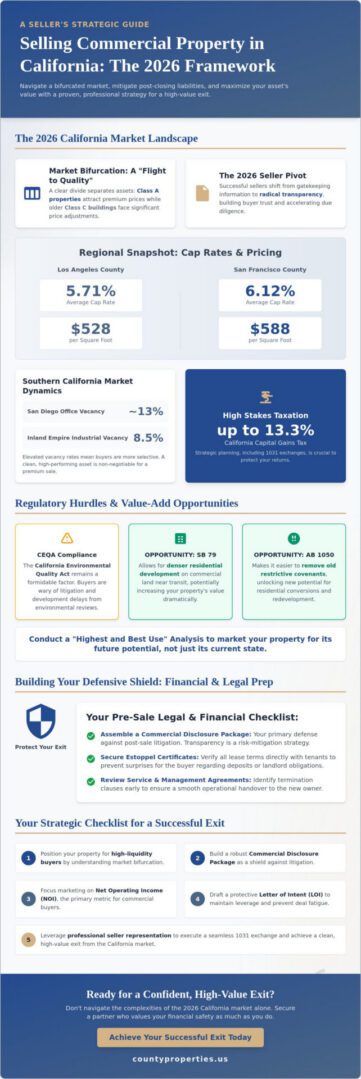
Selling commercial property in this state requires more than a simple listing; it demands a deep understanding of a bifurcated market. In 2026, we’re seeing a clear “flight to quality” where Class A assets attract premium prices while older Class C buildings often require significant price adjustments. Unlike residential sales, commercial transactions are driven by rigorous financial metrics and complex state oversight. The California Department of Real Estate (DRE) maintains strict standards for these transfers, but the true challenge lies in aligning your property’s performance with current buyer expectations.
Interest rates continue to influence capitalization (Cap) rates across the state. As of early 2026, Los Angeles County shows an average cap rate of 5.71% with prices around $528 per square foot. In contrast, San Francisco County sees cap rates closer to 6.12% with prices averaging $588 per square foot. These figures highlight why you must tailor your approach based on your specific region. While Silicon Valley thrives on AI-driven demand for R&D space, Southern California is navigating a normalization of the industrial sector after years of record-breaking growth. Understanding these nuances is the first step in learning how to sell a commercial property in California for its true market value.
Market Dynamics in Southern California
In regions like San Diego and the Inland Empire, the market is shifting. Office vacancy rates in San Diego have remained elevated at approximately 13%, which places more pressure on sellers to prove the long-term viability of their tenant rolls. Meanwhile, the industrial vacancy rate in the Inland Empire reached 8.5% in early 2026, suggesting that buyers are becoming more selective. Your negotiating power now depends on your ability to present a clean, high-performing asset. The 2026 Seller Pivot represents a fundamental shift where successful owners move away from gatekeeping information and toward radical transparency to build buyer trust early. Working with a specialized real estate agent near me can help you interpret these local shifts and position your property to attract high-liquidity investors who are ready to close.
Regulatory Hurdles: CEQA and Local Zoning
The California Environmental Quality Act (CEQA) remains a formidable factor in any commercial sale. Buyers are increasingly wary of potential litigation or development delays tied to environmental reviews. Furthermore, new laws like SB 79, effective July 1, 2026, allow for denser residential development on commercial land near transit stops. This can dramatically increase your property’s value if you conduct a “highest and best use” analysis before hitting the market. Similarly, AB 1050 now makes it easier to remove old restrictive covenants that once blocked residential conversions. By identifying these opportunities early, you can market a property not just for what it is today, but for its future redevelopment potential under modern San Diego zoning ordinances. This proactive approach is essential for anyone mastering how to sell a commercial property in California in a high-stakes environment.
Financial and Legal Preparation: Building Your Defensive Shield
Financial readiness is your strongest defense against the complexities of the 2026 market. When you’re determining how to sell a commercial property in California, you aren’t just selling a building; you’re selling a verified stream of income and a clean legal history. This starts with a comprehensive Commercial Disclosure Package. Unlike residential sales, commercial disclosures require a deep dive into every operational facet to prevent post-sale litigation. We believe that transparency isn’t just a courtesy, it is a risk-mitigation strategy that protects your legacy.
One critical tool often overlooked is the Estoppel Certificate. These documents verify the terms of existing leases directly with tenants, ensuring a buyer won’t face surprises regarding security deposits or unfulfilled landlord promises after closing. You should also review all property management and service agreements. Identifying termination clauses early allows for a smoother transition or a clean break before the new owner takes over. Understanding these obligations is part of the professional mastery required for high-stakes transactions.
Legal compliance involves more than just internal paperwork. A preliminary title report is essential to uncover hidden liens or encumbrances that could derail a deal. Additionally, most institutional lenders will require a Phase I Environmental Site Assessment (ESA). If this report flags potential contamination, a Phase II ESA involving soil or groundwater sampling becomes necessary. Adhering to the standards found in California Government Code § 25515.1 and other state regulations ensures your transaction remains on solid legal ground.
The 1031 Exchange: Deferring Capital Gains
Wealth preservation is a top priority for most sellers in 2026. A 1031 Exchange allows you to defer capital gains taxes by reinvesting your proceeds into a “like-kind” replacement property. However, the clock starts ticking the moment you close. You have exactly 45 days to identify potential properties and 180 days to complete the purchase. Executing this exchange correctly is a vital part of the process for anyone learning how to sell a commercial property in California while protecting their long-term equity. For a deeper look at high-value reinvestment strategies, see our Commercial Real Estate Southern California: An Investor’s Guide.
Essential Documentation Checklist
A structured approach to your data room builds buyer confidence. You’ll need to organize the following:
- Three years of certified Profit and Loss (P&L) statements and tax returns.
- Current rent rolls with detailed lease expiration schedules and escalation clauses.
- Updated ADA compliance documentation to mitigate accessibility liability.
Preparing these details early helps you maintain a position of strength during negotiations. If you feel overwhelmed by the technical requirements, our team can provide expert seller representation to guide you through every step of this journey with care and precision.
Positioning for Maximum Value: Strategy vs. Luck
A successful sale isn’t the result of a fortunate market swing; it’s the outcome of a calculated value-positioning strategy. When you’re evaluating how to sell a commercial property in California, you must shift your focus from emotional appeal to mathematical performance. In the commercial sector, investors aren’t just buying a building. They’re buying a predictable stream of Net Operating Income (NOI). While aesthetics play a role in first impressions, your financial statements are what ultimately dictate the final purchase price. By identifying “Value-Add” opportunities, such as reducing redundant operating expenses or restructuring under-market leases, you can significantly boost your asset’s valuation before the first tour occurs.
Addressing deferred maintenance is equally vital for protecting your price point. If a buyer identifies a failing HVAC system or a roof nearing the end of its life, they’ll use those costs as leverage points to “re-trade” or lower the price during escrow. By resolving these issues upfront, you remove the buyer’s ability to discount your property’s worth. It’s also essential to clarify exactly which assets are included in the transaction. When your sale involves specialized equipment, intellectual property, or trade names, consulting the California Department of Real Estate’s guide on business opportunity sales helps ensure you’re following proper agency and disclosure protocols for these unique components.
Optimizing the Income Stream
The strength of your leases is the heartbeat of your property’s value. In 2026, buyers are looking for resilience against inflation, which makes “Triple Net” (NNN) leases particularly attractive compared to Gross leases. Under an NNN structure, the tenant handles taxes, insurance, and maintenance, which protects your bottom line from rising costs. You should evaluate every in-place lease to see if they align with current 2026 market rates. A mere 5% increase in your Net Operating Income can translate into hundreds of thousands of dollars in added property value depending on local cap rates. This methodical approach ensures you aren’t leaving money on the table when you finally decide how to sell a commercial property in California.
Curb Appeal and Physical Inspection
Navigating the Transaction: From Agreement to Closing
Once you’ve identified a qualified buyer, the transaction moves from marketing to the rigorous mechanics of legal transfer. This phase begins with the Letter of Intent (LOI). While often non-binding, the LOI outlines the essential terms of the deal; it serves as the blueprint for the formal Purchase and Sale Agreement (PSA). You must ensure the LOI protects your interests by clearly defining the due diligence timeline and the “Free Look” period. Managing this timeline is crucial to prevent buyer “gazumping,” where a party attempts to renegotiate the price late in the process after tying up your property for weeks. We act as your steady, guiding presence during these high-stakes moments to ensure your leverage remains intact.
The Escrow process in California involves a high level of coordination. Your broker, attorney, and title company must work in unison to satisfy all specific California contingencies. In 2026, this includes adhering to new federal reporting rules. As of March 1, 2026, FinCEN mandates additional reporting for all-cash transactions involving entities like LLCs or trusts. Navigating these requirements is a standard part of how to sell a commercial property in California, ensuring your exit is both high-value and legally compliant. By staying ahead of these regulatory shifts, you protect yourself from delays and potential post-closing liabilities.
The Due Diligence Gauntlet
During the inspection period, buyers perform a deep dive into your “Books and Records.” They’ll scrutinize every service contract, tax bill, and insurance policy you’ve organized. You must manage site visits with extreme care to avoid disrupting your business operations. Under SB 1103, which offers protections for qualified small business tenants, maintaining positive relations during inspections is more important than ever. If you’re also managing residential assets alongside your commercial portfolio, you might find our insights on Selling a Home in Southern California: The Ultimate Guide helpful for understanding broader market sentiments.
Closing and Handover
The final steps of the transaction require meticulous attention to detail. Closing involves pruning the prorations to ensure utilities, property taxes, and rents are accurately credited between you and the buyer. You must also satisfy any outstanding liens to deliver a clean title, fulfilling your professional obligation to the new owner. The physical handover is the culmination of your journey. Providing the buyer with a complete package of keys, security codes, and organized tenant files ensures a professional transition. This methodical approach reflects your commitment to a clean exit and the fulfillment of your long-term personal goals.
If you want a partner to navigate these complex negotiations and ensure every detail is handled with care, we invite you to explore our professional Seller Representation services.
Partnering for Success: Why Seller Representation Matters
Local market nuances often dictate the difference between a standard sale and a record-breaking exit. A specialized real estate agent near me provides the localized knowledge necessary to navigate regional challenges that broader firms might overlook. We act as your dependable guide, managing the intense due-diligence periods and legal hurdles discussed earlier in this guide. Our goal is to ensure you feel secure and supported through every difficult transition, turning a high-stakes situation into a shared success story.
For many property owners, the 2026 landscape is a time for significant life milestones. We specialize in assisting seniors who are looking to exit complex commercial portfolios and transition into more manageable residential assets or liquid wealth. This specialized commercial-to-residential transition requires a sensitive, methodical hand. We understand that your property represents years of dedication, and we’re committed to honoring that legacy by delivering a clean, high-value exit that minimizes your post-closing liability.
The Power of Expert Guidance
Arnie Levine and our dedicated team bring the perspective of a seasoned veteran to your transaction. We have navigated various market cycles and understand that true success is built on relational professionalism rather than simple transactional speed. By integrating our Senior Real Estate Specialist expertise, we provide a holistic service model that addresses both your financial goals and your personal needs. We don’t just facilitate a sale; we act as an active partner in your progress, ensuring every legal and situational challenge is handled with professional mastery.
Your Next Steps to a Successful Sale
Your journey toward a successful exit begins with a clear understanding of your property’s current standing. We invite you to schedule a confidential portfolio review and property valuation to see how the 2026 market impacts your specific asset. We will develop a custom marketing plan tailored to the high-liquidity buyer profiles currently active in the California market. This structured, logical progression ensures you move forward with absolute certainty. We are ready to help you achieve the clean, high-value exit you deserve. Partner with County Properties for a high-value sale today and let us guide you home.
Secure Your Financial Future in the 2026 Market
Success in today’s commercial landscape requires more than just a list of features; it demands a defensive legal shield and a proactive financial strategy. You’ve learned that maximizing your asset’s value hinges on optimizing Net Operating Income and navigating the intricate due diligence gauntlet with precision. By mastering the process of how to sell a commercial property in California, you position yourself for a clean exit and a seamless transition to your next life milestone. Whether you’re executing a complex 1031 exchange or downsizing a senior investment portfolio, your choice of representation defines your final outcome.
Led by Arnie Levine, a seasoned veteran in Southern California real estate, our team provides the professional mastery you need to navigate these high-stakes decisions. We take pride in our collaborative, service-centric approach and our deep roots in the San Diego community. You don’t have to face these regulatory hurdles alone. We invite you to Request a Professional Commercial Property Valuation from County Properties to begin your journey with a dependable guide by your side. Your hard-earned equity deserves the protection of an experienced ally who values your long-term success as much as you do.
Frequently Asked Questions
How long does it typically take to sell a commercial property in California?
A typical commercial sale takes between six and twelve months to complete. This timeline includes the initial marketing phase, negotiating the Letter of Intent, and a due diligence period that usually lasts 30 to 90 days. Complex properties or those requiring environmental remediation may extend this window. We act as your dependable guide to keep the process moving efficiently toward your desired exit date.
What are the mandatory disclosures for commercial sellers in California?
Sellers must disclose all material facts that could affect the property’s value or a buyer’s decision. This includes known environmental hazards, structural issues, zoning violations, and any pending litigation or lease disputes. Providing a robust disclosure package is a critical step in how to sell a commercial property in California because it builds trust and creates a defensive shield against post-sale legal challenges.
Can I sell my commercial property “As-Is” in San Diego?
You can sell a property “As-Is,” but this doesn’t waive your legal obligation to disclose known defects. An “As-Is” clause simply states that you won’t pay for repairs found during inspections. In the 2026 San Diego market, most buyers will still use inspection findings to negotiate price credits. We help you decide which repairs are worth addressing upfront to maintain your negotiating leverage.
How is the value of a commercial building calculated in 2026?
Valuation is primarily determined by the Income Approach, which uses the property’s Net Operating Income (NOI) divided by the current market capitalization rate. In 2026, buyers also weigh the impact of new laws like SB 79 that allow for denser development near transit. We provide a professional valuation that considers both your current income stream and the property’s future redevelopment potential under modern zoning rules.
What is the difference between a Phase I and Phase II Environmental Study?
A Phase I study is a non-invasive research report that examines historical records and the site’s physical condition to identify potential contamination. If this report finds “Recognized Environmental Conditions,” a Phase II study becomes necessary. The Phase II involves actual soil, vapor, or groundwater sampling. Most lenders require these studies to ensure the property is a safe asset and to protect all parties from environmental liability.
Do I need a real estate attorney to sell commercial property in California?
California law doesn’t require an attorney to close a sale, but having legal counsel is highly recommended for complex commercial transactions. Attorneys provide an extra layer of protection by reviewing the Purchase and Sale Agreement and ensuring all contingencies favor your interests. We work collaboratively with your legal team to ensure a smooth, professional transition that meets all state and federal requirements.
How does a 1031 Exchange work for commercial real estate?
A 1031 Exchange allows you to defer capital gains taxes by reinvesting the proceeds from your sale into a “like-kind” replacement property. You have exactly 45 days after your close to identify potential properties and 180 days to finalize the purchase. This strategy is essential for anyone learning how to sell a commercial property in California while aiming to preserve wealth and fulfill long-term personal financial goals.
What happens if a tenant has a “Right of First Refusal” (ROFR)?
A Right of First Refusal gives your tenant the legal opportunity to match any offer you receive from an outside buyer. You must notify the tenant of the offer terms and allow them a specific timeframe to exercise their right to buy the property. We help you review your existing leases early in the process to identify these clauses and manage the notification process without disrupting your transaction.