

What if the most daunting part of selling your home isn’t finding a buyer, but figuring out where you’ll sleep the night after escrow closes? In a market where the median home price has reached $914,810, the pressure to time your move perfectly is immense. Utilizing a seller rent back agreement California can eliminate the fear of being homeless between closings and provide the breathing room you need. You shouldn’t have to choose between a profitable sale and the security of a stable transition. It’s natural to feel anxious about the state’s strict tenant laws, especially with eleven new regulations impacting the market this year.
We’re here to help you master the legal nuances of post-settlement occupancy so you can move on your own terms. This guide provides a clear, strategic roadmap for using the latest C.A.R. forms to create a legally airtight arrangement. You’ll learn how to navigate the 2026 habitability standards, distinguish between a temporary license and a formal tenancy, and ensure your transition to a new Southern California property is as smooth as the sale itself. By the end of this article, you’ll feel confident in your ability to maximize your profit without the pressure of an immediate move-out.
Key Takeaways
- Understand the vital distinction between C.A.R. forms SIP and RLAS to ensure your seller rent back agreement California creates a license to occupy rather than an accidental tenancy.
- Learn how to leverage a post-settlement stay as a powerful negotiation tool that can help you win multiple-offer scenarios while securing a stress-free transition.
- Navigate the 2026 legal landscape with confidence by mastering the new habitability requirements and security deposit return rules for post-closing occupancy.
- Protect your financial interests by establishing clear terms for holdover penalties and possession fees that safeguard both the buyer and the seller.
- Discover the methodical approach used by seasoned professionals to align your selling and buying timelines, eliminating the need for temporary storage or a double move.
The ‘Double Move’ Dilemma: Why California Sellers Need Rent-Backs in 2026
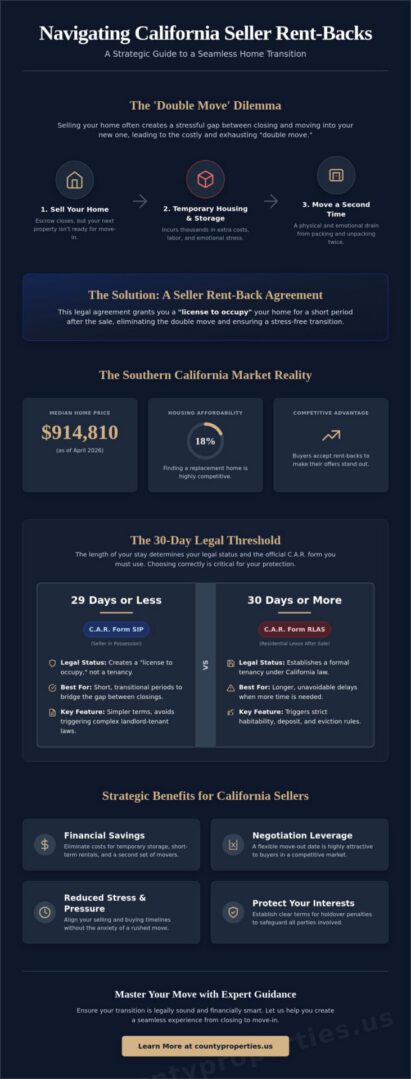
Selling your home is a major milestone, but it often creates a stressful logistical gap. You’ve signed the closing papers, yet your next house isn’t quite ready for move-in. This is where a seller rent back agreement California becomes your most valuable asset. It’s essentially a license that allows you to remain in your home for a short period after the buyer takes ownership. This arrangement is a localized version of a Leaseback, providing you with the legal right to stay put while you finalize your next move. It ensures you aren’t rushed out the door before your next chapter is ready to begin.
The “Double Move” is a financial and emotional drain that many families overlook during the excitement of a sale. Moving your belongings into temporary storage and then into a short-term rental costs thousands of dollars in extra labor, rental fees, and insurance. By negotiating a rent-back, you save that money and avoid the physical exhaustion of packing twice in one month. When selling a home in Southern California, staying in your property post-closing gives you the leverage to wait for the perfect replacement home without the ticking clock of a moving truck parked in your driveway.
Market Dynamics: The 2026 Southern California Reality
The 2026 market presents unique challenges for local sellers. With the median home price in California reaching $914,810 as of April 2026, and housing affordability sitting at just 18%, finding a replacement home is a competitive race. Low inventory levels mean you might not find your next residence as quickly as your current one sells. We’re seeing a significant rise in “contingent on seller finding replacement home” clauses to protect homeowners. Buyers are increasingly willing to accept a seller rent back agreement California because it makes their offer stand out in multiple-bid scenarios. They realize that giving you time is often more valuable than a slightly higher purchase price.
Senior Transitions and Lifestyle Changes
For seniors, the pressure of a quick move-out can be overwhelming. Transitioning to assisted living or downsizing requires a methodical, gentle approach that doesn’t prioritize speed over comfort. A senior real estate specialist understands how to coordinate these delicate timelines. We focus on reducing the physical stress of the move by ensuring you have a comfortable buffer period. A rent-back allows you to transition at a pace that respects your emotional well-being and ensures every heirloom is handled with care; it’s about providing a steady hand during a high-stakes life change.
Decoding the Paperwork: C.A.R. Form SIP vs. RLAS
In the complex landscape of Golden State real estate, precision in documentation is your best defense. You shouldn’t settle for a generic rental agreement when a specialized seller rent back agreement California requires specific legal protections. The California Association of Realtors (C.A.R.) provides standardized forms that were significantly updated on June 24, 2025, to address evolving market needs. Using these forms ensures your transition is governed by industry-standard language that protects both your equity and your peace of mind. Choosing the wrong document can inadvertently grant you tenant rights you didn’t intend to claim, or leave the buyer with unexpected liabilities.
The most critical factor in your paperwork is the 30-day threshold. This isn’t just a calendar date; it’s a legal boundary that changes the nature of your stay. If you remain in the home for 29 days or less, you’re typically granted a “license to occupy.” Once you hit 30 days, California law views you as a tenant. This shift triggers a host of protections and obligations, including habitability requirements and specific eviction procedures, that can catch unprepared homeowners off guard. Navigating these nuances is much simpler when you have expert seller representation to guide your choices.
Form SIP: Seller in Possession (Under 30 Days)
Form SIP is designed for short-term stays where the seller remains for 29 days or less. It clarifies that no tenancy is created, which keeps the arrangement simple and low-risk for both parties. You’ll need to agree on a daily rate, often based on the buyer’s new PITI (Principal, Interest, Taxes, and Insurance), and a security deposit held in escrow. Because it establishes a license rather than a lease, Form SIP allows the buyer to avoid the lengthy and expensive formal eviction process required for actual tenants. This form is the preferred choice for most Southern California transactions because it maintains the “sales” nature of the deal.
Form RLAS: Residential Lease After Sale (30 Days or More)
When your stay extends to 30 days or more, Form RLAS becomes mandatory. At this point, the buyer becomes a landlord and you become a tenant under California law. This means your agreement is subject to local rent control and “just cause” eviction ordinances. You must also consider lender restrictions; most lenders limit these stays to a maximum of 60 days for owner-occupied loans. If you stay longer, the buyer’s interest rate might increase because the property is reclassified as non-owner-occupied. Additionally, you’ll be subject to the 21-day security deposit return rule and new 2026 habitability standards regarding mandatory working appliances.
Legal Risks and Protection: Navigating the ‘Seller-Tenant’ Relationship
Transitions are high-stakes moments that require a steady hand and a clear set of rules. When you enter into a seller rent back agreement California, the legal relationship between you and the buyer shifts overnight. You’re no longer the owner; you’re either a licensee or a tenant. This change brings specific risks that both parties must manage with professional care. The California Department of Real Estate provides the regulatory framework to ensure these transitions remain fair and transparent. Understanding these boundaries is the first step toward a secure, stress-free move.
Maintenance responsibilities often become a point of confusion during a post-settlement stay. If the water heater breaks on day ten, who pays for the repair? In a short-term SIP arrangement, the seller typically maintains the property in its closing-day condition. However, if your stay exceeds thirty days under an RLAS agreement, the buyer becomes a landlord. Under 2026 standards like AB 628, landlords must ensure the property remains habitable, which includes providing working stoves and refrigerators. Clear communication about these “what-if” scenarios prevents disputes and protects your financial interests.
Insurance Nuances: HO-3 vs. Renter’s Policies
Your existing homeowner’s insurance (HO-3) is designed for owner-occupants. The moment the title transfers, that policy may no longer provide the coverage you expect. Sellers should obtain a renter’s insurance policy to protect their personal belongings and liability during the rent-back period. Simultaneously, the buyer must transition to a “Landlord” or “Non-Owner Occupied” policy. Without these specific updates, a fire or flood could leave both parties exposed to significant financial loss. We always recommend confirming these details with your insurance provider before the close of escrow to ensure there’s no gap in protection.
Holdover Penalties and Security Deposits
The fear that a seller won’t vacate on time is a common anxiety for buyers. To mitigate this risk, professional agreements include “holdover” penalties. These are daily rates, often significantly higher than the standard rent, designed to incentivize a timely move-out. These penalties are usually deducted from the security deposit if the seller stays past the agreed date. California law is very specific about these funds; the buyer must return the security deposit within 21 calendar days of the seller vacating. If deductions are made for damages, an itemized statement is required for any cost exceeding $125. Documenting the home’s condition with photos at both closing and move-out is the best way to ensure a fair return of your funds.
Strategic Negotiation: Winning a Rent-Back in California
Negotiation in a high-stakes market isn’t just about the final sales price. It’s about the terms that allow you to transition with dignity and financial security. In the current landscape, a seller rent back agreement California serves as a powerful “sweetener” that can tip the scales in your favor. Buyers are often willing to be flexible on move-in dates if it means their offer is the one you ultimately accept. You can leverage this desire to win by structuring a deal that prioritizes your timeline, ensuring you aren’t forced into a rushed move before your next home is ready.
When calculating the daily rate for your stay, most parties look at the buyer’s PITI (Principal, Interest, Taxes, and Insurance). With 30-year fixed mortgage rates in California averaging between 6.49% and 6.95% in June 2026, these costs are significant. For example; a buyer purchasing a $775,000 home at a 6.95% interest rate faces a daily PITI of nearly $185. Understanding these numbers helps you negotiate a fair rate that reflects the Southern California housing market trends. It ensures your agreement is grounded in financial reality rather than guesswork.
The ‘Free Rent-Back’ Strategy
Coordinating with Your Next Purchase
Timing is everything when you are buying a home in Southern California while simultaneously selling your current one. A well-structured rent-back allows you to use the proceeds from your sale to bolster your next down payment without the stress of an immediate move-out. You can align your move-out date perfectly with the close of escrow on your new property. This flexibility is vital in a volatile 2026 market where delays in construction or financing are common. We can help you build these strategic buffers into your contract to keep your family’s transition seamless. If you’re ready to secure your move, contact us for expert seller representation tailored to your unique timeline.
The County Properties Advantage: Seamless Transitions with Arnie Levine
Navigating a complex real estate transaction requires more than just a signature on a contract. It requires a steadfast partner who understands the high stakes of your personal journey. The Arnie Levine approach is built on a foundation of reliability and financial safety, ensuring that you feel secure during every phase of your move. When you choose our team for seller representation, you aren’t just getting a listing agent. You’re gaining a collaborative ally that specializes in managing the intricate sell-and-buy timeline for San Diego families. We ensure that every seller rent back agreement California is executed with the precision required by the 2026 legal landscape, protecting your equity and your peace of mind.
Local expertise is essential when dealing with California’s evolving real estate regulations. Our team stays at the forefront of industry changes, from the latest C.A.R. form revisions to the 2026 habitability standards. We act as a steady, guiding presence, focusing on navigating you through complex processes with care rather than using high-pressure tactics. This methodical assistance allows you to focus on your future while we handle the technical details of your post-settlement occupancy.
Personalized Service for Seniors and Distressed Properties
We recognize that some transitions are more delicate than others. Whether you’re navigating a senior real estate transition or seeking short sale and foreclosure prevention, our service-centric model prioritizes your family’s unique situation. We offer tailored solutions that include:
- Empathetic Guidance: We provide supportive assistance for seniors moving to assisted living or downsizing, ensuring the move happens at a comfortable pace.
- Crisis Management: Our expertise in foreclosure prevention helps homeowners find a path forward with dignity and financial stability.
- Collaborative Success: We work closely with all parties to ensure your seller rent back agreement California aligns with your long-term personal goals.
Your 2026 Real Estate Roadmap
Our process is structured and logical, moving you from an initial property valuation to a successful post-closing move-out. We don’t believe in one-size-fits-all solutions. Instead, we create a personalized roadmap that accounts for the current 18% affordability rate and high inventory pressures in Southern California. San Diego sellers trust County Properties because we bridge the gap between a successful sale and a smooth arrival at your next destination. We are committed to your success, acting as a seasoned mentor through every market cycle. If you’re ready to master your transition and maximize your profit without the stress of a double move, we’re here to lead the way.
Contact County Properties for a Strategic Home Sale Consultation
Take Command of Your Moving Timeline Today
Mastering the legal nuances of a seller rent back agreement California turns a potentially stressful move into a controlled, strategic transition. By selecting the correct C.A.R. disclosures and understanding the 30-day threshold, you protect your equity while securing the time needed to finalize your next property purchase. This methodical approach ensures you avoid the physical and financial burden of a double move; it allows you to focus on the excitement of your new chapter without the pressure of an immediate move-out.
Led by Arnie Levine, a dedicated Senior Real Estate Specialist with over 30 years of Southern California market experience, our team acts as your dependable guide through these high-stakes transitions. We are experts in C.A.R. legal disclosures and protections, ensuring your agreement is airtight and your interests are prioritized. You don’t have to navigate these complex regulations alone. Request a Professional Market Value and Strategic Sale Analysis today to begin your journey toward a successful home sale. We look forward to helping you achieve your significant life milestones with confidence and absolute peace of mind.
Frequently Asked Questions
What is a seller rent-back agreement in California?
A seller rent-back agreement is a contractual arrangement where the seller retains possession of the property after the legal transfer of ownership. This allows you to stay in your home for a short period while finalizing your next move. It serves as a vital bridge between your closing date and your actual move-out day, providing much-needed stability during a major life transition.
How long can a seller stay in a house after closing in California?
Sellers can typically stay for a period ranging from a few days up to 60 days. While the duration is negotiable between the parties, staying beyond two months often triggers lender complications. If you stay longer, the property might be classified as an investment home; this could negatively impact the buyer’s mortgage interest rate and loan terms.
Does a rent-back agreement make the seller a tenant?
It depends entirely on the length of the stay. If you remain in the property for 30 days or more, you are legally considered a tenant under California law. For stays under 30 days, you are typically viewed as a licensee. This distinction is vital because formal tenants receive full protections under state habitability and eviction statutes that licensees don’t enjoy.
What happens if a seller won’t leave after the rent-back period?
If a seller refuses to leave, the buyer must follow the formal legal eviction process to regain possession of their property. To prevent this scenario, professional agreements include daily holdover penalties that are often double or triple the standard daily rate. These fees are typically deducted from the security deposit to compensate the buyer for the delay and inconvenience.
Is a security deposit required for a California rent-back?
A security deposit is standard practice to protect the buyer’s new investment. In a seller rent back agreement California, this deposit is typically held in escrow and released only after a successful final walkthrough. This ensures the property is delivered in the same condition it was in at the close of escrow, providing financial safety for both parties.
Who pays for utilities during a seller rent-back?
Sellers are almost always responsible for all utility payments during the rent-back period. You should keep the accounts in your name until the day you officially vacate the premises. This prevents any service interruptions for you and ensures the buyer isn’t paying for your water, electricity, or gas while you are still residing in the home.
Can a buyer’s lender deny a rent-back agreement?
Yes, lenders can and do place strict limits on the length of a post-closing occupancy. Most owner-occupied loans require the buyer to take physical possession within 60 days of closing. If the agreement exceeds this limit, the lender may reclassify the property as a rental; this often requires a larger down payment and a higher interest rate for the buyer.
What is the C.A.R. SIP form and when is it used?
The C.A.R. SIP form is the Seller in Possession addendum specifically used for occupancies lasting 29 days or less. It is designed to grant a license to occupy rather than creating a formal tenancy. This form is essential because it helps the buyer avoid the more restrictive landlord-tenant laws that apply to longer residential leases in California.