

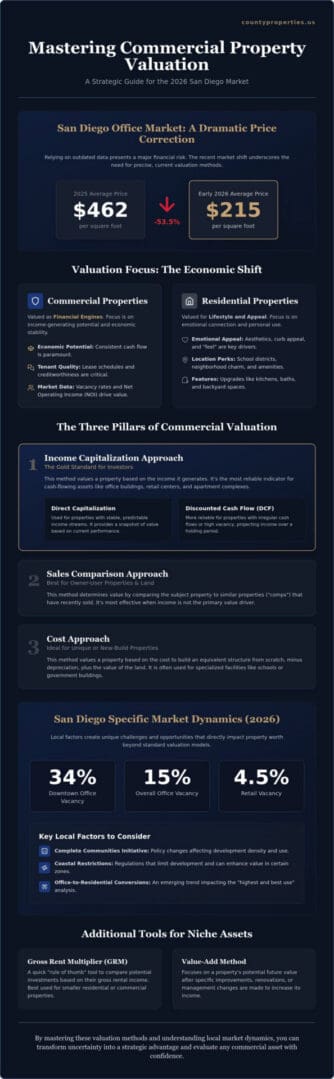
Did you know that average San Diego office prices dropped from $462 per square foot in 2025 to just $215 by the start of 2026? This dramatic shift proves that relying on outdated data is a major financial risk. You likely feel the pressure of these fluctuations, especially when trying to pinpoint the true value of an asset amidst shifting vacancy rates. Understanding the right commercial property valuation methods is no longer just a technical skill; it’s your primary defense against overpaying in a high-stakes environment.
We understand that the complexity of modern appraisals can feel overwhelming, but you deserve a clear framework that transforms market uncertainty into a strategic advantage. This guide will empower you to master the top valuation approaches used by experts throughout Southern California. We want you to feel secure in your choices as you build your portfolio and pursue your long-term financial goals.
We’ll break down the three pillars of valuation, explore the specific drivers currently shaping the San Diego landscape, and show you how to calculate property worth in 2026. By the end of this article, you’ll have a dependable roadmap for evaluating any commercial asset with the confidence of a seasoned professional.
Key Takeaways
- Learn why commercial valuation relies on economic potential rather than emotional appeal to ensure your investment aligns with your long-term financial goals.
- Master the primary commercial property valuation methods, including the Income Capitalization Approach, to accurately assess cash-flowing assets in today’s market.
- Discover how to use secondary tools like the Gross Rent Multiplier and the Value-Add method to identify hidden opportunities in niche property types.
- Understand how San Diego-specific factors, such as the Complete Communities initiative and coastal restrictions, directly impact property worth in 2026.
- Gain the confidence to execute a successful seller representation strategy by avoiding the common pitfalls of over-pricing in a sophisticated commercial landscape.
Commercial vs. Residential Valuation: Understanding the Economic Shift
Commercial property valuation is the process of determining the economic potential of a physical asset. It isn’t about how a building looks at sunset; it’s about the revenue it generates. While a home’s value is often tied to its emotional appeal or lifestyle perks, commercial assets are valued almost exclusively by their ability to produce consistent cash flow. We view these properties as financial engines rather than just real estate.
In 2026, market conditions require a level of rigor we haven’t seen in decades. With San Diego office prices falling to an average of $215.21 per square foot in early 2026, guessing is a recipe for disaster. Investors, lenders, and sellers all depend on precise data to mitigate risk in this high-stakes environment. You need more than a simple estimate; you need a defensible strategy backed by current market realities.
Why Commercial Real Estate Requires a Different Lens
When you’re selling a home in southern california, you focus on school districts, kitchen upgrades, and neighborhood charm. Commercial deals operate on a different frequency. We analyze lease expiration schedules, tenant creditworthiness, and detailed net operating income reports. Using various commercial property valuation methods allows us to see past the brick and mortar to the financial stability underneath. Professional mastery in this field means understanding how a single vacancy in a retail center, currently at 4.5% in San Diego, can shift your entire valuation. It’s a game of math and market intuition.
The Role of the Appraiser vs. the Specialized Agent
An appraiser provides a formal, defensible opinion of value following strict USPAP standards. They are essential for securing financing because lenders require an independent perspective. However, a specialized agent offers a different layer of market insight. We analyze the market through the lens of a “highest and best use” study, which is vital as Downtown San Diego faces a 34% office vacancy rate.
A collaborative team approach ensures your property is priced to move without leaving money on the table. We use commercial property valuation methods to bridge the gap between a bank’s conservative estimate and the true market potential. Our deep roots in San Diego help us spot emerging trends, like office-to-residential conversions, that a standard appraisal might overlook. We act as your dependable guide, ensuring every calculation serves your long-term goals.
The Three Pillars of Commercial Property Valuation
Professional mastery in real estate appraisal rests on three specific pillars. You don’t just pick one at random; you select the method that mirrors how the market actually treats that specific asset class. While the Income Capitalization Approach remains the gold standard for most investors, the Sales Comparison and Cost approaches provide vital context for owner-users and specialized facilities. Reconciling these commercial property valuation methods requires a steady hand and a deep understanding of buyer motivations.
Deep Dive: The Income Capitalization Approach
Most investors prioritize the Income Capitalization Approach because it treats the property as a financial instrument. It’s built on Net Operating Income (NOI), which is your total revenue minus necessary operating expenses. In the 2026 San Diego market, calculating this accurately is critical because even small accounting errors can lead to massive valuation gaps. A Cap Rate is the ratio between a property’s net operating income and its purchase price.
For properties with stable, long-term tenants, direct capitalization is often sufficient. However, if you’re navigating the current 15% office vacancy rate in San Diego, a Discounted Cash Flow (DCF) model is much more reliable. This method accounts for future lease-ups, potential tenant improvements, and shifting market conditions over a specific holding period. It provides a more realistic picture of long-term profitability in a price-sensitive environment.
When to Use the Sales Comparison and Cost Approaches
The Sales Comparison Approach is your best tool when valuing owner-user properties or vacant land where income isn’t the primary driver. Finding “comps” in Southern California is notoriously difficult due to low inventory. We look for properties with similar zoning, utility, and location context to ensure the data is relevant. If you’re looking for a clear framework for your next move, you can connect with our team to see how current sales data impacts your asset’s worth.
For highly specialized assets, such as the senior living facilities we often represent, the Cost Approach is frequently the most accurate choice. This method estimates value by calculating the cost to replace the structure from scratch, minus physical depreciation and functional obsolescence. It’s the preferred path for new constructions or unique buildings where no direct market comparisons exist. By weighing these different commercial property valuation methods, we help you arrive at a final reconciled value that stands up to the scrutiny of lenders and sophisticated buyers alike.
Hybrid and Secondary Valuation Methods for Niche Assets
While the primary pillars provide a solid foundation, some assets demand a more nuanced approach. You might encounter situations where traditional metrics don’t tell the whole story. In these cases, we employ secondary commercial property valuation methods to ensure no value is overlooked. These hybrid tools are especially useful when you need to act quickly or evaluate specialized properties that don’t fit the standard mold. For investors looking beyond traditional commercial spaces into specialized acreage, you can explore AI-Powered Horse Property Search to see how technology helps value and locate unique equestrian properties. We’re here to help you navigate these complexities with a steady hand and seasoned perspective.
The Gross Rent Multiplier (GRM) Shortcut
The Gross Rent Multiplier (GRM) is a favorite for investors needing a “back of the envelope” calculation. You calculate it by dividing the property price by the gross annual rental income. It’s a fantastic tool for a quick commercial real estate southern california screening. However, you must remember its limitations. Because it ignores operating expenses, it can be misleading if a property has unusually high maintenance costs or utility burdens. We use it as a starting point, never the final word.
If you’re looking at a distressed asset or a property with high vacancy, the Value-Add method becomes essential. We factor in the potential for renovations and strategic lease-ups to project a “stabilized” value. This aligns with the current trend of office-to-residential conversions in Downtown San Diego, where the office vacancy rate hit 34% in 2026. For tax or insurance purposes, we might also use the Unit-in-Place method. This breaks down the building’s value by individual components like the roof, HVAC systems, and foundation. It provides a granular view of the physical asset’s integrity that generic models often miss.
Valuing Senior Living and Specialized Care Facilities
Valuing senior housing requires a deep understanding of both real estate and operational business value. Unlike a standard warehouse, a care facility’s worth is heavily tied to its regulatory compliance and service quality. An experienced senior real estate specialist understands how to separate the physical property from the business’s goodwill. We analyze how staffing ratios and licensing impacts the bottom line, ensuring you don’t overpay for an underperforming operation.
Senior real estate transitions often involve high stakes and emotional complexity. The valuation must account for the specialized nature of the build-out, such as medical-grade infrastructure or ADA-compliant layouts. These features can significantly increase the “replacement cost” in a Cost Approach calculation. By using the right commercial property valuation methods for these niche assets, we provide the clarity you need to make life-changing decisions with total confidence.
San Diego Market Dynamics: Local Factors Affecting 2026 Valuations
Global valuation logic provides the math, but San Diego’s specific “soil” provides the context. If you are interested in how these principles translate to other major global markets, you can visit Net Real Estate to view premium property listings in Dubai. In 2026, we’re seeing a fundamental shift in how commercial property valuation methods are applied locally. It’s no longer enough to look at a spreadsheet; you have to look at the city’s changing blueprint. The “Complete Communities” initiative is a prime example. This program incentivizes high-density housing near transit hubs, which can instantly increase the underlying land value of a tired retail strip or aging office building. We help you identify these zoning “hidden gems” that standard models might overlook.
Environmental constraints also play a heavy hand in our regional pricing. The California Coastal Commission’s strict oversight creates a natural scarcity for beachfront and near-coast assets, often sustaining higher values despite broader market dips. Conversely, wildfire risk assessments have become a mandatory part of any rigorous valuation. Rising insurance premiums in high-risk zones directly impact your Net Operating Income (NOI). We factor these local realities into every analysis to ensure your financial safety.
The 2026 economic environment adds another layer of complexity. With the federal funds target range held at 3.50% to 3.75% through July 2026, and commercial mortgage rates starting at 5.81%, the cost of capital remains a significant driver of Cap Rates. While the office sector faces a 15% vacancy rate, San Diego’s robust biotech and defense sectors continue to anchor demand for specialized industrial and lab spaces. If you need a precise analysis of your property’s current worth in this environment, request a professional valuation today.
Regional Trends in Southern California Real Estate
Macro trends across the region are pushing retail owners toward mixed-use developments. By consulting the latest southern california housing market forecast, we can see how residential demand is bleeding into commercial spaces. Transit-Oriented Development (TOD) is creating significant “value premiums” for properties within walking distance of the Trolley or Coaster lines. These assets often command higher rents and lower vacancy rates than their car-dependent counterparts.
Distressed Commercial Assets and Foreclosure Prevention
When a property enters financial distress, the standard commercial property valuation methods must be adjusted for speed and liquidity. We specialize in valuing these assets for rapid cash offers, providing a lifeline for owners who need to exit quickly. If you’re facing a high-stakes situation, understanding your short sale options is vital. You can find resources on foreclosure prevention california to help navigate these difficult transitions. Our team acts as a dependable guide, ensuring you protect as much equity as possible during a crisis.
Executing a Successful Transaction with Expert Valuation
An accurate valuation isn’t just a number on a page; it’s the anchor for your entire seller representation strategy. When you enter the market with a price backed by rigorous logic, you command respect from sophisticated buyers and their lenders. In the current price-sensitive environment, over-pricing is a fatal error that leads to stale listings and lost leverage. Buyers in 2026 are exceptionally diligent, and they’ll use the same commercial property valuation methods to scrutinize your asset. If your numbers don’t hold up under their due diligence, the deal will collapse before it truly begins. We ensure your property is positioned to attract serious offers while protecting your hard-earned equity.
The County Properties Advantage
Arnie Levine’s service-centric philosophy is the heartbeat of our commercial division. We don’t just facilitate transactions; we act as your dependable guide through complex legal and situational challenges. As a seasoned veteran in the Southern California market, Arnie understands that every property represents years of dedication and investment. Our collaborative, team-based approach means you benefit from a collective pool of expertise rather than a single perspective. We defend your property’s value by providing a transparent, data-driven narrative that justifies every dollar of the asking price. This community-focused mastery gives you the peace of mind that your financial safety is our top priority.
Moving Toward Your Significant Life Milestone
Your property sale is often the bridge to a significant life milestone or a strategic business transition. Whether you’re liquidating a legacy asset to fund a senior living transition or shifting capital into a new venture, the outcome determines your future security. We link our professional services to the fulfillment of your personal goals, creating a path toward optimism and achievement. You don’t have to navigate these high-stakes decisions alone. Taking the next step is simple and starts with a professional Broker Price Opinion (BPO) that utilizes the most effective commercial property valuation methods for your specific asset class. We invite you to Contact County Properties for a professional commercial valuation today and secure the expert representation you deserve.
Securing Your Financial Future in a Shifting Market
Mastering the various commercial property valuation methods is the first step toward protecting your equity in an evolving Southern California landscape. You’ve learned how to look beyond the physical structure to the economic engine underneath; whether you’re analyzing Cap Rates for retail or replacement costs for specialized senior facilities. Understanding local San Diego drivers like the “Complete Communities” initiative ensures you’re pricing for tomorrow’s potential rather than yesterday’s data.
County Properties, led by seasoned real estate veteran Arnie Levine, provides the expert guidance you need to navigate these high-stakes market cycles. Our collaborative, client-first service model is designed to offer you financial safety and peace of mind during complex transitions. We act as your dependable guide, turning technical appraisals into a clear strategy for success. Each calculation we perform is a commitment to your long-term achievement.
If you’re ready to move toward your next significant life milestone with total confidence, we’re here to help. Partner with County Properties for an expert commercial valuation and take control of your investment journey today. You have the tools to build a lasting legacy, and we’re honored to be your steadfast ally in achieving your goals.
Frequently Asked Questions
What is the most accurate commercial property valuation method?
The most accurate approach depends on your property type and its intended use. For income-producing assets, the Income Capitalization Approach is the gold standard because it focuses on net operating income. However, specialized properties like senior living facilities often require the Cost Approach to account for unique infrastructure. We reconcile multiple commercial property valuation methods to provide a defensible and reliable estimate of worth that stands up to lender scrutiny.
How do interest rates affect commercial property values in 2026?
Interest rates have a direct, inverse relationship with commercial property values. With commercial mortgage rates starting at 5.81% in August 2026, the cost of borrowing remains a significant factor for investors. High interest rates generally lead to higher Cap Rates, which can compress property values. We monitor these shifts closely to help you understand how the current 3.50% to 3.75% federal funds target range impacts your property’s market position and your financial security.
What is a good Cap Rate for a commercial property in San Diego?
A “good” Cap Rate in San Diego varies significantly across different sectors. In 2026, retail assets remain strong with a 4.5% vacancy rate, often commanding lower, more aggressive Cap Rates. Conversely, the office sector, facing a 15% vacancy rate, typically requires higher Cap Rates to account for increased risk. We analyze these local market drivers to determine a competitive rate that reflects your property’s specific location and tenant quality within the Southern California landscape.
Can I use a residential appraiser for my commercial building?
You shouldn’t use a residential appraiser for a commercial building. Commercial assets require a Certified General Appraiser who has specialized training in complex commercial property valuation methods and income-based analysis. Residential appraisers focus on comparable sales and lifestyle features, which don’t account for complex lease structures or net operating income. Using a specialized professional ensures your appraisal meets USPAP standards and is accepted by commercial lenders and sophisticated investors.
What documents are needed for an income-based valuation?
You’ll need to gather several key financial documents for an accurate income-based valuation. These typically include current rent rolls, three years of profit and loss statements, and copies of all active tenant leases. Additionally, you should provide recent property tax bills, utility records, and a summary of capital improvements. Having these detailed records ready allows us to calculate your Net Operating Income with precision, ensuring a trustworthy and defensible valuation of your asset.
How does the ‘highest and best use’ affect my property’s worth?
“Highest and best use” is the most profitable, legally permissible, and physically possible use for your property. It serves as the foundation for your property’s worth, especially in a changing city like San Diego. If your current office building is better suited for a residential conversion due to high vacancy rates, its value might be tied to its redevelopment potential. We act as your dependable guide, identifying these opportunities to maximize your property’s economic potential.
What is the difference between market value and investment value?
Market value is the estimated amount a typical buyer would pay in an open and competitive market. Investment value is the specific worth of a property to a particular investor based on their unique goals, tax situation, or financing terms. While market value is objective, investment value is subjective and tailored to your personal financial journey. Understanding this distinction helps you negotiate with confidence and ensures your investment aligns with your long-term aspirations and achievements.
How long does a professional commercial appraisal take in California?
A professional commercial appraisal in California typically takes between two and four weeks to complete. This timeline depends on the complexity of the property and the availability of recent market data. The process involves a physical inspection, extensive market research, and a detailed reconciliation of different valuation approaches. We recommend starting this process early to ensure you have a reliable report ready for your next significant life milestone or business transition.