

What if you could trade your large family home for a peaceful coastal retreat without losing the property tax rate you’ve enjoyed for decades? Many Southern California homeowners feel “locked in” to their current houses because they fear the financial shock of a modern tax assessment. It’s an exhausting dilemma; you want a home that fits your current lifestyle, yet you don’t want to be penalized for moving. Understanding the california property tax transfer for seniors is the key to unlocking this transition with confidence and dignity.
We’re here to show you that the “tax lock” is a thing of the past. You’ll learn how Proposition 19 allows you to carry your low tax base to a new primary residence anywhere in the state, saving you thousands in your next transition. As specialists in senior real estate transitions, we’ve seen how these rules provide the financial freedom to downsize without compromise. This 2026 guide previews the eligibility rules, the three-transfer limit, and the specific timelines required to protect your investment. While we provide expert real estate guidance, you should consult with a tax professional for specific legal or financial advice regarding your situation.
Key Takeaways
- Unlock the ability to relocate to any county in the state while maintaining your original property tax basis, effectively ending the “tax lock” on your current home.
- Master the eligibility requirements for the california property tax transfer for seniors to ensure your next primary residence remains affordable, even if it has a higher market value.
- Gain a clear understanding of the strict two-year replacement window and the three-transfer limit to strategically plan your long-term housing transitions.
- Learn how to identify and calculate potential hidden costs, such as supplemental tax bills and Southern California special assessments, to protect your 2026 budget.
- Discover the benefits of collaborating with a Senior Real Estate Specialist (SRES) to synchronize your sale and purchase for a seamless, secure transition.
The Foundation: Proposition 13 and Tax Stability in California
For nearly five decades, property owners in our state have relied on a specific brand of financial predictability. This stability is rooted in Proposition 13, the landmark 1978 law that fundamentally changed how we approach homeownership costs. Before this amendment, property taxes could skyrocket based on volatile market swings, often forcing long-term residents out of their homes. Today, your tax bill is anchored by a 1% maximum base levy on your property’s assessed value. This creates a reliable floor for your annual expenses, allowing you to plan for the future without fearing sudden, unmanageable tax hikes.
The true power of this system lies in its protection against inflation. Your assessed value cannot increase by more than 2% in any given year, regardless of how fast home prices rise in San Diego or the surrounding areas. For many Southern California homeowners, this cap has created a massive gap between what their home is worth and the amount they actually pay in taxes. This “acquisition value” model is why you might see a neighbor pay significantly more than you for a similar house. It’s also why understanding the california property tax transfer for seniors is so vital; it allows you to carry that hard earned stability into your next chapter.
How Your Assessed Value is Determined
When you first purchase your home, the County Assessor establishes a base year value, which is typically the purchase price. From that point forward, the assessor only adjusts this value by the 2% annual inflation factor. Because market values in coastal California often outpace this small annual adjustment, your assessed value and market value will naturally diverge over time. This divergence is a financial gift to long-term owners. The assessment cap serves as a vital safeguard against market volatility, ensuring that your tax burden remains tied to your original purchase rather than the current real estate frenzy.
Calculating the Total Tax Bill
Your final tax bill involves more than just the base 1% levy. The standard formula used across the state is (Assessed Value x 1%) + Local Bonds. These local bonds represent voter approved indebtedness that funds essential community services, such as school improvements, fire stations, and infrastructure projects in your specific neighborhood. In Southern California, these additional assessments often mean your total effective tax rate lands between 1.1% and 1.25%. While these small percentages might seem minor, they are an important piece of the puzzle as you evaluate the changes brought by 2020 California Proposition 19 and prepare for a move in 2026.
Proposition 19 Explained: New Benefits for Seniors in 2026
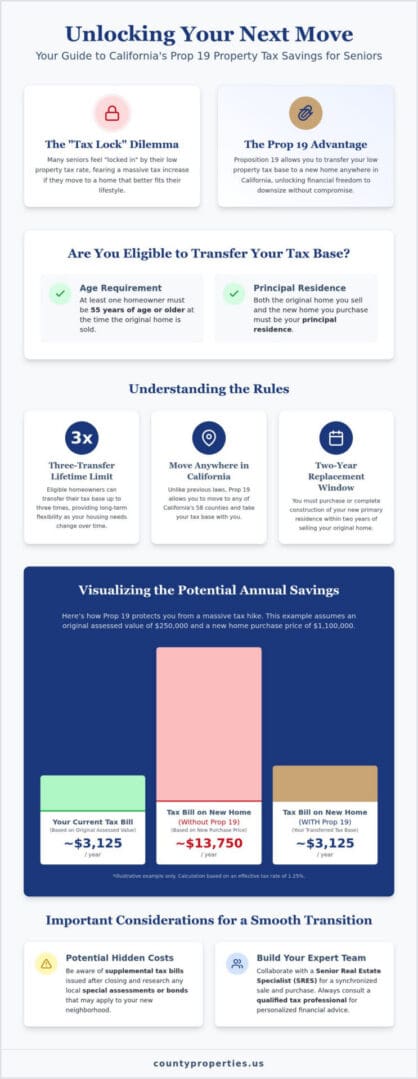
Proposition 19, officially titled the Home Protection for Seniors, Severely Disabled, and Families Act, represents a landmark shift in how you can manage your retirement assets. This law became effective on April 1, 2021, and it significantly expanded the tax benefits previously offered under Propositions 60 and 90. Those older rules were often restrictive, limiting you to a one-time transfer and frequently requiring you to stay within the same county. Prop 19 changed the landscape by allowing you to take your tax base anywhere in California. This means you’re no longer “locked in” to a specific region just to save on taxes; you can finally move closer to family or enjoy a coastal lifestyle without a massive financial penalty.
One of the most encouraging changes is the “Three-Time Rule.” Eligible homeowners can now complete a california property tax transfer for seniors up to three times in their lifetime. This flexibility is vital because your housing needs at age 55 might be very different from your needs at age 75. Whether you’re moving for a better climate, health reasons, or simply a change of scenery, the state now provides a path to maintain your tax stability through multiple moves. For official forms and technical details, you can visit the California State Board of Equalization on Prop 19.
Eligibility Requirements for Senior Transfers
To qualify for these benefits, at least one owner on the title must be 55 or older at the time the original property is sold. It’s a straightforward requirement, but the timing is critical. Both your original home and your replacement property must serve as your principal residence. Additionally, you must purchase or newly construct your replacement home within a strict two year window of selling your original residence. This window applies whether you buy the new home before or after the sale of the old one. Coordinating these dates requires careful planning, and our team can help you coordinate your sale and purchase to ensure you don’t miss these deadlines.
Buying a More Expensive Home
In the past, you were generally restricted to buying a home of “equal or lesser value” to keep your tax base. Prop 19 removed this barrier. If you decide on a more expensive property, you don’t lose your original tax base; instead, the difference in market value is simply added to your old assessment. For example, if you sell your home for $1 million and buy a new one for $1.2 million, the $200,000 difference is added to your transferred tax base. This calculation is particularly helpful when buying a home in Southern California where the 2026 market continues to show value growth. While these rules provide incredible savings, please remember that this guide does not constitute legal or tax advice; you should always consult with a qualified professional before finalizing your real estate strategy.
Strategic Tax Base Portability: A Step-by-Step for Downsizing
Successful execution of a california property tax transfer for seniors requires more than just knowing the law; it demands a tactical approach to the 2026 market. You aren’t just selling a house; you’re porting your financial history into a new residence. The first step involves a cold, hard look at your current tax bill. Compare your existing assessed value with the market price of the homes you’re considering. This delta determines your future monthly cash flow, and getting the math right early prevents surprises after you’ve already moved your furniture.
Because the timing of these transactions is so sensitive, working with a senior real estate specialist is a vital part of your strategy. An SRES navigator helps you synchronize the sale of your legacy home with the purchase of your next property, ensuring you stay within the mandatory two year window. Once you close on your new home, you’ll need to file specific claim forms with the County Assessor. Resources like the LA County Assessor’s Prop 19 Guide provide excellent local context for the documentation required to finalize your transfer.
Don’t be alarmed if your first tax bill on the new property reflects its full market value. It often takes several months for the assessor’s office to process your claim and apply the transferred base. You may need to pay the higher amount initially, but you’ll receive a refund or a corrected bill once the california property tax transfer for seniors is officially approved. Having a cash reserve for this temporary “gap” is a hallmark of a well planned transition.
The Intergenerational Transfer Shift
Prop 19 didn’t just expand benefits for seniors; it also fundamentally tightened the rules for family inheritances. Under the old system, children could often inherit a parent’s low tax base regardless of how they used the property. Today, an heir must make the property their primary residence within one year of the transfer to maintain that lower assessment. If you’re planning your estate, it’s essential to discuss these primary residence requirements with your family to protect your Southern California legacy from a massive tax reset.
Maximizing the “Three-Time” Opportunity
The “Three-Time Rule” is a game changer for those who want an active, evolving retirement. Previous laws limited this benefit to a single move, which often forced seniors to stay in homes that no longer suited their physical needs. Now, you can transition from a large family home to a manageable condo, and later to a specialized retirement community, without losing your tax advantage each time. Prop 19 allows seniors to downsize without a tax penalty. This flexibility supports a lifestyle of freedom and dignity, allowing your home to change as your life does.
Supplemental Tax Bills: Avoiding the Post-Closing Surprise
One of the most common shocks for new homeowners is the arrival of a supplemental tax bill months after the keys have changed hands. This isn’t an error or a double charge. It is a pro-rated bill designed to capture the “gap” between the previous owner’s old tax base and your new purchase price. Even when you successfully execute a california property tax transfer for seniors, the county initially records the property at its full market value upon sale. This triggers a reassessment that exists outside of your standard annual property tax statement.
The calculation is straightforward but can result in a significant amount. The assessor takes your new purchase price and subtracts the seller’s prior assessed value. This difference is the supplemental assessment. Because this bill is separate from your regular taxes, it won’t be sent to your mortgage company. It arrives via mail directly to your new home. You’re responsible for paying it, even if you have an impound or escrow account. Preparing for this cost is a critical step in maintaining your financial peace of mind during a transition.
The Timing of Supplemental Assessments
The wheels of county government turn slowly. It typically takes between 6 and 12 months for the County Assessor to process a sale and issue the supplemental bill. If you close your escrow near the end of the tax fiscal year on June 30, you might actually receive two separate supplemental bills. One covers the remainder of the current tax year, while the second covers the upcoming year at the new valuation. This timing is a vital consideration for those selling a home in Southern California. You must account for these pro-rated obligations to ensure your net proceeds are calculated accurately.
Budgeting for Your First Year
Most mortgage lenders calculate your monthly escrow payments based on the *existing* tax bill at the time of purchase. Since that bill is often based on the seller’s long-term Prop 13 rate, your lender may not collect enough funds to cover the eventual reassessment. This creates a shortage in your escrow account. We recommend setting aside a strategic reserve during your first year of ownership specifically for these supplemental costs. Our team provides professional representation to ensure you aren’t blindsided by these administrative delays. To ensure your 2026 move is financially sound, contact Arnie Levine for a detailed transition plan. We can help you estimate these “hidden” costs before you even make an offer on a new property.
Planning Your 2026 Real Estate Strategy in Southern California
Developing a successful 2026 strategy requires you to look beyond the listing price and analyze the Southern California housing market through a tax lens. In our region, two identical homes can have vastly different carry costs based on local assessments. For example, older neighborhoods in San Diego like Hillcrest often have minimal special assessments, while newer master-planned communities in North County may carry significant Mello-Roos fees. When you execute a california property tax transfer for seniors, you’re porting your base rate, but these local bonds remain tied to the new property. We help you compare these “hidden” costs across different zip codes to ensure your downsizing move actually results in lower monthly expenses.
A professional valuation is another cornerstone of a sound strategy. Since Prop 19 math depends on the market value of both your sold home and your new purchase, an accurate appraisal is vital. If your new home is more expensive, the “gap” added to your tax base is determined by the difference in fair market value. Partnering with a veteran like Arnie Levine provides the financial peace of mind needed to navigate these calculations. Our team ensures you don’t overpay on your new assessment by providing data-backed valuations that stand up to scrutiny from the County Assessor. Please remember that while we provide expert real estate guidance, you should consult with a tax professional for definitive financial advice.
Selling with Transparency
If your current legacy home has low special assessments, this is a major selling point that we highlight to increase your property’s marketability. The real estate agent’s role involves more than just finding a buyer; it’s about disclosing tax obligations with total transparency to ensure a smooth closing. We prepare all necessary Prop 19 documentation before you even list your property. This proactive approach prevents delays and gives you a clear picture of your net proceeds, allowing you to shop for your next home with a firm budget in mind.
The Value of Expert Guidance
Senior transitions are complex and require more than just a standard real estate agent. You need a specialist who understands the logistics of coordinating a tax base transfer across multiple county assessors, especially if you’re moving between counties like San Diego and Riverside. We act as your steady, guiding presence, managing the timelines and paperwork so you can focus on your next chapter. Our collaborative approach ensures that every detail of the california property tax transfer for seniors is handled with care. Contact County Properties for expert guidance on your Southern California home sale and let us help you achieve the financial freedom you’ve earned.
Unlocking Your Next Chapter with Financial Confidence
Transitioning to a new home in 2026 doesn’t have to mean sacrificing the property tax stability you’ve built over decades. By leveraging the california property tax transfer for seniors, you can carry your low Prop 13 base to any county in the state. This freedom allows you to downsize to a more manageable residence or move closer to family while protecting your retirement savings from sudden tax spikes. You now have the flexibility to move up to three times, ensuring your home always fits your current lifestyle and physical needs.
Navigating these complex rules requires more than just a standard real estate approach. Arnie Levine is an SRES® (Senior Real Estate Specialist) with decades of San Diego market experience, specifically dedicated to guiding families through these high-stakes transitions. We act as your dependable ally, coordinating every detail from the initial valuation to the final county assessor filing. Don’t let tax anxiety keep you in a home that no longer serves you. Schedule a consultation with Arnie Levine to plan your Prop 19 move today. You’ve worked hard for your legacy; it’s time to enjoy the financial freedom you’ve earned.
Frequently Asked Questions
How much is the property tax rate in California for 2026?
The base property tax rate in California remains 1% of the assessed value as established by Proposition 13. However, your total tax bill will likely land between 1.1% and 1.25% because of voter approved local bonds and special assessments. These additional levies fund essential services like schools and infrastructure in your specific neighborhood. You should review your local tax collector’s website for the exact percentages tied to your new home’s zip code.
Can I transfer my property tax base to a home in a different California county?
Yes, you can move your tax base to a replacement residence in any of California’s 58 counties. Before Proposition 19, you were often restricted to staying within the same county or moving to a county with a reciprocal agreement. Now, you have the freedom to relocate from San Diego to the Central Coast or Northern California while keeping your original assessment. This portability is a core benefit of the california property tax transfer for seniors.
How many times can a senior transfer their tax base under Proposition 19?
Eligible homeowners who are 55 or older can transfer their property tax base up to three times in their lifetime. This is a significant expansion from previous laws that typically allowed only a one time transfer. This change supports an active retirement, allowing you to downsize or relocate as your lifestyle needs evolve over the years. Each transfer requires you to meet the primary residence and timeline requirements to maintain your tax savings.
What happens to my property taxes if I inherit my parents home?
Under current rules, you must move into the inherited property and make it your principal residence within one year to maintain the parents’ original tax base. You also need to file for the Homeowners’ Exemption during that same timeframe. If you use the home as a rental or a second property, the county will reassess it at current market value. This change has made estate planning much more complex for many Southern California families.
When are property taxes due in California for the 2026 tax year?
Property taxes in California are paid in two installments during the fiscal year. The first installment is due on November 1 and becomes delinquent after December 10. The second installment is due on February 1 and becomes delinquent after April 10. It’s helpful to remember the mnemonic “No Darn Fooling Around” (November, December, February, April). Missing these deadlines results in a 10% penalty; keeping track of these dates is vital for your budget.
Do I have to buy a cheaper home to transfer my tax base as a senior?
No, you are no longer required to buy a home of equal or lesser value to qualify for a tax transfer. If you purchase a more expensive replacement home, the difference in market value is simply added to your original tax base. This calculation allows you to upgrade your lifestyle or move to a more desirable neighborhood without losing the foundational tax protections you earned over decades in your previous primary residence.
How do I apply for a Proposition 19 tax base transfer?
You must file a formal claim with the County Assessor’s office where your replacement property is located. This involves submitting specific forms, such as BOE-19-B, which detail the sale of your original home and the purchase of your new one. You generally have up to three years to file, though doing so immediately after your purchase is recommended. Our team can help you gather the necessary documentation to ensure your california property tax transfer for seniors is processed smoothly.
What is the difference between a regular property tax bill and a supplemental bill?
Your regular tax bill is an annual statement based on the property’s value as of January 1. In contrast, a supplemental tax bill is a one time charge issued after a change in ownership. It covers the “gap” between the previous owner’s old assessment and your new purchase price for the remainder of the tax year. These bills arrive separately from your annual statement and are usually not paid through your mortgage company’s escrow account.