

A $1 sale can transfer a California home to a family member, but it may be treated as a gift of equity rather than a straightforward sale. If you’re deciding how to sell a house to a family member in California, the key is to document the agreed price and understand how a below-market deal can affect taxes and financing.
Selling to a relative may feel simpler than selling to a stranger, especially if you want to make the home more affordable for someone you care about. But a family relationship does not replace planning for the deed transfer, the buyer’s financing, or the tax consequences of gifting part of the home’s value. A lender may also require a formal purchase agreement to process financing.
This guide explains the costs involved in transferring a deed, what to consider when setting a below-market price, and how family buyers may finance the purchase. It also looks at what a $1 sale can mean, so you can make informed decisions and keep the transaction clear for both sides.
Key Takeaways
- Plan the sale with written terms and an organized title transfer so both family members understand the transaction.
- Understand how below-market pricing can create a gift of equity and affect tax reporting.
- Explore how financing choices and a seller’s primary-residence status may shape the sale.
- Consider the tax and ownership consequences before treating a $1 transfer as a simple sale.
1. Cost to Transfer a Deed to a Family Member
Planning how to sell a house to a family member in California starts with a written purchase agreement. California Civil Code §1624 requires real estate sale contracts to be in writing. State the price, financing terms, contingencies, closing date, and any appliances or fixtures included. A real estate attorney can prepare or review the agreement when family members need help expressing their expectations clearly.
Informal promises can cause disagreements about repairs, move-out timing, or closing costs. If a parent expects to stay in the home after closing, for example, put that arrangement in the written terms. The agreement should reflect what both parties intend, not assumptions from a family conversation.
Disclose known property issues, including roof leaks, foundation cracks, or plumbing problems. California requires lead-based paint disclosure for homes built before 1978. A clear record of the home’s condition helps the buyer understand what is being transferred and gives both sides a shared reference during the transaction.
At closing, a title company or real estate attorney can coordinate deed signing, title transfer, lien clearance, and recording paperwork. Escrow uses a neutral third party to hold funds and documents until closing.
California property transfers can trigger property-tax reassessment. For qualifying parent-child transfers made after February 15, 2021, Proposition 19 may provide an exclusion; according to the California State Board of Equalization, partial reassessment may apply if the difference between the new assessable value and the parent’s original taxable value exceeds $1 million, adjusted for inflation.
A private sale can lead to misunderstandings about price, property condition, financing, or possession. A signed agreement and an organized title and escrow process create a clear path to closing. Careful planning for how to sell a house to a family member in California makes each person’s responsibilities and expectations clear.
2. Can my parents sell me their house below market value?
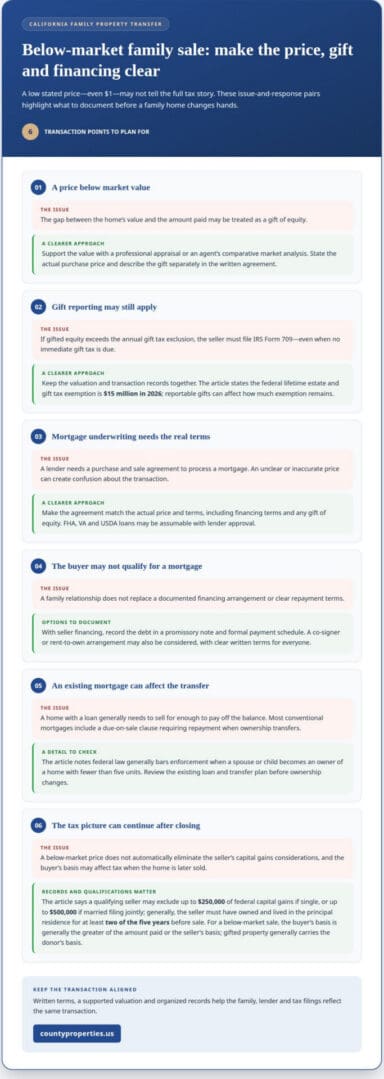
Yes. Parents can sell below fair market value, but the difference may be treated as a gift of equity. When considering how to sell a house to a family member in California, start by establishing the home’s value and documenting the intended terms. A professional appraisal provides a written valuation, while a real estate agent’s comparative market analysis can help support the agreed price.
It’s useful to distinguish the gift from the cash price in your records. The purchase agreement should state the actual price and clearly describe the gift, so the buyer, seller, and lender have the same understanding.
When gifted equity in a California family property sale exceeds the annual gift tax exclusion, the seller must file IRS Form 709, even if no immediate gift tax is due, according to the Internal Revenue Service. Filing reports the gift; it doesn’t necessarily mean gift tax is immediately payable. The federal lifetime estate and gift tax exemption is $15 million in 2026, and reportable gifts can affect how much exemption remains.
If you’re considering how to sell a house to a family member in California, keep the valuation and transaction documents together. Save the appraisal or market analysis, signed agreement, and records showing how you set the price. A below-market price does not automatically eliminate capital gains considerations for the seller. The seller’s basis and any applicable exclusion may affect the tax outcome.
For a seller who wants professional support presenting and pricing the home, seller representation for a family sale can help organize the transaction.
3. What are the financing options for family buyers?
A family buyer may use a mortgage, seller financing, or another documented arrangement. To process a mortgage through underwriting, the lender needs a purchase and sale agreement that matches the actual price and terms. FHA, VA, and USDA loans may be assumable with lender approval, so an existing loan could be relevant to the buyer’s financing plan.
With seller financing, the seller acts as the lender, and the buyer makes payments under agreed terms. A promissory note and formal payment schedule document the debt, payment amounts, and timing. If a relative cannot qualify for a mortgage, the parties may consider a co-signer or rent-to-own arrangement, with clear written terms for everyone.
Pay close attention to any existing mortgage before ownership changes. A home with a loan generally needs to sell for enough to pay off the balance. Most conventional mortgages include a due-on-sale clause requiring repayment when ownership transfers. Federal law generally bars enforcement when a spouse or child becomes an owner of a home with fewer than five units.
Financing choices don’t remove the seller’s potential capital gains tax. A qualifying seller may exclude up to $250,000 of federal capital gains if single, or up to $500,000 if married filing jointly, according to the Internal Revenue Service. The seller generally must have owned and lived in the principal residence for at least two of the five years before the sale.
The buyer’s cost basis can also matter later. In a below-market family sale, the buyer’s basis is generally the greater of the amount paid or the seller’s basis. A gifted property generally carries the donor’s basis, rather than a step-up to fair market value. This basis can affect taxable gain when the buyer eventually sells, so keep the agreement and transfer records with the home’s tax documents.
4. Selling a house to a family member for $1
A California homeowner can sell a house to a relative for $1, but the deed’s stated price may not tell the full tax story. If the home is worth more, the difference can be treated as a gift of equity. An appraisal can document fair market value, while a real estate agent’s comparative market analysis offers another way to support the price.
For example, compare the appraised value with the $1 payment. That gap represents value transferred to the buyer, not simply a bargain purchase. The annual federal gift tax exclusion is $19,000 per donor per recipient for 2025, according to the Internal Revenue Service. The exclusion concerns gift reporting and does not make the home’s value equal to its sale price.
Put the actual terms in a written contract, including the $1 consideration and the family’s intent to transfer the remaining equity as a gift. Keep the appraisal, contract, and transfer documents together. If the buyer uses financing, the lender needs accurate purchase terms for underwriting; a gift letter may document the equity contribution.
A $1 transfer can also affect property taxes and future gains. A change in ownership of California real property usually triggers reassessment at current fair market value for property tax purposes. The recipient generally takes the donor’s basis for gifted property, rather than a basis stepped up to fair market value. For a below-market sale, the buyer’s basis is generally the greater of the amount paid or the seller’s basis.
Keep the buyer’s inspection and known property issues in the transaction record. A home inspection can identify repairs and major problems before ownership changes. A $1 deed is not a shortcut around valuation, financing, or tax planning. Get guidance on planning your family home sale before agreeing on the transfer terms.
County Properties: Seller Representation
County Properties provides Seller Representation for homeowners planning a family sale and looking for professional guidance through the transaction. The team can help you consider pricing, evaluate offers, and navigate the sale with your family member. This support can be useful when you want a documented transaction rather than relying on informal family arrangements.
If you’re buying the home from a family member, Buyer Representation can help you approach the purchase from the buyer’s perspective. County Properties also provides Senior Real Estate Transition guidance for older adults making a housing change, including the sale of a family home. Choose support that fits your role and situation, and direct tax and legal questions to the appropriate professionals.
Contact County Properties to discuss your family home sale and the real estate guidance you need.
Move Forward With a Clear Plan
A practical first step in how to sell a house to a family member in California is to agree on your priorities before settling the transaction details. Consider whether your main goal is a straightforward transfer, support for a relative’s purchase, or a sale prompted by financial pressure. That decision can help you choose suitable real estate guidance and align family expectations.
County Properties offers Seller Representation and Buyer Representation for family transactions, as well as Short Sale and Foreclosure Prevention when financial hardship affects the sale. These services address different needs, so the right starting point depends on your role and circumstances. For legal or tax questions, consult the appropriate professional as you plan the transaction.
Take the next step at a pace that works for your family. Contact County Properties today to discuss your real estate needs and move toward a well-planned decision.
Frequently Asked Questions
Can you sell your house to a family member?
Yes, you can sell your home to a relative at market value or on agreed below-market terms. Treat the transfer as a real transaction: establish whether the buyer is paying the full price or receiving gifted equity, and make sure the deed reflects the intended ownership. If the buyer is financing the purchase, the lender needs accurate sale terms for underwriting.
Are there state-specific legal considerations?
Yes. California’s written-contract requirement and property-tax reassessment rules affect family sales. For an eligible parent-child transfer, Proposition 19 may provide a property-tax exclusion, and the appropriate claim, such as Form BOE-19-P, must be filed with the County Assessor on time. The California State Board of Equalization describes a value threshold that can affect the exclusion, so the property’s assessment details matter.
Can I finance the home myself for a family member?
Yes, you can finance a family member’s purchase by documenting the debt in a promissory note and setting out the payment terms. For example, the agreement can specify payment dates and how payments will be made. If an existing mortgage remains on the property, review its due-on-sale terms before transferring ownership, since the lender’s rights may affect the arrangement.
Can my parents sell me their house below market value?
Yes. The gap between the agreed price and the home’s fair market value may be treated as gifted equity. Keep a valuation record and make the purchase agreement clear about the price and any gifted portion. The Internal Revenue Service requires the seller to report gifted equity exceeding the annual gift tax exclusion on Form 709, even when no gift tax is immediately due.
Do I have to pay capital gains if I sell to family?
A family sale doesn’t automatically remove capital gains tax. A qualifying seller may exclude up to $250,000 of gain if single, or $500,000 if married filing jointly, according to the Internal Revenue Service. The seller generally must own and live in the primary residence for at least two of the five years before sale. A loss on a sale to a relative isn’t deductible under IRC Section 267.
How do I document a gift of equity?
Start with a written valuation, then make the purchase agreement state the sale price and gifted equity separately. If the buyer is financing the home, a gift letter can document the contributed equity for the lender. Keep the valuation, signed agreement, gift letter, and deed-transfer records together. The seller reports a gift exceeding the annual exclusion on IRS Form 709, even if no immediate gift tax is due.