

What if that auction date circled on your calendar isn’t a dead end, but actually your final window for a financial rescue? Many homeowners facing a Notice of Trustee Sale ask, can I sell my house before the auction date, only to find themselves paralyzed by the ticking clock. It’s a heavy burden to carry. You’ve likely spent weeks worrying about losing every cent of equity you’ve built over the last decade.
We understand the anxiety that comes with those confusing legal notices. You’ve worked hard for your home; you deserve a dignified exit strategy that protects your credit score from the lasting damage of a completed foreclosure. This 2026 guide reveals the exact steps to halt the process and find a qualified buyer before the gavel falls. We’ll explore how to negotiate with lenders, manage the legal timeline, and secure your financial future so you can move forward with confidence and peace of mind.
Key Takeaways
- Understand that you retain full legal ownership and the right to negotiate until the auction gavel falls, providing a vital window to save your equity.
- Discover the specific timeline requirements in California and find out exactly how can I sell my house before the auction date to avoid a total credit loss.
- Evaluate the pros and cons of traditional sales versus cash offers to choose the most effective exit strategy for your unique financial situation.
- Learn the actionable steps to postpone a foreclosure sale, including how to secure a formal payoff statement and present valid proof of funds to your lender.
- Leverage professional, team-based expertise to navigate complex legal notices and marketing challenges for a seamless transition during pre-foreclosure.
Can I Sell My House Before the Auction Date? Understanding Your Rights in 2026
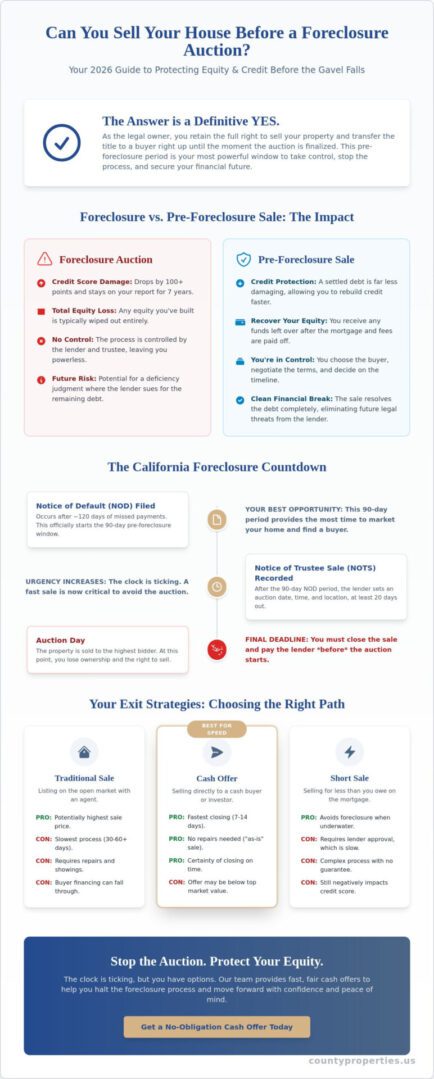
Facing a scheduled trustee sale creates immense pressure, but you still hold the keys to your financial future. If you are asking, can I sell my house before the auction date, the answer is a definitive yes. As long as the gavel hasn’t fallen at the auction, you remain the legal owner of the property. This ownership gives you the right to transfer the title to a buyer, provided the sale proceeds cover the total debt owed to your lender.
The period leading up to the auction is known as the pre-foreclosure phase. In 2026, this remains your most powerful window for negotiation. When you secure a buyer and open escrow, your legal team or real estate partner can present a firm purchase contract to the lender. Banks generally prefer a guaranteed payoff over the uncertainty of a public auction. Understanding Foreclosure and its timeline is vital because once a sale is finalized and the loan is paid in full, the foreclosure process stops automatically. There’s no longer a debt to collect, which means the auction is cancelled. Timing is the only variable that works against you; every day you wait reduces your ability to market the home effectively and satisfy the bank’s requirements.
The Legal Reality of Foreclosure Sales
The equity window is the period before the trustee sale where you can still leverage your home’s value to settle your debts. While some states offer a “Right of Redemption” after a sale, it’s often difficult to exercise. Selling before the auction is a proactive choice that keeps you in control. Remember that the bank’s primary goal is debt recovery, not property management. They don’t want to own your home; they want the capital they lent you returned with interest.
Why Selling is Often Better than Foreclosure
A foreclosure can stay on your credit report for seven years, often dropping your score by 100 points or more. By choosing a successful sale instead, you protect your credit and can often qualify to buy a home again in as little as two years. In California, selling also helps you avoid the risk of a deficiency judgment. While many California foreclosures are non-recourse, specific legal nuances can leave you vulnerable to the bank seeking the difference between the auction price and your loan balance. A traditional sale or a negotiated short sale eliminates this threat entirely.
- Ownership: You retain all legal rights to the property until the moment the trustee sale is finalized.
- Credit Protection: A settled sale is significantly less damaging than a foreclosure entry on your permanent record.
- Debt Resolution: A sale allows for a clean break from the lender without the lingering threat of legal collections.
- Future Housing: Preserving your record ensures you aren’t barred from rental agreements or future mortgages.
The California Foreclosure Timeline: Navigating the Countdown
The California foreclosure process is a non-judicial system, which means it moves rapidly without requiring a court hearing. Understanding the specific dates is vital because your options shrink as the auction nears. You’re likely asking, can I sell my house before the auction date to save your equity? The answer is a definitive yes, but you must act before the legal clock runs out. In 2026, lenders continue to follow a strict procedural path that gives you approximately 120 to 180 days from your first missed payment to the actual sale.
Understanding the Notice of Default (NOD)
The process officially starts when your lender files a Notice of Default (NOD) with the county recorder. This typically occurs after you’ve missed four consecutive monthly payments, totaling 120 days of delinquency. The NOD is a public record, but it doesn’t change your daily life immediately. You still own the home and have the full right to live there. Under the California Homeowner Bill of Rights, your lender must contact you to explore foreclosure alternatives at least 30 days before filing this notice. This 90-day window is your best opportunity to prepare the property for the market or negotiate a short sale while you still have full control.
The Notice of Trustee Sale (NOTS)
If the 90-day reinstatement period expires without a resolution, the lender records a Notice of Trustee Sale (NOTS). This document is more urgent. It lists the exact auction date, time, and location, which is usually a public space like a county courthouse. By law, this notice must be posted on your front door and published in a local newspaper for at least 21 days before the sale. While this feels like an eviction notice, it isn’t. You aren’t required to move out the moment you see it. Instead, the NOTS serves as the final warning for a private sale to occur before the property is liquidated. If you’re feeling stuck, our experienced team can help you evaluate your home’s current market value to see if a traditional sale can clear your debt.
The most important deadline is the “Point of No Return.” In California, your legal right to reinstate the loan by paying only the missed payments expires five business days before the auction. After this threshold, the lender can legally demand the entire loan balance to stop the foreclosure. Reviewing HUD’s Guide to Avoiding Foreclosure can help you understand federal protections that might apply to your specific loan type during this high-pressure period. Finally, on Auction Day, the Trustee’s Deed is transferred to the highest bidder. Once that deed is recorded, your window to sell the property yourself is officially closed. If you’re still wondering can I sell my house before the auction date, remember that the five-day rule is your ultimate boundary. Beyond that point, you lose the ability to catch up on payments and must pay the loan in full or vacate.
Exit Strategies: Traditional Sale vs. Short Sale vs. Cash Offer
Determining your next move starts with a clear look at your home’s equity. You need to know exactly where you stand before you can decide on a strategy. Equity is the difference between your home’s current market value and the total balance of all loans recorded against it. If your home is worth $600,000 and you owe $450,000, you have $150,000 in equity. This gives you leverage. However, if you owe more than the home’s value, you’re “underwater,” and your options shift. When homeowners ask, “can I sell my house before the auction date?” the answer is almost always yes, but the path you take depends on that math.
When to Choose a Traditional Listing
A traditional sale is the strongest way to protect your financial future if you have at least 20% equity and at least 60 days before the scheduled auction. By utilizing specific strategies for selling a home in Southern California, you can often fetch a price that covers your debt and leaves you with a relocation fund. You don’t have to tell every prospective buyer about the foreclosure status. Instead, focus on “As-Is” disclosures to signal that you won’t be performing repairs. This attracts serious investors and buyers who are ready to move quickly without the friction of repair negotiations.
The Mechanics of a Short Sale
If you lack equity, a short sale is your primary tool. This is a negotiation where your lender agrees to accept a sale price that is lower than your total mortgage balance. Banks are often willing to do this because the cost of a full foreclosure is high. Industry data from 2023 indicates that lenders can lose between 30% and 40% of a property’s value during the legal foreclosure process. A short sale is often their preferred way to mitigate losses. You can find more details on how to navigate these conversations in HUD’s Guide to Avoiding Foreclosure. Because the paperwork is dense, a specialist is usually required to manage the bank’s requirements and ensure the auction is officially stayed.
Rapid Cash Offers: The Emergency Brake
When the clock has run down and the auction is 14 days away or less, a traditional listing is no longer a viable option. At this stage, a rapid cash offer acts as your emergency brake. Professional buyers can bypass the 30-day appraisal and loan underwriting periods that stall standard buyers. Most cash deals can close in as little as 7 to 10 days. While the offer price may be lower than a retail listing, it’s a guaranteed way to ensure you can I sell my house before the auction date. This prevents the foreclosure from appearing on your credit report for the next seven years and allows you to exit the property on your own terms.
How to Postpone a Foreclosure Auction: Actionable Steps
If you’re asking, “can I sell my house before the auction date,” the answer is yes, but you must provide the lender with a concrete reason to pause. Banks don’t want to own your property; they want the debt resolved. To stop the clock, you must move from being a “delinquent borrower” to a “proactive seller” in their system. This shift requires specific documentation that proves a sale is imminent and viable.
- Request a formal Payoff Statement: Contact the lender’s trustee to get a document that expires in 30 days. This lists the exact amount needed to satisfy the lien, including late fees and legal costs.
- Provide Proof of Funds: Banks won’t stop an auction for a verbal offer. You must show a bank statement from a cash buyer or a verified pre-approval letter from a reputable lender to prove the buyer is serious.
- Submit a signed Purchase Agreement: Send the fully executed contract to the loss mitigation department. This is the primary trigger that often forces a stay of the auction.
- The Short Sale Package: If your home’s value is lower than your mortgage balance, submitting a complete short sale package can legally compel the bank to review your file, which often results in a 30 to 60-day postponement.
Communicating with Your Lender
Don’t ignore the bank’s phone calls. Silence is interpreted as abandonment, which accelerates the foreclosure timeline. When you speak to the loss mitigation department, use the phrase “I am requesting a postponement based on a pending sale.” It’s vital to reference the Dual Tracking rule. Under the Consumer Financial Protection Bureau (CFPB) regulations established in January 2014, lenders are generally prohibited from foreclosing while a borrower is being considered for a loss mitigation option. This federal protection is your strongest leverage when you’re wondering, “can I sell my house before the auction date” while the clock is ticking.
Working with a Distressed Property Specialist
A standard real estate agent often lacks the technical knowledge to navigate trustee sales and bank departments. You need a real estate agent near me who has specific experience in foreclosure intervention. These specialists understand that high-stakes negotiations require a collaborative team approach involving legal and financial experts. A specialist can often secure an auction postponement with one phone call by reaching the specific decision-maker at the lending institution who has the authority to pull the property from the auction block. They know how to bypass the first-level customer service agents to reach the departments that actually handle workout solutions.
Time is your most valuable asset in a foreclosure scenario. Connect with our expert team today to start the postponement process and protect your equity.
The County Properties Advantage: Collaborative Solutions for 2026
Arnie Levine founded County Properties with a specific vision that dates back to 1995. He wanted to move away from the aggressive, individualistic nature of traditional real estate offices. Today, he brings 36 years of experience in the Southern California market to help homeowners facing the toughest financial challenges. Our firm operates as a family of friends, utilizing a team-based approach that combines high-level marketing with deep legal resources. This collaborative model ensures that every client receives the full weight of our collective expertise rather than the limited perspective of a single agent.
When you’re wondering, “can I sell my house before the auction date,” you need more than just a standard listing. You need a partner who understands the urgency of the 2026 foreclosure timeline. We don’t just put a sign in the yard. We actively coordinate with lenders and legal professionals to pause the clock. Our priority is your financial recovery, not a quick commission check. By working as a unified team, we provide a level of service that individual agents simply can’t match.
Personalized Guidance for Every Situation
We tailor every exit strategy to fit your specific goals. Some homeowners need to maximize cash at closing, while others focus on protecting their credit score for future purchases. If you’re asking yourself, “can I sell my house before the auction date” to avoid a total loss of equity, our team provides the data you need to make an informed choice. Our team specializes in the logistics that often paralyze sellers, such as relocation and moving services. This is especially vital for seniors transitioning out of a long-term family home. We handle the physical and administrative burdens so you can maintain your dignity throughout the transition.
Start Your Journey Back to Financial Health
The first steps you take today will determine your financial standing for the next decade. County Properties offers a no-obligation consultation to help you understand exactly where you stand. We provide a free assessment of your equity and a clear breakdown of your options. Whether you’re dealing with a sudden job loss or a medical crisis, we provide a steady hand to guide you. Our service-centric philosophy means we put your needs first, providing the empathy and professional skill required to stop a 2026 auction. It’s time to take the next step in your life’s journey with a team you can trust. We are here to ensure your American dream doesn’t end with a foreclosure notice.
Don’t wait for the bank to make the final decision. Contact County Properties for a confidential foreclosure assessment and regain control of your future.
Take Charge of Your Financial Future Today
Navigating the 2026 real estate market requires speed and a deep understanding of the California foreclosure process. You’ve discovered that the answer to can I sell my house before the auction date is yes, but your window of opportunity narrows as the Notice of Trustee Sale deadline approaches. By exploring exit strategies like cash offers or short sales, you can protect your credit and potentially walk away with remaining equity. Don’t face this countdown alone. At County Properties, we bring 36 years of Southern California real estate experience to the table. As dedicated Short Sale and Foreclosure Prevention Specialists, we use a “Family of Friends” approach to guide you through every legal hurdle. We focus on your specific needs to ensure a seamless transition during a stressful time. You have the right to a fresh start; let’s work together to secure the best possible outcome for your home.
Get a Professional Home Valuation and Foreclosure Assessment
Frequently Asked Questions
Can I sell my house the day before the auction?
Yes, you can sell your house right up until the gavel falls, but a sale the day before requires a recorded deed or a court-ordered stay. In California, the Homeowner Bill of Rights provides specific protections, but most lenders require a completed sale or a formal postponement at least 48 hours in advance to stop the trustee. You’ll need an experienced team to coordinate with the bank’s legal department to ensure the auction is officially halted.
Does the bank have to stop the auction if I have a buyer?
No, the bank isn’t legally required to stop an auction simply because a buyer exists, unless you’ve reached a formal agreement or filed for bankruptcy. According to the National Consumer Law Center, lenders often proceed with a sale if the offer doesn’t cover the full loan balance or if the closing date is too far out. You must provide a signed purchase agreement and a proof of funds letter to the loss mitigation department to request a 30 day postponement.
What happens to my equity if the house goes to auction?
You’re entitled to any surplus funds if the house sells for more than your total debt, but these funds are often depleted by auction fees and legal costs. If a property with 100,000 dollars in equity sells at a trustee sale, the bank takes the loan balance plus interest and late fees first. Any remaining cash goes to junior lienholders before you see a cent. Selling before the date ensures you control the equity payout.
How much time do I realistically need to close a sale before foreclosure?
You should aim for at least 30 to 45 days to close a traditional sale before the scheduled auction date. While a cash buyer can sometimes close in 7 to 10 days, the lender needs time to process the payoff request and notify the trustee to cancel the sale. If you’re asking can I sell my house before the auction date, the answer depends on how quickly you can secure a firm offer and clear the title.
Can I sell my house if I am in a short sale position?
Yes, you can sell your house through a short sale, but the lender must approve the discounted payoff before the auction proceeds. Statistics from the HAFA program show that successful short sales can take 60 to 120 days to finalize. You’ll need a real estate expert who understands the bank’s specific requirements to negotiate a stay of sale while the short sale is under review. This process requires constant communication with the lender’s loss mitigation department.
Will selling my house before auction save my credit score?
Selling your home before the auction can prevent your credit score from dropping by the 250 to 300 points typically associated with a completed foreclosure. FICO data indicates that a “settled for less than full balance” or a standard sale has a smaller impact than a public record of a trustee sale. By acting early, you preserve your ability to qualify for a new mortgage in as little as 2 to 3 years rather than seven.
What is the difference between pre-foreclosure and a trustee sale?
Pre-foreclosure is the period after you miss payments but before the bank takes the property, whereas a trustee sale is the actual public auction. In California, pre-foreclosure begins with a Notice of Default and lasts at least 90 days. The trustee sale occurs after a subsequent 21 day Notice of Sale period. Understanding this timeline helps you determine if can I sell my house before the auction date is still a viable strategy for your specific situation.
Can a senior real estate specialist help with a foreclosure?
A Senior Real Estate Specialist (SRES) provides tailored guidance for homeowners over age 50 who are facing financial transitions or foreclosure. These professionals understand the complexities of reverse mortgage defaults and the tax implications of selling a long-term family home. They coordinate with legal experts and estate planners to ensure you maximize your remaining equity. This specialized support helps find a suitable, affordable housing solution for your next chapter while protecting your financial security.