

On a Tuesday morning in early 2026, a family in Sacramento receives a notice that could change their lives forever. They’re facing the agonizing choice between letting the bank take the keys or fighting for a managed exit. If you find yourself in this position, you aren’t alone. Understanding the nuances of a short sale vs foreclosure in California is the difference between a fresh start and a financial scar that lasts a decade.
It’s natural to feel overwhelmed by the fear of being sued for a remaining balance or seeing your credit score plummet by up to 300 points overnight. We believe you deserve a path that prioritizes your financial security. This guide shows you how to use California’s Homeowner Bill of Rights to avoid deficiency judgments and reclaim your status as a buyer in just 24 to 36 months. We’ll compare credit impacts, legal risks, and the specific timelines you need to know to make an empowered decision for your family’s future.
Key Takeaways
- Identify the critical “window of opportunity” between your first missed payment and a public auction to regain control over your property’s future.
- Evaluate the long-term credit consequences of a short sale vs foreclosure in California to determine which path allows for a significantly faster return to homeownership.
- Understand the legal protections provided by California’s anti-deficiency laws to ensure you are not held personally liable for remaining mortgage debt.
- Learn how a dedicated professional team manages complex lender negotiations on your behalf, shielding your family from the stress of “bank drama.”
Understanding the Basics: Short Sale vs. Foreclosure in the California Market
Facing a mortgage you can no longer afford creates a difficult crossroads. As we move through 2026, the California real estate market has seen localized shifts. While many areas maintain strong equity, homeowners who purchased at the 2023 peak or those dealing with adjusted interest rates may find themselves “underwater.” When your home is worth less than your loan balance, you generally face two paths: a short sale or a foreclosure. Understanding the nuances of a short sale vs foreclosure in California is the first step toward protecting your financial future.
A short sale is a voluntary real estate transaction. You, the homeowner, initiate the sale, and the lender agrees to accept a payoff that is “short” of the full amount owed. To understand the technical foundations, many homeowners ask, What is a short sale? at a legal level. It’s essentially a negotiated settlement that requires the bank’s explicit approval. Foreclosure, by contrast, is an involuntary process. It’s a forced repossession where the mortgage holder seizes the property because payments have ceased. Acting early gives you the “Power of Choice.” When you take the lead, you control the timeline and the narrative of your exit, rather than letting a bank dictate your life through a legal auction.
What is a Short Sale in California?
In the 2026 market, banks are often more willing to negotiate than they were a decade ago. A successful transaction hinges on the “Short Sale Package.” This is a comprehensive set of documents including a hardship letter, tax returns, and proof of financial distress. Lenders often prefer this route because a foreclosure can cost a bank over $50,000 in legal fees, maintenance, and lost time. They’d rather see a property sold to a new owner than manage a vacant building. Because these negotiations involve complex legal and tax implications, you should work with a short sale specialist who understands how to package your financial story to meet strict bank criteria.
The Reality of California Foreclosure
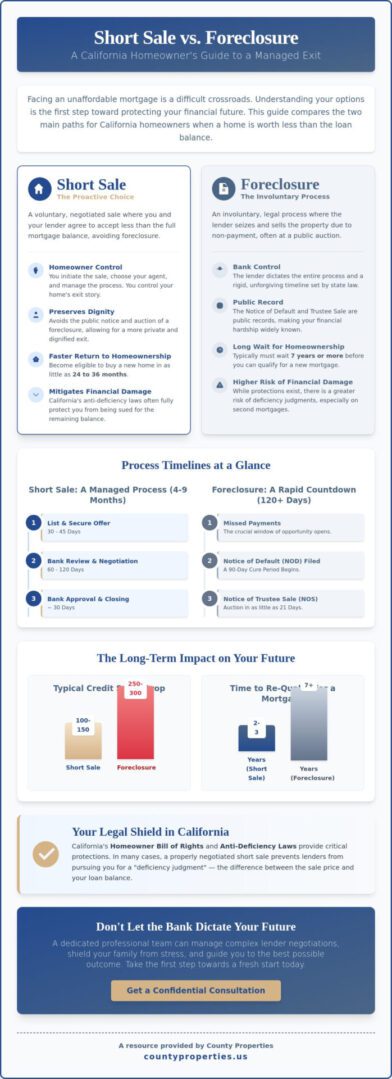
California primarily operates as a non-judicial foreclosure state. This means the lender doesn’t have to go to court to take your home; they follow a specific statutory process. The timeline moves faster than many homeowners anticipate. Once you miss several payments, the lender files a Notice of Default (NOD). This starts a 90-day clock. If the default isn’t cured, a Notice of Trustee Sale (NOS) follows, which allows the bank to sell the home in as little as 21 days. In 2026, digital filing systems have streamlined these steps, making it vital to act before the NOD is recorded. When comparing a short sale vs foreclosure in California, the speed of the non-judicial process is often the biggest shock to families who wait too long to seek help.
Comparing the Timelines: How Distressed Property Sales Work in 2026
Timing is everything when your home’s equity is underwater. In 2026, California homeowners have a specific window of opportunity to decide between a short sale vs foreclosure in California. This window opens the moment you miss your first mortgage payment and typically stays open for about 120 days before a lender can legally initiate the foreclosure process. Acting during this pre-foreclosure phase is vital to maintaining control over your financial future and credit health.
The Short Sale Negotiation Timeline
A short sale isn’t an overnight fix. It usually spans 4 to 9 months because it requires three distinct parties to agree: you, the buyer, and your lender. The process begins with listing the property and securing a qualified offer, which often takes 30 to 45 days in high-demand California markets. Your agent must then prove to the bank that the home is being sold for fair market value despite the payoff being less than the loan balance.
The middle phase is often the most taxing. Your agent submits your financial hardship package to the bank’s loss mitigation department. This review can take 60 to 120 days. During this period, stay alert for scams. The California Department of Justice has issued a short sale fraud warning to protect sellers from predatory “consultants” who charge illegal upfront fees. Once the bank issues an official approval letter, the final closing process mirrors a traditional sale, usually wrapping up in 30 days.
The Foreclosure Countdown
Foreclosure follows a rigid, statutory path in California that generally takes a minimum of 4 months once the legal filings begin. If you haven’t reached a resolution after 120 days of delinquency, the lender records a Notice of Default (NOD). This starts a mandatory 90-day waiting period. During these three months, you still have the legal right to sell the home or negotiate a loan modification. You aren’t out of the house yet, but the clock is ticking loudly.
If the debt isn’t resolved by the end of that period, the lender issues a Notice of Sale (NOS). This is the final 21-day countdown to the courthouse auction. The California Homeowner Bill of Rights provides a critical safety net here. It prohibits “dual tracking,” a practice where banks proceed with foreclosure while a homeowner’s completed short sale application is still pending. This law ensures you aren’t blindsided by an auction date while you are actively working toward a solution. Finding a trusted real estate partner early in this countdown can help you leverage these legal protections to stop the foreclosure clock and exit on your own terms.
The Legal Reality: Deficiency Judgments and Anti-Deficiency Laws in California
The most common fear for homeowners weighs heavy: can the bank sue me for the money they lost? This financial ghost is known as a deficiency judgment. A deficiency judgment is a court order for the remaining loan balance. When comparing a short sale vs foreclosure in California, understanding your legal exposure is the first step toward peace of mind. California offers some of the most robust homeowner protections in the United States, but these safeguards depend entirely on how your debt is structured and how the property is liquidated.
Non-Judicial Foreclosure and Your Protection
Lenders in California almost always choose non-judicial foreclosure because it’s faster and less expensive than going through the court system. This choice comes with a significant legal trade-off for the bank. Under California Code of Civil Procedure § 580d, a lender cannot pursue a deficiency judgment if they sell the property through a non-judicial trustee’s sale. They get the house back, but they lose the right to chase your other assets.
The “One Action Rule” also limits lenders to a single recovery effort. Additionally, CCP § 580b protects “purchase money” loans, which are loans used to buy an owner-occupied home with one to four units. If you never refinanced or took out a home equity line of credit, you’re generally safe from a deficiency after a foreclosure. Be aware that VA or FHA loans may have federal nuances that complicate these state-level protections. It’s vital to review your specific loan type before assuming you’re fully shielded.
Short Sale Legal Safe Harbors
Short sales once carried a risk where junior lienholders, like second mortgages, could still sue for their losses. This changed on July 15, 2011, with the passing of Senate Bill 458. This law expanded the protections of California’s anti-deficiency statute to include all lienholders. If a lender, whether it’s the primary or a secondary bank, agrees to a short sale, they’re legally prohibited from seeking a deficiency judgment after the close of escrow.
Success depends on the language in your short sale approval letter. You must ensure the documents state the bank accepts the proceeds as “Full Satisfaction of Debt.” Leveraging proven foreclosure prevention in California strategies is the best way to secure these legal releases. When you evaluate a short sale vs foreclosure in California, the short sale often provides a more controlled exit. It allows you to confirm in writing that you’re walking away with a clean slate. Don’t leave your financial future to chance; verify that every lienholder has signed off on a full release of liability before you sign the final closing papers.
Credit Impact and Future Homeownership: The Long-Term Recovery Path
Deciding between a short sale vs foreclosure in California isn’t just about your current mortgage; it’s about your ability to buy a home, rent an apartment, or even secure a job in 2027 and beyond. When you complete a short sale, the lender typically reports the account as “Settled for less than full balance.” While this still affects your score, it’s far less damaging than a foreclosure, which remains a permanent mark on your public record for seven years.
The numerical difference is stark. Industry data shows a short sale typically results in a credit score drop of 50 to 125 points. A foreclosure, however, can trigger a collapse of 200 to 300 points or more. Because a foreclosure is a public record, it’s virtually impossible to hide from future landlords or background screening companies. Choosing the short sale path demonstrates to future creditors that you acted to mitigate their loss, rather than walking away entirely.
When Can You Buy a Home Again?
Recovery timelines favor those who choose a proactive exit. Fannie Mae and Freddie Mac guidelines generally require a waiting period of only 2 to 4 years after a short sale before you can qualify for a new conventional mortgage. In contrast, a foreclosure requires a 7-year waiting period. A short sale allows for Fannie Mae loan eligibility in as little as 2 years. FHA and VA loans also offer flexible paths, sometimes allowing buyers back into the market in just 3 years if they’ve maintained clean credit post-sale. You can start rebuilding your score the day the transaction closes by opening a secured credit card and ensuring every utility payment is recorded on time.
Impact on Employment and Security Clearances
In regions like San Diego, where the defense and aerospace industries are major employers, financial history is a matter of professional survival. Security clearance investigators often view a short sale as “responsible debt management” because the homeowner took initiative to settle the debt. A foreclosure can be seen as a failure to meet financial obligations, which may jeopardize high-level clearances. Beyond the paperwork, a short sale provides a “graceful exit” that avoids the psychological trauma and public stigma of a forced eviction. You can begin rebuilding your score immediately by using secured credit lines and maintaining a 100% on-time payment history starting the month after your transaction closes.
If you’re worried about your credit future, our team can help you evaluate the best path for your specific situation. Contact County Properties today for a confidential consultation on your recovery options.
Taking Control: How a Professional Partner Navigates the Bank for You
You don’t have to face the lender’s legal department alone. Arnie Levine founded County Properties on a “Team Concept” that deliberately rejects the ego-driven model of traditional real estate offices. We prioritize your family’s stability over closing a quick deal. Our team works collaboratively to ensure your financial security through expert negotiation, focusing on your long-term recovery rather than just a single transaction. We manage the bank drama. This allows you to focus on the logistics of your move without the constant stress of automated collection calls.
Understanding the nuances of a short sale vs foreclosure in California requires a partner who knows how to protect your assets. This is especially vital for seniors looking to downsize under the weight of a looming auction date. We customize transition plans that respect your timeline and your dignity. We’ve seen every tactic banks use. We know how to counter them effectively to keep you in control of the narrative.
The County Properties Short Sale Process
- Step 1: Confidential Consultation. We conduct an empathetic review of your specific loan type and financial hardship. We don’t judge; we strategize.
- Step 2: Aggressive Marketing. We implement a targeted strategy to secure a high-quality offer. Our goal is to present a package the bank cannot ignore because it reflects true market value.
- Step 3: Direct Negotiation. We work directly with the lender’s loss mitigation department. Our primary objective is securing a full deficiency waiver, ensuring you aren’t pursued for the remaining balance after the sale.
Why Experience Matters in 2026
The 2026 landscape has introduced complex Automated Valuation Models (AVMs) that lenders use to set rigid price floors. Navigating these latest protocols requires more than just a real estate license; it requires a deep history with local data. With 36 years of experience in the Southern California housing market, we’ve survived multiple cycles and shifting regulations. We know how to challenge inaccurate bank appraisals with concrete evidence.
Lenders are more automated than ever in 2026, but we provide the human element that forces them to see you as a person, not a file number. We’ve successfully negotiated thousands of cases by staying ahead of lender requirements. Your journey to recovery starts with a single, no-obligation conversation. Let’s discuss your options and build a plan that preserves your future financial health.
Take Charge of Your California Homeownership Journey
Deciding between a short sale vs foreclosure in California is a pivotal choice that affects your credit and housing options for years. While foreclosure often stays on your record for seven years, a strategic short sale can reduce that recovery time significantly. Our team brings 36 years of Southern California real estate experience to your side, ensuring you benefit from the state’s specific anti-deficiency protections. We don’t just close deals; we provide a collaborative team approach that prioritizes your financial security over simple sales metrics. With specialized Senior Real Estate Specialists (SRES®) on staff, we understand the unique pressures facing homeowners in the 2026 market. You don’t have to navigate complex bank negotiations or legal timelines alone. We’re here to guide you through every step with the expertise you deserve. It’s time to move past the stress and toward a fresh start.
Request a Confidential Consultation with San Diego’s Short Sale Experts
You have the power to protect your future, and we’re ready to help you exercise it.
Frequently Asked Questions
Is a short sale better than a foreclosure for my credit score?
A short sale is generally better for your credit score than a foreclosure. FICO reports show a short sale typically causes a 100 to 160 point drop, while a foreclosure can lower scores by up to 300 points. When weighing a short sale vs foreclosure in California, the recovery time is the key. You can often rebuild your credit enough to buy again in 24 months.
Can I stay in my home during the short sale process in California?
You can stay in your home throughout the entire negotiation period. Most California short sales take 120 to 180 days from the initial listing to the final closing date. You aren’t required to move out until the title officially transfers to the new owner at the end of escrow. This gives your family several months to plan a transition without the pressure of an immediate eviction.
Will I have to pay taxes on the forgiven debt in a short sale?
Most California homeowners won’t pay taxes on forgiven debt if the property was their principal residence. The California Foreclosure Relief Act provides state level protection, and federal insolvency rules often apply at the national level. You’ll need to have your tax professional file IRS Form 982 to report the canceled debt correctly. This ensures you don’t get hit with a surprise bill on the 1099-C form.
How long does a short sale take to get approved by the bank in 2026?
Bank approval for a short sale currently takes between 60 and 90 days in 2026. This timeline starts once your agent submits a complete hardship package to the lender’s loss mitigation department. While the 2008 crisis saw delays of over a year, modern automated systems have cut processing times by 50%. You should expect the total process to last about 6 months from start to finish.
Does California law protect me from being sued after a foreclosure?
California law offers strong protections through Code of Civil Procedure Section 580d. This statute prevents lenders from pursuing a deficiency judgment after a non-judicial foreclosure sale. Since over 90% of California foreclosures happen through the trustee sale process, you’re likely protected from being sued for the balance. It’s a critical safety net that ensures you can walk away without a lingering debt hanging over your future finances.
Can I buy a new home immediately after a short sale?
You can usually buy a new home 2 years after a short sale if you use a standard FHA or conventional loan. If you managed to stay current on your payments until the sale closed, some lenders might even allow for an immediate purchase. This is a significant benefit when comparing a short sale vs foreclosure in California. Foreclosures typically require a 7 year waiting period before you’re eligible for a new mortgage.
What are the costs to the homeowner for a short sale?
There are generally no out of pocket costs for a homeowner during a short sale. The lender pays the 5% to 6% real estate commission, title fees, and escrow costs directly from the sale proceeds. You won’t have to pay for marketing or closing costs. In some cases, you may even qualify for a relocation incentive of $3,000 or more through the HAFA program or specific private lender initiatives.
What happens if the bank denies my short sale request?
If the bank denies your request, they’ll move forward with the foreclosure process, starting with a Notice of Sale. This notice establishes an auction date that is at least 20 days in the future. You have a 30 day window to appeal the denial under the California Homeowner Bill of Rights. If the appeal doesn’t work, you might explore a deed-in-lieu or a loan modification as a final alternative to save your credit.