

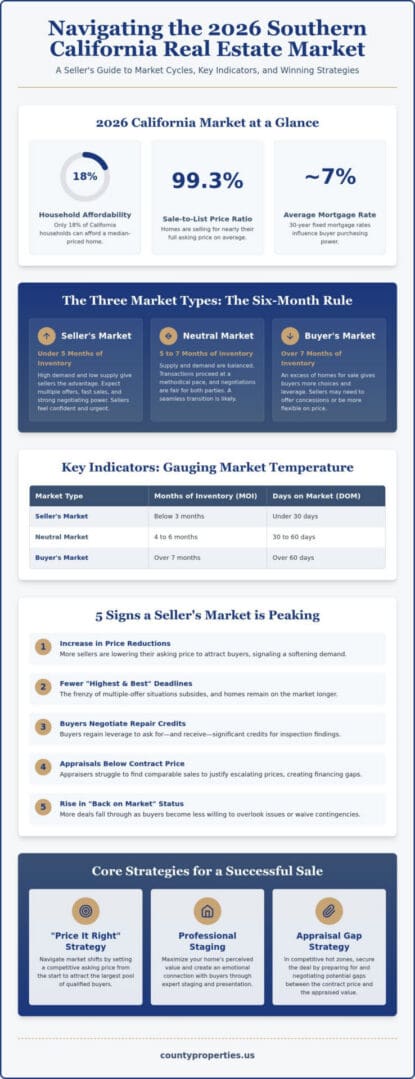
Only 18% of California households can afford a median-priced home in 2026, yet the statewide sales-price-to-list-price ratio still sits at a resilient 99.3%. You’re likely feeling the weight of these statistics while trying to pin down the best time to sell a house in California to protect your hard-earned equity. It’s natural to feel anxious about potential value drops or confused by national news that doesn’t seem to match what you’re seeing in your own neighborhood.
We believe you deserve a reliable professional ally who has navigated every market cycle with success. This guide will help you master the nuances of real estate cycles so you can make confident, financially secure decisions in the 2026 Southern California market. We’ll provide a clear breakdown of local trends, the impact of new 2026 real estate laws, and a month-by-month strategy for a seamless transition. You’ll gain the expert knowledge needed to move forward with optimism and achieve your long-term personal goals through a well-timed transaction.
Key Takeaways
- Understand the Six Month Rule to accurately gauge the supply-demand equilibrium and inventory levels in your specific Southern California zip code.
- Identify the five critical indicators that a sellers market is peaking so you can choose the best time to sell a house in California for peak financial security.
- Master the “Price it Right” strategy to navigate the 2026 market shift while utilizing professional staging to maximize your home’s perceived value.
- Prepare for a seamless transition with a comprehensive buyer’s checklist and advanced tactics like the Appraisal Gap strategy for competitive hot zones.
- Learn how a collaborative, service-first approach provides a steady guiding presence during high-stakes moves and senior real estate transitions.
Understanding the Dynamics: Buyers Market vs. Sellers Market in 2026
To master real estate market dynamics, you must first look at the balance between available homes and active buyers. This equilibrium dictates everything from your final sale price to the concessions you might have to grant a buyer. In Southern California, this balance is often measured by the Six Month Rule. This traditional benchmark suggests that a six month supply of inventory represents a neutral market where neither party has a significant advantage. If inventory drops below five months, you are in a sellers market. When it climbs above seven months, buyers take the lead.
In 2026, the emotional weight of these cycles is palpable. Sellers in a hot market often feel a sense of urgency and confidence, managing multiple offers within days. Buyers, conversely, frequently experience anxiety and the “fear of missing out” as they compete for limited listings. A neutral market offers a more methodical pace, allowing for a seamless transition where both parties feel the transaction is fair. Understanding these phases is the first step in determining the best time to sell a house in California to meet your specific financial goals.
The Core Difference: Supply vs. Demand
The 2026 Southern California Housing Pulse
The Southern California market rarely moves in perfect lockstep with national headlines. While the country might see a cooling trend, neighborhoods like Rancho Santa Fe or Hillcrest often maintain their own micro-climates due to high demand and limited land. Interest rates, which averaged 6.80% for a 30-year fixed mortgage in August 2026, continue to influence buyer behavior. High rates have created a “lock-in” effect for some, but the underlying demand remains strong because only 18% of households can currently afford a median-priced home. This scarcity ensures that even when the market shifts, well-maintained properties in prime San Diego locations remain highly sought after. Identifying these local nuances is essential for anyone looking for the best time to sell a house in California while seeking long-term financial security.
Identifying the Shift: How to Tell Which Market You Are In
Recognizing the best time to sell a house in California requires a sharp eye for local momentum. While statewide data provides a broad view, San Diego neighborhoods often show subtle shifts before the wider market reacts. Look for these five signs that a sellers market is reaching its peak: an uptick in price reductions, fewer “highest and best” offer deadlines, buyers successfully negotiating for significant repair credits, appraisals consistently coming in below the contract price, and a visible rise in “back on market” statuses. These indicators suggest that the extreme leverage previously held by homeowners is beginning to soften.
Monitoring the ratio of Active vs. Pending listings offers a real-time snapshot of current buyer demand. When the number of pending sales begins to dip while active listings climb, inventory builds, and the market starts to balance. For those seeking Expert Guidance for Complex Transitions, these data points are the foundation of a secure financial strategy. If you want to understand how these trends affect your specific property, you can connect with our team for a localized market report.
Months of Inventory (MOI) and Days on Market
To calculate Months of Inventory (MOI), divide the total number of active listings by the number of sales closed in the last 30 days. This metric tells you how long it would take to sell all available homes if no new ones were listed. It’s a critical tool for identifying market transitions.
- Sellers Market: Characterized by a DOM of under 30 days and an MOI below 3 months.
- Neutral Market: Typically shows a DOM between 30 and 60 days with an MOI of 4 to 6 months.
- Buyers Market: Identified when DOM exceeds 60 days and MOI climbs over 7 months.
The “Sweet Spot” for buyers usually emerges when DOM exceeds 60 days, as sellers become more willing to negotiate terms to ensure a successful closing and a smooth transition to their next home.
Pricing Trends and Neighborhood Specificity
Real estate is hyper-local. A specific zip code in Coastal San Diego might remain a sellers market while an inland neighborhood shifts toward buyers. To explore these regional variations in detail, review our Southern California Housing Market: Forecast & Trends for 2026. To spot micro-market shifts in your own area, use the following checklist:
- Track the frequency of price drops in your immediate zip code.
- Compare current new listing volume against the same period last month.
- Observe if open house attendance is noticeably thinning.
- Watch for “For Sale” signs that remain standing for more than three consecutive weekends.
Staying informed on these local patterns ensures you choose the best time to sell a house in California based on verifiable neighborhood facts rather than broad speculation.
Selling Your Home: Strategies for Every Market Cycle
Many homeowners worry that if prices aren’t skyrocketing, they’ve missed their window. We believe that financial security comes from strategy, not just luck. While the rate of price growth has slowed in August 2026, the statewide median price for a single-family home remained a robust $887,680 in July. The best time to sell a house in California is whenever you have a clear plan to capture that equity. Success in this balanced environment requires a shift from the “Price it High” mentality to a “Price it Right” approach. Overpricing in a cooling market often leads to stagnation, whereas accurate pricing combined with professional staging creates the competitive energy needed to secure a top-tier offer.
When you see a sales-price-to-list-price ratio of 99.3%, as we did in July 2026, it indicates that buyers are still willing to pay fair market value for quality homes. You can leverage multiple offers without alienating buyers by setting clear expectations and focusing on the strength of the terms. A seasoned professional can help you evaluate a Selling Your Home: Strategies for Every Market Cycle to ensure your local San Diego trends align with your personal goals.
Maximizing Value in a Sellers Market
Even in a high-demand phase, selling a home in Southern California requires a specialized touch to avoid leaving money on the table. In 2026, the Offer Deadline strategy remains effective but carries risks if the initial interest is thin. We recommend vetting buyers beyond the highest price point. With 30-year fixed mortgage rates averaging 6.80%, you must ensure your buyer’s financing is rock-solid. Look for shortened contingency periods and significant earnest money deposits as signs of a committed, high-quality partner in the transaction.
Navigating the Challenges of a Buyers Market
When inventory builds, as it did in May 2026 with over 108,000 homes for sale, you must be prepared to offer concessions. These might include repair credits or assistance with closing costs to help buyers manage their monthly payments. We follow the “First 21 Days” rule: if you don’t have significant interest or an offer within the first three weeks, your price likely doesn’t reflect the current market reality. This is especially vital for seniors who need to downsize with dignity. Our collaborative approach ensures you aren’t pressured into a “fire sale” but instead move forward with a methodical, supportive plan that protects your long-term achievement.
Buying a Home: Winning Tactics for Southern California Real Estate
Deciding on the best time to sell a house in California often means you’re simultaneously entering the market as a buyer. This transition can feel daunting in 2026, especially when only 18% of households can afford the median-priced home. However, long-term historical data proves that real estate remains a premier vehicle for financial security. Even those who purchased at previous market “tops” in Southern California have seen their property values recover and thrive over a decade. Success in this environment requires a “Pre-Flight” checklist: securing a local pre-approval, defining your non-negotiables, and understanding the specific inventory levels of your target zip code.
In competitive pockets of San Diego, the Appraisal Gap strategy is a vital tool. This involves promising to cover a specific dollar amount if the bank’s appraisal comes in lower than your offer price. It provides the seller with certainty and can make your offer stand out among multiple bids. To find opportunities before they hit the open market, we utilize our deep regional roots to identify off-market listings, giving our clients a distinct advantage. If you’re ready to start your search, view our current Southern California listings to see what’s available today.
Standing Out During a Sellers Market
When inventory is tight, a clean offer often beats a slightly higher price with messy terms. Sellers in 2026 are looking for reliability and a smooth closing. We recommend using a reputable, local San Diego lender whose name carries weight with listing agents. A pre-approval letter from a known local professional is far more persuasive than one from a faceless national call center. For a deeper dive into these strategies, read our Buying a Home in Southern California: A Realistic 2026 Guide.
Leveraging Opportunity in a Buyers Market
If you find yourself in a cooling market where inventory exceeds a six-month supply, your negotiating power increases. This is the time to ask for mortgage rate buy-downs or significant repair credits. These concessions can save you thousands in monthly payments, effectively neutralizing the impact of current interest rates. Be cautious with “low-ball” offers, though; they often shut down communication entirely. Instead, work with a seasoned mentor who understands how to structure a win-win deal. This expertise is especially critical for those seeking a retirement property, where the right terms can ensure a peaceful, long-term achievement.
Expert Guidance for Complex Transitions: The County Properties Approach
We believe that a successful move is built on a foundation of trust and expert guidance. Real estate transactions are often tied to significant life changes that don’t always align with perfect market conditions. While data helps identify the technical best time to sell a house in California, your personal needs and financial security remain our primary focus. We operate on a philosophy of Collaborative Success. This means our team acts as your dependable guide, focusing on your long-term achievement rather than high-pressure sales tactics. Arnie Levine, a seasoned veteran with decades of experience in Southern California, leads our agency with a service-first model designed to handle the most complex situational challenges.
Whether you’re managing a family estate or facing a sudden relocation, we provide a structured, logical path forward. We understand that high-stakes personal situations require more than just a listing agent; they require a steadfast partner. Our approach bridges the gap between professional mastery and empathetic support, ensuring you feel secure at every step of your journey. We’re deeply rooted in the local San Diego fabric, giving us the historical perspective needed to navigate any market cycle with certainty.
Senior Downsizing and Lifestyle Transitions
Transitioning from a long-term family home is an emotional process that requires methodical assistance. We specialize in managing the logistics of senior moves, offering a turn-key solution that relieves the burden on both seniors and their adult children. We believe empathy is the most important tool in real estate today. Our team coordinates every detail, from initial sorting and decluttering to the final closing, allowing your family to focus on the personal aspects of the transition. We provide the steady presence needed to navigate these high-stakes life milestones with dignity and optimism. This collaborative approach ensures that your move is not just a transaction, but a successful fulfillment of a long-term goal.
Distressed Property Solutions and Foreclosure Prevention
If you’re facing financial hurdles, the best time to sell a house in California is often as soon as you can to preserve your credit and equity. We offer specialized expertise in short sales and foreclosure prevention, providing a professional framework for solving difficult situations. In 2026, many homeowners are finding that a short sale is a far superior alternative to the long-term damage of a foreclosure. You can learn more about your options in our foreclosure prevention California guide. For those who need to move quickly, our rapid cash offer facilitation provides a reliable exit strategy, ensuring you can transition to your next chapter with financial safety and professional support.
Secure Your Financial Future in the 2026 California Market
Success in today’s shifting landscape depends on moving beyond national headlines to master your local San Diego data. You’ve learned that identifying inventory shifts and embracing a “Price it Right” strategy are the most effective ways to protect your equity. Determining the best time to sell a house in California is a deeply personal decision, and we’re here to ensure you move forward with absolute certainty. Our collaborative approach focuses on your unique needs, whether you’re navigating a senior transition or managing a complex financial hurdle.
Arnie Levine, a Senior Real Estate Specialist (SRES®) with decades of Southern California market experience, offers the expert short sale and foreclosure prevention resources required for a secure outcome. We’re committed to acting as your steadfast ally, turning high-stakes moves into celebrated life milestones. If you’re ready to take the next step toward a seamless home transition, Request a Personalized Market Analysis for Your Southern California Home today. You don’t have to navigate this journey alone. We look forward to helping you achieve your long-term goals with confidence and peace of mind.
Frequently Asked Questions
Is 2026 a buyers market or a sellers market in San Diego?
The market is currently transitioning into a more balanced environment as of August 2026. While the statewide median price remains high at $887,680, inventory is gradually improving, which grants buyers more negotiating power than in previous years. San Diego often behaves uniquely due to high demand in coastal neighborhoods. This makes it a strategic window rather than a frenzied sellers market, allowing for a more methodical transition for those seeking the best time to sell a house in California.
What is the most important indicator of a market shift?
The most reliable indicator is the Months of Inventory (MOI) combined with Days on Market (DOM). When you see DOM climb past 30 days and MOI rise toward six months, the leverage is moving from sellers to buyers. We also watch the ratio of price reductions very closely. If more than 25% of active listings in a specific zip code show price cuts, it’s a clear signal that the previous peak has passed.
Can a market be both a buyers and sellers market at the same time?
Real estate is hyper-local and can vary significantly by price point and neighborhood. For example, entry-level homes under the median price might stay in a sellers market due to high demand from first-time buyers. Simultaneously, luxury properties in high-end coastal areas could experience a buyers market with much higher inventory. This duality is why we focus on zip-code-specific data to help you determine the best time to sell a house in California.
How does a sellers market affect home appraisals?
In a hot sellers market, appraisals often lag behind rapidly rising contract prices. This happens because appraisers rely on past sales, which may not reflect the current week’s demand. When a gap occurs, it creates a “shortfall” that must be covered by the buyer or negotiated with the seller. We often use Appraisal Gap strategies to provide our clients with certainty that the deal will close regardless of the bank’s valuation.
Should I buy a house now or wait for a buyers market?
Decisions should be based on your personal life stage and long-term financial goals rather than trying to time the bottom perfectly. With 30-year fixed mortgage rates averaging 6.80% in August 2026, waiting for a buyers market might mean facing higher prices later if inventory remains constrained. Historical Southern California data shows that time in the market is usually more rewarding than timing the market. A seasoned mentor can help you find value even in competitive cycles.
What strategies work best for seniors selling in a buyers market?
Seniors should focus on a “Turn-Key” presentation and offering flexible seller concessions. In a slower market, buyers are often cash-strapped due to high monthly payments, so offering to pay for a mortgage rate buy-down can make your home much more attractive. Our service-first model prioritizes empathy and methodical assistance. We handle the logistics of downsizing so you can transition to your next home with dignity and financial security without feeling pressured or overwhelmed.
How does inventory affect my home’s market value?
Inventory levels directly influence your home’s perceived value through the principle of scarcity. When there were only 108,753 homes for sale statewide in May 2026, low supply kept prices resilient despite higher interest rates. If inventory increases, buyers have more options, which forces sellers to compete on price and condition. High inventory doesn’t always lower your value, but it does require a more sophisticated marketing and staging strategy to ensure your property stands out.
Is it possible to sell a house fast in a buyers market?
You can sell quickly in any market by utilizing a rapid cash offer facilitation or pricing slightly below the current “comps.” In a buyers market, the first 21 days are critical for capturing interest. If your home is professionally staged and priced accurately from day one, you’ll attract the most serious buyers who have been waiting for a quality listing. Our collaborative team approach ensures your home is positioned to move efficiently regardless of broader regional trends.