

Is buying a house with foundation issues in California financial suicide, or could it actually be your smartest path to building equity? Most buyers see a cracked stem wall or a sticking door and immediately run the other way. It’s completely natural to worry about catastrophic structural failure after close of escrow, especially with Southern California’s expansive clay soils and the lingering fear that mortgage underwriters might reject your loan.
You’re right to feel protective of your hard-earned savings. Yet structural concerns often look far scarier than they actually are. When quantified with engineering data rather than emotion, foundation defects transform into powerful negotiating leverage. In this guide, you’ll learn how to tell common regional settling from genuine structural threats, complete the proper engineering inspections, and secure substantial price reductions or repair credits. Here is your clear roadmap to evaluating foundation concerns calmly and closing with total confidence.
Key Takeaways
- Distinguish between benign drywall hairline settling and urgent structural displacement caused by California’s expansive clay soils and seismic faults.
- Learn why buying a house with foundation issues in California requires specialized structural engineer evaluations rather than relying solely on standard home inspection overviews.
- Understand how mandatory Transfer Disclosure Statements (TDS) and strict lender appraisal standards affect your financing, loan underwriting, and insurance approval.
- Master proven negotiation strategies during your 17-day contractual contingency window to turn certified repair bids into substantial price reductions or seller credits.
- Evaluate proven engineering solutions, from steel push piers to foundation retrofitting, so you can accurately budget long-term structural repairs and protect your equity.
Identifying Foundation Issues in California Homes: Red Flags vs. Normal Settling
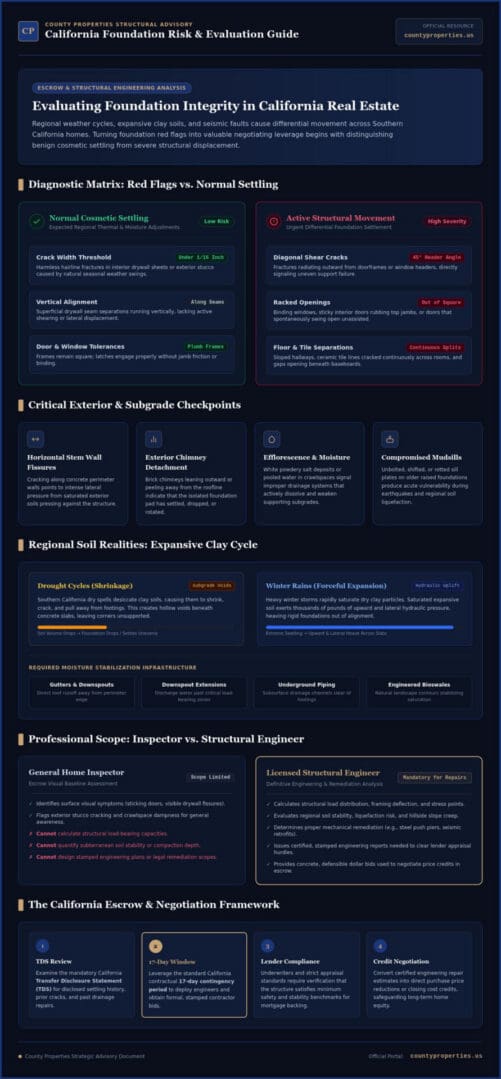
Every California home experiences some movement over its lifespan. As seasonal weather cycles swing between parched summers and heavy winter rains, regional soils naturally expand and contract. This rhythm frequently leaves behind harmless hairline cracks in drywall and exterior stucco. When you are considering buying a house with foundation issues in California, your first priority is separating these minor cosmetic shifts from active, dangerous structural movement.
A general home inspector provides a great visual baseline during escrow, but their scope has strict limits. A standard home inspector can identify visible red flags, yet they cannot calculate load capacities, determine soil stability, or draft remediation plans. Answering those deeper questions requires specialized structural engineer assessments.
Interior Warning Signs You Cannot Afford to Ignore
Cosmetic cracks typically run vertically along drywall seams and stay under one-sixteenth of an inch wide. Structural shifting, however, produces unmistakable symptoms across your living spaces:
- Diagonal shear cracks: Fractures that radiate diagonally upward from doorframes or window headers at a 45-degree angle signal differential foundation settlement.
- Racked openings: Windows that bind and interior doors that stick, rub against upper jambs, or drift open on their own indicate that the home’s framing is pulling out of square.
- Floor separations: Continuous hairline fractures slicing through ceramic floor tiles, sloped hallways, or unexplained gaps opening between baseboards and finished flooring reveal uneven slab settlement.
Exterior and Crawlspace Structural Checkpoints
Evaluating the home’s exterior envelope and crawlspace gives you direct visibility into its primary load points. Pay close attention to these structural checkpoints:
- Horizontal stem wall fissures: Horizontal cracking along concrete perimeter foundations points to severe lateral pressure from wet soils pushing against the structure.
- Chimney detachment: An exterior brick chimney leaning outward or separating from the roofline and siding demonstrates that the underlying pad has dropped or rotated.
- Crawlspace moisture and efflorescence: White powdery salt deposits on concrete walls or standing water in the crawlspace show poor drainage that steadily weakens supporting subgrade.
- Compromised mudsills: Older raised foundations frequently have shifted, decayed, or completely unbolted sill plates, raising catastrophic vulnerability to seismic movement or regional soil liquefaction during an earthquake.
California Soil, Seismicity, and Foundation Types: Regional Realities
California’s complex geology plays a decisive role in home stability. From the canyon rims of San Diego to the active fault corridors running through Los Angeles and the Inland Empire, subterranean movement is an everyday reality. Successfully buying a house with foundation issues in California means understanding the earth beneath the subfloor just as thoroughly as the framing above it. Hillside parcels face natural slope creep, coastal bluffs grapple with marine erosion, and regional soil chemistry continually tests structural concrete.
The Impact of Expansive Soils on Southern California Homes
Expansive clay soils cover extensive portions of Southern California. During prolonged drought cycles, these clay particles shrink and crack, creating voids beneath concrete pads and footings. When heavy winter rains saturate the ground, that same clay expands forcefully, exerting thousands of pounds of upward and lateral pressure.
This relentless cycle produces differential movement across rigid slabs. In microclimates throughout San Diego County, one corner of a residence can rise while the opposite corner sinks into dried soil. Managing this movement requires disciplined surface drainage. Gutters, extended downspouts, underground drainage pipes, and bioswales work together to channel stormwater away from the building perimeter, keeping soil moisture levels consistent throughout the seasons.
Raised Foundations vs. Concrete Slab-on-Grade
A home’s construction era dictates its structural vulnerabilities and repair pathways:
- Raised pier-and-beam foundations: Common in pre-1960s builds, these configurations provide straightforward crawlspace access for leveling adjustments. However, they frequently feature unbolted mudsills, dry rot, and unbraced cripple walls that shift during ground tremors.
- Seismic retrofit standards: Compliance with the California Residential Code for foundations requires anchoring framing to the perimeter concrete using heavy-duty foundation bolts and reinforcing short wood-stud cripple walls with structural plywood.
- Slab-on-grade and post-tensioned foundations: Dominant in modern subdivisions, continuous slabs withstand lateral shaking well. When unreinforced slabs crack from underlying soil expansion, repairs require invasive concrete work. Post-tensioned cables embedded within newer slabs add tensile strength, though they severely limit post-settlement plumbing and slab alterations.
Evaluating these era-specific quirks takes specialized local insight. Securing experienced, boutique buyer representation gives you a trusted guide who understands regional soil conditions and helps protect your financial safety long before you sign off on escrow contingencies.
Repair Methods and the Cost of Foundation Repair in Southern California
Remediating structural movement requires matching the right engineering solution to the specific ground failure beneath the home. When you are buying a house with foundation issues in California, you cannot rely on rough estimates or generic repair allowances. You need exact scopes of work designed by licensed specialists who understand local load requirements. Structural repairs range from minor non-structural sealing to deep underpinning that anchors the building to stable bedrock.
Comparing Structural Repair Techniques
Licensed contractors and geotechnical teams rely on several proven methods to stabilize and re-level residential structures:
- Steel push and helical piers: Underpinning with steel piers is the gold standard for settling foundations. Hydraulic rams drive heavy-duty steel piers past unstable topsoil until they reach load-bearing strata or bedrock. Typical Southern California installations require 6 to 12 piers, with costs generally running between $1,000 and $3,000 per pier.
- Pier and beam re-leveling: For older raised foundations, crews install new posts, concrete pads, and screw jacks beneath sagging girders. Complete crawlspace re-leveling typically ranges from $6,000 to $20,000.
- Polyurethane injection (poly-jacking): High-density expanding foam injected beneath sunken interior slab sections lifts concrete back into alignment quickly without heavy excavation. Minor crack injections for cosmetic water control run between $500 and $1,500 per crack.
- Drainage interceptor systems: Installing exterior French drains, catch basins, and deep discharge sump pumps relieves hydrostatic pressure, preventing future shifting.
Key Factors Driving California Foundation Repair Budgets
Every foundation bid reflects regional site conditions. Depth to competent bedrock dictates pier lengths, meaning a home perched on a coastal terrace in San Diego County may require substantially deeper underpinning than an Inland Empire property sitting on stable alluvial soil. Total foundation replacement represents the most extensive scenario, spanning anywhere from $45,000 to upwards of $150,000 depending on framing complexities and access limitations.
Secondary expenses also shape your bottom line. Securing a certified structural engineer’s report costs between $500 and $1,500, followed by municipal permitting fees for seismic design compliance. Lifting a home back toward level often cracks interior drywall, pinches doors, or fractures brittle copper plumbing and sewer pipes embedded in concrete. Factor in these cosmetic and plumbing restorations so you can evaluate whether the property’s acquisition price leaves an adequate financial safety margin.
California Disclosures, Financing Hurdles, and Insurance Implications
When you are buying a house with foundation issues in California, the physical condition of the property is only half the battle. Legal disclosures, strict lending criteria, and an increasingly restricted insurance marketplace directly impact whether your transaction can cross the finish line. Even if a property is listed “as-is,” California statutory protections hold sellers accountable, ensuring you receive transparent documentation before removing your contingencies.
California Mandatory Disclosures and the Paper Trail
California law mandates complete transparency through the Real Estate Transfer Disclosure Statement (TDS). Sellers must explicitly reveal known settlement, past structural repairs, grading drainage defects, and historical soil movement. Reviewing the Natural Hazard Disclosure (NHD) report reveals whether the parcel sits directly within an active Alquist-Priolo Earthquake Fault Zone or a designated liquefaction zone.
Do not simply rely on a seller’s written disclosure. Always cross-reference the TDS against municipal building permit records. If a prior owner installed steel push piers or rebuilt stem walls without pulling municipal permits, uncertified work can create serious permitting headaches and liability during your ownership.
Navigating Lender Underwriting with Structural Defects
Traditional mortgage underwriting comes to a complete halt the moment an appraiser flags active structural failure. Conventional, FHA, and VA loan guidelines demand that a home be structurally sound, safe, and sanitary to qualify for financing:
- Lender-required engineering sign-offs: When an appraiser spots noticeable shearing cracks, lenders pause the file until a licensed structural engineer inspects the property and certifies structural stability.
- Escrow repair holdbacks: If repairs are clearly defined, some lenders permit an escrow holdback where 120% to 150% of the bid estimate is held in escrow to fund repairs right after closing.
- Alternative transaction solutions: When severe damage renders a home completely uninsurable and unfinanceable through conventional channels, partnering with seasoned professionals to arrange private funds or explore cash offer facilitation can rescue an otherwise impossible transaction.
Securing property insurance poses an equal challenge. Standard California homeowners policies strictly exclude earth movement, settling, and earthquake damage. Securing earthquake protection requires a dedicated policy from the California Earthquake Authority (CEA) or private specialty carriers. With California’s insurance market tightening rapidly, verify property insurability with your broker during your early contingency days.
Strategic Negotiation: Turning Foundation Flaws into Homebuying Leverage
Uncovering structural movement during escrow feels overwhelming, but it often marks the turning point where smart buyers build immediate equity. When you approach buying a house with foundation issues in California through an objective engineering lens, fear turns into measurable negotiating power. The California residential purchase agreement provides a standard 17-day contingency period. Using this critical timeframe to gather verified data gives you the upper hand when returning to the bargaining table.
The 4-Step Structural Inspection Strategy
Securing an advantageous outcome requires a disciplined, four-phase due diligence sequence:
- Phase 1: Identify baseline defects: Working with a dedicated property inspection service like Lin Inspects helps flag visible abnormalities early, including binding frames, uneven subfloors, and perimeter cracks.
- Phase 2: Hire an independent engineer: Retain a licensed structural engineer who does not sell foundation repair services. Their neutral analysis delivers an unbiased evaluation of load capacities and settlement causes.
- Phase 3: Secure competitive contractor bids: Solicit at least two itemized bids from licensed foundation contractors based on the engineer’s exact structural specifications.
- Phase 4: Submit California Form RR: Package the engineering schematic alongside contractor proposals into a formal Request for Repair (Form RR), giving the seller documented evidence that cannot be dismissed as subjective opinion.
Structuring Your Purchase Offer and Contingencies
How you structure your remedy request determines whether the transaction protects your financial future. Avoid asking sellers to complete repairs prior to closing. Sellers naturally lean toward the cheapest contractor and minimal fixes to get past escrow. Demanding a direct purchase price reduction or seller-paid closing credits keeps complete quality control in your hands post-closing.
Keep your contractual loan and inspection contingencies fully intact until engineering calculations confirm the repair scope is manageable. If inspection bids reveal unstable hillsides or active subterranean movement exceeding reasonable repair margins, exercise your contingency right to walk away with your earnest money deposit intact.
Mastering these high-stakes escrow negotiations requires seasoned, boots-on-the-ground guidance. Partnering with County Properties safeguards your interests through every phase of due diligence, pairing you with trusted structural specialists and turning complex structural challenges into winning purchases.
Take Control of Your California Home Purchase with Confident Advocacy
Discovering foundation flaws does not mean your homeownership dream is over. When you replace fear with engineering facts, buying a house with foundation issues in California becomes a strategic opportunity to build long-term value. Distinguishing harmless cosmetic settling from genuine structural displacement, securing certified engineering scopes, and using your contractual contingency timeline allow you to negotiate meaningful price reductions while keeping complete quality control over future repairs.
You don’t have to face complex escrows, strict lending conditions, or high-stakes structural negotiations alone. Backed by decades of seasoned transaction experience across San Diego County market cycles, County Properties delivers dedicated buyer representation designed to protect your hard-earned equity and guide you through every disclosure challenge. When you are ready to evaluate a property with total peace of mind, connect with County Properties for expert buyer representation and step into your next purchase with complete financial safety.
Frequently Asked Questions
Is buying a house with foundation issues always a bad idea in California?
No, buying a house with foundation issues in California is not inherently a bad decision if the structural concerns are accurately diagnosed and financially accounted for. Many properties with settlement problems scare off casual shoppers, creating prime opportunities for prepared buyers. Provided the required stabilization costs leave an ample safety buffer below true market value, acquiring a distressed structure can yield substantial long-term equity.
How much does foundation repair typically cost in Southern California?
Southern California foundation repairs range widely depending on structural severity and site topography. Minor cosmetic crack sealing typically runs from $500 to $1,500. Hydraulic pier underpinning generally costs between $1,000 and $3,000 per pier, with most homes requiring 6 to 12 piers. Full structural foundation replacements in complex hillside or restricted-access parcels can exceed $45,000 to $150,000 once permitting and engineering calculations are included.
Can I get a standard mortgage on a California home with structural foundation damage?
Traditional lenders typically halt conventional, FHA, and VA loan approvals the moment an appraiser flags active structural failure or unaddressed safety hazards. When standard financing stalls, buyers can utilize specialized programs like Fannie Mae HomeStyle or FHA 203(k) renovation loans to bundle purchase and repair costs together. Lenders may also allow escrow repair holdbacks if the scope of work is straightforward and fully contractor-bid.
What is the difference between a general home inspector and a structural engineer?
A general home inspector conducts a broad visual review of visible home systems, identifying red flags such as wall fractures, doorframe racking, and moisture intrusion. A licensed structural engineer is a state-certified professional who performs mathematical calculations, assesses soil loads, and diagnoses root causes. Engineers deliver official remediation plans and stamped structural certifications, which general property inspectors are legally and professionally unauthorized to produce.
Does California law require sellers to disclose past foundation settling or repairs?
Yes, California law mandates complete transparency regarding property defects under the Real Estate Transfer Disclosure Statement (TDS). Sellers must explicitly document known soil movement, settling history, slab cracks, and past structural repairs, even when selling a home strictly “as-is.” Failing to disclose known defects exposes sellers to significant post-closing legal liabilities and gives buyers legal grounds for contract cancellation during escrow.
Will standard California homeowners insurance policies cover foundation repair work?
Standard California homeowners insurance policies strictly exclude damage caused by earth movement, soil settling, hydrostatic pressure, and natural wear. Unless foundation cracking directly stems from a covered peril like an abrupt interior pipe rupture, carriers will deny the claim. Earthquakes require standalone insurance through the California Earthquake Authority or private underwriters, making upfront structural retrofitting critical for securing favorable coverage terms.
How do expansive clay soils damage residential foundations throughout San Diego?
Expansive clay soils contain minerals that absorb moisture during winter rain cycles, swelling forcefully and exerting immense upward and lateral pressure against concrete footings. In dry summer months, this soil shrinks, pulling away from concrete slabs and leaving hollow structural voids. This continuous cycle of swelling and shrinking creates differential settlement, which breaks rigid concrete slabs and knocks framing out of square.