
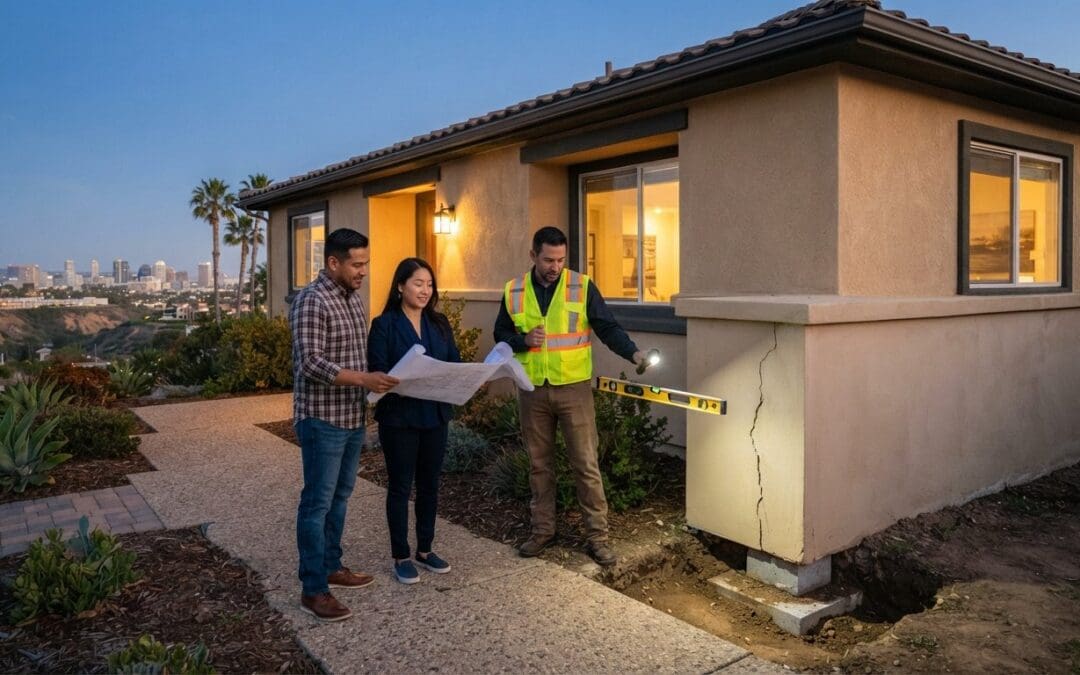
You notice a hairline crack snaking up your stucco or a bedroom door that won’t quite latch, and suddenly, your San Diego dream home feels like a growing financial liability. With the local median home price now hovering near $1 million, structural instability is a heavy burden that can trigger deep anxiety about your hard earned equity. You aren’t alone in this concern. Many homeowners across the county face similar challenges due to our region’s expansive marine clays and canyon topography. If you are worried about selling a home with foundation problems in San Diego, you likely feel caught between the fear of low ball offers and the confusion of California’s strict disclosure requirements.
We understand that this transition feels high stakes, but structural issues don’t have to derail your long term financial goals. This guide provides a clear, professional path to help you navigate legal risks and maximize your property value. You’ll discover the specific requirements of California Civil Code § 1102, learn how to weigh repair costs against market discounts, and determine whether a traditional listing or a streamlined cash offer facilitation best serves your needs. Our goal is to provide the expert knowledge you need to move forward with total confidence and security.
Key Takeaways
- Understand how San Diego’s unique geology, including expansive clay soils and canyon rim locations, directly impacts your property’s structural integrity and market value.
- Discover the essential steps for selling a home with foundation problems in San Diego, including the importance of obtaining certified engineering reports and detailed repair bids.
- Navigate California’s mandatory disclosure laws to ensure you meet all legal obligations under the Transfer Disclosure Statement and mitigate the risk of future litigation.
- Analyze the financial trade-offs between completing structural repairs and selling as-is, especially regarding how these issues affect FHA and VA loan eligibility.
- Learn how expert guidance and cash offer facilitation can simplify complex real estate transitions, providing you with a clear path toward maximizing your equity.
Understanding Foundation Issues in the San Diego Real Estate Market
San Diego’s natural beauty often hides a challenging geological reality. When you’re considering selling a home with foundation problems in San Diego, you must first understand the ground beneath your feet. Our region is famous for its rolling hills and coastal bluffs, but these features often come with soil conditions that test the limits of residential engineering. Stability in Southern California isn’t just about the structure; it’s about how that structure interacts with the unique environment of the Pacific coast.
Why San Diego Soil is Tough on Foundations
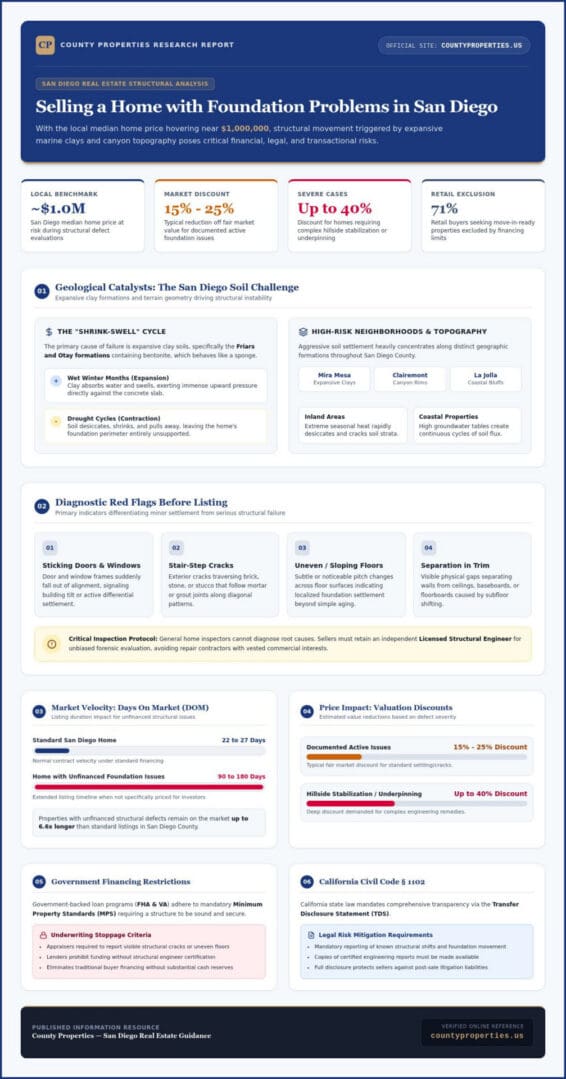
The primary culprit behind structural movement in our area is the prevalence of expansive clay soils, specifically the Friars and Otay formations. These soils contain bentonite, which acts like a sponge. During our wet winter months, the clay absorbs water and swells, exerting immense upward pressure on your home’s concrete slab. When the inevitable drought cycles return, the soil shrinks and pulls away, leaving your foundation unsupported. This “shrink-swell” cycle is particularly aggressive in neighborhoods like Mira Mesa, Clairemont, and parts of La Jolla. Inland areas face extreme heat that desiccates the soil, while coastal properties deal with high groundwater tables that keep the soil in a near-constant state of flux.
Identifying Red Flags Before You List
Before you put your property on the market, you need to know if you’re dealing with minor settling or a major structural failure. Cosmetic cracks are common in older San Diego homes, but certain “red flags” demand professional attention. These signs often manifest differently depending on whether your home is a coastal cottage or an inland ranch.
- Sticking Doors and Windows: If frames are suddenly out of alignment, the house may be tilting or experiencing differential settlement.
- Exterior Stair-Step Cracks: Look for cracks in the brick, stone, or stucco that follow the grout lines in a diagonal pattern.
- Uneven or Sloping Floors: A subtle pitch in the floor often indicates a localized settlement issue that has progressed beyond simple aging.
- Gaps in Trim: Separation between the walls and the ceiling or floorboards is a classic sign of structural movement.
A general home inspector might flag these issues, but they aren’t qualified to diagnose the root cause. When selling a home with foundation problems in San Diego, your first step should be hiring a licensed structural engineer. They provide an unbiased, forensic evaluation that a foundation repair contractor, who has a vested interest in selling you a specific repair solution, simply cannot offer. This professional report becomes a vital tool for establishing trust with potential buyers.
Repair vs. Selling As-Is: Calculating Your Best Move
Deciding whether to invest in structural repairs or list your property as-is is the most significant financial choice you’ll face when selling a home with foundation problems in San Diego. It’s a delicate balance between your available capital, your risk tolerance, and your desired move-out timeline. You aren’t just weighing the cost of concrete and steel; you’re weighing the value of your time and peace of mind in a high-stakes market.
The financial math is often sobering for many homeowners. Market data indicates that homes with documented, active foundation issues typically sell at a 15% to 25% discount off fair market value. If the property requires complex hillside stabilization or extensive underpinning, that discount can climb to 40%. Beyond the price reduction, you must consider market velocity. While a standard San Diego home might go under contract in 22 to 27 days, a property with unfinanced structural issues often sits for 90 to 180 days if it isn’t priced specifically for the investor market.
Financing creates a massive roadblock for traditional buyers. Government-backed loans, such as FHA and VA, adhere to strict Minimum Property Standards that require a home to be safe and structurally sound. Appraisers are trained to report visible structural cracks or unlevel floors, and lenders generally won’t fund these loans unless a licensed professional certifies the home’s stability. Since about 71% of retail homebuyers seek move-in-ready properties, you’re effectively excluding the majority of the market by leaving these issues unaddressed.
The Pros and Cons of Fixing the Foundation
Repairing the structure allows you to market the home to the widest possible audience and command a higher sale price. It eliminates the “fear factor” for buyers and prevents predatory low-ball offers. However, you must be prepared for “scope creep,” where initial excavations reveal hidden plumbing leaks or soil voids that weren’t in the original estimate. Researching foundation repair costs shows that while minor epoxy injections are relatively affordable, major underpinning projects can quickly exceed $20,000 to $50,000.
When Selling As-Is Makes Sense
If you want to avoid significant out-of-pocket expenses and the anxiety of a long construction timeline, selling as-is is a highly effective strategy. This approach targets cash buyers and professional investors who possess the expertise to handle structural rehabilitation. You bypass the appraisal hurdles and the 35% chance of a contract failing during the inspection phase. If you’re looking for a dignified, stress-free exit from a difficult property, considering cash offer facilitation can help you move forward without the burden of managing complex repairs.
Steps to Sell a Home with Foundation Problems
Once you’ve decided to move forward, you need a methodical plan to protect your equity. Success when selling a home with foundation problems in San Diego requires total transparency and objective data. You can’t rely on guesswork or vague estimates. Buyers are naturally cautious about structural issues, so your goal is to replace their fear with verifiable facts. By taking a proactive approach, you maintain control of the narrative and the negotiation table.
A structured approach involves five critical steps:
- Step 1: Commission a structural engineering report to define the exact scope of the movement.
- Step 2: Secure two or three detailed repair bids from licensed San Diego foundation specialists.
- Step 3: Identify your target buyer based on the severity of the damage.
- Step 4: Set a realistic price by calculating your After Repair Value (ARV) and subtracting the “hassle discount.”
- Step 5: Complete all mandatory California disclosures to ensure a clean legal break.
Professional Documentation is Your Shield
An engineering report is your most powerful defensive tool. It provides a forensic evaluation of the soil and foundation that a standard home inspection cannot offer. Without this document, buyers will often assume the worst and slash their offers based on fear. This report proves you aren’t hiding anything and sets a clear boundary for negotiations. Even if you don’t perform the work yourself, having professional bids allows you to justify your asking price. For a deeper look at navigating these hurdles, explore our Selling a Home in Southern California: The Ultimate Guide.
Pricing Strategy for Structural Issues
Pricing a damaged home requires a nuanced understanding of the “hassle factor.” Buyers expect a discount that exceeds the actual cost of repair because they’re taking on the risk and management of the project. If a repair bid comes in at $20,000, a buyer may expect a $30,000 or $40,000 price reduction to account for their effort. In San Diego’s current low-inventory market, you may have more leverage, but financing remains the primary hurdle. Offering repair credits at closing can sometimes satisfy lenders, but this strategy depends heavily on the specific loan type and the appraiser’s findings.
Finally, you must strictly follow the California Department of Real Estate disclosure guidelines. State law under Civil Code § 1102 is very clear. You’re legally obligated to reveal any known settling, sliding, or soil movement. Full transparency is not just a moral choice. It’s your best defense against future litigation. When you provide all the facts upfront, you eliminate the buyer’s ability to claim they were misled after the sale closes.
Navigating California Disclosure Laws and Legal Risks
California real estate transactions are governed by some of the most stringent consumer protection laws in the United States. When you’re selling a home with foundation problems in San Diego, the “as-is” clause in your contract doesn’t grant you immunity from disclosure requirements. Under California Civil Code § 1102, sellers must act in good faith to reveal all material facts that could affect the property’s value or desirability. Failing to do so can lead to expensive litigation long after you’ve handed over the keys.
The legal stakes in our high cost market are significant. Because San Diego median home prices often exceed $1 million, a buyer’s perceived loss from an undisclosed foundation issue can be substantial. California law is designed to prevent “buyer’s remorse” from turning into a courtroom battle, but that protection only works if you are completely transparent during the escrow process.
Mandatory California Disclosures
The centerpiece of this process is the Transfer Disclosure Statement (TDS). You must pay close attention to Section II, which specifically asks about “any settling, slipping, sliding, or other soil problems.” If you’ve noticed hairline cracks in the driveway or a slight slope in the living room, you’re legally obligated to check “Yes” and provide a detailed explanation. In California courts, the defense of “I didn’t know” is rarely successful if a reasonable person or a professional inspector could’ve identified the defect. If you’re facing structural issues while also managing financial distress, you may find our guide on Foreclosure Prevention in California: A Homeowner’s Step-by-Step Guide helpful for understanding your broader options.
Mitigating Your Post-Sale Liability
The most effective way to protect yourself is through the philosophy of “over-disclosure.” If you have an engineering report or a repair bid, give it to the buyer during the escrow period. Have them sign an acknowledgment of receipt for every document. This creates a paper trail proving the buyer was fully aware of the structural status before the close of escrow. This level of transparency might feel counterintuitive, but it’s your best defense against future claims.
Under California Code of Civil Procedure § 338(d), buyers have a three year statute of limitations to sue for fraud or non-disclosure. This clock starts from the date they discover the defect, not the date of the sale. This means a lawsuit could arrive years after you’ve moved. By being transparent from day one, you effectively eliminate the buyer’s grounds for a future claim. If you want to ensure your transaction is handled with this level of professional care, contact our team for a confidential property evaluation today.
How County Properties Simplifies Difficult San Diego Sales
Dealing with structural failure is emotionally and financially draining. At County Properties, we specialize in managing the specific challenges that come with selling a home with foundation problems in San Diego. Arnie Levine brings decades of experience to every transaction, acting as a seasoned mentor who has navigated every type of market cycle. Our approach isn’t about high pressure sales tactics; it’s about providing a steady, guiding presence when you need it most.
We’ve built a robust network of trusted local professionals to support our clients. This includes certified structural engineers who understand San Diego’s unique geology and licensed contractors who provide honest, transparent repair bids. By leveraging these relationships, we remove the guesswork from your sale. We ensure that you have the objective data required to protect your interests, whether you’re negotiating with a traditional buyer or considering a more direct exit strategy.
Expert Representation for Every Situation
Many of our clients are seniors transitioning from long term family homes that have developed maintenance issues over the decades. We understand the deep emotional connection you have with your property and the anxiety that structural defects can cause. Our service-centric model prioritizes your personal journey and long term aspirations. You don’t have to navigate this structural crisis alone. We work as a collaborative team to ensure you receive the highest possible value for your home, regardless of its current condition.
Our tailored marketing strategies are designed to highlight a property’s potential rather than just its problems. We know how to position a “fixer-upper” to attract the right demographic, from experienced rehabbers to families looking for a project in a prime neighborhood. If the foundation damage is too severe for a traditional listing, we offer cash offer facilitation. This rapid exit strategy bypasses the appraisal hurdles and inspection breakdowns that often plague difficult sales, allowing you to move forward with financial security.
Your Next Steps with County Properties
The first step toward a successful sale is obtaining a professional home valuation that accounts for the current status of your foundation. We provide a clear, logical progression from initial assessment to the final close of escrow. We’ll help you evaluate whether a traditional market listing or a rapid cash offer best serves your financial goals. Our mission is to be your steadfast partner during this significant life transition, ensuring you achieve the best possible outcome with care and professional mastery.
Ready to explore your options with a local expert? Schedule a consultation with Arnie Levine today to begin your journey toward a stress free sale.
Secure Your Financial Future and Move Forward with Confidence
While discovering structural cracks can be overwhelming, you now have a clear roadmap to navigate this transition successfully. Your success depends on total transparency through the California Transfer Disclosure Statement and making an informed choice between investing in repairs or seeking a rapid exit. By arming yourself with an engineering report and professional repair bids, you replace uncertainty with objective data and maintain control over your home’s equity.
Selling a home with foundation problems in San Diego requires a professional ally who understands the local soil and the complex legal landscape. With over 30 years of Southern California real estate experience, our team specializes in providing turn-key solutions for complex and distressed property sales. Whether you need traditional representation to reach retail buyers or direct access to cash offer facilitation for an as-is sale, we act as your dependable guide to protect your interests and your peace of mind.
Your path to a successful closing starts with expert analysis and a committed strategy.
Get a Professional Valuation and Strategy Session for Your San Diego Home.
You’ve worked hard for your home’s equity, and we’re here to help you secure it so you can focus on your next chapter with optimism.
Frequently Asked Questions
Can I get a mortgage on a house with foundation problems in San Diego?
Securing standard financing is difficult when structural integrity is compromised. FHA and VA lenders adhere to HUD Minimum Property Standards, which require a home to be safe and sound. If an appraiser notes visible cracks or unlevel floors, the lender will typically require a certified structural engineer’s report and completed repairs before closing. Conventional lenders also restrict funding on homes with active settlement without significant escrow holdbacks.
How much does foundation repair usually cost in Southern California?
Costs vary significantly based on the severity of the soil movement. Minor crack repairs using epoxy injections typically range from $500 to $3,000. If your home requires moderate leveling or helical piering, costs often fall between $4,000 and $15,000. Major structural restoration or complex hillside stabilization can exceed $50,000. You should also factor in a structural engineer’s report, which usually costs between $250 and $600 in the San Diego area.
Do I have to fix the foundation before selling my home?
You aren’t legally required to complete repairs before selling a home with foundation problems in San Diego. However, you must disclose every known defect to comply with California Civil Code § 1102. Selling as-is means you’ll likely target cash buyers or investors, as most retail buyers can’t secure traditional financing for damaged structures. This approach saves you from construction stress but results in a lower sale price to account for the buyer’s risk.
Will foundation issues show up on a standard San Diego home inspection?
A general home inspector will likely identify surface level red flags during their walkthrough. They look for stair-step cracks in stucco, horizontal cracks in the foundation, and interior signs like sticking windows or sloping floors. While they can identify symptoms, they aren’t qualified to diagnose the underlying geological cause. If they suspect structural failure, they’ll recommend a specialized forensic evaluation by a licensed structural engineer to determine the root issue.
What is the most common type of foundation failure in San Diego?
Differential settlement caused by expansive clay soils is the most frequent issue in our region. Formations like the Friars and Otay clays swell during winter rains and shrink during dry cycles. This constant movement puts immense pressure on concrete slabs. Additionally, homes built on canyon rims often experience slope creep. This is where the soil slowly migrates downhill, leading to significant perimeter settlement and structural displacement over time.
Is it better to sell to a cash investor or list on the MLS with foundation issues?
This choice depends on your financial liquidity and desired timeline. Listing on the MLS can attract a higher price if you’ve already completed repairs and have engineering certifications. If you don’t have the capital for construction, selling to a cash investor is often the most reliable path. It eliminates the 35% risk of contract failure during the inspection phase and bypasses strict lender appraisal requirements that often stall traditional sales.
How much value does a bad foundation take off a house?
Foundation issues typically trigger a market discount of 15% to 25% compared to fair market value. If the property suffers from severe structural displacement or hillside failure, that discount can grow to 40%. Buyers factor in the actual cost of repairs plus an additional risk premium for the hassle of managing a major project. Setting a realistic price based on this data is essential for attracting serious offers in a competitive market.