

In 2026, the true market price of your asset is determined by a complex intersection of net yield and shifting state regulations. You likely feel a sense of unease as you watch commercial mortgage rates fluctuate between 5.40% and 8.75%, or perhaps you’re concerned that local zoning changes could render your current price tag obsolete. Understanding how to value a commercial property for sale in California requires more than just looking at recent comps; it demands a strategic audit of variables like the Abundant and Affordable Homes Near Transit Act. We understand the high stakes of these transitions and the pressure to get the numbers right for your future goals.
We agree that the current environment feels complex, especially with new disclosure laws for AI images and adjusted transfer taxes in cities like Los Angeles. Our promise is to provide you with the professional frameworks needed to accurately price your property while accounting for every California specific variable. You’ll learn how to maximize your Net Operating Income and leverage new redevelopment laws to unlock hidden equity. This guide offers a clear path to building a defensible valuation that satisfies lenders and secures your financial legacy.
Key Takeaways
- Master the Income Capitalization Approach to align your property’s valuation with the high-yield expectations of today’s California investors.
- Identify how state-specific variables like Proposition 13 reassessments and CEQA regulations directly impact your asset’s post-sale operating expenses.
- Learn the professional framework for how to value a commercial property for sale in California by accurately auditing Net Operating Income against 2026 utility and insurance spikes.
- Distinguish between a strategic, market-driven Broker Opinion of Value and the formal professional appraisals required by lenders for mortgage financing.
- Discover how to uncover “hidden” value in your commercial assets through a collaborative, community-focused approach to real estate transitions.
Primary Methods for Valuing California Commercial Real Estate
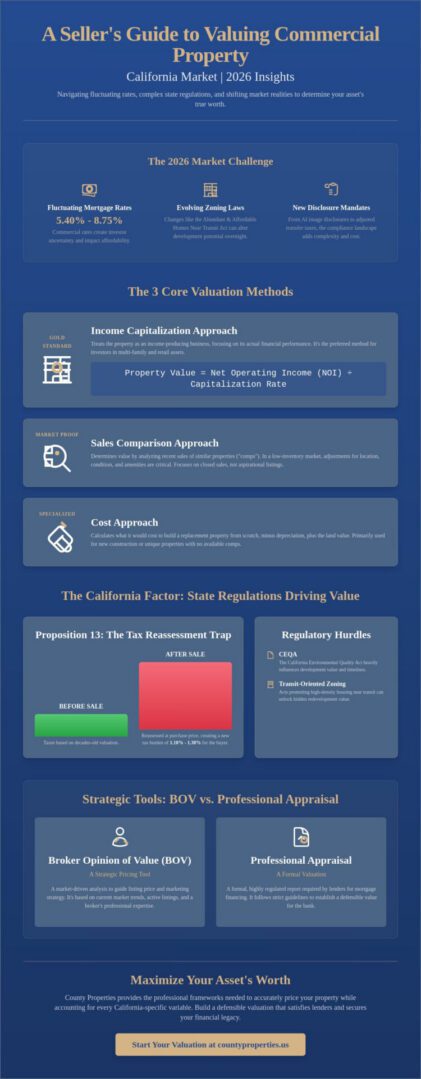
Determining the worth of your asset requires a multi-faceted strategy. You can’t rely on a single, isolated number to represent a complex investment. Experienced investors and lenders look for a defensible price backed by established data and professional frameworks. Understanding how to value a commercial property for sale in California involves balancing immediate income potential with shifting market trends. Most professionals utilize three standard real estate appraisal methods to arrive at a fair market value that stands up to scrutiny.
The Income Capitalization Approach
This method is the gold standard for California investors, particularly those focused on multi-family assets or multi-tenant retail centers. It treats the property as an income-producing business. The formula is direct: you divide the Net Operating Income (NOI) by the current market Capitalization Rate. To arrive at a trustworthy figure, you must normalize the income. This involves looking past the current rent roll to account for realistic vacancy rates and potential credit losses. It’s a favorite for seasoned mentors in the field because it focuses on the asset’s actual financial performance rather than speculative growth.
Sales Comparison and Market Data
In a low-inventory 2026 market, the Sales Comparison Approach faces unique hurdles. This method relies on finding “true” comparables, which are properties that sold recently with similar size, use, and location. In Southern California’s fragmented markets, you have to look deeper than just the zip code. You must adjust your price based on the building’s age, physical condition, and specific San Diego neighborhood amenities like proximity to new transit corridors. We always prioritize “closed” sales over “active” listings. Active listings often reflect a seller’s aspirations, whereas closed sales provide the hard evidence of what buyers are actually willing to pay.
The Cost Approach serves as a specialized third pillar. It calculates what it would cost to replace the entire building from scratch at today’s labor and material prices, minus depreciation, plus the value of the land. This is the primary tool for new construction or unique builds where recent comps simply don’t exist. Your choice of method often depends on the specific sector. For San Diego industrial sites, where demand remains high, the Sales Comparison Approach is often quite effective. Conversely, for the office sector, the Income Capitalization Approach provides the stability and reassurance lenders require. Mastering how to value a commercial property for sale in California means knowing which of these tools will best highlight your property’s unique strengths.
The California Factor: How State Regulations Impact Property Value
In California, the regulatory landscape isn’t just a hurdle; it’s a primary driver of valuation. While standard financial metrics are essential, you must view your asset through a “state-lens” audit to understand its true worth. State-specific mandates on environmental standards, accessibility, and tax structures can either suppress or skyrocket your final sale price. Understanding how to value a commercial property for sale in California requires a deep dive into these local variables, many of which are outlined in the California DRE appraisal guide. We act as your dependable guide through these complexities, ensuring no regulatory detail is overlooked during your transition.
Proposition 13 and the Tax Reassessment Trap
Many sellers overlook the “tax bite” that occurs the moment a deed transfers. Under Proposition 13, your current property tax might be based on a decades-old valuation. However, upon sale, the property is reassessed at the new purchase price. Buyers typically face a cumulative tax rate between 1.10% and 1.30%, which can be a massive jump from your current carrying costs. This increase directly impacts the buyer’s post-sale operating expenses and their pro-forma yield. To justify a high valuation, you must demonstrate that the property’s income potential outweighs this new tax burden. We often help clients prepare for these discussions by highlighting long-term stability and reliable cash flows that offset the reassessment.
Specialized Assets: Valuing Senior Living and Healthcare Facilities
San Diego’s aging demographic has turned senior living and healthcare facilities into high-value commercial investments. Valuing these assets is a specialized process where “business value” often merges with “real estate value.” Factors such as regulatory licensing, bed counts, and specialized equipment must be audited alongside the physical structure. This is where the expertise of a Senior Real Estate Specialist becomes indispensable. They understand the nuances of these transitions, focusing on the client’s needs with empathy and professional mastery. If you are considering a sale in this sector, our team provides the seasoned mentorship needed to navigate these high-stakes personal situations. For those ready to explore their options, we offer expert seller representation to ensure your specialized asset is positioned for maximum success.
For those looking to evaluate the business side of medical facilities alongside the real estate, you can discover Healthcare Biz Brokers, Inc. for specialized guidance on valuation and sales in the healthcare sector.
Calculating Net Operating Income (NOI) and Cap Rates in 2026
Precision in your financial reporting is the bedrock of a successful sale. When you explore how to value a commercial property for sale in California, your Net Operating Income (NOI) serves as the primary evidence for your asking price. You must start with a rigorous audit of your Gross Scheduled Income (GSI). This means capturing every revenue stream, from base rent and parking fees to laundry income or billboard leases. However, a high top-line number is only half the story. 2026 brings specific challenges to the expense side of the ledger, particularly with insurance premiums and utility costs that have seen significant shifts. We act as your seasoned mentor, helping you identify these patterns to present a clear, trustworthy financial picture.
A common error that can derail a valuation is the omission of “reserves for replacement.” While you might not have replaced the roof this year, savvy buyers and lenders will deduct a standardized annual amount for future capital expenditures. If you leave this out, your NOI will look artificially inflated, leading to a “valuation gap” during the buyer’s due diligence. To avoid this, we recommend a methodical breakdown of management fees and maintenance costs that reflects the actual operational reality of your asset. By addressing these details upfront, you foster a sense of security for potential investors.
2026 Market Cap Rates by Asset Class
In San Diego and the broader Southern California market, capitalization rates are stabilizing after a period of expansion. Industrial and flex spaces remain highly sought after, with cap rates often staying compressed due to low vacancy rates, such as the 8.7% seen in the Inland Empire. Retail and office assets require a more nuanced adjustment for risk. For instance, the San Francisco office market faced a 31.6% vacancy rate in early 2026, which pushes cap rates higher to account for longer lease-up times. Multi-family properties continue to trade in a specific range; institutional Class A assets in the Bay Area are trading between 4.25% and 4.75%, while Class B value-add properties sit closer to 5.25% or 5.75%.
Debt Service Coverage Ratio (DSCR) and Value
Lenders in 2026 are looking closely at the Debt Service Coverage Ratio (DSCR) to determine if a property is financeable. With conventional commercial mortgage rates ranging from 5.40% to 8.75%, the “spread” between your cap rate and the cost of debt has narrowed. A DSCR measures your NOI against your annual debt obligations. Most lenders require a ratio of at least 1.20 to 1.25. If your asking price is too high, the resulting loan-to-value (LTV) ratio might not satisfy these requirements. We help you calculate these figures early so you can offer a defensible valuation that aligns with current lending standards and market expectations.
Broker Opinion of Value (BOV) vs. Professional Appraisal
Choosing the right report is a critical step in your journey toward a successful transition. While both documents aim to define a property’s worth, they serve very different masters. A Broker Opinion of Value (BOV) acts as a market-driven, strategic pricing tool designed to reflect the “now.” It captures street-level sentiment and the immediate motivations of active buyers. Conversely, a professional appraisal is a formal, retrospective audit required by lenders to mitigate risk. Understanding how to value a commercial property for sale in California often requires you to utilize both at different stages of the transaction. We act as your dependable guide, helping you determine which report provides the specific level of defensibility you need for your situation.
The differences in cost and timeline are significant. An appraisal can take several weeks and cost thousands of dollars because it must adhere to strict regulatory standards. A BOV is typically more agile, focusing on actionable intelligence that helps you set a competitive listing price. While an appraisal looks at what has happened in the past, a BOV from a local expert considers where the market is heading tomorrow. This forward-looking perspective is vital when navigating the fluctuating interest rates we see in 2026.
When to Request a Broker Opinion of Value
You should consider a BOV during the preliminary stages of a listing decision or when navigating internal partnership buy-outs. It’s an excellent tool for estate planning where a “real-world” price is more useful than a conservative bank estimate. For mixed-use assets, the analysis becomes even more nuanced. We often apply the strategic logic used when selling a home in Southern California, merging residential demand patterns with commercial yield requirements. This collaborative approach ensures that your asset is positioned to attract the widest possible pool of qualified buyers. Actionable intelligence always beats static data when you’re preparing for a high-stakes transition.
The Role of the Certified Appraiser
There are moments when a USPAP-compliant appraisal is non-negotiable. If you are pursuing an SBA 504 loan with rates currently in the 5.88% to 6.17% range, the lender will require a formal appraisal to secure the financing. These reports are also essential in litigation or formal tax appeals. A certified appraiser performs a deep “highest and best use” analysis, which is particularly relevant now that new laws like SB 79 allow for increased density near transit stops. To ensure the appraiser sees the full potential of your property, you should prepare a comprehensive “deal room” that includes up-to-date maintenance records, tenant profiles, and a clear history of capital improvements. If you need a market-driven perspective to guide your next move, our team provides comprehensive seller representation to ensure your pricing strategy is both aggressive and defensible.
Maximizing Your Asset Worth with County Properties
Mastering how to value a commercial property for sale in California is the first step toward a successful exit. A valuation is only as strong as the execution behind it. At County Properties, we believe that the numbers on a page must be paired with a collaborative, service-centric approach to truly maximize your asset’s worth. We don’t just provide a figure; we provide a partnership designed to protect your financial safety throughout the entire transition. This commitment to reliability ensures that you feel secure in your choice of a long-term professional ally.
Arnie Levine and our team leverage deep San Diego roots to find “hidden” value that standard algorithms often overlook. Whether it’s identifying the specific redevelopment potential under new 2026 transit laws or understanding the “street-level” demand for flex space in your specific neighborhood, our localized knowledge is a significant advantage. We act as your seasoned mentor, guiding you through the complexities of the market with the wisdom gained over decades of navigating various economic cycles. This experienced perspective allows us to position your property not just as a piece of real estate, but as a high-performing investment vehicle.
A professional valuation must eventually move into a comprehensive marketing program to be effective. We develop tailored strategies for every asset, utilizing professional “deal rooms” and targeted outreach to reach the most qualified buyers. Our process is structured and logical, moving you from the initial NOI audit to a strategic listing that captures the highest possible market interest. We focus on the “why” behind every operational decision, ensuring that every marketing claim we make is backed by defensible data and sincere intent.
A Personalized Approach to Southern California Real Estate
Our personalized approach focuses on the unique nuances of commercial real estate in Southern California. We understand that many commercial owners are also residential investors, and we bridge that gap with a team that respects both residential wealth and commercial yield. We offer supportive and methodical assistance, demonstrating sensitivity toward the high-stakes personal situations that often accompany a property sale. Our collaborative team player ethos ensures that your goals always remain the primary focus of our strategy.
Ready to Determine Your Property’s True Value?
Your 2026 valuation roadmap moves from a rigorous NOI audit to a market-driven BOV and finally to a successful closing. To navigate this path with confidence, you need a partner who acts as a dependable guide. We invite you to contact County Properties for a professional consultation and a no-obligation strategic market analysis for your asset. For additional context on the broader economic environment, we recommend reviewing our Southern California Housing Market Forecast to see how regional trends will shape your 2026 exit strategy. Let’s work together to fulfill your significant life milestones and achieve your long-term financial goals.
Securing Your Financial Legacy in the 2026 Market
Mastering how to value a commercial property for sale in California requires a blend of analytical rigor and local intuition. You’ve seen how the intersection of net yield and regulatory shifts, like Proposition 13 and the new transit laws, defines your asset’s true worth. Success in this environment means moving beyond simple comps to perform a deep audit of your Net Operating Income and debt service coverage. This level of clarity is what satisfies lenders and attracts serious investors in a fluctuating interest rate environment. Whether you need a strategic Broker Opinion of Value or a formal appraisal, you don’t have to navigate these high-stakes transitions alone.
Our team, led by seasoned professional Arnie Levine, brings specialized expertise in Senior Real Estate (SRES) and complex asset transitions to every client relationship. We prioritize your financial safety through a collaborative, service-first approach that transforms complex data into a clear path forward. We act as your dependable guide, ensuring you feel secure as you move toward your next significant life milestone.
Partner with the Southern California Experts at County Properties today to ensure your property is positioned for maximum success. We look forward to helping you achieve your long-term goals with confidence and peace of mind.
Frequently Asked Questions
How do I calculate the cap rate for my California commercial property?
You calculate the capitalization rate by dividing your property’s Net Operating Income (NOI) by its current market value or purchase price. This percentage represents your unleveraged yield. If your building generates $100,000 in NOI and is valued at $2,000,000, your cap rate is 5%. It’s a vital tool when learning how to value a commercial property for sale in California because it allows for quick comparisons across different asset classes like retail or industrial.
What is the difference between a Broker Opinion of Value and an appraisal?
A Broker Opinion of Value (BOV) is a strategic, market-driven pricing estimate, while a professional appraisal is a formal, retrospective audit required by lenders. Brokers use “street-level” sentiment and active buyer demand to help you set a listing price. Appraisers follow strict USPAP standards to provide a defensible value for mortgage financing or legal proceedings. We act as your dependable guide to help you decide which report fits your current needs.
How does Proposition 13 affect the sale price of commercial real estate?
Proposition 13 limits annual property tax increases to 2%, but the tax resets to approximately 1.10% to 1.30% of the new purchase price upon sale. This “tax reset” significantly increases the buyer’s future operating expenses. When you determine how to value a commercial property for sale in California, you must account for this shift in the buyer’s pro-forma income. Highlighting long-term lease stability can help offset the impact of these higher taxes for a potential investor.
What is a good Debt Service Coverage Ratio (DSCR) for a commercial loan in 2026?
Most commercial lenders in 2026 require a Debt Service Coverage Ratio (DSCR) between 1.20 and 1.25. This ratio ensures your property generates enough income to cover the annual mortgage payments plus a 20% to 25% cushion. With commercial mortgage rates currently ranging from 5.40% to 8.75%, maintaining a healthy DSCR is essential for ensuring your property is financeable. We help you audit your financials to ensure your asking price aligns with these lender requirements.
Do I need an environmental report (Phase I) before valuing my property?
You should ideally have an environmental report before finalized valuation because hidden liabilities can drastically reduce an asset’s worth. A Phase I Environmental Site Assessment (ESA) identifies potential contamination from past or present uses. Lenders almost always require this report before approving a loan. Addressing these concerns early prevents late-stage deal collapses and reinforces your reputation as a reliable seller who prioritizes financial safety.
How does the “Triple Net” (NNN) lease structure impact property value?
A Triple Net (NNN) lease structure increases property value by shifting the burden of property taxes, insurance, and maintenance costs to the tenant. This creates a predictable and stable Net Operating Income for the owner. Investors often pay a premium for NNN properties because they offer lower management intensity and protection against rising operating costs. This structure is particularly valuable in a high-inflation environment where utility and insurance spikes are common.
Can I use a 1031 exchange if I sell my commercial property in San Diego?
You can absolutely use a 1031 exchange to defer capital gains taxes when selling your commercial property in San Diego. This federal tax provision allows you to reinvest the proceeds into a “like-kind” investment property. It’s a powerful tool for building long-term wealth and fulfilling significant life milestones. We provide the expert seller representation needed to navigate the strict 45-day identification and 180-day closing deadlines required for a successful exchange.
What are the most common mistakes when valuing a commercial building?
The most common mistake is failing to account for “reserves for replacement” when calculating Net Operating Income. Many owners also use unrealistic vacancy rates or ignore the impact of new state laws like SB 79 on redevelopment potential. We help you avoid these pitfalls by providing a methodical, expert audit of your financials. Accuracy in these details ensures you don’t underprice a high-value asset or lose credibility during the buyer’s due diligence process.