

What if your Section 8 tenant was actually your property’s strongest selling point rather than a liability? In California’s 2026 real estate market, guaranteed government rent is a rare and valuable hedge against economic shifts. Many landlords feel overwhelmed by the prospect of selling a section 8 tenant occupied property in California, fearing that complex regulations or tenant-friendly laws will derail their financial goals.
We understand the pressure you feel to remain compliant while maximizing your investment’s value. It’s natural to worry about missing a Public Housing Authority notification or inadvertently violating the latest updates to the Tenant Protection Act. Our mission is to guide you through this transition with confidence and clarity. You can achieve a smooth, profitable sale without the stress of legal missteps or displaced residents.
This guide provides a comprehensive roadmap for your journey. We’ll explore the specific 2026 notification timelines for Southern California housing commissions, explain how to handle property showings legally, and show you how to market your occupied unit as a high-performing asset to savvy investors.
Key Takeaways
- Navigate the latest 2026 updates to AB 1482 to ensure your sale remains compliant with California’s strict “Just Cause” eviction protections.
- Discover how selling a section 8 tenant occupied property in California can be positioned as a turnkey opportunity for investors seeking reliable, government-backed cash flow.
- Learn the critical steps for reviewing and transferring your Housing Assistance Payments (HAP) contract to avoid payment delays during the escrow process.
- Master professional strategies for coordinating showings and inspections that respect tenant rights while showcasing your property’s full financial potential.
The Reality of Selling Section 8 Properties in California (2026)
Selling a property with a tenant who participates in the Section 8 Housing Choice Voucher Program is a specialized transaction that requires a deep understanding of state mandates. In 2026, California’s real estate market views these properties as high-value assets rather than liabilities. The core of this process involves transferring a home while keeping a government-subsidized lease intact. When you’re selling a section 8 tenant occupied property in California, you aren’t just selling real estate; you’re selling a reliable income stream that’s often more stable than traditional market-rate rentals.
The market in 2026 is shaped by a high demand for housing and a limited supply of affordable units. This dynamic makes Section 8 properties particularly attractive to a specific class of investors who prioritize financial safety. Because the local Public Housing Authority (PHA) pays a substantial portion of the rent directly to the owner, the risk of total income loss is significantly minimized. This consistency is a major draw for buyers looking to balance their portfolios against market volatility.
SB 329 and Source of Income Protections
You must be aware of the legal framework established by SB 329. This 2020 law redefined Section 8 as a protected source of income, making it illegal to discriminate against tenants or buyers based on their participation in the program. In California, you can’t use phrases like “No Section 8” in your marketing materials or property listings. Doing so exposes you to significant legal risks and potential lawsuits from fair housing advocates. This law serves as a shield for tenants, ensuring their housing remains secure even as the property title changes hands between landlords.
- Marketing Compliance: Your listings must focus on the property’s merits and financial performance without excluding voucher holders.
- Ownership Transfers: The law ensures that the tenant’s rights remain protected and their voucher status isn’t a valid reason for lease termination.
- Professional Standards: It’s vital to treat all prospective buyers and current tenants with the same level of respect and legal consideration.
The Southern California Investor Landscape
Investors in San Diego and Riverside counties are currently hungry for properties that offer immediate cash flow. In the 2026 economic environment, where interest rates remain a hurdle for many, the “recession-proof” nature of Section 8 is a powerful selling point. Guaranteed rent checks provide a buffer that market-rate properties simply can’t match. We’ve seen that selling a section 8 tenant occupied property in California attracts multiple offers from seasoned investors who value the consistency of government-backed payments over the high-stakes fluctuations of the open market. This demand often leads to higher sale prices for well-maintained, occupied units.
Navigating California’s Just Cause Eviction & Tenant Rights
You can’t simply ask a tenant to leave because you’ve decided to list your home. Under California’s Just Cause Eviction Law (AB 1482), landlords must provide a valid legal reason to terminate a tenancy if the resident has lived there for 12 months or longer. When you’re selling a section 8 tenant occupied property in California, the new owner typically inherits the existing lease and the Housing Assistance Payments (HAP) contract. This means the sale itself doesn’t qualify as a “just cause” for eviction unless the buyer intends to move into the unit as their primary residence.
Local ordinances often add layers of protection that you must respect. In San Diego, the “Tenant Protection Ordinance” provides even more robust safeguards than the state baseline. If your property is located within city limits, you must navigate these specific local rules alongside state mandates. Failing to comply can lead to costly legal delays or even the cancellation of your sale. It’s vital to know which set of rules applies to your specific address before you start the marketing process.
AB 1482 Compliance for Landlords
While many single-family homes are exempt from state rent caps, they aren’t always exempt from “just cause” protections. To qualify for an exemption, you must have provided your tenant with a specific written notice at the start of their lease. In 2026, the burden of proof rests entirely on the property owner. If you plan to sell to a buyer who wants a vacant home, you must ensure the termination falls under a “no-fault” reason, such as an owner move-in, and follow strict notification procedures to remain within the law.
Relocation Assistance Costs in 2026
When a “no-fault” termination occurs, California law requires you to provide relocation assistance. This is usually equal to one month of the tenant’s current rent. You can provide this as a direct payment within 15 days of the notice or as a rent waiver for the final month. These costs will impact your net proceeds, so it’s important to factor them into your financial planning from the start.
- Direct Payment: A check issued to the tenant to help with moving costs.
- Rent Waiver: Forgiving the final month’s rent to simplify the transition for both parties.
- Cash for Keys: A voluntary agreement where a tenant moves out early in exchange for a negotiated sum, which often provides a faster and more predictable timeline than formal termination.
Managing these moving parts requires a steady hand and a clear strategy. If you’re feeling uncertain about these legal hurdles, working with an expert in seller representation can help you protect your equity and avoid common compliance pitfalls.
Selling Occupied vs. Requesting Vacancy: Pros and Cons
Deciding whether to keep your tenant in place or deliver a vacant unit is the most pivotal financial choice you’ll make during the listing process. When you’re selling a section 8 tenant occupied property in California, you’re essentially choosing between two distinct buyer pools with very different priorities. Investors seek a cash-flowing asset from day one; families and owner-occupants seek a place to call home. Your decision should hinge on the property’s current condition and your specific timeline for the sale.
Selling with the tenant in place often leads to an “as-is” transaction. This is a significant relief for landlords who prefer not to spend thousands on cosmetic repairs or staging before hitting the market. Professional investors look past the current paint colors and focus on the strength of the Housing Assistance Payment (HAP) contract. They value the guaranteed monthly check, which serves as a powerful hedge against economic shifts in 2026. However, if a tenant is uncooperative with showings, it can limit your market exposure and potentially lead to a lower final sales price.
The Investor Advantage (Selling Occupied)
Marketing your property as a “turn-key” investment with a pre-vetted Section 8 tenant can boost its appeal to a specific, well-capitalized buyer pool. You’re selling a proven cap rate and a reliable income stream. This approach also protects you from the “vandalism risk” that often affects vacant homes in certain Southern California neighborhoods. By utilizing specialized seller representation, you can ensure that the transfer of the HAP contract and tenant records is handled with professional precision, keeping your equity secure throughout the transition.
The Vacancy Path (Selling to Families)
If your goal is to reach the highest “retail” price point, vacancy is usually the preferred route. Owner-occupant buyers are often willing to pay a premium for a home they can occupy immediately. To take this path, you must navigate the 60-day notice requirement for tenants who have lived in the unit for more than a year, as mandated by California law. Once the property is empty, you gain the freedom to renovate and stage the space. This often results in multiple offers from families who aren’t looking for an investment, but a primary residence, which can drive the price well above what an investor would pay.
You must weigh the lost rent during the vacancy period and any required relocation assistance against the potential for a higher sales price. For many Southern California landlords, the immediate sale to another investor provides the most predictable and stress-free outcome.
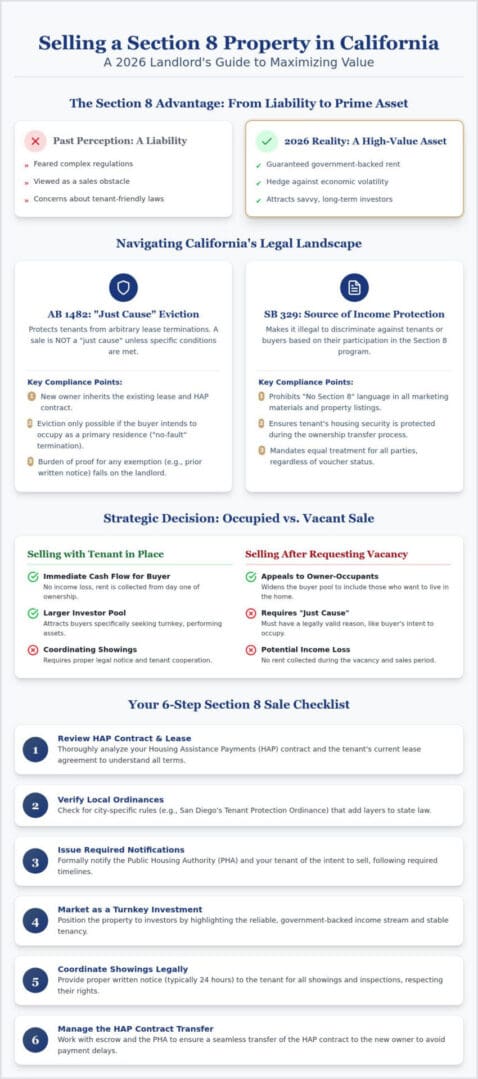
The 2026 California Section 8 Sale Checklist
Success when selling a section 8 tenant occupied property in California relies on a structured administrative approach. Missing a single notification window or failing to provide the correct disclosure can stall your escrow or lead to post-closing disputes. This checklist ensures you meet every legal and procedural milestone required by both state law and local housing authorities.
- Step 1: Review the Housing Assistance Payments (HAP) Contract. Confirm the current lease term and any specific riders. You need to know exactly what obligations the new owner will inherit.
- Step 2: Provide 24-Hour Notice for Showings. Under California Civil Code § 1954, you must provide written notice before entering the unit. Clear communication helps maintain tenant cooperation during the marketing phase.
- Step 3: Notify the Public Housing Authority (PHA). Inform the agency of your intent to sell as soon as you list the property. This initiates the administrative process for the eventual contract transfer.
- Step 4: Disclose Section 8 Status. Transparency is vital. Ensure all potential buyers understand the current tenant’s status and the terms of the existing government subsidy.
- Step 5: Execute Ownership Paperwork. At closing, both the seller and buyer must sign specific PHA documents to pro-rate rent and redirect future payments.
Coordinating with the Housing Authority
If your property is in San Diego, you must work closely with the San Diego Housing Commission (SDHC). While the commission can often process a HAP contract transfer in 10 business days, the entire transition usually takes 30 to 60 days to finalize. You must ensure the buyer submits their application packet promptly to avoid interruptions in rent payments. We’ve found that early coordination prevents the common “payment gap” that occurs when a PHA isn’t notified until after the deed is recorded.
Disclosure and Escrow Requirements
Escrow for a tenant-occupied property involves more than just a title search. You must provide an Estoppel Certificate, which is a document signed by the tenant to verify the current rent amount, security deposit, and lease terms. This prevents the buyer from facing unexpected claims after the sale. Additionally, the tenant’s security deposit must be transferred directly through escrow to the new owner. Handling these details with precision protects your equity and ensures a clean break from the property’s management responsibilities.
Navigating these technical steps requires an advocate who understands the intersection of real estate and government regulations. If you’re ready to start the process, our team can provide the specialized seller representation you need to ensure a compliant and profitable transaction.
Expert Representation: How County Properties Protects Your Equity
Successfully selling a section 8 tenant occupied property in California requires more than a simple listing. It demands a professional partner who understands the delicate intersection of state law, federal housing subsidies, and the specific needs of local investors. You deserve a real estate agent near me who doesn’t just see a transaction, but a high-stakes life transition that requires expert guidance. Arnie Levine and the team at County Properties act as your steady advocate, ensuring your financial interests are shielded throughout the entire sales process.
Our approach centers on reliability and professional mastery. We don’t just wait for buyers to find us. We actively market your property to a curated network of Southern California investors who specifically value the income stability provided by Section 8 vouchers. By highlighting the guaranteed nature of the rent and the property’s long-term performance, we position your investment to attract competitive offers that reflect its true market value.
Southern California Market Mastery
We leverage extensive knowledge of rental trends across San Diego and the Inland Empire to give you a distinct advantage. Our team vets every prospective buyer to ensure they have the financial capability and the administrative experience to handle an occupied property sale without delays. For landlords navigating more difficult financial paths, we offer specialized assistance in foreclosure prevention. We can facilitate cash offers that provide a dignified and rapid exit strategy, protecting your equity even when time is a critical factor.
A Service-Centric Approach to Complex Sales
Tenant cooperation is often the most significant hurdle in an occupied sale. Arnie Levine employs a collaborative mediation style that treats tenants with respect while clearly communicating the sale’s progress. This empathetic approach minimizes friction, ensuring that inspections, appraisals, and showings occur smoothly. We act as your dependable guide, providing the wise and seasoned perspective necessary to navigate 2026 market cycles with confidence. Our mission is to transform a complex legal situation into a predictable, profitable success story for you.
Every investment property has a unique story and a specific set of challenges. We invite you to contact us for a tailored strategy designed specifically for your occupied property. Whether you need a traditional sale or a rapid cash-offer facilitation, our team is ready to stand by your side as your professional ally.
Secure Your Financial Future with a Compliant Section 8 Sale
Successfully selling a section 8 tenant occupied property in California requires a blend of legal precision and strategic marketing. You’ve seen that while AB 1482 and local ordinances create a complex landscape, these regulations also provide a clear framework for a successful exit. By positioning your government-subsidized tenancy as a stable income asset, you can attract serious investors who value consistency in the 2026 market.
County Properties acts as your steady guide through every notification window and PHA requirement. We bring decades of experience in complex situational real estate to your transaction. Our team is expert in California AB 1482 compliance and deeply specialized in Southern California investor markets. We’re here to ensure you don’t just close the deal; we make sure you do so with your equity and reputation fully protected.
Take the first step toward a stress-free closing. Get a professional valuation and strategy for your occupied property. Your transition to a new investment milestone can be both smooth and profitable with the right partner by your side.
Frequently Asked Questions
Can a Section 8 tenant be evicted if I sell the house in California?
No, selling your property isn’t a valid “just cause” for eviction under AB 1482. In California, the new owner typically inherits the existing lease and the Housing Assistance Payments contract. If a buyer intends to occupy the home as their primary residence, they may terminate the tenancy, but this requires specific legal notices and the payment of relocation assistance. You must follow state and local guidelines strictly to avoid legal complications.
Do I have to notify the Section 8 office before I list my property for sale?
You should notify the Public Housing Authority (PHA) as soon as you decide to list. While you don’t need their permission to sell, early communication ensures a smoother transition for the Housing Assistance Payments contract. This proactive step helps prevent payment delays for the buyer during the escrow period. Providing the PHA with a copy of the listing agreement or a formal letter of intent is a standard part of the process.
Does the new owner have to keep the Section 8 tenant after the sale?
Yes, the new owner generally takes over the property subject to the existing lease agreement. When selling a section 8 tenant occupied property in California, the buyer becomes the new landlord and must abide by the terms of the current HAP contract. They can’t terminate the tenancy simply because the home changed hands. The buyer will need to complete change of ownership paperwork with the local housing commission to receive government rent portions.
What happens to the security deposit when selling a tenant-occupied home?
The tenant’s security deposit must be transferred from the seller to the buyer through the escrow process. You don’t return the deposit to the tenant during the sale. Instead, the escrow officer debits the seller’s account and credits the buyer’s account for the full amount. Both parties should sign an Estoppel Certificate to confirm the exact deposit amount held, ensuring there are no disputes regarding the funds after the property title transfers.
Can I sell my property for cash if it has a Section 8 tenant?
Yes, you can certainly sell your property for cash while it’s occupied by a Section 8 tenant. Many professional investors specifically look for cash-flowing units with government-backed rent. County Properties specializes in cash offer facilitation, providing a streamlined exit for landlords who need to close quickly. This path often bypasses the need for traditional appraisals or extensive repairs, making it an excellent option for those facing time-sensitive financial or personal situations.
Are Section 8 properties harder to sell in the 2026 California market?
Not necessarily. In the 2026 market, many investors view Section 8 properties as highly desirable due to the guaranteed income stream. While owner-occupant buyers might be deterred by the occupancy, the investor pool for these assets is robust. The key is to market the property’s financial performance and “recession-proof” nature. With expert representation, you can highlight the reliability of government payments to attract buyers who prioritize long-term financial safety over immediate vacancy.
How much notice do I need to give a Section 8 tenant for showings?
You must provide at least 24 hours of written notice before entering the property for showings or inspections. This requirement is mandated by California Civil Code § 1954 and applies to all tenancies, including Section 8. It’s often helpful to coordinate with the tenant to find mutually agreeable times. Maintaining a respectful and collaborative relationship during this phase is essential for ensuring the property presents well to prospective buyers and that inspections proceed without friction.
Does Section 8 pay for the tenant’s relocation if I sell?
No, the Public Housing Authority doesn’t pay for relocation costs. If you terminate a tenancy for a “no-fault” reason, such as an owner move-in, the landlord is responsible for providing relocation assistance under state law. This typically equals one month’s rent and can be given as a direct payment or a rent waiver. You should factor this cost into your net proceeds calculations when planning the sale of your occupied investment property.