

A shared well agreement can shape a home sale long before a buyer reviews the paperwork. If you’re selling a home with a shared well agreement California buyers may want clear answers about access, maintenance, shared expenses, and the records behind the arrangement.
It’s understandable to wonder whether the agreement is recorded, whether it reflects the current setup, and what you’re expected to disclose. Preparing early can help you organize the documents you have, explain what you know, and avoid presenting assumptions as facts.
This 2026 guide explains which agreement and well records to gather, what buyers may ask, and how to prepare before listing. It also distinguishes transaction preparation from legal interpretation. Disclosure duties and contract terms can depend on your circumstances, so have legal questions reviewed by a qualified professional. County Properties provides collaborative seller representation to help you organize property information and communicate clearly with prospective buyers as you prepare for your next move.
Key Takeaways
- For selling a home with a shared well agreement California, locate the agreement and review your property and title records for information about its recording status.
- Gather available well and property documents. Separate written terms from informal practices and details that still need clarification.
- Compare the agreement’s terms for access, upkeep, and shared expenses with your understanding and the records you have.
- Prepare factual responses to likely buyer questions, and review disclosure forms and requirements against current guidance and your transaction details.
- Seller representation can help organize property information and coordinate communication, supporting informed buyer review without promising a particular outcome.
Selling a Home With a Shared Well Agreement in California: What Changes?
A shared well adds another layer to a home sale. Buyers need to understand the property’s water source and how the participating properties share access and responsibilities. A shared well doesn’t automatically make a home difficult to sell. The practical questions are what the documents say, how the arrangement works, and what information is available for review.
A shared well is a water source used by more than one property; a shared well agreement is a document or arrangement describing how those properties share its use, access, or responsibilities. There isn’t one standard agreement for every property. Terms and documentation vary, so the signed documents and the actual arrangement matter.
What a shared well agreement may cover
Depending on the signed documents and property arrangement, an agreement may address:
- Who can access the well and related equipment, and how access is arranged.
- How routine maintenance, repairs, or replacement work is handled.
- How expenses are divided, such as equal shares or another stated allocation.
- How participants communicate or address disagreements about the well.
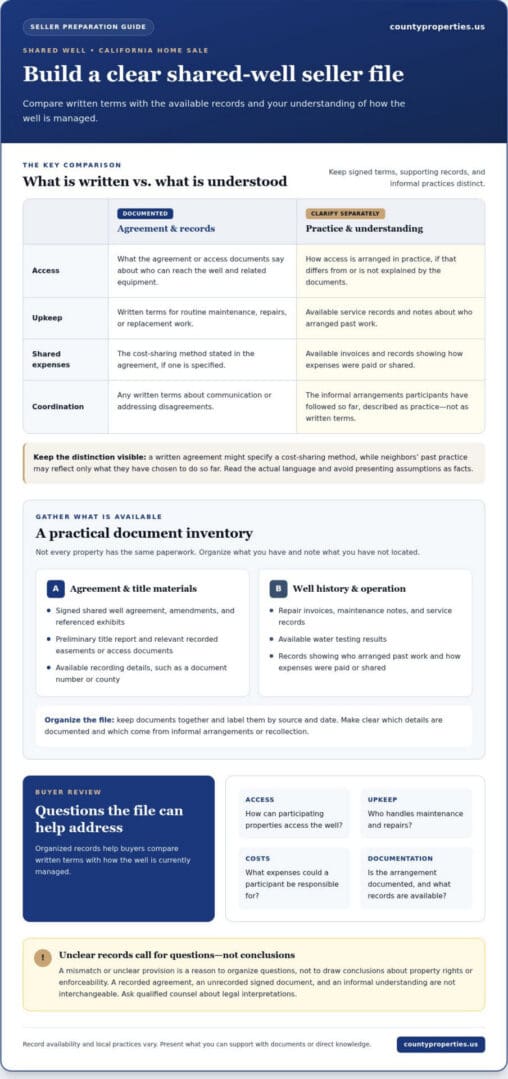
These are examples, not a checklist of legally required provisions. Read the actual language. A written agreement might specify a cost-sharing method, while neighbors’ past practice may reflect only what they have chosen to do so far. Keep the written terms separate from informal arrangements when describing the well.
Why buyers examine the arrangement
Buyers may ask how they can access the well, who handles upkeep, what costs they could be responsible for, and whether the arrangement is documented. Organized records help them compare the written terms with the way the well is currently managed. If a document is missing, unclear, or inconsistent with your understanding of day-to-day practice, expect questions or requests for clarification.
Groundwater conditions can also be relevant to a property’s broader water context. California’s Sustainable Groundwater Management Act (SGMA) establishes a framework for local groundwater management in certain basins. Its relevance depends on the property’s location and circumstances. It doesn’t explain the specific rights or responsibilities in a private shared-well arrangement.
As you prepare for selling a home with a shared well agreement California, focus on what you can support with documents or direct knowledge. A recorded agreement, an unrecorded signed document, and an informal understanding aren’t interchangeable. Identify which applies before describing the arrangement to buyers. Uncertainty may prompt more questions, but the presence of a shared well alone doesn’t determine marketability. The property’s circumstances and available documentation matter.
Which California Well and Property Records Should Sellers Gather?
Start assembling records before marketing begins. Not every property has the same paperwork. The goal is to identify what you have, note what you haven’t located, and give buyers an organized picture of the well arrangement.
A useful core seller file includes the shared well agreement, relevant title materials, and available well history. Keep the documents together and label them by source and date. That makes it easier to distinguish a signed record from a service document or your own recollection.
Review the agreement and title materials
Locate the signed agreement, amendments, exhibits, and documents describing access. An agreement may be recorded or unrecorded, so don’t rely on memory or assume its status based on a brief title reference. Review the agreement alongside available title materials, including the preliminary title report, and note any apparent differences that need clarification.
- Shared well agreement, amendments, and referenced exhibits
- Preliminary title report and relevant recorded easements or access documents
- Any available recording details, such as a document number or county
A mismatch or unclear provision is a reason to organize questions, not to draw conclusions about property rights or enforceability. Ask qualified counsel about those legal interpretations.
Gather well operation and maintenance history
Collect available records rather than searching for one universally required set. Useful materials may include repair invoices, maintenance notes, service records, and water testing results. Include records showing who arranged past work and how expenses were paid or shared. Make clear which details are documented and which come from informal arrangements or recollection.
The California State Water Resources Control Board’s guide for private well owners offers background on well maintenance and water quality. You can also look for relevant information through California Department of Water Resources or county sources where applicable, including available well records. Record availability and local practices vary, so treat a search result as information to review, not proof that a complete file exists.
For selling a home with a shared well agreement California, a simple folder and document inventory can help you and your real estate representative prepare for buyer review. If you’re organizing a Southern California sale, seller representation guidance can help you present property information clearly and coordinate transaction communication.
How Can Sellers Clarify Shared Costs, Access, and Responsibilities?
A shared well isn’t automatically a sale blocker. Help buyers distinguish what the written agreement says from what participants have done in practice. Clear, factual explanations make ongoing responsibilities easier to understand. Address unclear or conflicting details before listing rather than guessing during a buyer conversation.
Use a comparison like this to organize the facts and identify gaps:
| Topic | Agreement language | Your understanding | Available records and questions |
|---|---|---|---|
| Shared costs | Does it describe how expenses are allocated? | How have participants typically divided bills? | Invoices or payment records may show past practice. Does that practice match the written terms? |
| Maintenance and repairs | Who handles routine work or repair decisions? | Who has arranged service in practice? | Service records may help establish what work occurred. Is responsibility for future repairs clear? |
| Access | What does the document say about reaching the well or equipment? | How has access been arranged day to day? | Are access terms documented, and do they appear consistent with current use? |
| Disagreements | Does the agreement describe a process for resolving concerns? | How have participants handled questions so far? | Is there a written process, or is this based on informal understanding? |
Compare written terms with actual practice
Review the agreement’s terms for routine upkeep, repair decisions, and expense allocation. Then compare them with invoices, payment records, and service history. For example, the document may describe one cost-sharing method while past bills show a different pattern. Note the difference neutrally. Payment history doesn’t establish that the agreement has changed, and a marketing description isn’t the place to settle a disagreement.
If well construction information is relevant to a question, the California Department of Water Resources’ Online System for Well Completion Reports may help locate available well completion reports. A report can provide factual context, but it doesn’t determine how private participants interpret their agreement.
Identify unresolved questions before listing
Separate items you can document from questions that call for interpretation. Factual items include which expenses were paid, who arranged a repair, and how access has worked. Legal questions about rights, obligations, or ambiguous language should go to qualified counsel. County Properties guides the real estate process by helping organize property information and coordinate communication, without offering legal opinions.
For selling a home with a shared well agreement California, prepare a concise, evidence-based summary and flag unresolved details instead of filling gaps with assumptions. Seller representation guidance can help you present those details clearly as you prepare for buyer review.
What Steps Should You Take Before Listing a California Home With a Shared Well?
A clear pre-listing process helps turn scattered paperwork into a buyer-ready explanation. For selling a home with a shared well agreement California, work through these steps before marketing to distinguish confirmed facts from open questions.
- Collect the records you have. Gather the agreement and amendments, relevant title materials, and available maintenance, repair, service, or water-testing records. Make a note of documents you haven’t located rather than assuming they don’t exist.
- Compare written terms with actual practice. Check the agreement’s terms for access, expenses, upkeep, and repairs against available records and your direct knowledge. Note differences without trying to resolve a legal dispute yourself.
- Identify gaps and local questions. Record unclear terms, missing documents, and details that may need further research. County records and local practices vary, so use current, relevant sources to verify jurisdiction-specific information before describing it as a requirement.
- Prepare factual responses. Draft a plain-language summary based on the documents, and state clearly what you don’t know. Avoid promising water quality, supply, enforceability, or future maintenance outcomes you can’t substantiate.
- Review disclosures before completing them. Check which California disclosure forms and requirements apply using current authoritative guidance and the facts of your transaction. Don’t assume one form or rule fits every property.
Prepare the property information before marketing
Keep the agreement, amendments, title materials, and available well history in an organized file for buyer questions. A concise summary can explain the documented arrangement without presenting informal assumptions as written terms. For the broader sale sequence, see this Southern California home-selling guide.
Prepare for questions such as:
- How is access to the well and equipment arranged?
- What records are available about maintenance, repairs, and testing?
- How are shared costs documented, and what does the agreement say?
- Who has handled past repairs, and what written information exists about responsibilities?
Handle disclosures and buyer follow-up carefully
Answer from the records and your knowledge, and keep copies of materials shared during the transaction. If a buyer asks what ambiguous agreement language legally means, refer them to qualified California counsel rather than offering an agent’s legal opinion. Seller representation can help you organize information and coordinate transaction communication while keeping legal interpretation in the proper hands.
For personalized guidance as you prepare to list, explore seller representation for your home sale.
How County Properties Can Guide a Shared-Well Home Sale
A shared-well sale involves more than collecting paperwork. You also need to present available information clearly, respond to buyer questions consistently, and keep the transaction moving while open issues are handled appropriately. County Properties provides personalized seller representation in Southern California, with collaborative guidance focused on your property and sale goals.
Preparation can support informed buyer review, but it can’t guarantee an offer, a particular price, or a completed transaction. Each buyer evaluates the property and its documentation according to their needs and circumstances.
Coordinate the sale information clearly
Your agent can help organize the agreement, title materials, and available well records so prospective buyers can review the information in context. They can also help distinguish documented facts from your understanding and from details that remain unresolved. This helps keep responses consistent across listing materials, conversations, and transaction communications.
Buyer questions may involve access, maintenance history, shared expenses, or past repairs. Seller representation can help coordinate those questions and direct buyers to information available in the transaction file. Refer questions about the legal meaning, enforceability, or interpretation of agreement language to qualified counsel. Real estate representation supports the sale process; it isn’t legal advice, a well inspection, or a repair service.
If you’re considering representation for your sale, this related guide to choosing a real estate agent offers broader context on the relationship and support an agent can provide.
Move forward with a prepared listing plan
Review the records you’ve gathered, identify unanswered questions, and decide how property information will be shared during marketing and buyer review. Your plan can account for what’s documented, what needs clarification, and how follow-up will be coordinated. This keeps communication factual without suggesting certainty about water quality, supply, future upkeep, or legal rights.
County Properties’ service-centered approach, led by Arnie Levine, helps sellers prepare for transaction conversations with a collaborative partner. Discussing your home and sale goals can help shape a listing plan around the available information and your transaction needs. For support with selling a home with a shared well agreement California, talk with County Properties about your home sale.
Prepare Your Sale With Clear, Factual Information
A shared well doesn’t automatically prevent a home sale. Buyers need a clear picture of the documents, how access and shared responsibilities work, and which details still need clarification. Gather the agreement and available well records, compare written terms with documented practice, and review applicable disclosures using current guidance and the facts of your transaction.
Selling a home with a shared well agreement California can raise questions that call for different kinds of support. A real estate representative can help organize property information and coordinate buyer communication, while qualified counsel handles legal interpretation.
County Properties provides personalized seller representation in Southern California, with collaborative, service-centered guidance led by Arnie Levine. If you’re preparing to list, talk with County Properties about preparing your home sale. Start the conversation with your records and sale goals to plan how to present the property information clearly.
Frequently Asked Questions
Can you sell a California home with a shared well agreement?
Yes, a shared well doesn’t automatically prevent you from selling a California home. Buyers may want to understand how access, upkeep, costs, and other responsibilities are handled. Before listing, gather the signed agreement, available amendments, title materials, and relevant well records. Each arrangement is different, so describe the terms in the actual documents and the property’s circumstances rather than assuming every shared well works the same way.
What should a California shared well agreement include?
There’s no single set of terms to assume applies to every California property. An agreement may address well access, maintenance, repairs, expense allocation, and how participants make decisions. Review the signed document and amendments to see what they actually say. Don’t use informal recollections as a substitute for written terms. If language is unclear or its legal effect is disputed, ask qualified California counsel to interpret it.
Do you have to disclose a shared well when selling a home in California?
Which disclosure requirements and forms apply depends on current California guidance, the transaction, and the property’s circumstances. Don’t assume the agreement alone answers every disclosure question. Organize accurate records and verify applicable requirements before completing forms. Describe what you know carefully, distinguishing documented facts from uncertainty, and avoid unsupported claims about water quality or reliability. Questions about the legal meaning of an agreement or disclosure duty call for qualified California counsel.
Does a shared well agreement need to be recorded in California?
Don’t assume every shared well agreement is recorded or that recording status alone determines its legal effect. Review the signed document, amendments, and available title materials to identify what’s on file. You may have a copy of an agreement even if you don’t find a recording reference in the materials you review. Recording practices and legal consequences depend on the circumstances, so consult qualified California counsel about enforceability or property rights.
What happens if the shared well agreement is missing or unclear?
Start by gathering any copies, amendments, title materials, and records of well use, maintenance, or shared expenses. Make a list of what you know and what remains uncertain; don’t fill gaps with assumptions. Missing or unclear paperwork may lead to buyer follow-up or a need for clarification during the sale process. A real estate agent can help organize transaction information, while legal interpretation or disputed rights require qualified legal guidance.
Can buyers ask about shared well maintenance and costs?
Yes, buyers may ask how access, routine maintenance, repairs, and shared expenses are handled. Review the agreement and gather available invoices, service records, or payment documentation. Keep written cost-sharing terms separate from informal payment history, since past practice may not explain what the agreement says. Give factual answers based on the information you have. If the records don’t establish a clear answer, say so rather than making promises.
Should a shared well agreement be reviewed before listing?
Yes, reviewing the agreement before listing can help you spot missing documents, unclear language, or differences between written terms and past practice. Gather amendments and relevant title materials, then prepare a factual summary for buyer review. This early work can help you respond more clearly when questions arise, but it doesn’t resolve legal uncertainties. For opinions about enforceability, property rights, or disclosure duties, seek qualified California legal advice.