

Imagine waking up on a Tuesday morning in San Diego to a stack of “Final Notice” letters that feel more like a countdown clock than actual mail. You’ve spent years building a life within those four walls, yet one financial setback makes the future feel uncertain. It’s exhausting to deal with loan servicers who provide vague answers about a loan modification to avoid foreclosure while you worry about your credit score dropping by 100 points or more. We understand that your home is your sanctuary, and we believe your financial security is worth fighting for.
We know the fear that comes with a potential loss of your family home, but you don’t have to face the banks alone. A successful modification can lower your monthly payments and provide the breathing room you need to stay in your home. With over 36 years of experience helping Southern California families, our team is here to act as your dependable guide. This article will walk you through the 2026 eligibility requirements, the specific documents your lender will demand, and the best local alternatives if a modification isn’t the right path for your journey.
Key Takeaways
- Understand how a loan modification permanently restructures your existing mortgage to ensure monthly payments remain affordable without the need for a new loan.
- Explore specific strategies like interest rate reductions and 40-year term extensions designed to provide immediate financial relief and stability.
- Evaluate the long-term credit and equity impacts of a loan modification to avoid foreclosure compared to alternatives like short sales or cash offers.
- Follow a clear, step-by-step application roadmap to navigate the “Loss Mitigation” process and prepare a winning “Request for Mortgage Assistance” package.
- Discover why partnering with a seasoned San Diego real estate advocate provides the holistic guidance and 36 years of expertise needed to protect your home.
What is a Loan Modification to Avoid Foreclosure?
A loan modification acts as a permanent restructuring of your existing mortgage note. Unlike a standard refinance, you aren’t applying for a brand new loan or paying off the old one with a different lender. Instead, your current servicer agrees to change the terms of your original contract. You might see a lower interest rate, an extension of the loan term from 30 to 40 years, or a principal forbearance. If you’ve been researching What is a mortgage loan modification?, you likely know the process focuses on sustainability. A loan modification to avoid foreclosure serves as the most direct path to staying in your home when your current payments no longer fit your budget.
The core difference between this and refinancing lies in the qualification process. Refinancing requires high credit scores and equity. Modifications are designed for people already facing financial stress. You don’t need a 700 credit score to qualify. You just need to prove that you can afford a new, lower payment. The bank wants your money, not your house. By extending a 30-year term to 40 years, the lender reduces the monthly burden without forcing you to move. The primary goal centers on reducing your monthly debt-to-income ratio to a manageable level, typically around 31% of your gross income. A loan modification is a proactive agreement between a borrower and a servicer to reset financial terms.
The 2026 Landscape for California Homeowners
Entering 2026, California homeowners face a unique environment where interest rates have stabilized after the volatility of previous years. Lenders currently prefer modifications because the average foreclosure costs a bank approximately $50,000 in legal fees and lost time. You have specific protections under the California Homeowner Bill of Rights (HBOR), which was updated in 2023 to ensure servicers provide a single point of contact. This legislation prevents “dual tracking,” meaning a lender can’t proceed with a foreclosure sale while your modification application is under review. Our team at County Properties has seen how these protections empower homeowners to negotiate from a position of strength.
Signs You Should Pursue a Modification
Identifying the right time to act is critical for your financial security. You don’t need to be months behind on payments to seek help. In fact, seeking a loan modification to avoid foreclosure is most effective when you identify “imminent default.” This happens when you’re still current but know your savings will run out within 60 days. Consider these common indicators:
- Involuntary Hardship: You’ve experienced a 20% reduction in household income or medical expenses exceeding 10% of your annual earnings.
- Life Transitions: A divorce or the death of a co-borrower has permanently altered your ability to manage the original mortgage terms.
- Long-term Shifts: Your financial struggle isn’t a three-month blip but a permanent change that requires a structural fix rather than a temporary forbearance.
If you’re seeing these signs, it’s time to gather your documents. Acting early gives you the best chance to secure a favorable “HAMP-style” modification or a proprietary lender program that keeps your American dream intact.
Common Types of Mortgage Loan Modifications
Lenders use several specific mechanisms to restructure debt, with the primary goal of reducing your monthly payment to a sustainable level. In most cases, banks aim for a debt-to-income ratio where your mortgage payment doesn’t exceed 31% of your gross monthly income. A loan modification to avoid foreclosure isn’t a single product, but rather a combination of these four common adjustments:
- Interest Rate Reduction: If your current rate is 7% or higher, the lender may drop it to a fixed rate closer to 4.5% or 5% to match current market conditions. Some programs use “step” rates, where the interest starts very low and increases by 1% annually after five years until it hits a pre-determined cap.
- Term Extension: This involves stretching your remaining balance over a longer period, such as moving from a 30-year term to a 40-year (480-month) term. While this adds more interest over the life of the loan, it significantly lowers the immediate monthly burden.
- Principal Forbearance: The lender sets aside a portion of your principal balance as a non-interest-bearing “balloon” payment. You don’t pay interest on this amount during the life of the loan, but you must pay it back in full when you sell the home or finish the mortgage term.
- Principal Reduction: This is the least common option. It involves the lender actually forgiving a portion of what you owe. It’s typically reserved for homeowners in extreme distressed equity situations where the property value has dropped 20% or more below the loan balance.
Many homeowners find that a loan modification to avoid foreclosure provides the breathing room needed to keep their family in their home. For additional resources and official guidance on avoiding foreclosure, homeowners should review the latest updates from the U.S. Department of Housing and Urban Development.
Government-Backed vs. Proprietary Programs
The specific rules for your modification depend on who owns or insures your loan. FHA Loss Mitigation programs follow strict HUD guidelines, often utilizing “partial claims” where HUD pays the lender to bring your account current. Conventional loans owned by Fannie Mae or Freddie Mac typically use the Flex Modification program, which offers a standardized 20% payment reduction for eligible borrowers. If a private bank holds your loan in their own portfolio, they may offer proprietary modifications. These internal programs at banks like Chase or Bank of America have unique criteria that don’t always follow federal standards.
The “Trial Period” Requirement
Before a modification becomes permanent, you’ll enter a Trial Period Plan (TPP). This is a three to four month “test run” where you make the new, lower payment on time to prove your financial stability. Missing just one trial payment is the most frequent reason for a final denial, as it signals to the lender that the new terms still aren’t affordable. Once you successfully complete the TPP, the lender sends a permanent modification agreement for you to sign and notarize. If you’re feeling overwhelmed by the paperwork, you can consult with an experienced real estate partner to evaluate your options and ensure your application is handled with expert care.
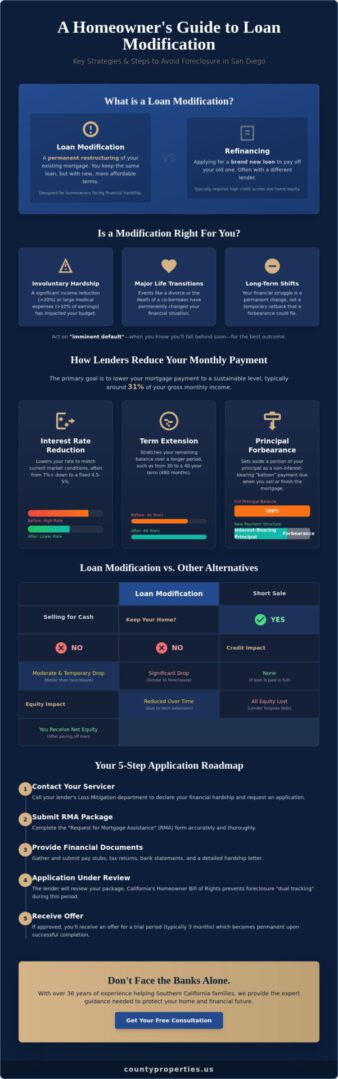
Loan Modification vs. Short Sale vs. Selling for Cash
Deciding between these three paths requires a clear look at your balance sheet and your long-term goals. A loan modification to avoid foreclosure is usually the first choice for those who want to keep their roots in the community. It typically has a minimal impact on your credit score, often resulting in a dip of fewer than 50 points if you are already delinquent. In contrast, a short sale can cause a more significant drop of 100 to 160 points. While a loan mod saves the home, a short sale may better save your future credit by settling the debt and preventing a deficiency judgment.
The “Equity Factor” is the biggest decider in the current 2026 San Diego market. As of January 2026, median home prices in San Diego have remained high, meaning many homeowners possess more wealth in their walls than they realize. If your home has 15% or more equity, selling is often smarter than modifying a loan you can barely afford. You shouldn’t struggle with a restrictive new payment plan when you could walk away with a cash settlement. For those exploring federal options, the U.S. Department of Housing and Urban Development offers Tips to Avoid Foreclosure that explain how to navigate bank negotiations versus liquidation.
- Loan Modification: Typically takes 90 to 200 days to finalize through a servicer.
- Short Sale: Usually requires 120 to 180 days for lender approval and closing.
- Cash Sale: Can close in as little as 10 to 14 days in Southern California, stopping an auction immediately.
When a Loan Modification is the Right Choice
This path works best if you have a deep emotional attachment to your home and intend to stay for at least another decade. You’ll need a stable income to satisfy the bank’s new debt-to-income requirements. If your mortgage is “underwater,” meaning you owe more than the home’s 2026 market value, a loan modification to avoid foreclosure is a vital lifeline. It allows you to stay in place without being forced to bring cash to the closing table to cover the bank’s loss.
When Selling Your Home Makes More Sense
If the monthly payment remains a financial strain even after a rate reduction, it’s time to move on. Homeowners with equity can use those funds for a seamless transition to a more affordable property. We often recommend cash offer facilitation for a rapid exit when a foreclosure auction is scheduled in fewer than 30 days. This strategy clears the debt, puts cash in your pocket, and allows you to rebuild your credit to buy again in as little as 24 months.
How to Apply for a Loan Modification: A Step-by-Step Roadmap
Securing a loan modification to avoid foreclosure is a structured process that demands your full attention. It’s not a simple request; it’s a formal application where you must prove your financial situation has changed but is now stable enough to support a new payment. Success depends on your ability to provide a clear, documented narrative to your lender. You’re essentially asking them to rewrite a legal contract, so your presentation must be flawless.
Step 1: Contact your loan servicer’s Loss Mitigation department. Don’t wait until you’ve missed three payments. Call as soon as you anticipate a struggle. Ask specifically for the “Loss Mitigation” team. These professionals have the authority to discuss workout options that standard customer service agents cannot access. Document the date of this first contact immediately.
Step 2: Gather the Request for Mortgage Assistance (RMA) package. This is the core application. It requires a detailed breakdown of your assets, debts, and monthly expenses. Treat this like a new loan application. Accuracy is vital because lenders cross-reference this data with your credit report and bank statements. Any discrepancy can lead to a quick denial.
Step 3: Draft a compelling Hardship Letter. You need to explain why you fell behind. Be specific with dates and facts. Instead of saying you had medical bills, state that a surgery on January 12, 2025, resulted in $15,200 in out-of-pocket costs. Explain that your situation is now resolved or stabilized so the lender feels confident you can make future payments.
Step 4: Submit evidence of income. You’ll need the last 60 days of paystubs and bank statements. If you’re self-employed, prepare a profit and loss statement for the most recent quarter. Lenders use these to calculate your debt-to-income ratio to see if you qualify for a 31% or 40% payment cap.
Step 5: Follow up weekly. Mortgage servicers handle thousands of files. Documents often get lost or scanned incorrectly. Keep a detailed log of every conversation, including the date, time, and the name of the representative you spoke with. This log is your insurance if the bank claims they never received your paperwork.
Essential Documentation You Will Need
Lenders require a mountain of paperwork to verify your claim. You’ll need proof of all household income, including Social Security award letters or child support payments. Provide the most recent two years of federal tax returns to show your long-term earning history. Finally, create a detailed monthly expense budget. This budget must show the deficit that makes your current payment unsustainable, while also demonstrating that a modified payment would fit within your means.
Common Pitfalls to Avoid During Application
The biggest mistake is the “ostrich” approach. Ignoring mail won’t stop the foreclosure clock. Another danger is submitting an incomplete package. Missing just one signature can stall your review, which might allow the “dual tracking” process to continue. This means the lender moves toward a sale while you think you’re being reviewed. Lastly, never pay upfront fees to “foreclosure rescue” firms. According to the FTC’s MARS Rule, it’s illegal to charge fees before a written offer is accepted. Always lean on HUD-approved counselors or a seasoned real estate partner who understands the local landscape.
If you’re feeling overwhelmed by the paperwork, you don’t have to face the bank alone. Get personalized guidance from our experienced team to help protect your home and your financial security.
Why a Trusted Real Estate Partner is Your Best Advocate
Facing a potential auction date feels like a race against time. You need a partner who understands the local San Diego market from the inside out. Arnie Levine and the County Properties team bring 36 years of specialized experience to your side. Since 1995, we’ve helped homeowners manage the complexities of distressed property situations with a focus on empathy and professional excellence. We don’t just look at the immediate crisis. We provide a holistic approach that evaluates your entire financial picture, including your credit health and long-term housing goals.
Our goal is to ensure your long-term security. Sometimes a loan modification to avoid foreclosure is the ideal path. Other times, a strategic sale might be the better move to preserve your equity. We analyze these options through a lens of three decades of market cycles. This ensures you aren’t just making a quick fix, but a sustainable decision for your future. We look at the numbers, but we also look at the people behind them to ensure your home remains a source of stability rather than stress.
Our Commitment to Southern California Homeowners
We treat every client like a “family of friends.” This isn’t a slogan; it’s how we’ve operated for over 30 years in the San Diego region. For older homeowners, we integrate specialized knowledge through our senior real estate specialist expertise. This allows us to offer age-in-place solutions or transitions that respect your unique lifestyle needs, such as proximity to healthcare or downsizing requirements. We help you decide whether to fight for a modification or pivot to a sale that maximizes your return while protecting your legacy.
Take the Next Step Toward Financial Peace
Waiting for an auction date only limits your options. The more time you have, the more leverage we can create with your lender. Every day counts when you’re seeking a loan modification to avoid foreclosure. We offer a free, no-obligation consultation to assess your home’s current market value and review the specific details of your case. You’ll get clear, data-driven advice without the pressure of a traditional sales pitch. We provide the roadmap; you make the decisions based on facts and decades of local expertise.
Don’t face the bank alone. Contact Arnie Levine at County Properties today for expert foreclosure guidance and take control of your financial journey.
Take Control of Your Home’s Future
Navigating mortgage relief in 2026 requires a proactive strategy and clear data. Whether you need to lower your monthly payments or restructure your debt, a loan modification to avoid foreclosure provides a viable path to stay in your home. It’s important to understand the specific roadmap for applications and how this choice differs from a short sale or a cash offer. Early action is your strongest defense against displacement.
You can rely on a team with 36 years of San Diego real estate experience to guide you. County Properties operates as Certified Short Sale and Foreclosure Specialists, bringing an A+ service-centric philosophy to every client interaction. We’ve been helping local families secure their financial journeys since 1995; we understand the pressure you’re feeling. Expert advocacy makes the difference when dealing with lenders who have their own interests at heart.
Start your journey toward stability today. Get Your Free Foreclosure Prevention Report from County Properties and discover the best options for your specific situation. You’ve built a life in your home, and we’re here to help you protect it.
Frequently Asked Questions
Will a loan modification hurt my credit score?
A loan modification will likely cause a temporary dip in your credit score. Most lenders report the account as “modified” or “not paid as agreed” to credit bureaus like Experian and Equifax. While this is far better than a foreclosure, which can drop a score by 200 points, you should expect an initial decrease of 30 to 100 points depending on your starting number.
Your score typically begins to recover once you make three consecutive on time payments under the new terms. Since the modification prevents a total loss of your home, it serves as a vital tool for long term financial stability. Our team helps you understand these credit impacts so there are no surprises during your recovery journey.
How long does the loan modification process take in California?
The loan modification process in California typically takes between 90 and 120 days from the moment you submit a complete application. Under the California Homeowner Bill of Rights, lenders must provide a single point of contact to help you navigate this timeline. This person is responsible for giving you clear deadlines and status updates every 30 days.
Delays often happen when documents expire or are missing from the initial packet. If your servicer requests updated pay stubs or bank statements, the window can extend beyond four months. We recommend keeping a digital folder of all records to ensure you can respond to lender requests within 48 hours.
Can I apply for a loan modification if I am already in foreclosure?
You can apply for a loan modification to avoid foreclosure even after the legal process has already started. Federal CFPB rules generally prevent a lender from starting the foreclosure process until you are more than 120 days delinquent on your payments. If you submit a complete application at least 37 days before a scheduled foreclosure sale, the lender must stop the auction to evaluate your request.
It’s vital to act quickly once you receive a Notice of Default. Waiting until the final week before a sale makes it much harder to pause the legal machinery. We provide the expert guidance you need to submit an accurate application before these critical deadlines pass.
What is “Dual Tracking” and is it legal in 2026?
Dual tracking occurs when a lender proceeds with the foreclosure process while simultaneously reviewing your application for a loan modification to avoid foreclosure. This practice remains illegal in 2026 under California Civil Code Section 2923.6. Lenders cannot legally file a Notice of Default or Notice of Sale while a complete loss mitigation application is pending review.
If you have submitted all required paperwork, the bank must provide a written decision before taking further legal action. If they violate these rules, you may have grounds for a lawsuit to stop the sale. We stay updated on these consumer protection laws to ensure your lender treats you fairly throughout the entire process.
Do I need a lawyer to get a loan modification?
You aren’t legally required to hire a lawyer to secure a loan modification. Many homeowners successfully navigate the process using HUD approved housing counselors who provide free assistance. However, 2024 industry data indicates that applicants with professional representation often experience 25 percent fewer procedural delays caused by servicer errors.
A lawyer or an experienced real estate partner can be helpful if your case involves complex issues like “standing” or disputed debt amounts. We focus on being your dependable guide, providing the structured support you need to communicate effectively with your lender’s legal department.
What happens if my loan modification application is denied?
You have the right to appeal a denial within 30 days of receiving the written decision from your mortgage servicer. The lender’s notice must specify the exact reasons for the rejection, such as failing the “Net Present Value” test or having insufficient income. You can then submit new documentation to address these specific concerns during the appeal window.
If the appeal fails, you still have options to protect your equity and credit. You might consider a short sale or a deed in lieu of foreclosure as a backup plan. Our team specializes in these transitions, ensuring you have a clear path forward even if the initial modification doesn’t work out.
Is there a fee to apply for a loan modification with my lender?
Your mortgage servicer cannot charge you a fee to apply for a loan modification. The Federal Trade Commission’s MARS Rule also protects you from third party companies that demand upfront payments for these services. It’s a major red flag if anyone asks for cash before they deliver a signed agreement from your lender.
Legitimate help comes from housing counselors or licensed real estate professionals who follow strict ethical guidelines. We pride ourselves on being a trusted partner, offering transparent advice without the predatory fees often found in the “foreclosure rescue” industry.
Can a loan modification reduce the total amount I owe on my house?
While most modifications focus on lowering interest rates or extending the loan term, a true reduction in the principal balance is rare. Lenders usually prefer “principal forbearance,” where a portion of the debt is set aside to be paid later without interest. Only about 10 percent of private modifications include actual debt forgiveness according to recent market trends.
Even without a balance reduction, a modification can significantly lower your monthly payment by spreading the debt over 40 years instead of 30. This creates the breathing room you need to keep your home and rebuild your financial future. We help you analyze the numbers to see which modification structure makes the most sense for your family.