

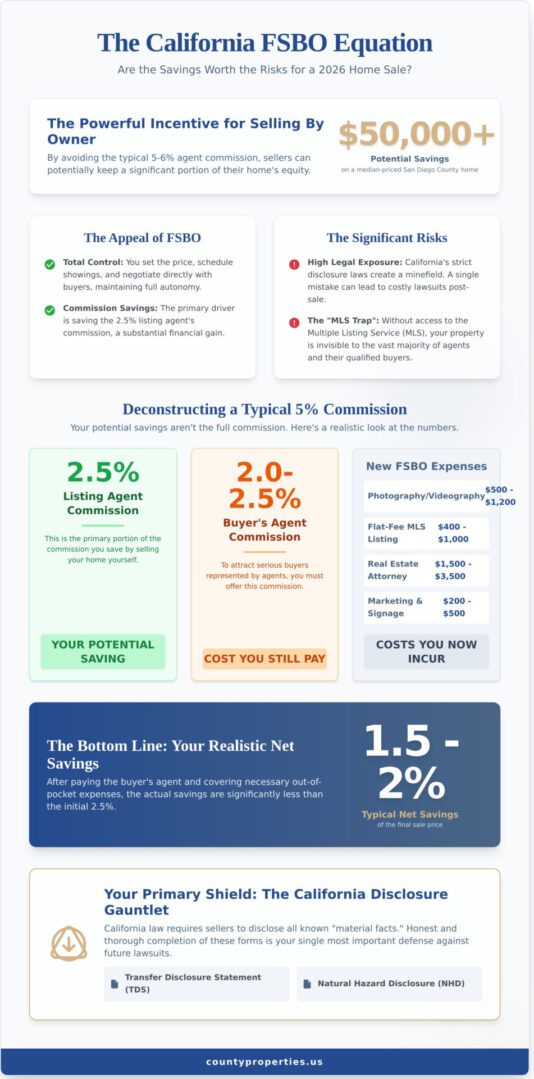
What if you could pocket the entire 5-6% commission on your California home sale, legally and with complete confidence? For a median-priced home in San Diego County, that’s a savings of over $50,000. It’s a powerful incentive, but the path to get there can feel like a minefield of legal risks.
We understand that the thought of going it alone is daunting. You’re likely concerned about the mountain of state-mandated paperwork, like the Transfer Disclosure Statement (TDS), and the potential for a lawsuit if you miss a single detail. These are valid fears in one of the nation’s most complex real estate markets. That’s why we created this guide. We’re here to provide the expert, step-by-step guidance you need to master the process of how to sell a house by owner in California.
This comprehensive 2026 guide will empower you with a clear timeline, walking you through everything from correctly completing disclosures to confidently managing escrow. You’ll gain the knowledge needed to achieve a successful, commission-free closing and ensure full legal compliance.
Key Takeaways
- Navigate California’s strict disclosure laws, including the critical Transfer Disclosure Statement (TDS), to protect yourself from future lawsuits.
- Get a clear framework for deciding if you’re prepared for how to sell a house by owner in California by accurately calculating your savings against the legal demands.
- Understand the “MLS Trap” and learn the marketing strategies required to ensure your home is seen by serious buyers, not just casual browsers.
- Master the final steps of your sale by learning how to select a neutral escrow partner and confidently manage the closing timeline.
The Reality of FSBO in California: Is Selling by Owner Right for You?
Deciding to sell your home is a monumental step in your life’s journey. Opting to do it yourself, without a listing agent, is an even bigger one. Known as For Sale By Owner (FSBO), this path puts you in complete control, but it also places every responsibility squarely on your shoulders. In the dynamic 2026 California market, this decision carries unique weight. The primary motivation is clear: saving a significant amount of money. But before you plant that sign in the yard, it’s critical to understand the full picture of what this process demands.
The financial incentive is undeniably attractive. On a home valued at $900,000, which is near the median for many California metro areas, a typical 2.5% listing agent commission amounts to $22,500. That’s a substantial sum you could potentially keep in your pocket. This figure alone is why many homeowners seriously consider the FSBO route. However, this journey isn’t just about saving money; it’s about earning it through what we call ‘sweat equity’. You become the project manager, marketer, scheduler, and negotiator for one of the largest financial transactions of your life.
This is where the ‘California Complexity’ factor comes into play. Our state has some of the most stringent real estate disclosure laws in the nation. Forgetting to provide a Natural Hazard Disclosure (NHD) Report or improperly completing the multi-page Transfer Disclosure Statement (TDS) can lead to costly legal disputes long after the sale closes. Successfully learning how to sell a house by owner in California requires a level of diligence and legal awareness far beyond what’s needed in states like Texas or Florida. You must honestly assess if you have the time, expertise, and emotional resilience to manage every showing, vet every potential buyer, and meticulously handle stacks of legally binding paperwork.
The Pros and Cons of Going Solo in the Golden State
The appeal of FSBO is rooted in autonomy and savings. You set the price, control the showing schedule, and communicate directly with potential buyers, eliminating the middleman. By 2026, digital platforms have made it easier than ever to list your property and access marketing tools. The downside, however, is significant. You lose access to the Multiple Listing Service (MLS), the primary tool agents use to find homes for their clients. You also face a high legal risk in a litigious state and must confront the buyer’s agent commission dilemma on your own.
A Reality Check on California Commission Rates
Many sellers are surprised to learn that forgoing a listing agent doesn’t eliminate commissions entirely. To attract the largest pool of qualified buyers, you’ll almost certainly need to offer a commission to the buyer’s agent, typically between 2.0% and 2.5%. On that same $900,000 home, that’s $18,000 to $22,500 you must plan to pay. Additionally, you’ll have out-of-pocket marketing expenses that are usually covered by a listing agent, including:
- Professional Photography & Videography: $500 – $1,200
- Flat-Fee MLS Listing Service: $400 – $1,000
- Real Estate Attorney (for contract review): $1,500 – $3,500
- Marketing & Signage: $200 – $500
After factoring in a 2.5% buyer’s agent commission and these essential services, the average net savings for a successful CA FSBO sale in 2026 typically lands between 1.5% and 2% of the home’s final sale price.
The California Disclosure Gauntlet: Mandatory Forms and Legal Requirements
California’s real estate laws are among the strictest in the nation, built on a simple but powerful principle: a seller must disclose all known “material facts” that could affect a buyer’s decision. This isn’t just about avoiding a lawsuit; it’s about building trust and ensuring a smooth transaction. While it might seem like a mountain of paperwork, mastering these disclosures is the single most important step in protecting yourself legally when you sell your house by owner in California.
Think of this process not as a burden, but as your primary shield. Your comprehensive and honest disclosures are what stand between you and a costly legal battle years after you’ve handed over the keys. Let’s break down the essential documents you’ll need to provide.
Mastering the Transfer Disclosure Statement (TDS)
The Real Estate Transfer Disclosure Statement, or TDS, is the centerpiece of your disclosure package. This standardized three-page form is your official testimony about the condition of your property. California law is clear: you must disclose what you know. This includes everything from a roof that leaks during heavy winter rains to ongoing noise from a neighbor’s garage band. Other examples include:
- Known plumbing, electrical, or structural defects.
- Previous issues with termites or other pests.
- Any death on the property within the last three years (except from AIDS-related causes).
- Problems with shared fences or property lines.
An “innocent” omission can have severe consequences. If a buyer discovers an issue after closing that you knew about but didn’t disclose, they can sue for damages or even seek to rescind the sale. The best practice is simple: when in doubt, disclose it. It’s far better to explain a known issue upfront than to defend your silence in a courtroom.
Navigating the Natural Hazard Disclosure (NHD)
For sellers in San Diego and across Southern California, the Natural Hazard Disclosure (NHD) Report is absolutely critical. Given the state’s geography, your property is likely located in one or more statutorily defined hazard zones. You are legally required to inform the buyer. Sellers typically hire a third-party NHD company for around $95 to prepare this report, which identifies if the home is in:
- A Special Flood Hazard Area
- An Area of Potential Flooding (Dam Inundation)
- A Very High Fire Hazard Severity Zone
- A State-mandated Wildland Fire Area
- An Earthquake Fault Zone
- A Seismic Hazard Zone
To provide an even deeper layer of protection, you’ll also complete the Seller Property Questionnaire (SPQ). This form goes beyond the TDS, asking more detailed questions about the property’s history and condition. Completing both the TDS and SPQ thoroughly is a key part of how to sell a house by owner in California without future complications.
Finally, don’t forget the federal requirement to provide a lead-based paint disclosure pamphlet for any home built before 1978 and a notice regarding the statewide database of registered sex offenders (Megan’s Law). For a complete overview of your obligations, the California Department of Real Estate offers comprehensive guides for consumers. While you can manage these forms yourself, navigating the nuances can be complex. If you’re feeling unsure, getting a professional review of your disclosure packet is a wise investment that provides invaluable peace of mind.
Pricing and Marketing Your California Home in 2026
Once you’ve prepared your home, the next two steps-pricing and marketing-are where your journey to sell a house by owner in California will truly be defined. In the fast-paced 2026 market, a “For Sale” sign and a Zillow post are not enough. You need a professional strategy to attract serious buyers and command the highest possible price. Getting this part right is the difference between a successful sale and a frustrating, costly ordeal.
Setting the Right Price in a Volatile Market
The single biggest mistake FSBO sellers make is overpricing their homes based on emotion or flawed data. While AI-driven tools like Zillow’s Zestimate offer a starting point, they often fail to capture the nuances of Southern California’s diverse micro-neighborhoods. An algorithm can’t see the custom kitchen you installed last year or differentiate your home’s value from one on a busier street just two blocks away.
For true accuracy, you have two primary options:
- Comparative Market Analysis (CMA): This involves analyzing “comps”-comparable homes in your specific neighborhood (e.g., North Park, San Diego) that have sold in the last 90 days. Look for properties with similar square footage, bed/bath count, and condition within a half-mile radius.
- Broker Price Opinion (BPO): For a few hundred dollars, you can hire a licensed real estate broker to provide a professional valuation. This is far more reliable than an online estimate and gives you a defensible price point grounded in expert analysis of current market conditions.
Starting with an inflated price is a trap. National Association of Realtors data from 2023 consistently shows that overpriced homes accumulate days on the market, which buyers interpret as a major red flag, leading to lower offers down the line.
High-Impact Marketing for the Solo Seller
With your price set, your marketing must create an irresistible first impression for the 2026 digital buyer. This is non-negotiable.
Your listing description needs to sell a lifestyle, not just a house. Instead of “3 bed, 2 bath,” write “A turnkey coastal retreat with a chef’s kitchen, perfect for enjoying Southern California’s year-round sunshine.” Your description must be both compelling and compliant. While you highlight the new quartz countertops, you also have to prepare for mandatory disclosures, like those outlined in California’s lead-based paint disclosure laws for homes built before 1978.
Next, invest in professional assets. Listings with professional photography receive over 60% more online views. For today’s market, especially to attract out-of-state buyers, a Matterport 3D virtual tour is essential. It allows a potential buyer in New York to walk through your living room from their laptop. Before you let anyone through the door in person, protect your time by verifying their “Proof of Funds” (POF) or mortgage pre-approval letter. This simple step ensures you’re only dealing with serious, qualified buyers.
Finally, you must overcome the ‘MLS Trap.’ Many sellers think listing on Zillow is enough. It isn’t. The Multiple Listing Service (MLS) is the central database used by every real estate agent to find properties for their clients. According to NAR, 86% of buyers use an agent, and those agents live on the MLS. The most effective way to learn how to sell a house by owner in California and still get maximum exposure is through a flat-fee MLS listing service. For a one-time fee, typically $300-$500, a licensed broker will list your property on the local MLS, syndicating it to thousands of agents and every major real estate website, including Zillow and other prominent platforms. It’s the single best investment you can make for a successful FSBO sale.
The Escrow and Closing Process: Managing the Final Hurdles
Once you’ve accepted an offer, you enter the most legally intensive phase of the sale: escrow. This is where the promises made in the purchase agreement become a legal reality. An independent escrow company acts as a neutral third party, a trusted stakeholder that holds all funds and documents until every condition of the sale is met. This process, typically lasting 30 to 45 days in California, is the final sprint where attention to detail is paramount for a successful closing.
Your first step is to mutually agree with the buyer on an escrow company and “open escrow” by providing them with the signed purchase agreement and the buyer’s earnest money deposit. The escrow officer then begins the critical work of clearing the property’s title and preparing for the transfer. Two significant costs you’ll encounter are title insurance and transfer taxes, and their handling varies across the state.
- Title Insurance: California has a distinct North/South divide. In Southern California counties like San Diego, Los Angeles, and Orange, the seller traditionally pays for the owner’s title insurance policy. In Northern California counties, including Alameda and Santa Clara, this cost is customarily paid by the buyer.
- Transfer Taxes: Every California county levies a transfer tax at a rate of $1.10 per $1,000 of the sale price. On a $950,000 home, this amounts to $1,045. However, 13 charter cities, including Los Angeles, San Francisco, and Berkeley, impose their own additional, often much larger, city transfer tax. Be sure to account for both in your net proceeds calculation.
Negotiating the Purchase Agreement
Most California transactions use the California Association of Realtors (CAR) Residential Purchase Agreement (RPA). While you can use other forms, the RPA is meticulously designed to protect both parties by outlining specific timelines for contingencies. Standard timelines include 17 days for inspections and 21 days for loan approval. As a For Sale By Owner seller, you’ll directly receive and respond to the buyer’s ‘Request for Repairs’ without an agent’s buffer, so be prepared to negotiate calmly and with firm data, like competing quotes from licensed contractors.
Closing the Deal and Handing Over the Keys
Before closing, the buyer will conduct a final walk-through using the ‘Verification of Property Condition’ form to ensure the home is in the same state as when they made the offer and that all agreed-upon repairs are complete. You’ll then review the final settlement statement, which itemizes every single cost and credit. Finally, you and the buyer will sign the closing documents with a notary. The escrow officer then records the new deed with the County Recorder’s office, transfers funds, and you hand over the keys. Your home is officially sold.
This final stage involves intricate legal and financial steps, making it the most challenging part of learning how to sell a house by owner in California. The details matter immensely. Ensuring every document is accurate and every deadline is met protects your investment and prevents costly delays. The legal and financial details of closing can be overwhelming. For expert guidance on navigating your escrow and ensuring a secure transaction, get a professional review of your closing documents from our experienced team.
When FSBO Becomes Risky: How County Properties Provides a Safer Alternative
The decision to sell your home by owner is often driven by one compelling number: the potential commission savings. Yet for many California homeowners, there comes a ‘breaking point’ where the mounting legal risks, complex negotiations, and emotional stress begin to eclipse any financial benefit. This is the moment when the DIY path becomes more of a burden than a bargain. While learning how to sell a house by owner in California is an empowering first step, successfully navigating the state’s notoriously complex transaction process requires a level of expertise that goes far beyond a yard sign and an online listing.
This challenge is magnified in specific life situations. For senior homeowners looking to downsize, the process isn’t just a transaction; it’s a major life transition. The physical and emotional demands of preparing a home, marketing it, and vetting buyers can be overwhelming. Similarly, in distressed situations like a short sale or foreclosure prevention, FSBO is simply not a viable option. These sales require intricate negotiations with lenders and a deep understanding of legal frameworks that demand seasoned professional guidance.
At County Properties, we see these challenges not as roadblocks, but as opportunities to provide true value. Our ‘Collaborative Team’ approach was designed as a direct alternative to the isolation of FSBO. We believe that protecting your net equity is about more than just avoiding a commission; it’s about securing the best possible outcome through expert strategy and steadfast support.
Personalized Support for Southern California Sellers
Arnie Levine and the County Properties team offer a holistic alternative to DIY selling, built on a foundation of 36+ years of dedicated San Diego market experience. This isn’t just about listing a property; it’s about providing comprehensive guidance that empowers you. That experience becomes your strategic advantage in high-stakes negotiations. Consider a recent client in La Jolla who listed FSBO for 62 days. Their best offer was plagued with contingencies and was $25,000 below their goal. After partnering with us, our professional marketing and negotiation strategy yielded a non-contingent offer $10,000 over their initial goal, netting them nearly $18,000 more than their best FSBO offer, even after commission.
Take the Next Step in Your Journey
Understanding your options is the most critical part of the process. A no-obligation consultation with our team can provide the clarity you need to make the best decision for your unique situation. For homeowners who prioritize a rapid and certain sale, we can also discuss our ‘Cash Offer Facilitation’ service, connecting you with qualified buyers to ensure a swift and predictable exit. Don’t navigate this complex journey alone. Let County Properties guide you through a seamless, stress-free sale.
Take the Next Step in Your California Home Sale
Selling your home is a major financial milestone. While learning how to sell a house by owner in California is empowering, the path for 2026 is lined with complex legal disclosures and sophisticated marketing demands. Successfully navigating the state’s stringent requirements and pricing your home accurately requires more than just a listing; it requires deep market insight and legal diligence to protect your investment. You don’t have to manage these hurdles alone.
The team at County Properties brings 36+ years of Southern California real estate expertise to your journey. With a proven track record in San Diego and surrounding counties and certified Senior Real Estate Specialists (SRES) on our team, we provide the trusted, personalized guidance needed to ensure a seamless and profitable sale. Before you take on the risks of FSBO, let our experience work for you.
Discover your home’s true potential. Request a Free Home Valuation and Consultation from County Properties today. Let’s make your next move a successful one.
Frequently Asked Questions About Selling Your House By Owner
Do I need a lawyer to sell my house by owner in California?
No, California law doesn’t require you to hire a lawyer to sell your home. However, given the complexity of real estate contracts and disclosure laws, consulting an attorney is highly recommended. For a flat fee, often between $500 and $2,500, a lawyer can review your purchase agreement and other documents. This investment provides crucial protection and helps ensure your transaction is legally sound, preventing potentially expensive future disputes.
What is the most important disclosure form for California sellers?
The most critical disclosure form is the Real Estate Transfer Disclosure Statement (TDS). This legally required, three-page document compels you to disclose all known material defects and issues with your property, from a leaky roof to neighborhood noise. Completing the TDS accurately and honestly is your primary defense against future lawsuits from the buyer. You must provide this form to the buyer as soon as is practicable before the transfer of title.
How much does it cost to sell a house FSBO in California?
Selling FSBO isn’t free. Expect to pay for costs like escrow, title insurance, and marketing, which typically total 1-2% of the sale price. The most significant expense is usually the buyer’s agent commission, which averages 2.5% to 3% in California. On an $800,000 home, this means you could pay between $28,000 and $40,000 in total closing costs, even without paying a commission to a listing agent.
Can I list my home on the MLS without a real estate agent?
Yes, you can get your home on the Multiple Listing Service (MLS) without hiring a full-service agent. You can use a flat-fee MLS listing service, which typically charges between $300 and $1,000. These services syndicate your listing to the local MLS and major websites like Zillow and Realtor.com. This step is critical for gaining visibility, as over 86% of all buyers in 2023 used a real estate agent who relies on the MLS.
What happens if I forget to disclose a problem with the house?
Forgetting or intentionally omitting a known material defect can have severe consequences. The buyer could sue you for damages, the cost of repairs, or in some cases, even seek to rescind the entire sale. California courts take disclosure laws very seriously, and a claim can be brought up to two years after the sale closes. It’s always better to over-disclose than to risk a lawsuit. Documenting everything provides the best protection for you.
Who typically pays for escrow fees in Southern California?
In Southern California, it’s customary for the buyer and seller to split the escrow fees 50/50. This is a common local practice that differs from Northern California, where the buyer often pays the entire fee. While this is the standard convention, the exact split is always negotiable. The agreed-upon terms should be clearly defined in section 7.D of the California Residential Purchase Agreement to avoid any confusion during closing.
Is selling ‘as-is’ in California a safe way to avoid disclosures?
No, selling a home ‘as-is’ does not relieve you of your legal disclosure obligations in California. The term ‘as-is’ simply informs the buyer that you won’t be making any repairs. You are still legally required by Civil Code 1102 to disclose every known material fact that could affect the property’s value or desirability. Attempting to hide a known defect under the guise of an ‘as-is’ sale is a significant legal risk.
How long does the average FSBO sale take in California compared to an agent-led sale?
Knowing how to sell a house by owner in California involves managing timelines effectively. According to 2023 data from the National Association of Realtors, agent-assisted homes sold in a median of just two weeks. In contrast, FSBO homes often remain on the market longer. This is typically due to challenges with initial pricing strategy, achieving broad market exposure, and navigating negotiations without professional guidance, which can add several weeks to the process.