

In a market where the median home price is projected to hit a record $905,000 this year, many sellers mistakenly believe that an aggressive asking price is the only way to protect their equity. Learning how to price your home for sale in Southern California requires more than just looking at a Zillow estimate; it’s about understanding a landscape where inventory is up 10 percent and buyers are highly sensitive to mortgage rates near 7 percent. You’ve likely spent hours worrying about how high transfer taxes and closing costs will impact your bottom line. It’s natural to feel protective of your investment while wanting a strategy that ensures you don’t sit on the market for months.
This guide will show you how to master a strategic, psychological approach that attracts serious offers and maximizes your equity. We’ll move beyond simple math to help you find the “sweet spot” price that creates immediate urgency among qualified buyers. You’ll gain a clear understanding of current local factors, from shifting buyer behavior to specialized strategies for senior transitions. By the end, you’ll have the confidence to partner with a professional team and secure a fast sale that honors your financial goals and your home’s true value.
Key Takeaways
- Understand how 2026 inventory shifts and neighborhood micro-climates dictate whether you should price for stability or aggressive competition.
- Master the technical steps of how to price your home for sale in Southern California by using a hyper-local CMA that adjusts for high-value premiums like ADUs and views.
- Compare the “Market Value” approach against the “Event Pricing” strategy to determine which model will best trigger a bidding war for your specific property.
- Learn to identify and bypass the emotional traps of overvaluation, ensuring your asking price is rooted in market reality rather than personal financial needs.
- Discover how a collaborative, data-driven partnership can help you justify a premium price point while navigating the complexities of the Southern California market.
Navigating the Southern California Market Micro-Climates
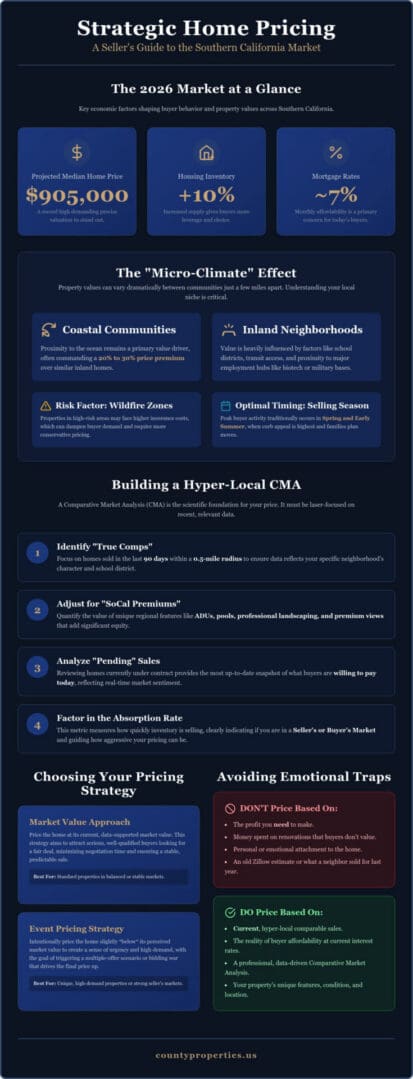
Pricing your property isn’t a “one size fits all” calculation. In our region, we use the “Micro-Climate” concept. This means the market value in a coastal zip code can behave completely differently than an inland community just five miles away. Understanding these shifts is the first step in learning how to price your home for sale in Southern California. While the statewide median price is projected to reach $905,000 in 2026, inventory has increased by roughly 10 percent. This extra supply gives buyers more leverage, making precise valuation critical. You can’t rely on broad regional averages when your specific street might be experiencing a unique supply and demand curve.
Environmental factors also play a major role in your strategy. Properties in wildfire hazard zones often face higher insurance premiums, which can dampen buyer demand and require a more conservative pricing approach. Buyers are more cautious about long-term carrying costs than ever before. Timing your entry is equally vital to your success. We recommend selling a home in Southern California during the spring and early summer windows when buyer activity traditionally peaks and curb appeal is at its highest.
San Diego Neighborhood Dynamics
San Diego County offers a study in contrasts. Luxury enclaves like Rancho Santa Fe maintain high entry points but often see longer days on market due to a smaller pool of qualified buyers. Conversely, emerging areas like City Heights attract first-time buyers looking for entry-level value, often leading to faster turnover. Proximity to the Pacific Ocean remains the primary driver for the “price per square foot” metric; coastal homes often command a 20 to 30 percent premium over similar inland structures. For 2026, we are seeing “hot zones” in neighborhoods near expanding transit corridors and established employment centers where demand stays consistently high.
The 2026 Economic Landscape
Buyer purchasing power is currently tethered to interest rates, which have stabilized between 6.68 and 7 percent. This creates a firm ceiling on what local families can comfortably afford each month. A professional real estate appraisal or a detailed CMA must account for the local “employment anchor” effect to be accurate. Neighborhoods near biotech hubs in Sorrento Valley or military bases like North Island often see more resilient valuations due to consistent housing demand. In 2026, Southern California pricing is dictated more by monthly affordability than total sticker price. We focus on these nuances to ensure your price reflects the reality of what a buyer can actually pay.
Conducting a Comparative Market Analysis (CMA) for SoCal Properties
A Comparative Market Analysis (CMA) serves as the scientific foundation for your listing strategy. While broad reports on California’s Housing Market provide essential context, a successful sale depends on hyper-local data. To understand how to price your home for sale in Southern California, you must filter out “outlier” sales that don’t reflect your property’s true potential. This involves looking past the highest and lowest sales to find the consistent middle ground that reflects current buyer behavior.
- Step 1: Identify “True Comps.” Focus on properties within a 0.5-mile radius sold in the last 90 days. In dense San Diego neighborhoods, going beyond this range often introduces different school districts or neighborhood vibes that skew the data.
- Step 2: Adjust for “The SoCal Premium.” We specifically evaluate features like swimming pools, professional landscaping, and Accessory Dwelling Units (ADUs) to determine their exact contribution to your equity.
- Step 3: Analyze “Pending” sales. These listings show real-time buyer sentiment. They reveal what people are actually bidding today, providing a more accurate snapshot than a sale that closed three months ago.
- Step 4: Factor in the Southern California housing market absorption rate. This metric helps us determine if we are in a seller’s or buyer’s market by measuring how fast current inventory is being consumed.
The Three Pillars of a Southern California CMA
We view valuation through three distinct lenses to ensure accuracy. Recent sales provide the historical baseline for your home’s value. Pending sales reveal current bidding war potential and the level of buyer urgency in your specific zip code. Finally, active listings represent your immediate competition. If three similar homes just hit your block, your pricing must be sharper to capture the attention of qualified buyers who are comparing your home to others in real-time.
Adjusting for Unique Property Features
In San Diego, not all views are created equal. An ocean view might add a six-figure premium; a canyon or city lights view offers a more modest but significant boost. By 2026, sustainable features like solar panels and drought-tolerant yards have transitioned from luxuries to essential value-adders. If you have an ADU, value it based on its potential for rental income or multi-generational living rather than just construction costs. If you need assistance navigating these variables, reaching out to a seasoned advisor can provide the clarity you need to move forward with confidence.
Strategic Pricing Models to Outshine the Competition
Once you’ve analyzed the data from your CMA, you must choose a specific model to position your property. In our collaborative approach, we help you select a strategy that aligns with your timeline and financial goals. Deciding how to price your home for sale in Southern California isn’t just about the final number; it’s about the psychological impact that number has on the market. We use three primary models to guide our clients toward a successful closing.
- The Market Value Approach: This strategy targets the exact middle of the current sales range. It’s steady, predictable, and fair. It works best for sellers who want a reliable equity return without the volatility of a bidding war.
- The Event Pricing Strategy: By intentionally pricing your home 3 to 5 percent below market value, we trigger immediate urgency. This model acts as a catalyst for multiple offers, often driving the final price well above the initial ask.
- The Premium Pricing Model: We reserve this for unique, high-end properties in low-inventory enclaves. If your home offers a feature that can’t be replicated, we price it as a “one of a kind” asset to attract the right high-net-worth buyer.
For those navigating life transitions, such as downsizing or moving into assisted living, the strategy shifts toward certainty. Working with a senior real estate specialist allows you to price for a quick, respectful lifestyle transition. We focus on minimizing stress while protecting the financial legacy you’ve built in your home.
When to Use “Bait Pricing” vs. “Aspirational Pricing”
Bait pricing involves a low entry point to lure in a crowd. While effective in 2021, it carries more risk in a 2026 environment where mortgage rates hover near 7 percent. Buyers are more analytical; they may worry a low price hides property defects. Conversely, “Aspirational Pricing” sets the bar too high. This often leads to the dreaded price reduction, which signals to buyers that the seller is getting desperate. We also consider the psychology of the $9,000 ending. Pricing at $899,000 instead of $900,000 still resonates with buyers, creating a perception of value that can lead to more clicks and tours.
Pricing for the 2026 Tech-Savvy Buyer
Modern buyers rely heavily on search filters on platforms like Zillow and Redfin. These filters typically move in $50,000 or $100,000 increments. If you price your home at $905,000, you’ll be invisible to anyone with a $900,000 search ceiling. We recommend “bracket pricing” to capture multiple search ranges. Pricing at a round number like $900,000 ensures you appear in both the “$800k to $900k” and “$900k to $1M” search results. This simple adjustment can double your digital foot traffic and increase the pool of serious, qualified buyers overnight.
Avoiding the Emotional Traps of Home Pricing
Selling a home is a personal experience, especially if you have raised a family or built a lifetime of memories within its walls. However, the market operates on data rather than sentiment. One of the most common pitfalls in learning how to price your home for sale in Southern California is the “I Need X Amount” fallacy. Your home’s value is determined by what a qualified buyer is willing to pay today, not by the down payment required for your next property or the total cost of your past renovations. We act as a steady, guiding presence to help you separate these financial needs from market reality.
We often see sellers overvalue “emotional improvements” like custom designer wallpaper, specialized backyard water features, or niche landscaping. While these additions made the house a home for you, they may not align with the tastes of a broad buyer pool. The “test the market” mentality is particularly dangerous in our current economic climate. Starting with a high price to “see what happens” usually results in a stale listing that eventually sells for less than it would have with a sharp initial price.
For our senior clients, these emotional hurdles are often paired with complex logistical needs. California’s Proposition 19 provides a significant advantage here, as it allows many homeowners over the age of 55 to transfer their property tax base to a new primary residence. This financial safety net makes downsizing with dignity much more achievable. Our team focuses on navigating these transitions with care, ensuring you capture your equity without the stress of overpricing.
The Cost of “Days on Market” (DOM)
In San Diego, a high DOM count acts as a red flag to savvy buyers and their agents. When a home sits for more than three weeks, the market begins to wonder what is “wrong” with the property. This skepticism often leads to lower offers regardless of the home’s actual condition. You must also consider the monthly carrying costs. Property taxes, insurance, and maintenance expenses can quickly eat into the gains you hoped to achieve with a higher price. Your first 14 days on the market are your most valuable; do not waste them on an unrealistic price.
Handling Low-Ball Offers Empathetically
Receiving an offer significantly below your asking price can feel like a personal insult, but it’s often just a starting point for negotiation. We help you distinguish between a “bottom-feeder” looking for a steal and a serious buyer who is simply testing your flexibility. By maintaining a collaborative, team-based ethos, we use counter-offers to discover the true market ceiling. If you are ready to see how a professional valuation can protect your peace of mind, schedule a collaborative pricing consultation with our experienced team today.
The County Properties Advantage: Expert Valuation
Arnie Levine and the County Properties team believe that valuation is an art supported by science. While we rely on the technical steps of a CMA, we also apply decades of local San Diego intuition to every assessment. Understanding how to price your home for sale in Southern California requires a deep-rooted connection to specific regional fabrics that an automated algorithm simply cannot grasp. We see the value in a quiet cul-de-sac or a meticulously maintained garden that a computer script might miss. This human-centric approach ensures you don’t leave money on the table or risk a stagnant listing.
Our comprehensive marketing program is designed to justify your asking price to every potential buyer who walks through your door. We don’t just list your home; we position it as a premium asset. By utilizing professional staging and high-end photography, we create a narrative of value that supports our pricing strategy. This is especially vital for our senior clients and those navigating distressed property situations. We provide tailored solutions that prioritize financial safety and a respectful transition, offering methodical assistance during what can be a high-stakes life change. Our brand acts as a reliable professional ally, serving as a central anchor for your financial security.
For clients who require a guaranteed timeline, we offer a “Rapid Cash Offer” facilitation service. This acts as a reliable safety net and a pricing floor strategy. It gives you the certainty of a sale if the traditional market path doesn’t align with your immediate needs. Whether you are looking for a market-leading price or a swift transition, we provide the steady, guiding presence you need to move forward.
Our Collaborative Pricing Process
Our customized Seller Representation program is built on internal cooperation and client-first outcomes. We walk you through a structured process where your input is valued as much as our data. Working with a team that knows San Diego County block-by-block means we can identify micro-trends before they hit the headlines. We use this knowledge to prepare your home for the market, coordinating every detail from minor repairs to the final professional photo shoot. This collaborative ethos ensures that everyone is aligned on the goal: a successful, high-value closing.
Ready to Discover Your Home’s True Value?
An online estimate is a starting point, but it isn’t a strategy. There is a significant difference between a generic algorithm and an expert real estate agent near me who understands the nuances of San Diego County. We invite you to experience a no-obligation professional valuation that considers the unique soul of your property. Our team is ready to provide the clarity and confidence you deserve. Contact County Properties today for a strategic pricing consultation and let us act as your dependable guide toward a successful sale.
Secure Your Financial Success in the Southern California Market
Mastering how to price your home for sale in Southern California requires a delicate balance of local data and psychological strategy. You’ve learned that your home’s value isn’t just a number on an app; it’s a reflection of neighborhood micro-climates and current buyer purchasing power. By avoiding emotional traps and utilizing professional bracket pricing, you position your property to capture maximum attention in the first 14 days. This strategic approach ensures you don’t just sell. You sell with the confidence that your equity is fully protected.
Arnie Levine and the County Properties team offer a steady, guiding presence throughout this transition. As a San Diego local expert with SRES® certification, Arnie specializes in navigating senior transitions as well as standard and distressed sales with empathy. We invite you to move beyond algorithms and partner with a team that has a proven track record of success. Get Your Professional Southern California Home Valuation today to see the difference that expert intuition makes. You deserve a partner who treats your financial legacy with the respect it’s earned.
Frequently Asked Questions
How do I know if I have priced my Southern California home too high?
Low foot traffic and a lack of offers in the first 14 days are the clearest signals that your price is unrealistic. If you’ve had more than ten showings without a single offer, the market is telling you the price doesn’t align with current value. We monitor these metrics closely to help you adjust your strategy before the listing becomes stale and loses its initial momentum.
Are Zillow Zestimates accurate for San Diego homes in 2026?
Zestimates are automated algorithms that often miss hyper-local nuances like a quiet cul-de-sac location or high-end interior upgrades. While they provide a broad starting point, they shouldn’t dictate your final strategy. A professional analysis of how to price your home for sale in Southern California requires human intuition and an understanding of specific neighborhood micro-climates that computers simply can’t replicate accurately.
Should I price my home lower to start a bidding war?
This “Event Pricing” strategy can be highly effective if your property is in a high-demand area with low inventory. By pricing 3 to 5 percent below market value, you create immediate urgency among qualified buyers. This approach requires a seasoned advisor to manage the resulting negotiations and ensure the final contract price reflects the true equity you’ve built in your property over the years.
How does Proposition 19 affect how I should price my home for a senior move?
Proposition 19 allows homeowners over 55 to transfer their tax base to a new primary residence of any value within California. This often removes the financial pressure to hit a specific “net” number to afford your next home’s property taxes. We help seniors use this tax advantage to price competitively, facilitating a smoother transition while maintaining their long-term financial security and peace of mind.
What is the most important factor in pricing a Southern California home?
Monthly affordability for the buyer is the most critical factor in the 2026 market landscape. With 30-year fixed mortgage rates averaging between 6.68 and 7 percent, buyers focus on their total monthly payment rather than just the sticker price. We analyze local employment hubs and purchasing power to ensure your asking price fits within the realistic budget of the most likely buyer pool.
Can I change my listing price if I don’t get offers in the first week?
You can adjust your price at any time, but we typically recommend waiting until the 14-day mark to gather sufficient market data. A price correction should be significant enough to trigger a new wave of interest, often by crossing into a lower search bracket on major platforms. We guide you through this process to ensure any change is a strategic move rather than a sign of desperation.
How do wildfire insurance rates impact my home’s market value?
High insurance premiums in designated hazard zones directly reduce a buyer’s purchasing power by increasing their monthly carrying costs. If your home is in one of these areas, your pricing strategy must account for these extra expenses. We look at average premium increases for 2026 to help you set a price that remains attractive to buyers despite these mandatory environmental costs.
Should I get a professional appraisal before listing my home for sale?
While not mandatory, a pre-listing appraisal can provide a solid baseline for unique or high-end properties that lack direct comparables. It offers a third-party perspective that can help justify your asking price during tough negotiations. However, for most standard sales, our comprehensive CMA provides the necessary data to understand how to price your home for sale in Southern California without the extra cost.