

Waiting for interest rates to return to historic lows might be the most expensive mistake you make this year. While it’s tempting to stay “locked-in” to an old rate, understanding how interest rates affect the housing market in 2026 is about more than just the monthly payment. You’ve likely felt the pressure of decreased purchasing power, especially with the 30-year fixed mortgage rate at 6.51% as of May 16. It’s natural to feel uncertain about home value retention when the median price for a detached home in San Diego County has reached $1,100,000.
We believe that your life transitions shouldn’t be put on hold by market volatility. This guide provides a clear strategy to help you leverage your equity and find peace of mind despite current rate levels. We’ll examine the specific trends shaping Southern California right now, from the persistent lock-in effect to the shifting inventory levels in Orange and Riverside counties. You’ll gain the insights needed to prioritize your long-term goals and make a move with the confidence of a seasoned professional by your side.
Key Takeaways
- Master the fundamental mechanics of how interest rates affect the housing market and why the current “cost of money” is the primary driver of property values in 2026.
- Understand the inventory paradox created by the “Lock-In Effect,” which explains why supply remains constrained even as rates fluctuate.
- Discover the unique geographic and economic factors that provide San Diego and coastal Southern California with a distinct “moat” of market resilience.
- Learn actionable strategies for today’s climate, such as utilizing seller-funded rate buy-downs and prioritizing long-term lifestyle goals over short-term market timing.
- See how a collaborative, expert-led approach can help you navigate complex transitions with the confidence of a seasoned professional.
The Mechanics of 2026: Why Interest Rates Matter to the Housing Market
Interest rates act as the primary pulse for our local economy. They dictate the “cost of money,” which is the actual price you pay for the privilege of borrowing. Understanding how interest rates affect the housing market is essential for any Southern California resident planning a move in 2026. As of May 16, 2026, the 30-year fixed mortgage rate in California is 6.51%. This figure isn’t just a decimal point; it’s a gatekeeper for your lifestyle goals and financial security.
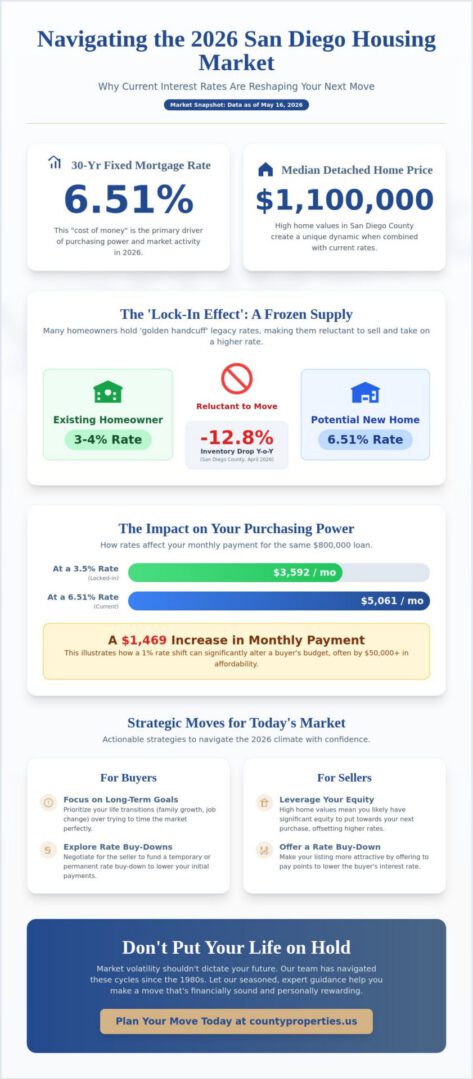
The 2026 outlook requires a careful balance. Federal policymakers are currently navigating the thin line between controlling inflation and maintaining housing stability. When rates climb, purchasing power drops instantly. A 1% shift can alter a buyer’s budget by $50,000 or more. This often makes the difference between securing a detached home in San Diego or settling for a smaller condo. This reality influences seller psychology just as much as buyer affordability. Many homeowners feel hesitant to list their properties because they don’t want to trade a legacy low rate for today’s market reality. This standoff creates the inventory shortages we see across the region, where total inventory in San Diego County was down 12.8% year-over-year in April 2026.
The Relationship Between the Fed and Mortgage Rates
A common misconception is that the Federal Reserve sets mortgage rates directly. They don’t. The Fed sets the federal funds rate, which is the interest rate banks charge each other for overnight loans. Mortgage rates are more closely tied to the 10-year Treasury yield. In 2026, the “spread” is the difference between that Treasury yield and the mortgage rate, representing the lender’s profit and risk management. Monitoring this spread helps us understand what is a real-estate bubble and how to avoid the risks associated with market volatility. We track these indicators daily to provide you with the most reliable data possible.
Purchasing Power and the ‘Monthly Payment’ Reality
The Lock-In Effect: How Rates Dictate 2026 Housing Supply
The logic of supply and demand usually dictates that higher costs lead to lower prices. However, 2026 has presented a unique inventory paradox. Many homeowners currently enjoy mortgage rates between 3% and 4% from loans secured years ago. Trading that for a 6.51% rate feels like a significant financial step backward. This reluctance to sell is widely known as the ‘lock-in effect’, and it’s the primary reason housing supply remains so tight in Southern California. When owners stay put, the entire ecosystem slows down.
While high rates have cooled buyer demand, they’ve also frozen the supply side of the equation. This creates a “price floor.” Even when buyer activity slows, the lack of available homes prevents prices from falling significantly. In San Diego County, total inventory dropped 12.8% year-over-year as of April 2026. For you as a buyer, this means you’ll face less competition than in previous bidding wars, but you’ll have far fewer properties to choose from. Understanding how interest rates affect the housing market requires looking at how these rates influence the psychology of your potential neighbors just as much as your own wallet.
The ‘Golden Handcuffs’ Phenomenon in Southern California
Established neighborhoods in San Diego and Orange County are seeing record-low turnover. Move-up buyers, who would typically sell a condo to buy a detached single-family home, are staying put. They can’t justify the massive increase in monthly interest expense when their current payment is so low. This inventory squeeze maintains the overall Southern California housing market resilience. If you feel stuck in your current home, it’s helpful to examine your equity position to see if a transition still aligns with your long-term wealth goals.
When Life Overrides Interest Rates
Despite the economic “handcuffs,” life doesn’t stop. Real estate professionals often refer to the “5 Ds” that drive moves regardless of market conditions: Divorce, Death, Diamonds, Deliveries, and Displacement. These life transitions continue to fuel the market. Consider a growing family in Rancho Santa Fe. They might need more space for a new child today. Waiting for a significant rate drop that may not arrive for years isn’t a viable option when their daily quality of life is at stake. In these cases, the focus shifts from timing the market to securing a home that serves the family’s immediate needs. We act as your dependable guide, helping you navigate these high-stakes transitions with the care and professional mastery you deserve.
Southern California Dynamics: San Diego’s Resilience in 2026
San Diego’s housing market doesn’t always follow national headlines. Our region possesses a “geographic moat,” bounded by the Pacific Ocean, the mountains, and an international border. This limited land availability prevents the oversupply issues seen in states like Texas or Florida. We can’t simply build outward, so our existing inventory retains its value more effectively during economic shifts. Understanding how interest rates affect the housing market in San Diego requires looking at this supply constraint. While rates might dampen demand, our lack of land ensures that supply never quite catches up to the needs of our growing community.
San Diego County’s Economic Buffer
Our local economy is built on pillars that provide significant stability. The heavy presence of the military ensures a consistent flow of residents with stable housing allowances. Additionally, our biotech and tech sectors continue to attract high-income professionals who are less sensitive to minor rate fluctuations. San Diego remains a primary destination market. Many buyers arrive from out-of-state with significant cash reserves, often viewing our $925,500 median home price as a relative value compared to Northern California or New York. Historically, our region has outperformed national averages in previous cycles. This proves that local resilience often overrides national rate trends.
Price sensitivity varies across the region. In coastal San Diego, the luxury market for homes over $5 million saw pending sales rise 12.3% year-over-year in May 2026. These buyers often bypass traditional financing entirely. In contrast, inland markets like Riverside and San Bernardino are more sensitive to rate hikes. Riverside’s median home price of $643,740 and San Bernardino’s $502,600 make them more accessible for first-time buyers. However, residents in these areas often rely on conforming loans. This makes them more vulnerable to shifts in the 30-year fixed rate than those in wealthier coastal enclaves.
The Role of Cash Buyers and Investors
Higher interest rates often create a unique opportunity for cash-heavy buyers and seasoned investors. When financing becomes more expensive, the pool of competing buyers shrinks. This gives those with liquid capital more negotiating power and a better chance to secure prime properties without aggressive bidding wars. Investors are also closely watching these trends as a signal for rental market growth. As more people are priced out of buying, demand for high-quality rentals increases. If you are looking to diversify your portfolio, our commercial real estate Southern California guide offers deep insights into navigating these investment windows. We believe that a strategic, well-timed move in 2026 can set the foundation for long-term financial success.
Strategic Moves: Navigating the Market as a Buyer or Seller
Success in 2026 doesn’t come from waiting for a perfect economic headline. It comes from making a plan that accounts for current realities. Understanding how interest rates affect the housing market is the first step toward building a winning strategy. Whether you’re looking to upgrade or downsize, you have more options than you might realize. The key is to move past the “wait and see” approach and focus on the tools that make a move financially viable today.
Sellers often worry that high rates will scare off every buyer. This isn’t the case. By offering rate buy-downs, you can effectively lower a buyer’s monthly payment without slashing your asking price. This preserves your home’s value while making it more affordable for the next family. Professional seller representation is essential here. An expert team knows how to market these concessions as a superior alternative to a simple price drop. For buyers, the “Marry the House, Date the Rate” philosophy remains relevant. You’re securing the property you want now with the intent to refinance when rates eventually soften. If you have significant equity in your current home, you can leverage it for a larger down payment, which directly offsets the impact of a 6.51% interest rate.
Creative Financing and Seller Concessions
One of the most effective tools in 2026 is the 2-1 buy-down. This arrangement allows the seller to pay a fee that reduces the buyer’s interest rate by 2% in the first year and 1% in the second. It’s a win-win that provides the buyer with immediate relief while the seller avoids a stagnant listing. We also see the return of the assumable mortgage. While rare, these allow a buyer to take over a seller’s existing low-rate loan. If your current mortgage is eligible, it becomes a massive selling point that can drive a premium price.
Special Considerations for Seniors and Downpours
Interest rates often matter less for seniors who have spent decades building home equity. If you’re selling a high-value San Diego home to move into a smaller, more manageable property, you may be able to purchase your next home with cash. This removes the interest rate equation entirely. Transitioning to a new lifestyle is about more than just numbers. Waiting for a 1% rate drop can cost you years of “life time” in a home that no longer serves your needs. Our team includes a senior real estate specialist to help guide you through these delicate transitions with the empathy and professional mastery you deserve. If you’re ready to explore your options, read our comprehensive guide on seller representation to see how we can position your home for a successful sale.
County Properties: Your Seasoned Guide in Any Rate Environment
Arnie Levine has guided clients through every major market shift since the 1980s. He’s seen interest rates climb to nearly 18% and drop to historic lows. This deep background is vital when you’re trying to understand how interest rates affect the housing market today. While newer agents might struggle with the current 6.51% environment, Arnie and the County Properties team view it as another cycle to navigate with precision. We don’t believe in a one-size-fits-all approach. Instead, we work as a collaborative team to find the best financial path for your specific situation. We act as your reliable professional ally, ensuring you have the data needed to move forward with certainty.
Our roots in San Diego run deep. We understand the local fabric, from the coastal luxury enclaves where cash buyers dominate to the growing inland communities where monthly payments are the primary concern. This community focus means we aren’t just looking at data points; we’re looking at your neighbors and your long-term goals. Whether you need expert buyer representation or a specialized senior transition, we offer supportive and methodical assistance. We’ve built our reputation on reliability and professional mastery, positioning ourselves as a steadfast partner during your most significant life transitions.
Why Experience Matters More When Rates Are Volatile
A “fair weather” agent can handle a market where everything sells in hours. However, when rates fluctuate, you need a seasoned veteran who knows how to negotiate concessions and structure creative deals. For homeowners facing financial stress, we provide specialized foreclosure prevention in California. We’ve helped countless residents avoid the pitfalls of high-stakes personal situations through methodical assistance and short sale expertise. Our commitment is always to ethical, service-first guidance. We prioritize your financial safety above all else, ensuring you feel secure in your choices.
Take the Next Step with Confidence
Generic online estimates often fail to account for the nuances of San Diego’s “geographic moat” or the specific impact of recent rate shifts. A personalized market analysis is the only way to get a true picture of your home’s value in 2026. We’ll look at your equity, your neighborhood’s specific inventory levels, and your personal timeline. This allows you to make decisions based on facts rather than headlines. We invite you to schedule a no-obligation consultation to discuss your 2026 goals and see how our team-based ethos can work for you. Connect with County Properties today to navigate the 2026 market and find the peace of mind that comes from working with a true industry veteran.
Secure Your Financial Future in a Shifting Market
Navigating the current climate requires a deep understanding of how interest rates affect the housing market, but it also requires the confidence to act when the right opportunity appears. San Diego’s unique economic buffers and limited inventory continue to provide a foundation of stability that sets our region apart. Whether you’re leveraging significant equity for a new lifestyle or utilizing creative concessions to attract buyers, your goals remain within reach when you have the right data at your disposal. You don’t have to wait for the market to change to find the home that fits your life.
Arnie Levine brings over 30 years of San Diego market experience to every conversation. As a certified Senior Real Estate Specialist (SRES®) with extensive expertise in both traditional and distressed property sales, he offers the seasoned perspective you need to navigate 2026 with peace of mind. Our collaborative team is ready to help you identify your best financial path and move forward with a clear, effective strategy. We’ve seen these cycles before and know exactly how to position our clients for success.
Take the first step toward your next milestone today. Schedule a Strategic Consultation with Arnie Levine to discuss your specific needs and discover how we can help you thrive in any rate environment. We’re here to act as your dependable guide and ensure your next move is a positive one.
Frequently Asked Questions
Will housing prices drop if interest rates continue to rise in 2026?
Prices aren’t expected to drop significantly because housing supply remains extremely tight across Southern California. While high rates dampen demand, the lack of inventory creates a firm price floor. In San Diego, detached home inventory fell 22.4% as of April 2026. This shortage prevents the sharp price corrections seen in markets with more available land. You can expect market stabilization rather than a crash in our local neighborhoods.
Is it better to buy a home now or wait for interest rates to go down?
Buying now allows you to secure a property before prices climb further. If rates drop later, a surge of buyers will likely enter the market, driving prices up and increasing competition. By purchasing today, you can refinance if rates improve in the future. Waiting often means losing “life time” in a home that fits your needs. Focus on your long-term goals rather than trying to time the bottom of a cycle.
What is a mortgage rate buy-down, and how does it help sellers?
A mortgage rate buy-down is a concession where the seller pays an upfront fee to lower the buyer’s interest rate for a specific period. This helps sellers by making their home more affordable without requiring a major price reduction. It attracts buyers who are sensitive to monthly payments. We often recommend this as a strategic tool to maintain your home’s value while providing genuine financial relief to the next family.
How do interest rates affect the value of my current home equity?
High rates can slow the pace of appreciation, but they don’t necessarily erase your existing equity. In Southern California, the limited supply of homes keeps values resilient even when borrowing costs rise. Understanding how interest rates affect the housing market helps you see that your equity remains a powerful tool. You can use it to make a larger down payment on your next property, effectively reducing the amount you need to borrow.
Can I still sell my house fast if interest rates are high?
You can still sell your home quickly if it’s priced correctly and marketed with professional mastery. In Orange County, homes averaged just 31 days on the market as of May 2026. Buyers are still active, particularly those with cash or those who have been waiting for a specific property. We focus on highlighting your home’s unique features and utilizing strategic concessions to ensure your listing stands out and moves at your desired pace.
What happens to the San Diego rental market when mortgage rates increase?
Rental demand typically increases when high mortgage rates make homeownership less accessible for first-time buyers. As potential buyers stay in the rental market longer, the competition for quality units intensifies. This often leads to higher monthly rents across San Diego County. For investors, this environment can represent a period of growth. For residents, it underscores the value of securing a fixed housing payment to protect against future cost increases in the rental sector.
Are adjustable-rate mortgages (ARMs) a safe option in 2026?
Adjustable-rate mortgages can be a strategic option if you plan to sell or refinance before the rate adjusts. They often provide a lower initial payment than fixed-rate loans. However, you must have a clear exit strategy and understand the potential for future increases. We recommend discussing your goals with a trusted professional to ensure you aren’t taking on unnecessary risk. Our team focuses on finding the most reliable path for your success.