

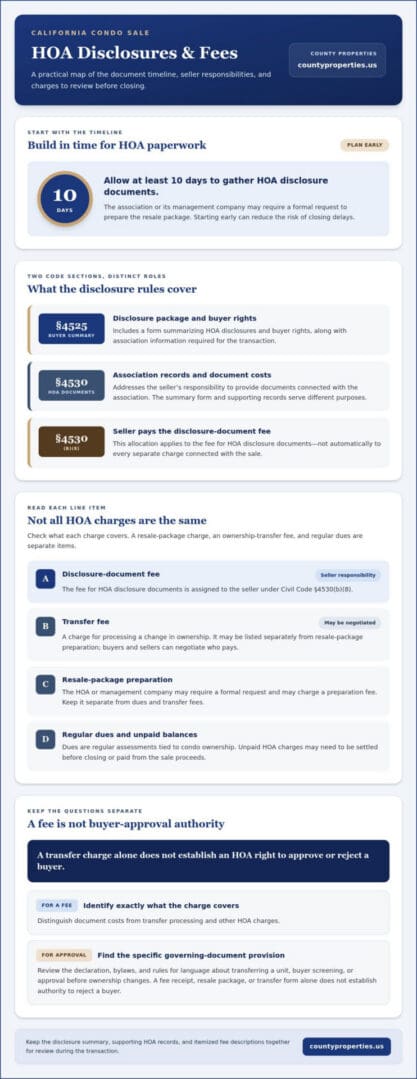
Plan for at least 10 days to gather HOA disclosure documents when selling a condo in California. The HOA rules for selling a condo in California include a seller’s responsibility for the disclosure-document fee under Civil Code Section 4530(b)(8), though the sale process can also involve other HOA charges and requirements. An HOA’s paperwork can affect timing, but that doesn’t automatically mean it can stop a sale.
It’s reasonable to want a clear timeline and understand which costs or restrictions could complicate closing. This guide explains how HOA disclosures work, what transfer fees may apply, and where an association’s authority over a condo sale begins and ends. You’ll also learn what California sellers need to provide and how addressing HOA requirements early can help keep a transaction on track.
Key Takeaways
- Allow at least 10 days for HOA disclosure documents to be gathered, and start early to reduce the risk of closing delays.
- Resale-package and transfer charges can affect closing costs; understand what each fee covers and that buyer and seller may negotiate who pays transfer fees.
- California Legislative Information says HOA sellers must provide a Civil Code §4525 disclosure form summarizing HOA disclosures and buyer rights.
- Explore how HOA requirements and governing documents relate to a sale, including whether the association has a basis to restrict the transaction.
What About Transfer Fees?
The HOA rules for selling a condo in California involve both recurring dues and charges connected with a sale. California Civil Code Section 4530(b)(8) assigns the seller the fee for HOA disclosure documents.
HOA Transfer Fees
An HOA transfer fee is a charge for processing a change in ownership. It may appear separately from the cost of preparing a resale package. Sellers commonly pay transfer fees at closing, but buyers and sellers can negotiate who is responsible. Review each charge by its description so you can discuss who pays before finalizing the closing figures.
For example, an itemized statement might list a disclosure-document charge and an ownership-transfer charge separately. The seller’s responsibility under Section 4530(b)(8) applies to the disclosure-document fee. It doesn’t automatically make every transfer fee the same charge. Review each line item individually.
Dues and Resale Packages
HOA dues are regular assessments associated with condo ownership; a resale package provides the buyer with information about the association. Unpaid HOA charges may need to be settled before closing or paid from the sale proceeds. Understanding the HOA rules for selling a condo in California also means accounting for outstanding balances, which can affect how much you receive at closing.
The HOA or its management company may require a formal request to prepare the resale package, and the association may charge a preparation fee. Keep that cost separate from regular dues and any transfer fee. Identifying which charges cover records, ownership assessments, or processing a change in ownership helps prevent confusion about the total HOA costs.
HOA authority to restrict a sale
A California HOA’s transfer charge does not, by itself, establish a buyer-approval right. California Civil Code Section 4530(b)(8) assigns the seller the fee for HOA disclosure documents. That fee rule concerns document costs, not a separate approval condition. Treating the two as interchangeable can create confusion during negotiations and closing.
If the HOA claims a sale restriction applies, review the association’s declaration, bylaws, and rules. Look for specific language about transferring a unit, screening buyers, or requiring approval before ownership changes. A general rule about residents or common areas does not necessarily establish that the association can control a sale. Identify the exact provision cited, then distinguish routine document processing from a condition that could affect the buyer or transaction.
The key question is whether the claimed approval condition is supported by the governing documents and applicable law. A fee receipt, resale package, or transfer form alone does not establish that the HOA can reject a buyer. If the association requests buyer information, for example, determine whether it is an administrative step or part of an expressly stated approval process. These requirements do not necessarily carry the same authority.
Can a California HOA impose a transfer fee or require buyer approval before a condo sale? A transfer fee and buyer approval are separate matters; the disclosure-document fee rule doesn’t itself establish an HOA power to approve or reject a buyer. For a fee, identify what the charge covers; for approval, locate the applicable rule and its stated process. If a buyer’s approval concerns affect offer terms, buyer representation can help the purchaser consider those terms alongside the transaction. That distinction keeps the seller’s fee responsibility separate from any claimed limit on who may buy the condo.
What California laws govern HOA disclosures when selling a condo?
California Civil Code Sections §4525 and §4530 govern disclosures for homes and condos in homeowners associations. For a condo sale, these provisions make HOA information part of the seller’s disclosure responsibilities. They provide the legal framework for delivering association documents to the buyer, alongside the other disclosures required during a property transaction. Knowing both section numbers helps you identify which rules relate to the HOA portion of your sale.
Section §4525 addresses the disclosure package provided to the buyer. It includes a form summarizing HOA disclosures and buyer rights, along with association information required for the transaction. Section §4530 addresses the seller’s responsibility to provide documents connected with the association. Read together, the sections cover both the summary presented to a buyer and the supporting materials that help explain the condo’s HOA obligations.
The distinction matters when reviewing a resale package. A summary form and the underlying association records serve different purposes: one organizes key disclosures, while the records provide supporting detail. If a buyer asks about an item in the package, the relevant association record may clarify it. Keep requested materials together so the buyer can understand each disclosure in context, rather than receiving isolated pages without related documents.
Section §4530 also addresses the cost of obtaining HOA disclosure documents. Under §4530(b)(8), the seller is responsible for the fee for those documents. That statutory allocation applies to the disclosure-document fee, not automatically to every separate charge connected with a sale. Keep the fee description and the documents it covers with your transaction records. Separating document costs from other HOA charges makes it easier to explain the closing paperwork and identify which legal provision applies.
What HOA documents must a California condo seller provide to the buyer?
California’s disclosure requirements involve more than a single HOA form. Organize the association records and required summaries so the buyer can review them together during the sale.
California Legislative Information says HOA sellers must provide a Civil Code §4525 disclosure form summarizing HOA disclosures and buyer rights. This form gives the buyer an organized overview of association-related information. It belongs with the HOA documents provided for the condo sale, not as a substitute for the supporting records.
California Civil Code §§4525 and 4530 address the disclosures and HOA documents sellers must provide. The package can include:
- The §4525 disclosure form, summarizing HOA disclosures and buyer rights.
- Association documents and disclosures required under §§4525 and 4530.
- Available board, member, and committee meeting minutes from the past 12 months.
- The resale package prepared by the HOA or its management company.
Meeting minutes can help a buyer understand association decisions and ongoing discussions. Include available minutes from the past 12 months, covering board, member, and committee meetings. For example, a committee discussion about a building matter may give context to information elsewhere in the HOA package. Keeping the minutes with related records makes the disclosures easier to follow.
Timing matters. Request required documents from the HOA or management company as soon as the condo goes under contract. Sellers should allow at least 10 days to gather HOA disclosure documents. An early request gives the association time to assemble the resale package and helps avoid a last-minute scramble for records before closing. Keep the completed package together so the buyer receives a coherent set of information.
If you’re preparing a condo sale, plan your next steps with the transaction timeline and HOA paperwork in view.
County Properties: Seller Representation
County Properties provides Seller Representation for owners preparing to sell a condo with HOA requirements. A real estate representative can help organize the sale timeline, buyer communications, and transaction paperwork, including coordination of HOA disclosures.
If the sale is part of a major life change, Senior Real Estate Transition can support your real estate plans. If financial pressure is affecting the sale, Short Sale and Foreclosure Prevention may be relevant. The right support depends on your circumstances and the outcome you’re working toward.
For guidance on your condo sale, visit County Properties online.
Move Forward With a Clear Sale Plan
Your next step is to consider the property details, your priorities, and the timing that suits your plans. Understanding the HOA rules for selling a condo in California can help you make informed decisions as the transaction develops, especially when personal or financial circumstances affect your options.
County Properties offers Seller Representation for owners preparing to sell, Buyer Representation for purchasers, and Short Sale and Foreclosure Prevention when financial pressure affects a home sale. Each service addresses a different need, so consider which best fits your situation before deciding how to proceed.
Share your goals and discuss the real estate support that fits your circumstances. Contact County Properties for guidance as you plan your next move. With a thoughtful partner and a clear direction, you can approach this transition with greater confidence.
Frequently Asked Questions
Selling A House In An HOA: What Should Homeowners Know Before Selling?
Review your HOA’s governing documents and sale procedures before setting a closing schedule. A house or condo may have association requirements for buyer information, records, or fees. For homeowners navigating complex community bylaws, consulting an experienced realtor in Apple Valley CA can provide practical guidance on managing association timelines and paperwork. Check, for example, whether the association requires a particular resale package or transfer paperwork. Keep these tasks separate from ordinary sale disclosures and include them in your transaction timeline.
Who Settles Unpaid HOA Fees When Selling a House?
Unpaid HOA fees may need to be settled before closing or paid from the sale proceeds. Request an account statement that separates regular dues from other charges, then compare it with your payment records. If the ledger shows a missed assessment, resolve any discrepancy before the final closing figures are prepared. This helps clarify how the outstanding balance affects your proceeds.
How can a seller request a California HOA resale disclosure package, and how long does it take?
Request the package from the HOA or its management company as soon as the property goes under contract. Allow at least 10 days to gather the disclosure documents. Include the condo address and sale details in your request, and keep a copy of the submission and response. If the package arrives in parts, track what remains so the buyer receives a complete set.
What are California HOA document and transfer fees for condo sales, and who pays them?
California Civil Code Section 4530(b)(8) makes the seller responsible for the HOA disclosure-document fee. Transfer fees commonly fall to the seller at closing, but buyer and seller may negotiate who pays them. Review the itemized charges so each fee’s purpose and payment responsibility are clear.
What deadlines apply to HOA disclosures and buyer cancellation rights in California condo sales?
Allow at least 10 days for gathering HOA disclosure documents, and track when the buyer receives the completed package. That collection period is not itself a buyer cancellation deadline. Keep the delivery date and any cancellation terms in the transaction paperwork together, so you can distinguish document turnaround from the buyer’s rights under the sale agreement and applicable disclosures.
How do unpaid HOA dues, special assessments, and liens affect a California condo sale?
Unpaid HOA dues may need to be settled before closing or paid from the sale proceeds, reducing the amount available to you. Request an itemized account that distinguishes regular dues from any special assessment and identifies the outstanding balance. If title materials show an HOA lien, flag it as a separate closing item and make sure its status is reflected in the transaction records.