

Imagine standing in a hallway in La Jolla, surrounded by boxes, while your siblings argue over who gets the antique china and your mother quietly wipes away a tear. In 2025, over 10,000 Americans turn 65 every single day. For many San Diego families, this milestone brings the daunting task of helping parents move out of the family home. You want what’s best for them, but the guilt of “taking away” their independence feels heavy. It’s normal to feel overwhelmed by thirty years of clutter and the pressure of timing the Southern California real estate market just right.
We understand that this isn’t just a real estate transaction; it’s a deeply personal journey. This guide will show you how to turn a stressful relocation into a peaceful family transition that honors your parents’ legacy while securing their financial future. We’ll explore expert strategies for managing sibling dynamics, maximizing home sale proceeds to fund high-quality care, and finding a safer living situation that truly feels like home. You don’t have to manage these complexities alone when you have a trusted partner to guide the way.
Key Takeaways
- Learn to identify the physical and cognitive red flags that signal when your parents’ safety is at risk in their current multi-story home.
- Master the “team concept” for family meetings to ensure your parents feel empowered and heard rather than managed during the transition.
- Evaluate specialized Southern California housing options, from low-maintenance San Diego condos to the benefits of multi-generational ADU solutions.
- Discover strategic ways of helping parents move out of the family home by focusing on high-ROI repairs and objective market valuations.
- See how a Senior Real Estate Specialist (SRES) streamlines the entire journey by coordinating professional movers, estate liquidators, and cleaners.
Recognizing the Signs: When is it Time for Your Parents to Move?
Deciding when to start helping parents move out of the family home is one of the most significant emotional and financial milestones a family will face. It’s often a gradual realization rather than a sudden event. We view this process as a “Senior Transition,” which is a proactive strategy designed to preserve safety and quality of life. This shift isn’t about losing autonomy. Instead, it’s about choosing an environment that supports a parent’s current lifestyle rather than one that hinders it.
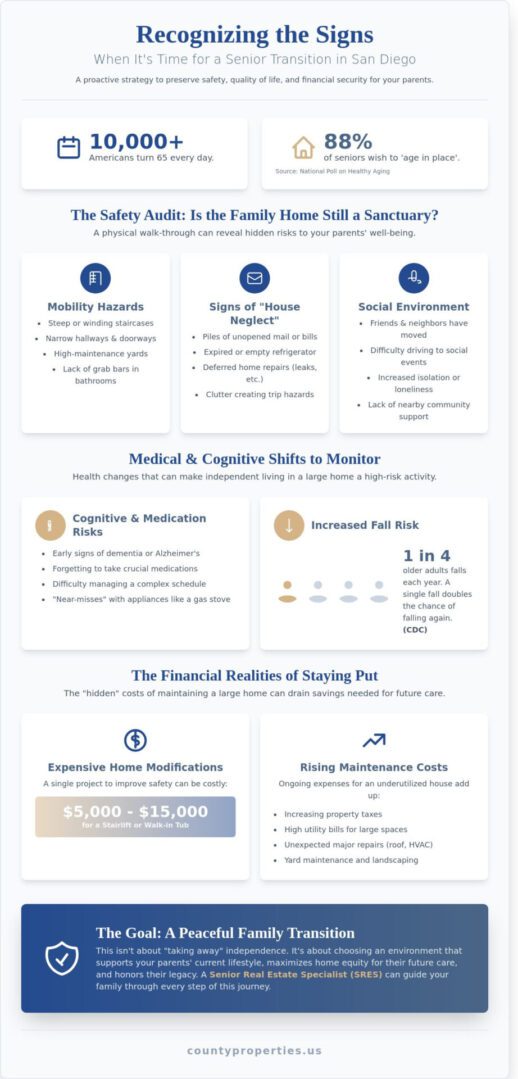
Many families struggle to distinguish between a parent’s desire to stay and their actual ability to manage a large property. A 2023 report from the National Poll on Healthy Aging found that 88% of adults aged 50 to 80 felt it was important to remain in their homes as they age. However, the reality of maintaining a multi-story house in Southern California often conflicts with physical limitations. Families should begin by understanding aging in place to determine if the home can truly be adapted for long-term safety.
The Safety Audit: Evaluating the Family Home
Medical and Cognitive Shifts to Monitor
Cognitive changes demand immediate attention. If a parent is showing early signs of dementia or Alzheimer’s, simple tasks like using a gas stove or managing a complex medication schedule become high-risk activities. Data from the CDC indicates that one out of four older adults falls each year, and a single fall doubles the chances of falling again. When helping parents move out of the family home, it’s vital to consult with healthcare providers. They can offer an objective assessment of whether the current living situation is a manageable risk or a crisis waiting to happen. If medication errors or “near-miss” falls are occurring monthly, the home is no longer a place of sanctuary.
Navigating the Emotional Landscape: The Family Meeting
The decision to start helping parents move out of the family home is rarely just about real estate; it’s about legacy, memory, and the shift in family roles. By 2030, nearly one in five San Diego residents will be over the age of 65, which means thousands of local families are currently facing the same emotional hurdles you are. To make this transition successful, you must move away from the idea of “managing” your parents. Instead, establish a team concept where they remain the primary decision-makers, supported by your logistical help. They need to feel heard and empowered, not pushed.
Successful transitions happen when you schedule discussions during calm periods. Don’t wait for a medical emergency or a fall to bring up the topic. Crisis-driven moves are high-stress and often lead to resentment. You can find excellent guidance on relocating your parents that emphasizes the importance of starting these conversations early. Focus the narrative on “the next chapter” rather than the “end of an era.” This shift in language helps maintain a positive atmosphere and keeps the focus on future opportunities.
Siblings often fall back into old childhood roles during these meetings. To avoid conflict, assign clear, objective tasks based on each person’s strengths. One sibling might handle the financial paperwork, while another manages the physical decluttering. Keeping roles specific prevents anyone from feeling overwhelmed or left out of the process.
Effective Communication Strategies
Use “I” statements to express your thoughts without sounding accusatory. Saying “I worry about your safety on these stairs” is much more effective than “You can’t handle these stairs anymore.” Ask open-ended questions to uncover what they value most. You might ask, “What part of this house feels like the biggest burden to you right now?” If emotions run high, involving a neutral third party like a senior real estate specialist can provide objective data that removes the emotional charge from the conversation.
Addressing the “Independence” Objection
Choosing the Right Path: Housing Options in Southern California
The decision of where to go next depends heavily on your family’s financial goals and your parents’ health. According to the Southern California housing market forecast for 2026, inventory remains tight, but the equity built in a long-held family home often provides a substantial nest egg for the next phase. Helping parents move out of the family home requires balancing these financial gains with their physical comfort and long-term safety.
Downsizing vs. Right-Sizing
Right-sizing focuses on utility rather than just square footage. A smaller San Diego condo or townhome reduces maintenance burdens, yet it must offer single-level living to be viable long-term. Stairs are a leading cause of falls for seniors, so look for buildings with elevators or ground-floor units. 55+ active adult communities in North County, like those in Oceanside or Carlsbad, provide built-in social networks that prevent isolation. These communities often feature amenities that encourage an active lifestyle, which is crucial for mental health during a transition. Using professional tips for downsizing can help your family sort through decades of belongings without the emotional burnout often associated with such a move.
Multi-Generational Living: The ADU Option
Accessory Dwelling Units (ADUs), or Granny Flats, have become a staple of Southern California real estate. California state laws passed between 2020 and 2025 have made it significantly easier to permit these units on existing residential lots. This option allows parents to stay close to grandchildren while maintaining their own private kitchen and living space. It’s a cost-effective alternative to high monthly facility fees. While the initial construction investment is significant, it typically adds long-term value to your property and keeps the family unit intact.
Assisted Living and Specialized Care
If your parents require daily medical support, professional facilities are the safest bet. Independent living suits those who want a social environment without the chores of homeownership. Assisted living provides help with activities of daily living, such as bathing or medication management. Memory care is a specialized tier for those with Alzheimer’s or dementia, featuring secured perimeters and high staff-to-resident ratios. When helping parents move out of the family home, prioritize proximity to major medical hubs like the Scripps Memorial Hospital or UCSD Health system. San Diego offers some of the highest-rated care facilities in the state, but waitlists can exceed six months for top-tier locations. Plan for these transitions early so your parents aren’t forced into a facility that doesn’t meet their standards during a sudden health crisis.
Preparing the Family Home for Sale: A Strategic Approach
Helping parents move out of the family home requires balancing deep emotional ties with the cold reality of the 2026 real estate market. Most seniors have lived in their residences for 20 to 40 years. During that time, the gap between sentimental value and market value grows wide. To get the best results, you’ve got to treat the property as a financial asset rather than a museum of family history. Setting a realistic price based on local sales data from the last 90 days is more effective than pricing based on what the home feels like it’s worth.
The Downsizing and De-cluttering Process
Maximizing Value in the Southern California Market
Professional staging is another vital tool. It helps buyers visualize how they’ll use the space, which is hard to do when rooms are filled with 1990s-era furniture. For properties that need extensive structural repairs, a rapid cash offer might be better than a traditional listing. This path avoids the stress of renovations and multiple open houses. It provides a faster exit, even if the final price is lower than a market listing.
Understand the local tax benefits before you sign a listing agreement. Under California’s Prop 19, which took effect in April 2021, homeowners over 55 can often transfer their low property tax base to a new primary residence anywhere in the state. This can save your parents thousands of dollars annually in their new home. Additionally, the IRS Section 121 exclusion allows couples to exclude up to $500,000 of capital gains from taxation if they’ve lived in the home for two of the last five years.
The Logistics of the Move: How a Specialist Simplifies the Journey
Moving a lifetime of memories requires more than just boxes; it demands a project manager who understands the emotional weight of helping parents move out of the family home. A Senior Real Estate Specialist (SRES) fills this role by overseeing every moving part. These professionals undergo specific training to manage the needs of homeowners over age 50. They coordinate with specialized senior movers, estate sale liquidators, and professional cleaners to ensure the property is market-ready without placing the physical burden on you or your parents. In 2026, Southern California’s real estate market remains fast-paced, making this high-level coordination essential for meeting tight closing cycles.
Legal readiness is the foundation of a smooth sale. Before the sign goes in the yard, verify that all trusts and Power of Attorney (POA) documents are updated and accessible. This prevents delays at the title company that can stall a transaction for weeks. A common strategy to reduce emotional distress involves moving parents into their new residence before the heavy lifting begins at the old house. Watching a lifelong home get emptied can trigger significant anxiety. By transitioning them first, they can focus on their new beginning while the SRES manages the estate sale and final clean-out behind the scenes.
Managing the Financial Transition
Work closely with financial advisors to ensure the home sale proceeds are protected for long-term care needs. In California, the Section 121 exclusion currently allows for a capital gains tax exemption of up to $500,000 for married couples, but you should verify all specific closing costs with a tax professional. If your parents need to secure their new apartment or assisted living suite before the family home sells, explore bridge loans. These short-term financing options provide the necessary liquidity to secure a new space before the old one is officially off the books.
Settling Into the New Home
Step Confidently into Your Family’s New Future
Helping parents move out of the family home involves far more than just packing boxes; it’s a significant life transition that requires patience and a specialized strategy. You’ve now seen how to identify the right timing for this shift and how to navigate the complex 2026 Southern California housing market. By focusing on open communication during family meetings and preparing the property for sale with professional guidance, you can ensure your parents’ financial security and long term comfort. You don’t have to manage these logistics alone. County Properties brings 36+ years of specialized San Diego real estate experience to your side. Our team consists of Certified Senior Real Estate Specialists (SRES®) who understand the unique legal and emotional hurdles of senior transitions. We operate as a collaborative “Family of Friends,” providing a service model that prioritizes your family’s peace of mind over a simple transaction. We’re here to turn a potentially stressful process into a well managed journey. Take the first step toward a seamless move today.
Download our Free Senior Transition Guide and Schedule a Consultation
Your family’s next chapter is waiting, and it’s going to be a bright one.
Frequently Asked Questions
How do I tell my parents they need to move without hurting their feelings?
Start the conversation by focusing on safety rather than a loss of independence. Experts recommend the 40/70 Rule, which suggests helping parents move out of the family home should be discussed when you’re 40 and they’re 70. This proactive approach prevents crisis-driven decisions. Since 1 in 3 seniors falls each year, framing the move as a way to stay active and safe helps reduce their natural defensiveness.
Can I sell my parents house if I have Power of Attorney?
Yes, you can sell the property if you hold a durable power of attorney that specifically grants real estate authority. California Probate Code Section 4123 outlines these legal rights for agents acting on behalf of a principal. You’ll need to provide the original, notarized document to the title company during the escrow process. It’s also vital to record the document with the San Diego County Recorder’s Office to ensure a smooth legal transfer.
What is the best time of year to sell a senior-owned home in San Diego?
The best time to list a senior-owned home in San Diego is between March and May. Statistics from the San Diego Association of Realtors show that homes sold in the spring often see a 5% price premium compared to winter sales. This window captures the highest buyer demand before the school year ends. Conversely, local sales volume typically drops by 20% in December, making the holidays a difficult time for a quick sale.
What is an SRES and how do they differ from a regular real estate agent?
A Seniors Real Estate Specialist (SRES) is a REALTOR who has completed advanced training through the National Association of Realtors to serve clients over age 50. They specialize in helping parents move out of the family home by managing the unique financial and emotional hurdles involved. Unlike a regular agent, an SRES maintains a vetted network of estate planners and senior movers to provide a holistic transition for the entire family.
How do we handle a lifetime of belongings when downsizing to a small apartment?
Start by using the One-Year Rule to identify items that haven’t been used in the last 12 months for donation or sale. Professional organizers suggest digitizing paper photos, which can reduce physical storage needs by 80% while keeping memories safe. For furniture, the 2026 market shows a 15% increase in demand for mid-century modern pieces. This means selling select items could help fund the relocation costs to a smaller San Diego apartment.
What happens if my parents refuse to move but the home is clearly unsafe?
If a home is unsafe and your parents refuse to leave, you may need to consult a lawyer about a legal conservatorship. In California, a judge can grant this if a senior is unable to provide for their own physical health or safety. Before taking legal steps, 75% of families find success by hiring a geriatric care manager. These professionals provide an objective third-party assessment that parents often accept more readily than advice from children.
Are there tax benefits for seniors selling their home in California in 2026?
Yes, California’s Proposition 19 allows homeowners over 55 to transfer their current property tax basis to a new primary residence anywhere in the state. This can result in thousands of dollars in annual savings. Additionally, the IRS allows a capital gains exclusion of up to $250,000 for individuals or $500,000 for married couples. You must have lived in the home for at least two of the five years preceding the sale to qualify.
How much does it cost to hire a senior relocation manager?
Hiring a senior relocation manager typically costs between $50 and $125 per hour according to the National Association of Senior and Specialty Move Managers (NASMM). For a standard 3-bedroom home, a full-service move usually ranges from $2,500 to $5,000. This fee covers specialized services like floor planning for the new space, sorting belongings, and managing the entire moving day. These experts reduce the physical and emotional burden on the family during the transition.