

Imagine standing in the kitchen where you’ve brewed coffee every morning since June 1996, realizing that in just thirty days, a new family will be making their own memories there. For many, the physical act of packing boxes is the easy part; it’s the emotional aspects of downsizing for seniors that often feel like an insurmountable mountain. You aren’t just sorting through old linens or dusty books. You’re deciding which pieces of your identity to carry forward and which to leave behind as you look toward 2026.
It’s completely natural to feel a sense of anxiety or even grief when letting go of a home that has anchored your life for decades. You’ve likely spent years curating a space that reflects who you are, and the thought of “thinning out” those possessions can feel like erasing your history. This article promises to help you manage these complex feelings while providing practical strategies for a graceful transition. We’ll provide a roadmap that respects your emotional pace, showing you how to turn a daunting “last move” into an empowering step toward your next vibrant chapter.
Key Takeaways
- Learn to identify “Relocation Stress Syndrome” and understand the deep psychological link between your long-time home and your personal identity.
- Discover practical strategies for managing the emotional aspects of downsizing for seniors, including how to handle family heirlooms and the “sunk cost fallacy.”
- Build your decluttering stamina by starting in “non-emotional” zones and applying the “one in, one out” rule for a seamless transition to a smaller space.
- Understand why early planning and a neutral support system are essential for avoiding a high-stress “crisis move” and ensuring a graceful transition.
- See how a relational, “family of friends” approach to real estate can provide the steady hand you need to protect your peace of mind during your next chapter.
Why Downsizing Feels Like Losing a Piece of Yourself
For many Southern California homeowners, a house isn’t just a structure; it’s a physical archive of a life well-lived. After 30 or 40 years in the same residence, your identity becomes woven into the floorboards and the height marks on the kitchen doorframe. This deep connection makes the emotional aspects of downsizing for seniors particularly complex. It’s not just about moving boxes. It’s about untangling yourself from a place that has defined your daily reality for decades.
Selling the family home is a major transition that requires a compassionate, expert hand. You aren’t just selling real estate; you’re closing a chapter that spanned your most formative adult years. Acknowledging this loss is the first step toward a successful move.
The ‘Memory Box’ Effect of Long-Term Residency
Every room in a San Diego or Orange County home holds a milestone. The dining room might represent 1,500 Sunday dinners, while the backyard marks three decades of summer graduations. When friends or neighbors suggest it’s “just a house,” they’re engaging in disenfranchised grief. They don’t see the invisible layers of history you do. To manage this weight, some find solace in The Gentle Art of Swedish Death Cleaning, a method that helps categorize belongings by their emotional value rather than just their utility. The home serves as a living repository for family history, where every corner acts as a physical trigger for a cherished memory.
Fear of the Unknown: The Anxiety of a ‘Last Move’
The subconscious often links downsizing with the finality of the aging process. This creates a paralyzing anxiety that can stall the process for years. It’s important to differentiate between truly not being ready and simply being afraid of the unknown. Choosing to move now, rather than waiting for a health crisis to dictate the timeline, is a form of empowerment. By taking the lead in the 2026 market, you retain the power to choose your next environment, turning a fearful transition into a proactive life choice that preserves your autonomy. Understanding the emotional aspects of downsizing for seniors allows you to move forward with clarity instead of hesitation.
The Psychology of Letting Go: Common Emotional Hurdles
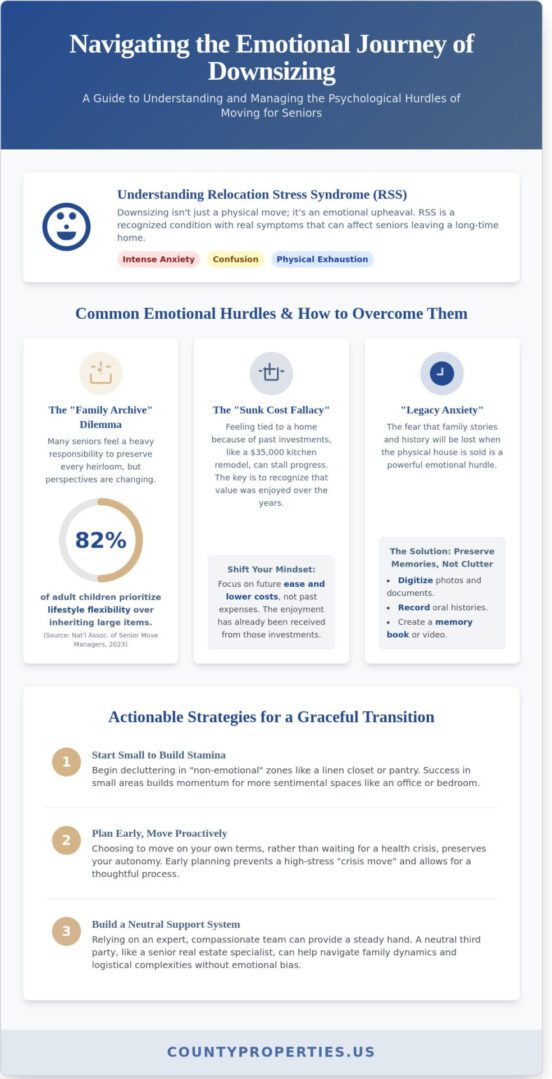
Moving out of a long-term family residence involves much more than just logistics. It requires a deep dive into the emotional aspects of downsizing for seniors, particularly when facing the weight of the “Family Archive.” Many homeowners feel a heavy responsibility to preserve every heirloom, yet a 2023 study by the National Association of Senior Move Managers found that 82% of adult children prioritize lifestyle flexibility over inheriting large furniture or formal dinnerware. This disconnect creates a significant emotional burden for the person moving.
Overcoming the “Sunk Cost Fallacy” is another major hurdle. You might have invested $35,000 into a kitchen remodel back in 2018 or spent thousands on custom drapery that won’t fit a new space. It’s easy to feel that leaving these investments behind is a financial loss. However, holding onto a house solely because of past expenses often leads to higher maintenance costs and physical strain in the long run. Realizing that the value of those improvements has already been “used” through years of enjoyment can help break this mental loop.
Managing “Legacy Anxiety” is perhaps the most delicate part of the process. This is the persistent fear that family stories and history will disappear once the physical house is sold. To combat this, focus on the difference between physical clutter and emotional anchors. A heavy oak desk is clutter if it doesn’t fit your new life, but the letters kept inside it are anchors. By digitizing photos or recording oral histories, you ensure the legacy survives without the need for 3,000 square feet of storage.
The Heirlooms Dilemma: When Kids Don’t Want the China
Identity Disruption and Social Connection
Strategies for Emotional Decluttering: Preserving Memories, Not Just Things
Decluttering isn’t a race; it’s a marathon of the heart. To successfully manage the emotional aspects of downsizing for seniors, you’ll need to build decision-making stamina before you ever touch a box of old letters or a wedding album. Start your journey in “Non-Emotional” zones like the pantry, the linen closet, or the laundry room. These spaces contain items with utility but no sentimental weight, which helps you practice the art of letting go without the heavy emotional tax of more personal belongings.
Selective preservation is your best tool for keeping the story of your life without the physical bulk. You don’t need a massive 12-piece set of holiday china to remember decades of family gatherings; keeping a single ornate serving platter can spark those same joyful memories. For items that are too large to keep but too precious to simply discard, use the “Photo First” method. Capture a high-quality digital image of the object in its original setting. This allows you to release the physical item while keeping the visual trigger forever.
The ‘Legacy Gallery’ Approach
Digitizing decades of physical photos protects your history from fire, floods, or the natural fading of age. A 2024 survey of digital archiving services shows that professional scanning can preserve 500 photos in less than 24 hours, making it an efficient way to clear shelf space. Before the “For Sale” sign goes up, create a “memory book” of the house itself, capturing the specific way the morning light hits the breakfast nook or the garden you tended for twenty years. Digital preservation honors the past while freeing the future.
The ‘Blessing’ Method of Parting
Reframing the act of donation as “gifting” changes the emotional frequency of your move. Instead of feeling like you’re losing an item, you’re providing a vital resource for a new generation. Identify local San Diego charities that match your personal values, such as Father Joe’s Villages or the San Diego Habitat for Humanity ReStore. There’s profound emotional relief in knowing your dining table will host new family dinners or your collection of books will educate a child, ensuring the item’s story continues elsewhere.
Building Your Support System: Moving Beyond the Physical House
Downsizing is rarely a solo mission. The most successful transitions in 2026 are those that prioritize a support network long before the first box is taped shut. Industry data from the National Association of Senior Move Managers indicates that seniors who begin their planning at least 12 to 18 months in advance experience significantly lower rates of relocation stress syndrome. Starting early prevents the “crisis move,” which usually happens after a health scare or an emergency. By addressing the emotional aspects of downsizing for seniors early, you keep the power in your own hands.
A neutral third party often provides the clarity family members cannot. Professional organizers or transition specialists see your belongings as items to be managed, not memories to be grieved. This objective perspective helps you stay on track when the process feels overwhelming. You also need a real estate partner who sees more than just a commission. Learning how to find the best real estate agent near me is a critical step in ensuring you have an advocate who respects your pace and your legacy.
When building your relocation team, consider the needs of your pets as well. A well-trained companion makes the transition to a smaller home much smoother, and resources like JPK9 Academy provide the professional training necessary to help your dog adapt to a new lifestyle with ease.
While this guide focuses on local transitions, the need for professional expertise is global; you can learn more about Chainex Real Estate to see how high-standard property agencies support clients through significant life changes.
Involving Family Without the Friction
Family dynamics can get complicated during a move. Adult children often jump into “fixer” mode, trying to toss items quickly to save time. This creates friction. Set firm boundaries early. Tell your family you need emotional support, not just manual labor. If you want a child to act as a Project Manager, clearly define their role; they should manage the schedule, while you maintain the final say on every sentimental object. This division of labor keeps the peace and honors your autonomy.
The Value of a Senior Real Estate Specialist (SRES®)
A Seamless Transition: How County Properties Protects Your Peace of Mind
Arnie Levine brings 36 years of localized expertise to the San Diego real estate market. Since he established County Properties in 1995, he’s served as a steady hand for families navigating the complexities of the Southern California landscape. We recognize that the emotional aspects of downsizing for seniors involve much more than just signing paperwork. It’s about honorably closing one chapter to begin another. Our “Family of Friends” philosophy ensures that our approach remains relational rather than transactional. We don’t just close escrow; we help you transition into a new phase of life with your legacy intact.
Personalized Guidance for Every Step
Your Next Chapter Starts Here
Embrace Your Next Chapter with Confidence
Moving from a long-term family home involves much more than packing boxes. It’s a journey through decades of memories. You’ve learned that preserving your legacy doesn’t mean keeping every physical object; it means honoring the stories they tell while creating space for what comes next. Navigating the emotional aspects of downsizing for seniors requires a team that values your history as much as your future. At County Properties, our collaborative team puts your peace of mind before any deal. We bring 36+ years of San Diego real estate expertise to your doorstep, ensuring every step of your transition feels secure and respectful.
Frequently Asked Questions
How do I know if I’m emotionally ready to downsize?
What should I do with family heirlooms that my children don’t want?
Start by digitizing memories through high quality photos or creating a legacy book to preserve the story without the physical bulk. According to the 2024 State of Senior Living report, roughly 65% of adult children prefer minimalist lifestyles and decline inherited furniture. You can host a legacy party where friends choose items they truly value. This ensures your treasures find a 100% appreciative home rather than gathering dust in a storage unit.
How can I help my elderly parents with the emotional side of moving?
Listen more than you talk and allow your parents to make the final decisions on what stays or goes. Research from the University of Kansas indicates that seniors who feel they have 100% control over their moving decisions experience significantly less relocation stress. Offer to document their stories as they sort through belongings to validate their history. By acting as a patient guide, you help them manage the complex emotional aspects of downsizing for seniors.
Is it better to downsize while I’m still healthy or wait until I have to?
How do I deal with the guilt of selling the family home?
Reframe the sale as passing the home to a new family who will create their own 20 or 30 years of memories. A 2022 study in the Journal of Housing for the Elderly suggests that 75% of seniors find relief once the sale is finalized and they settle into a manageable space. Take a final walkthrough to say goodbye to each room and perhaps save a small architectural detail. This ritual helps close one chapter while opening a new one.
What is the first room I should start decluttering to avoid feeling overwhelmed?
Start with a low emotion room like the laundry room, guest bathroom, or linen closet. Professional organizers often recommend the 80/20 rule, noting that we only use 20% of our belongings regularly. These areas rarely contain sentimental items, allowing you to see 100% immediate progress without an emotional drain. Clearing out expired bottles and old towels builds your decision making muscle for harder rooms like the attic or basement later in the process.
Can a real estate agent really help with the emotional aspects of a move?
As your Trusted Real Estate Partner, an experienced agent acts as an objective buffer during stressful negotiations and emotional hurdles. The National Association of Realtors reports that 20% of agents now hold Senior Real Estate Specialist designations to handle these specific transitions. We provide a structured timeline that reduces anxiety and connects you with vetted resources like professional organizers. Our goal is to handle the 100 or more logistical details so you can focus on your personal journey.