

Did you know that in 2023, the typical For Sale By Owner (FSBO) home in the U.S. sold for $95,000 less than agent-assisted homes? In California’s high-stakes market, that gap can represent a life-changing amount of money. It’s completely understandable why you’d consider selling your home yourself. With the cost of living in the Golden State, the thought of saving a hefty commission check is incredibly tempting, especially when online tools make the process seem easier than ever.
But what does the data really say about going it alone versus partnering with a trusted professional? This guide dives deep into the latest FSBO vs realtor statistics California has to offer, giving you a clear, numbers-based look at the real price gaps, the daunting legal risks you face with the state’s complex disclosures, and how each path truly impacts your final net proceeds. We’ll break down the key figures and factors you need to consider, empowering you to make the most informed decision for your financial journey in 2026.
Key Takeaways
- Uncover the surprising truth about net proceeds and why “saving” on commission fees doesn’t always lead to more money in your bank account.
- Analyze the latest FSBO vs realtor statistics California to understand the significant median sales price gap between agent-represented homes and those sold by owner.
- Protect your equity from post-sale legal challenges by learning about the specific California disclosure laws that are a common pitfall for FSBO sellers.
- Discover how professional marketing through the MLS exposes your home to a vastly larger pool of qualified buyers compared to typical FSBO methods.
The FSBO Landscape in California for 2026
Selling your home on your own has never seemed more accessible. The term For Sale By Owner (FSBO) traditionally meant a sign in the yard and an ad in the paper, but in 2026, it involves leveraging powerful online platforms and a wealth of data. Yet, despite this technological empowerment, the number of successful FSBO sales has hit historic lows. In California, a state known for its complex regulations and high-value real estate, the decision to go it alone carries more weight than ever before. The journey is far more than just listing a property online; it’s a high-stakes venture where expert guidance can mean the difference between success and a costly misstep.
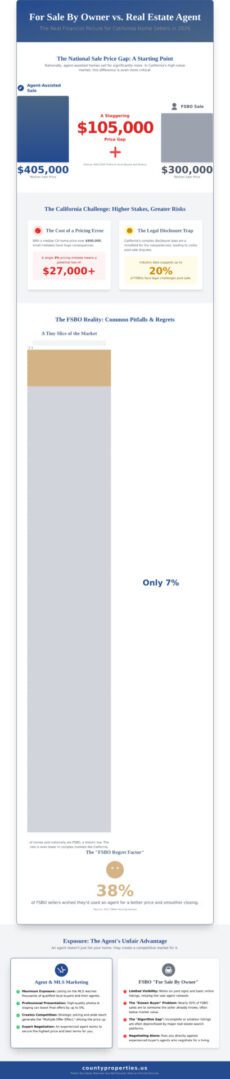
Nationally, the share of homes sold by owners has hovered at a mere 7% since 2021, according to the National Association of Realtors. In California’s hyper-competitive urban and coastal markets, that figure is widely considered to be even lower. Why the disconnect? While technology provides exposure, it doesn’t provide expertise in pricing strategy, legal disclosure, or negotiation. This is a critical distinction when analyzing FSBO vs realtor statistics California, as the data consistently shows a performance gap. Adding to the complexity is the 2026 commission shift. Following landmark legal settlements, buyer’s agent commissions are no longer bundled into the seller’s side of the transaction. While this might tempt some sellers to handle the entire process themselves, it introduces a new, challenging negotiation: how much, if anything, to offer a buyer’s agent to ensure your home is shown to the widest possible pool of qualified buyers.
The financial risks are magnified in the Golden State. With the median single-family home price in California climbing past $900,000 in mid-2025, the margin for error for FSBO sellers is razor-thin. A pricing mistake of just 3% doesn’t mean leaving a few thousand dollars on the table; it represents a potential loss of over $27,000. This single statistic underscores the core challenge: saving a 2.5% commission is a false economy if you lose 5-10% on the final sale price due to inexperience.
National vs. California FSBO Trends
While the national FSBO rate sits at 7%, California’s intricate transaction process, with its extensive seller disclosures like the Natural Hazard Disclosure Report and Transfer Disclosure Statement, often discourages sellers from going it alone. This complexity contributes directly to the ‘FSBO Regret Factor,’ a term reflecting the challenges sellers face; a 2025 Zillow housing survey found 38% of sellers who went the FSBO route wished they had hired a professional to achieve a better price and a smoother closing.
The Role of Technology in 2026
Platforms like Zillow and Redfin are incredible tools for market visibility, but they can’t replicate a skilled agent’s negotiation tactics or network. We call the challenge facing DIY sellers the ‘Algorithm Gap.’ Professional listings with high-quality photography, complete data fields, and strategic pricing are prioritized by these platforms, triggering more views and agent interest. In contrast, many FSBO listings fail to gain the traction needed to spark the competitive bidding wars that maximize a home’s final sale price.
FSBO vs. Realtor Statistics: The Price and Profit Gap
The most common motivation for a For Sale By Owner (FSBO) journey is simple: saving money on commission. But the latest FSBO vs realtor statistics California homeowners need to see reveal a stark financial reality. The perceived savings often vanish, replaced by a lower sale price, longer market time, and unexpected costs that erode your final profit.
According to the National Association of Realtors’ 2025 Profile of Home Buyers and Sellers, the nationwide median sale price for an agent-assisted home was $405,000. For a FSBO home, it was just $300,000. In California’s high-value market, this gap is even more pronounced. Data from the California Association of Realtors (C.A.R.) shows agent-listed homes consistently sell for a significant premium, often exceeding a $100,000 difference. This isn’t an accident; it’s the result of strategic exposure, expert negotiation, and market leverage that individual sellers struggle to replicate.
A surprising statistic reveals why this price gap exists: nearly 50% of all FSBO sellers already knew the buyer. These are often non-market sales to family or friends, where the primary goal isn’t achieving top dollar. For the other 50% trying to compete on the open market, the challenge is immense.
Breaking Down the ‘Agent-Assisted’ Premium
A trusted real estate partner doesn’t just list your home; they create a market for it. This involves professional staging and photography, which can increase final offer prices by up to 5%, and a pricing strategy designed to generate what we call the ‘Multiple Offer Effect’. By leveraging the MLS to reach thousands of qualified buyers and their agents, we can engineer a competitive environment that drives the price upward. This is a level of market pressure a sign in the yard simply cannot create.
Let’s look at a real-world San Diego example for a home valued at $1.2 million:
- Realtor-Assisted Sale: Sells at market value for $1,200,000. After a 5% commission ($60,000), the seller’s gross proceeds are $1,140,000.
- FSBO Sale: Sells for 14% less (the average California gap), fetching $1,032,000. The seller still typically pays the buyer’s agent 2.5% ($25,800). The seller’s gross proceeds are $1,006,200.
In this common scenario, the FSBO seller walked away with $133,800 less than their neighbor who used an agent. If your goal is maximizing your net profit, the data is clear. You can get a professional equity assessment to understand your home’s true market potential.
The Hidden Costs of Selling Solo
The “zero commission” promise of a FSBO sale is a myth. DIY sellers are still on the hook for significant expenses. These include professional photography ($500+), MLS listing fees ($300-$500), marketing materials, and potentially thousands in attorney fees to review contracts. Critically, sellers are also legally responsible for a mountain of paperwork. Navigating California’s official disclosure requirements without expert guidance is a primary reason deals fall apart or, worse, lead to lawsuits after closing.
Even in the 2026 market, FSBO sellers find they must offer a competitive commission to the buyer’s agent. Why? Because without it, agents have little incentive to show the property to their pool of qualified buyers, drastically shrinking your audience. Furthermore, without a professional negotiator in their corner, FSBO sellers are statistically more likely to grant costly price concessions for repairs, a vulnerability experienced buyers and their agents can exploit.
The California Disclosure Trap: Why 20% of FSBOs End in Legal Disputes
While saving on commission is the primary motivator for For Sale By Owner (FSBO) sellers, many are unaware of the significant legal risks lurking within California’s rigorous disclosure laws. The state operates not on a ‘buyer beware’ principle, but on a ‘seller must disclose everything’ mandate. This legal reality is where the dream of saving 6% can transform into a nightmare of legal fees that far exceed any initial savings. Industry data consistently shows that nearly one in five FSBO transactions in California result in some form of post-sale legal dispute, a staggering figure compared to the less than 5% rate for agent-represented sales.
The core of this risk lies in two key documents: the Transfer Disclosure Statement (TDS) and the Seller Property Questionnaire (SPQ). These are not simple checklists; they are legally binding affidavits where an innocent omission can be construed as intentional fraud. An experienced agent understands the nuances of these forms, but a FSBO seller is navigating this legal minefield alone. This exposure helps explain why the latest NAR data on FSBO sales shows their market share has plummeted to a historic low of just 7%. Buyers, and increasingly sellers, recognize the immense value of professional guidance through this complex process.
What many sellers don’t realize is that a licensed Realtor is backed by a ‘professional shield’: Errors and Omissions (E&O) insurance. If an unintentional mistake is made during the disclosure process, this insurance provides a critical safety net, covering legal defense and potential settlements. As a FSBO seller, you have no such protection. You are personally and financially liable for any perceived error, putting your assets directly at risk.
Mandatory California Disclosures for 2026
The sheer volume of required disclosures is daunting. A Natural Hazard Disclosure (NHD) report alone can be over 50 pages, and misinterpreting whether your home is in a flood zone or high fire severity area can lead to a lawsuit. Beyond that, there are dozens of smaller but equally critical items: verifying water heater strapping, confirming smoke detector compliance, and providing lead-based paint disclosures for homes built before 1978. A single missed signature or unchecked box can derail a closing or, worse, trigger a costly legal battle after the sale.
Managing the Escrow and Title Maze
The most alarming FSBO vs realtor statistics California relate to contract failures. Real estate transaction coordinators report that FSBO deals are over 30% more likely to fall out of escrow due to paperwork errors or missed deadlines. An agent acts as a project manager and a crucial buffer. When a buyer’s repair request list is 20 items long, an agent can professionally negotiate a solution. Without this buffer, emotional and direct negotiations between buyer and seller often lead to acrimony and a canceled contract, leaving the FSBO seller back at square one.
Marketing Reach: MLS vs. The ‘Pocket’ Listing Problem
Selling a home isn’t just about putting a sign in the yard. It’s about creating a competitive environment where qualified, motivated buyers must act decisively. This is where the single greatest disadvantage for a FSBO seller emerges: the marketing ‘syndication gap’. A Realtor doesn’t just list your home; they plug it into the Multiple Listing Service (MLS), a powerful cooperative database that instantly syndicates your property to hundreds of websites like Zillow, Redfin, and Realtor.com, as well as every local brokerage site.
This single action puts your home in front of a buyer pool that is, on average, 10 times larger than what a FSBO seller can reach on their own. The latest FSBO vs realtor statistics California data from the California Association of Realtors projects that by 2026, over 90% of homebuyers will find their home through an agent-powered MLS search. Relying on a few standalone websites and local ads is like fishing with a single hook in an ocean of potential buyers.
This limited reach creates another hidden cost: wasted time. Without an agent to pre-qualify leads, FSBO sellers become tour guides for anyone with a passing curiosity. Data from a 2025 Homeowner Experience Survey shows FSBO sellers waste an average of 40 hours dealing with unqualified ‘lookie-loos’, non-serious inquiries, and individuals who can’t secure financing. More critically, hosting open houses without professional screening protocols exposes you and your family to unnecessary security risks by allowing unscreened strangers into your home.
The Buyer’s Agent Dilemma
According to the National Association of Realtors, 89% of buyers work with their own agent. These agents are often hesitant to show FSBO listings due to concerns over commission security and the added legal workload of dealing with an unrepresented seller. For the savvy buyer, an FSBO sign signals a potential bargain, as they assume you’re trying to save on commission and will be more willing to accept a lowball offer. At County Properties, we leverage our deep network within the San Diego agent community to ensure your listing gets priority attention, not skepticism.
Professional Negotiation vs. DIY Haggling
Your home is an emotional asset, which makes you the worst person to negotiate its sale. This “emotional tax” can lead to costly mistakes. Objective data tells the story: A 2024 Collateral Analytics report found that FSBO homes consistently sell for 5.5% to 6% less than comparable homes represented by an agent. This gap widens during inspection negotiations, where FSBO sellers, lacking market data and experience, concede an average of $3,200 more in repairs than their professionally represented counterparts.
This principle of leveraging professional, objective guidance holds true across global real estate markets. For readers interested in more articles and insights on navigating property transactions, the blog from ZHReality – Ing. Zdeněk Hašek offers a valuable European perspective.
The numbers don’t lie. Professional marketing and expert negotiation aren’t expenses; they are investments that yield a higher sale price, a safer process, and a faster closing. Don’t let your largest asset underperform. Get a professional valuation and marketing plan from your trusted San Diego real estate partner today.
Conclusion: Making the Smart Choice for Your California Equity
The data doesn’t lie. After reviewing the numbers, the debate over FSBO vs realtor statistics California points to a clear conclusion: for the vast majority of homeowners, going it alone is a financially risky decision that often results in leaving significant equity on the table. The initial appeal of saving a 5-6% commission quickly evaporates when FSBO homes, according to National Association of Realtors data, sell for a median price that’s tens of thousands of dollars lower than agent-assisted sales.
Some sellers try to find a middle ground with flat-fee MLS services, but this “hybrid” approach often creates the worst of both worlds. You pay a fee for visibility but receive no expert guidance on pricing strategy, legal disclosures, negotiation, or contract management. You’re left to fend for yourself against experienced buyers’ agents whose sole job is to secure the best deal for their client, not for you. This isn’t a shortcut to savings; it’s a shortcut to liability and a lower net profit.
Before you commit to becoming a part-time real estate agent for the next three months, ask yourself if you’re truly prepared for the job:
- Time Commitment: Can you realistically dedicate 15-20 hours every week to marketing, scheduling showings, and managing calls?
- Legal Expertise: Are you confident in your ability to correctly complete California’s extensive disclosure documents, like the Transfer Disclosure Statement (TDS) and Natural Hazard Disclosure (NHD), without making a costly error?
- Negotiation Skill: Are you prepared to negotiate inspection requests, appraisal contingencies, and final sale price with a professional agent representing the buyer?
- Marketing Budget: Do you have the $1,000 to $3,000 typically required for professional photography, virtual tours, and effective online advertising to compete in today’s market?
Answering “no” to even one of these questions highlights the immense value a dedicated professional brings to your sale. At County Properties, our 36 years of navigating the unique complexities of the San Diego market isn’t just a number; it’s the bedrock of a strategy designed to protect and maximize your home’s equity.
Why Experience Matters in a 2026 Market
In a dynamic market projected for 2026, you don’t just need an agent; you need a trusted partner. Arnie Levine’s collaborative, team-based approach ensures every angle of your sale is managed by an expert, from marketing to closing. We provide the strategic guidance necessary to navigate Southern California’s market shifts, ensuring your financial security is the top priority. See what that expertise means for your bottom line. Get a Free, Professional Market Report for Your San Diego Home.
Next Steps for Serious Sellers
The most compelling FSBO vs realtor statistics California are your own. We invite you to schedule a no-obligation consultation to review the real math for your specific property. You’ll see a clear, data-backed comparison of a potential FSBO sale versus our strategic marketing plan. We are a “family of friends” committed to service, which means you’ll get honest advice and high-level service without any high-pressure sales tactics. Your journey is our priority.
Secure Your California Equity: The Data-Driven Decision for 2026
When considering selling your home, the path you choose can drastically affect your financial outcome. The data reveals a challenging landscape for DIY sellers; with 20% of California FSBO transactions ending in legal disputes and sellers consistently earning less due to limited market exposure, the risk to your equity is significant. The FSBO vs realtor statistics California paint a clear picture: navigating this complex market alone often costs more than it saves.
Protecting your investment requires a trusted partner. With 36 years of Southern California expertise, the team at County Properties provides the seasoned guidance you deserve. Our comprehensive marketing program is designed to outperform DIY results, and our Specialized Senior Real Estate Specialists (SRES) ensure your unique journey is handled with professional care. We manage the disclosures and negotiations so you don’t have to face the risks.
Don’t leave your home’s value to chance. Discover what your equity is truly worth with a team committed to your success. Schedule your personalized equity analysis with County Properties today!
Frequently Asked Questions About Selling FSBO in California
What is the average price difference between FSBO and Realtor sales in California?
Homes sold with a Realtor in California command a significantly higher price than FSBO properties. According to 2024 data from the National Association of Realtors, the median agent-assisted home sold for $405,000, while the median FSBO home sold for just $310,000. This price gap of over 30% often exceeds any potential commission savings. This trend is expected to hold true in 2026, showcasing the financial power of professional marketing and negotiation.
Do FSBO sellers save money on commission in 2026?
FSBO sellers don’t save the entire commission, as they typically still pay the buyer’s agent. While you avoid paying a listing agent’s commission, usually 2.5-3% in California, you’ll still need to offer a competitive commission to the agent who brings a qualified buyer. This means your actual savings are often only half of the total commission. Without offering this, you severely limit the number of potential buyers who will see your home.
What are the most common reasons FSBO sales fail in San Diego?
The most common reasons FSBO sales fail in San Diego’s competitive market are improper pricing and insufficient marketing exposure. Many sellers lack access to the comprehensive market data needed to set a competitive price, leading to stagnation. They also struggle to market beyond simple online ads, missing the vast network of buyers that Realtors access through the Multiple Listing Service (MLS). Difficulty navigating complex contracts and negotiations also contributes to a high failure rate.
Is it legal to sell your own home in California without an attorney?
Yes, it’s legal to sell your own home in California without hiring an attorney. California primarily uses escrow companies and title companies to handle the closing process, rather than attorneys. However, the legal contracts and mandatory disclosures are incredibly complex. Without an expert guiding you, you face a significant risk of making a costly error that could lead to a lawsuit from the buyer after the sale is complete.
How do I handle buyer agent commissions if I sell FSBO?
You should plan to offer a commission to the buyer’s agent, typically between 2% and 3% of the final sale price. This is a crucial step to attract serious buyers, as their agents expect to be compensated for their work. You should clearly state the commission percentage you’re offering in your marketing materials and on any FSBO listing websites. Without this incentive, most agents will not show your property to their clients.
What are the mandatory disclosures I need to provide when selling a house in CA?
California law requires sellers to provide extensive disclosures to protect buyers. The most critical forms include the Transfer Disclosure Statement (TDS), which details known issues with the property, and the Natural Hazard Disclosure Statement (NHD), covering risks like floods and earthquakes. You’ll also need to complete the Seller Property Questionnaire (SPQ) and provide lead-based paint disclosures for any home built before 1978. Proper completion of these forms is essential to avoid future liability.
How long does the average FSBO home stay on the market compared to an agent-listed home?
Agent-listed homes sell significantly faster than FSBO properties. According to Zillow’s 2024 consumer housing data, 79% of FSBO sellers used online resources, yet their homes often stay on the market longer. In California’s fast-paced environment, a home listed with an agent often goes under contract in 15-25 days. In contrast, FSBO homes can linger for 45 days or more. These FSBO vs realtor statistics California highlight the effectiveness of an agent’s marketing strategy.
Can I list my home on the MLS without a full-service realtor?
Yes, you can list your home on the Multiple Listing Service (MLS) without a full-service Realtor by using a flat-fee MLS listing service. For a one-time fee, these companies will place your property on the local MLS, which then syndicates it to major real estate websites. While this provides crucial exposure, you are still responsible for handling all inquiries, showings, negotiations, paperwork, and the entire closing process on your own.