

Imagine finding a beautiful single-story home closer to your family, only to realize that moving might triple your annual property tax bill. For many homeowners in San Diego, this “tax trap” creates a frustrating sense of being locked into a house that no longer fits your physical needs. Understanding california prop 19 for seniors is the key to breaking this cycle and regaining your freedom. You’ve spent decades building equity and deserve to enjoy your retirement without the fear of losing your financial stability to a massive tax hike.
The reality is that these tax laws serve as a vital tool for mobility and financial protection. You can successfully relocate to a new residence while carrying your original, lower tax base with you. This article provides a clear roadmap for the 2026 tax year, explaining how to navigate the transfer process and maximize the proceeds from your home sale. We’ll explore the eligibility requirements and the methodical steps needed to ensure your housing costs stay predictable and your future remains secure.
Key Takeaways
- Learn how Prop 19 allows you to carry your current low property tax base to a new home anywhere in California, protecting your long-term retirement budget.
- Discover the specific eligibility rules, including the “Age 55” requirement and primary residence criteria, that ensure you qualify for this financial benefit.
- Master the calculation process for california prop 19 for seniors to accurately predict your monthly housing costs when downsizing or relocating.
- Identify critical pitfalls, such as the strict two-year purchase deadline, that could accidentally disqualify your tax base transfer.
- Explore how a specialized senior real estate transition service can handle the complex logistics of your move while securing your property tax savings.
Understanding California Prop 19: A Lifeline for Seniors
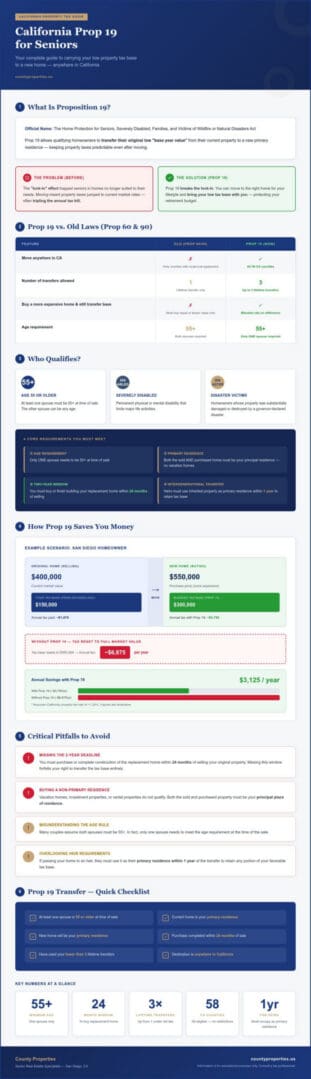
Formally known as the Home Protection for Seniors, Severely Disabled, Families, and Victims of Wildfire or Natural Disasters Act, Proposition 19 serves as a critical financial shield for homeowners across the state. This legislation allows you to move to a new home without the heavy burden of a reset property tax bill. By transferring your original “base year value” from your current property to a new primary residence, you can maintain the predictable housing costs you’ve relied on for decades. This protection is especially vital as we look toward 2026. With Southern California home values remaining high, long-term homeowners often face massive tax spikes if they choose to sell without these protections in place.
Eligibility for this benefit is specifically designed to support those facing significant life transitions. You qualify for the tax base transfer if you fall into one of the following categories:
- Homeowners aged 55 or older: At least one spouse must meet this age requirement at the time of the sale.
- Individuals with severe disabilities: Those with permanent physical or mental disabilities that limit major life activities.
- Disaster victims: Homeowners whose properties were substantially damaged or destroyed by a governor-declared disaster.
The “Lock-In” Effect and How Prop 19 Breaks It
For many years, a phenomenon known as the “lock-in” effect kept seniors in homes that were no longer practical. Because the benefits of Proposition 13 were tied to staying in your current home, moving often meant your property taxes would jump to current market rates. This financial penalty forced many to remain in large, multi-story houses that were difficult to maintain. Prop 19 provides the emotional and financial freedom to right-size your life. Working with a Senior Real Estate Specialist ensures you have an expert guide to navigate these complex transitions. You can finally choose a home based on your current lifestyle needs rather than your tax obligations.
Key Differences from Previous Laws (Prop 60 & 90)
Prop 19 significantly expanded the rights previously offered under the older Proposition 60 and 90 rules. One of the most impactful changes is geographic flexibility. You can now move anywhere within the state of California, regardless of whether the destination county has a reciprocal agreement. Additionally, california prop 19 for seniors allows you to transfer your tax base up to three times, whereas previous laws generally limited you to a single lifetime transfer. The “equal or lesser value” rule has also been modernized. Even if your new home costs more than the one you sold, you can still transfer your original base value. You’ll only pay current market taxes on the difference in price, making it much easier to find the perfect home in San Diego or any other California community.
Eligibility Rules: Do You Qualify for the Tax Base Transfer?
To benefit from california prop 19 for seniors, you must meet specific criteria established by the state. These rules ensure the tax relief reaches those who truly need it for their primary housing needs. Understanding the nuances of these requirements can be the difference between a successful move and an unexpected tax bill.
- The “Age 55” Rule: This requirement is often misunderstood. Only one spouse needs to be 55 or older at the time the original property is sold to qualify the household for the transfer.
- Primary Residence Requirement: Both the home you’re selling and the one you’re buying must be your principal place of residence. Vacation homes or investment properties in San Diego don’t qualify for this specific tax base transfer.
- The Two-Year Window: You have a strict 24-month period to complete your transition. This window begins the day you sell your original residence; you must buy or finish building your replacement home within that timeframe.
- Intergenerational Transfers: Prop 19 also revised the rules for passing property to children. Heirs must now use the property as their primary residence within one year of the transfer to retain a portion of the tax base.
The “Equal or Lesser Value” Myth
Many homeowners believe they’re restricted to buying a cheaper home to keep their tax base. That’s no longer the case. You can now purchase a more expensive residence and still retain a significant portion of your tax savings. If your new home costs more, the state applies a “blended” tax rate. This preserves your original tax base while adding only the price difference at current market values. The blended value calculation adds the difference between the replacement home’s purchase price and the original home’s sale price to the transferred tax base.
Filing Requirements for San Diego Homeowners
To lock in these savings, you’ll need to coordinate with the San Diego County Assessor. The primary document required is Form BOE-19-B, which serves as the official claim for the transfer of base year value. You’ll also need to provide a valid government ID to verify your age at the time of the sale. The application process is methodical, and errors in the paperwork can cause significant delays. Having a dependable guide for senior transitions can help you navigate these filings with confidence, ensuring you receive the full financial benefit you’ve earned through years of homeownership. The Assessor’s office typically requires these filings within three years of the purchase to receive full retroactive relief.
Calculating Your Savings: Prop 19 in Action
Understanding the math behind california prop 19 for seniors helps you visualize the actual dollars you’ll keep in your pocket every month. While state formulas can seem daunting, the core concept is straightforward. You’re effectively taking your old, lower tax assessment and “pasting” it onto your new property. This process protects you from being taxed at the current market value of your new home, which is often significantly higher than what you paid for your original residence decades ago.
The calculation follows two primary paths based on the value of your new home:
- Equal or Lesser Value: If your new home costs the same or less than the sale price of your old one, your entire tax base transfers. Your annual property tax bill remains virtually unchanged.
- Greater Value: If you buy a more expensive home, you don’t lose the benefit. You keep your original base and simply add the difference in price to it. For example, if you sell for $900,000 and buy for $1 million, you only pay market-rate taxes on that $100,000 difference.
Real-World San Diego Scenario
Let’s look at a typical transition within our local community. Imagine you are selling a long-held family home in the Hillcrest real estate market for $1.2 million. You originally bought this home years ago, and your current tax base is only $300,000. You decide to move to a $1 million condo in Rancho Santa Fe to be closer to golf courses and friends. Because the new home costs less than the one you sold, your tax base stays at $300,000. Without this protection, you’d be paying taxes on the full $1 million purchase price, which would likely cost you an additional $7,000 to $8,000 every single year.
The Financial Impact Over 10 Years
When you look at these savings over a decade, the impact on your retirement is profound. Saving $7,500 annually adds up to $75,000 in retained wealth over ten years. For a retiree on a fixed income, this isn’t just “extra money”; it’s a vital resource for healthcare, travel, or supporting grandchildren. By following a structured plan for selling a home in Southern California, you can maximize the equity from your sale while ensuring your monthly housing costs remain predictable. This financial stability allows you to focus on enjoying your new lifestyle rather than worrying about fluctuating tax obligations. It’s about ensuring your home remains an asset that supports you, rather than a liability that drains your savings.
Common Pitfalls and How to Avoid Them
While california prop 19 for seniors offers a clear path to financial freedom, the process isn’t without its risks. You’ve worked hard to build your equity, and a single administrative oversight shouldn’t be the reason you lose it. Many homeowners mistakenly believe the tax transfer happens automatically at the close of escrow. This is not the case. You must be proactive to secure your savings.
To protect your financial future, stay alert to these frequent stumbling blocks:
- The Two-Year Deadline: This is a strict 24-month window. If you sell your home on June 1, 2024, you must close on your replacement property by June 1, 2026. There are no extensions for market delays or construction setbacks.
- The Claim Form Requirement: You must file a formal claim with the County Assessor. If you don’t submit the proper paperwork, the state will tax your new home at its full market value.
- The “Transferee” Trap: The names on the deed of your new home should generally match the names on the deed of the home you sold. Adding children or other relatives to the title prematurely can complicate your eligibility.
- The $1M Family Transfer Limit: For those planning to pass property to children, remember that Prop 19 limited the tax shield to the first $1 million of market value above the original base.
Timing the Market in 2026
Navigating the Southern California housing market in 2026 requires a proactive strategy. With inventory levels fluctuating, coordinating a “contingent” sale is often necessary to ensure you don’t sell your current home before you’ve secured a replacement. This protects your two-year window and prevents the stress of being “homeless” between transactions. Working with a Senior Real Estate Specialist is vital here, as they understand how to structure these complex timelines to protect your tax base transfer.
The Importance of Professional Guidance
Success in a Prop 19 transition requires a collaborative approach. While our team provides expert market guidance and handles the logistics of your move, we always recommend consulting with your CPA or tax professional. Realtors guide the transaction, but tax professionals verify the legal filings. At County Properties, we act as your dependable guide, collaborating directly with your financial advisors to ensure every detail of your senior real estate transition is handled with methodical care. We focus on the big picture so you can focus on your new lifestyle. To ensure your move is handled with the expertise it deserves, contact our senior real estate transition experts for a personalized consultation.
Making the Move: How County Properties Supports San Diego Seniors
Moving from a long-held family home is more than a real estate transaction; it’s a significant emotional journey. County Properties adopts a “Service-First” mindset to ensure this transition feels secure, methodical, and respectful. While we’ve discussed the legal mechanics of california prop 19 for seniors, the actual execution of the move requires a local ally who understands the San Diego County Assessor’s specific workflows. Arnie Levine acts as your steady guide, bridging the gap between complex tax regulations and the practical logistics of your relocation.
We provide holistic support that goes far beyond a standard listing. Our team handles the heavy lifting, including decluttering, organizing estate sales, and preparing your property for the market. This collaborative approach removes the physical and mental burden often associated with downsizing. By managing these details, we allow you to focus on your future while we ensure your Prop 19 paperwork is filed accurately and promptly with local officials.
Personalized Relocation Strategy
A successful sale of a home you’ve owned for decades requires a nuanced marketing plan. We don’t just put a sign in the yard; we tell the story of your home to attract buyers who value its history. Simultaneously, we assist you in identifying a replacement property in Southern California that aligns perfectly with your new lifestyle goals. As a certified Senior Real Estate Specialist, Arnie Levine possesses the specialized training to address the unique financial and emotional needs of homeowners over 55.
Your Next Chapter Starts Here
Your future shouldn’t be limited by the fear of a tax hike. Downsizing is a dignified step toward a more manageable and fulfilling lifestyle, and with the protections of california prop 19 for seniors, it’s also a smart financial move. You can move forward with total confidence knowing your housing costs will remain predictable. The first step in this journey is understanding the current market value of your asset. You can obtain a professional home valuation to see exactly how much equity you have to work with. Our team is ready to stand by your side throughout this entire process. Contact Arnie Levine and the County Properties team today to begin planning your successful transition.
Secure Your Financial Future and Your Ideal Lifestyle
Prop 19 represents a historic shift in California real estate, offering you the freedom to move without the burden of a tax penalty. By mastering the eligibility rules and strict filing timelines, you can successfully carry your low property tax base to a home that better fits your current needs. Whether you’re downsizing to a single-story residence or moving closer to family, california prop 19 for seniors ensures your retirement savings remain protected from unpredictable tax spikes.
Navigating these complex regulations requires a partner who understands the local San Diego market and the specific requirements of the Assessor’s office. Arnie Levine and the County Properties team bring over 30 years of Southern California expertise to every transition. As SRES® Certified specialists, we provide the turn-key relocation services you need to handle the logistics of your move with ease. We focus on the technical details so you can focus on your next chapter. Schedule Your Free Prop 19 Consultation with Arnie Levine today to start your journey with a dependable guide. Your ideal retirement lifestyle is within reach, and we’re here to help you secure it.
Frequently Asked Questions
Can I use Prop 19 more than once?
You can use the Prop 19 tax base transfer up to three times in your lifetime. This is a significant improvement over previous laws that generally allowed only a single transfer. This flexibility allows you to right-size your home as your lifestyle needs evolve throughout your retirement years. It’s designed to provide long-term financial security for seniors who may need to move multiple times for health or family reasons.
Does Prop 19 apply if I move to a different county in California?
Prop 19 applies to moves anywhere within the state of California. Unlike the older Prop 90 rules, which required the destination county to have a reciprocal agreement, you can now relocate from San Diego to any other county without losing your tax base. This statewide portability ensures you have the freedom to move closer to grandchildren or a preferred climate while maintaining your predictable property tax payments regardless of your new location.
What happens if I buy my new home before I sell my old one?
You can purchase your replacement residence before selling your original home, provided both transactions occur within a two-year window. The sequence doesn’t disqualify you from the tax benefit. However, you must ensure that both properties serve as your primary residence during their respective ownership periods. Coordinating these dates is critical to meeting the strict 24-month requirement set by the state for california prop 19 for seniors.
Is there a limit on the value of the replacement home?
There’s no longer a cap on the price of your replacement home. If you choose to buy a more expensive property, you can still transfer your original tax base. The difference between the sale price of your old home and the purchase price of the new one is simply added to your transferred base year value. This “blended” assessment allows you to upgrade to your dream retirement home without facing a full market-rate tax bill.
How do I apply for the Prop 19 tax base transfer in San Diego?
You apply by filing Form BOE-19-B, the Claim for Transfer of Base Year Value, with the San Diego County Assessor’s office. This application isn’t automatic and must be completed after both the sale and purchase are finalized. You’ll need to provide documentation such as your closing statements and age verification. Working with a dependable guide ensures your paperwork is submitted correctly to avoid unnecessary delays or denials of your tax benefits.
Does Prop 19 affect the taxes my children will pay when they inherit my home?
Prop 19 changed the rules for intergenerational transfers significantly. For children to inherit your low tax base, they must move into the home and make it their primary residence within one year of the transfer. Additionally, the tax shield only applies to the first $1 million of market value above the original assessed base. If the home is used as a rental property, it will be reassessed at current market value upon transfer.
Can severely disabled persons under age 55 use Prop 19?
Severely and permanently disabled individuals qualify for the tax base transfer regardless of their age. The law recognizes that physical or mental disabilities often necessitate a move to a more accessible or supportive living environment. Like seniors, disabled homeowners can use this benefit up to three times. You’ll need to provide medical certification to the Assessor to verify eligibility for this specific protection under california prop 19 for seniors.
What is the deadline to file the claim after moving?
You should file your claim within three years of purchasing or completing construction on your replacement home to receive full retroactive relief. While you can file after this three-year window, the relief will only apply to future tax bills and won’t be retroactive to the date of your move. It’s best to submit your application as soon as your transition is complete to maximize your financial benefits and ensure your housing costs remain stable.