
California Fire Hazard Severity Zones are classified as Moderate, High, or Very High. When selling a home in a High or Very High Fire Hazard Severity Zone in California, you may need to address defensible-space requirements and provide added disclosures. According to California Legislative Information, AB 38 requires sellers of covered homes built before Jan. 1, 2010, to disclose home-hardening improvements and fire-vulnerable features.
A fire-zone label can raise practical questions about preparing the property, describing its fire-resistant features, and helping buyers understand insurance considerations. The classification describes fire hazard, not the specific risk or potential damage to an individual home. Understanding what the label means is an important part of planning the sale.
This article explains how California’s zone classifications work, when defensible-space documentation and AB 38 disclosures matter, and how insurance information fits into a sale. With a clearer picture of these requirements, you can plan the transaction and share relevant property details with prospective buyers.
Key Takeaways
- Learn how California’s fire-zone classification can shape the disclosures and defensible-space steps involved in a home sale.
- Understand what a CAL FIRE map communicates about wildfire hazard, and why that label alone doesn’t describe a home’s full insurance picture.
- Find out which home-hardening improvements and fire-vulnerable features may need to be disclosed under AB 38.
- See how Seller Representation can help you organize the transaction when fire-zone requirements add complexity to your sale.
Defensible space requirements for California home sellers
Defensible space reduces nearby fuels and can affect preparation and documentation for a home sale. California Public Resources Code 4291 requires homeowners in wildfire-prone areas to maintain 100 feet of defensible space around their home, according to California Legislative Information.
Defensible Space and Vegetation Management
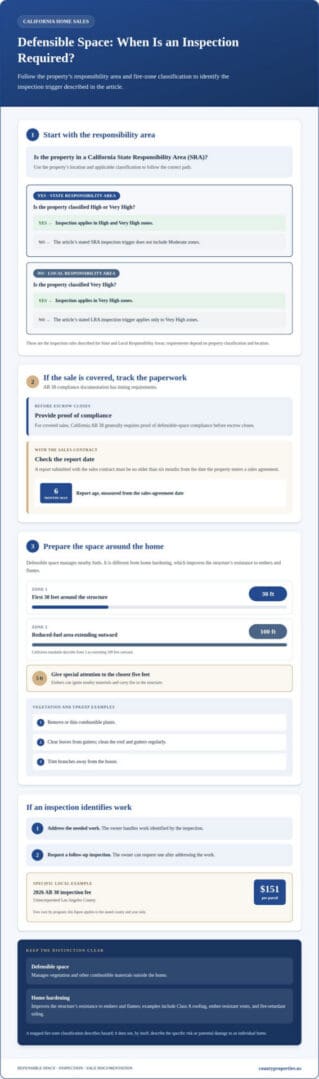
Defensible space is the managed area around a home where vegetation and other combustible materials are reduced. California standards describe Zone 1 as the first 30 feet around a structure and Zone 2 as a reduced-fuel area extending 100 feet outward.
For a sale, vegetation management can include removing or thinning combustible plants, clearing leaves from gutters, and trimming branches away from the house. Give particular attention to the five feet closest to the home, where embers can ignite nearby materials and carry fire to the structure. Regularly cleaning the roof and gutters also helps keep this area clear.
Inspections, Fees, and Clearance Standards
Defensible-space inspections assess whether a property meets applicable clearance standards. Requirements depend on the property’s classification and location: in California State Responsibility Areas, inspections apply in High and Very High Fire Hazard Severity Zones; in Local Responsibility Areas, they apply only in Very High zones.
For covered sales, California AB 38 generally requires proof of compliance before escrow closes. A report submitted with the sales contract must be no older than six months from the date the property enters a sales agreement, according to California Legislative Information. If an inspection identifies needed work, the owner addresses it and can request a follow-up inspection. Fees vary by program; the 2026 AB 38 inspection fee in unincorporated Los Angeles County is $151 per parcel.
Defensible Space and Home Hardening
Defensible space manages fuels outside the home, while home hardening improves the structure’s resistance to embers and flames. Together, they help buyers understand how the property has been prepared, beyond its mapped fire-zone classification.
Sellers can highlight completed upgrades such as Class A roofing materials, ember-resistant vents, and fire-retardant siding. Stucco exteriors, double-pane windows, and metal or tile roofs are also examples of more fire-resistant construction materials. Gather accurate details about completed improvements and distinguish them from vegetation work, since buyers may consider both the home and its immediate surroundings.
Insurance information related to CAL FIRE maps
CAL FIRE maps show fire hazard, not the full risk or likely damage to an individual home. This distinction matters to sellers and buyers because a map classification can inform insurance discussions without determining coverage or cost.
Wildfire Risk and Insurance Availability
Wildfire risk combines mapped hazard with conditions that affect potential damage, while hazard describes the likelihood and expected behavior of fire. A High or Very High zone label can shape insurance conversations, but it does not describe every property feature insurers may consider.
Before listing, review the current policy’s coverage details and potential costs. Buyers can explore homeowners coverage with multiple insurance carriers and, when possible, ask about the property’s past insurance claims. If standard coverage is difficult to obtain, buyers may consider the California FAIR Plan, which has its own terms and costs.
Insurance Costs and Buyer Considerations
Insurance costs depend on the home and available coverage, so buyers should weigh premiums alongside the purchase price. Comparing these expenses can make insurance affordability an important part of evaluating the property.
Buyers should compare coverage and rates from multiple carriers, review available claims history, and consider how fire-resistant features affect their assessment. The California FAIR Plan’s rate increase took effect in October 2026. Sellers who organize current insurance information can help buyers understand what the existing policy covers, without implying that the buyer can keep it.
Insurance and Loan Contingencies
A loan contingency concerns the buyer’s ability to secure financing under the purchase agreement. Insurance can affect the process because buyers may need suitable property coverage to complete a financed purchase.
A California homeowners policy generally doesn’t transfer automatically to the buyer. The buyer typically arranges a new policy through a private carrier or considers the California FAIR Plan as an alternative. Early insurance discussions can help buyers understand coverage options while they assess financing and contingencies. For sellers, seller-side transaction planning can help keep insurance information organized alongside other sale details.
What home hardening disclosures does AB 38 require?
AB 38 disclosures cover fire-hardening improvements and vulnerable features for certain California homes. They are distinct from defensible-space compliance and from a requirement to complete every possible upgrade before sale.
Seller Inspection and Wildfire Hazard Disclosures
Wildfire hazard disclosures tell buyers whether a property is located in a designated fire hazard zone. Sellers typically disclose whether a home is in a High Fire Hazard Severity Zone, while AB 38 applies to specified properties in High or Very High zones.
Inspection requirements depend on the location’s responsibility area and classification. In State Responsibility Areas, inspections apply in High and Very High zones; in Local Responsibility Areas, they apply only in Very High zones. This distinction matters because a zone label alone does not establish the same inspection requirement everywhere.
Fire-Hardening Disclosure Requirements
Fire-hardening disclosures describe improvements made to reduce a home’s vulnerability to embers and flames. California AB 38 requires sellers of homes built before January 1, 2010, in a High or Very High Fire Hazard Severity Zone to disclose home-hardening improvements and fire-vulnerable features, according to California Legislative Information.
Buyers may want details about features such as ember-resistant vents, roofing materials, and siding. Sellers should distinguish completed upgrades from planned work and accurately describe known vulnerable features. This helps buyers understand the home’s condition rather than assume that a fire-zone designation confirms specific improvements.
Hardening Standards Before Sale
Does a home in a high fire hazard zone have to meet home-hardening standards before sale? AB 38 requires covered sellers to disclose improvements and vulnerable features; that disclosure rule is not itself a requirement to complete every hardening upgrade before selling.
Defensible-space compliance is a separate consideration for covered transactions. California AB 38 generally calls for proof of compliance before escrow closes, with a written seller-buyer agreement allowing the buyer to assume responsibility. Keep that documentation distinct from home-hardening disclosures.
Undisclosed Hazards and Fire-Safety Issues
If a seller omits a known zone designation or fire-safety issue, the buyer may lack important information when evaluating the home. Incomplete disclosures can create uncertainty during the transaction and lead to follow-up questions or disputes about what was represented.
Do rules vary by county, city, or fire district? Requirements differ by responsibility area and fire-zone classification, as the State and Local Responsibility Area inspection rules illustrate. Sellers should clearly report the property’s known designation and applicable compliance information.
California Fire Hazard Severity Zone classifications
California classifies Fire Hazard Severity Zones as Moderate, High, or Very High. If you’re selling a home in a high fire hazard severity zone in California, the parcel’s location and responsibility area help determine what the designation means for the sale.
California law requires Fire Hazard Severity Zone classifications for State Responsibility Areas, with California Government Code Sections 51175-89 among the laws requiring these zones. State Responsibility Area classifications are governed by Title 14 of the California Code of Regulations, section 1280.01. Local Responsibility Areas use a separate mapping process, so nearby properties may have different designations or jurisdictions.
For real estate planning, confirm the parcel’s current zone and whether it falls within a State or Local Responsibility Area. That distinction helps clarify which sale-related requirements may apply. For example, inspection rules differ: in State Responsibility Areas, they apply in High and Very High zones; in Local Responsibility Areas, they apply only in Very High zones. A map label alone does not answer every transaction question. Buyers may also ask how the designation relates to disclosures and property preparation when selling a home in California’s High Fire Hazard Severity Zone.
Map timing matters, too. State Responsibility Area maps became effective on April 1, 2024, and CAL FIRE completed mapping those areas at the end of 2023. Mapping considers physical conditions over a 30 to 50-year time horizon, rather than only current vegetation or recent fire activity. The Office of the State Fire Marshal’s 2026 SRA map update reflects boundary changes in 34 counties.
Local maps also changed: California released Local Responsibility Area rollout phases on February 10, February 24, March 10, and March 24, 2025. CAL FIRE’s March 2025 update added more than 440,000 acres to Los Angeles County hazard zones. Confirm the parcel’s designation during a sale instead of relying on an old listing or neighborhood assumption. For help planning around property-specific details, get real estate sale guidance.
County Properties
County Properties provides Seller Representation for homeowners managing a sale with fire-zone disclosures, inspection records, or insurance considerations. If you’re preparing a Southern California property for market, guidance through the real estate transaction can help keep these details organized and clear for buyers. Support can also reflect your circumstances: Short Sale and Foreclosure Prevention may help when financial pressure affects your options, while Senior Real Estate Transition can support a move related to changing housing needs.
If fire-zone requirements feel difficult to coordinate, discuss your questions about the property and sale process with County Properties. Contact the team to talk through your real estate needs.
Choose your next step with confidence
When selling a home in a high fire hazard severity zone in California, turn property-specific details into a practical transaction plan. Consider how preparation, documentation, and buyer questions fit your priorities, then decide what needs attention first. A focused conversation with County Properties can help you approach the sale with a clearer sense of direction.
Before choosing a path, consider what matters most: your preferred timing, a smooth transition, or support during financial strain. County Properties provides Seller Representation and Buyer Representation, as well as Short Sale and Foreclosure Prevention. These services support different real estate circumstances, helping you focus on your goals and the questions still on your mind.
Contact County Properties to plan your next step. You can start the conversation before every detail is settled and move forward at a pace that feels right for you.
Frequently Asked Questions
What are Fire Hazard Severity Zones?
Fire Hazard Severity Zones are California map classifications that show the potential for wildfire to affect an area. The categories are Moderate, High, and Very High. They reflect conditions related to fire likelihood and behavior, not a prediction that a particular property will burn. Two nearby homes, for example, can have different designations if they fall on opposite sides of a mapped boundary.
Can a buyer negotiate for the seller to pay for fire-hardening retrofits?
Yes. A buyer and seller can negotiate retrofit work or another agreed arrangement as part of the purchase terms. The outcome depends on their agreement and the property’s condition. A buyer might request ember-resistant vents, for example, while a seller might prefer to negotiate another term. The agreement should clearly describe the work or arrangement and its timing.
What do sellers need to do before selling their home?
Start by organizing property records that help buyers understand the home’s fire-safety features and sale requirements. Separate completed improvements, such as a roof upgrade, from planned work, and keep inspection documentation with the transaction records. Confirm the property’s mapped designation and prepare accurate disclosures. Clear records make it easier to address buyer questions without relying on assumptions.
Why Is This Important for Sellers?
Clear fire-related information gives buyers a more grounded picture of the property and helps them evaluate their next steps. For example, documented improvements help a buyer distinguish existing features from upgrades they may want to consider. Accurate details also support informed conversations about offer terms, inspections, and insurance, giving both sides shared context for discussing the property.
How do I find out whether a California home is in a High or Very High Fire Hazard Severity Zone?
Use the property address to locate the parcel on California’s Fire Hazard Severity Zone maps, then note its mapped classification and responsibility area. CAL FIRE maps cover State Responsibility Areas, while Local Responsibility Area maps provide classifications for those jurisdictions. This distinction matters because a neighborhood’s general reputation or an older listing may not reflect the parcel’s current designation.
What California wildfire disclosure forms must sellers provide when selling a home in a high fire hazard zone?
Wildfire-related disclosures should tell buyers whether the property is in a High Fire Hazard Severity Zone. For a covered home built before January 1, 2010, in a High or Very High zone, sellers disclose home-hardening improvements and fire-vulnerable features. Covered sales may also involve defensible-space compliance documentation. The required paperwork depends on the home’s location, classification, and applicable sale requirements.