

What if the first step in selling a house with unpermitted work in San Diego isn’t fixing it, but finding out exactly what was done and what the records show? It’s understandable to worry that a buyer or inspection could uncover undocumented improvements and lead to costly repairs or delays. But acting on assumptions can create more uncertainty than starting with a clear, well-documented sale plan.
You can sell a home with unpermitted work, but you’ll need to approach the sale carefully. California sellers of one-to-four-unit residential properties generally must disclose known unpermitted additions or alterations, even when selling “as-is.” The right next steps depend on the work, the property’s jurisdiction, and your goals.
This guide explains how to identify whether your home falls under City of San Diego or County jurisdiction, search the relevant permit records, and organize useful documentation. You’ll also learn how to compare your options, prepare for buyer questions, and involve qualified professionals when permit or legal determinations are needed. With personalized seller representation, County Properties can help you shape a realistic listing strategy around your timing, presentation, and the facts you’ve gathered.
Key Takeaways
- Gather facts about the work before assuming it must be removed or corrected.
- Identify whether your property falls under City or County jurisdiction, then compare permit records with what you know about the project.
- Selling a house with unpermitted work in San Diego may still be possible. Buyer, financing, appraisal, and insurance questions can vary with the circumstances.
- Compare investigation, approvals, corrective work, and an as-is sale in light of safety, feasibility, timing, and your goals.
- Organize records, an improvement timeline, known facts, and unresolved questions to support disclosures and a clear listing strategy.
Selling a House With Unpermitted Work in San Diego: Start With the Facts
Finding a room addition, converted garage, or altered electrical system with no paperwork can feel alarming. Start by gathering facts, not by assuming the work must be removed. A gap in your files doesn’t prove that a permit was required or that the work was never approved. That distinction matters as you plan to sell a house with unpermitted work in San Diego.
In general, unpermitted work means work that required a permit but lacks evidence of that permit or its documented final approval. Local records and terminology can vary, so treat this as a working description, not a determination about your property. A permit may have been issued to a previous owner, or documents may be missing from your files. In other cases, no permit or inspection record may exist. These situations call for different follow-up, and an incomplete online record alone may not settle the question.
What kinds of work can raise permit questions?
Permit questions can arise around additions, structural changes, electrical or plumbing work, and spaces converted from one use to another. These are examples, not a definitive list of work requiring permits. Requirements can depend on the project’s scope, timing, and location. A feature’s appearance or age isn’t enough to establish whether it was permitted or complies with local requirements. For broader context on the term, see Illegal construction. Local authorities determine how permit rules apply to a specific property.
Why San Diego jurisdiction matters
San Diego addresses may fall under the City of San Diego or unincorporated San Diego County, and those areas use separate departments and permit-record systems. The City’s Development Services Department handles city processes, while San Diego County Planning & Development Services serves unincorporated county areas. A city mailing address alone doesn’t establish which jurisdiction governs your parcel.
Before searching records or drawing conclusions, identify the property’s governing jurisdiction. Then compare your documents with the information held by the appropriate agency. This helps you avoid searching the wrong system and gives you a stronger basis for distinguishing what is known from what is missing or still unclear. County Properties can help you organize property information and consider how it fits into a seller strategy. Permit and legal determinations belong with the relevant authorities and qualified professionals.
How to Check San Diego Permit Records Before Listing
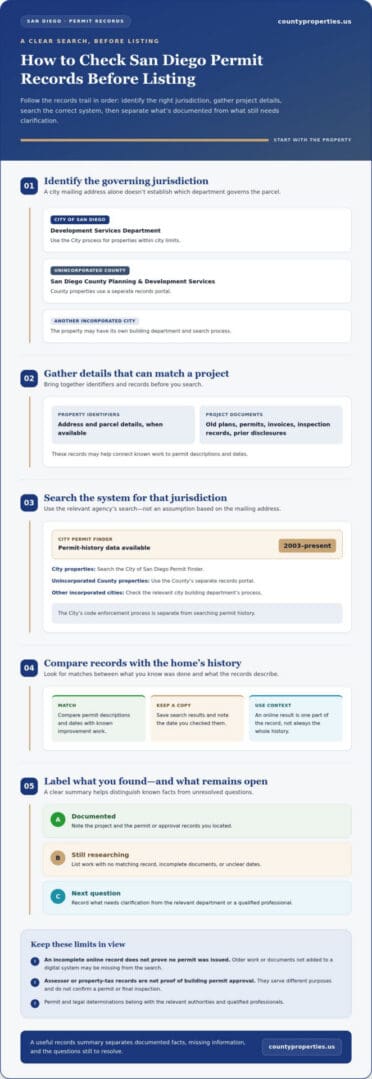
A focused records search can help separate what’s documented from what needs follow-up. Work through the process in order: confirm the property’s jurisdiction, gather identifying details, search the correct records system, and compare what you find with the home’s improvement history. Keep copies of search results and note the date you checked them.
Find the correct San Diego permitting department
Start with the property address and determine whether it’s within the City of San Diego, in unincorporated San Diego County, or in another incorporated city. Properties within the City use the City of San Diego Development Services Department; unincorporated properties use San Diego County Planning & Development Services. A home in another city may have its own building department and search process.
For properties within city limits, the City’s online Permit Finder provides permit-history data from 2003 to the present. County properties use a separate records portal. The San Diego Development Services Department also provides information about the City’s code enforcement process, which is separate from searching permit history. Use the official search system for the property’s jurisdiction rather than relying on the mailing address alone to identify the right agency.
Build a useful record of past improvements
Gather the address and any parcel details you have, then collect documents that may help match a project to a permit record. Useful items include old plans, permit documents, contractor invoices, inspection records, and prior disclosures. Search by address and, when available, parcel number. Compare permit descriptions and dates with the work you know was done.
Online records can be incomplete, especially for older work or documents that haven’t been added to a digital system. A missing result doesn’t prove that no permit was issued, and property tax or assessor records aren’t proof of building permit approval. Those records serve different purposes, so don’t treat an assessed area or tax entry as confirmation of a permit or final inspection.
- Documented: Note the project and the permit or approval records you located.
- Still researching: List work with no matching record, incomplete documents, or unclear dates.
- Next question: Record what needs clarification from the relevant department or a qualified professional.
This organized summary can support a more informed listing plan without overstating what the records establish. County Properties can help you arrange property information and consider buyer questions as part of personalized seller representation.
Does Unpermitted Work Stop a San Diego Home Sale?
No. Unpermitted work doesn’t automatically make a home sale impossible, but it can raise questions that affect how a buyer evaluates the property and how the transaction proceeds. The impact depends on the work’s scope and condition, the records available, and the buyer’s plans. Selling a house with unpermitted work in San Diego often comes down to understanding the facts and preparing a candid sale plan, not assuming there’s only one outcome.
Buyers may want more information about an addition, altered electrical system, or converted space. Depending on the circumstances, they could request permit records, inspections, estimates, or other review. An appraiser may treat undocumented area differently from permitted living space, while a lender or insurer may assess the property under its own requirements. These are possibilities, not guaranteed responses. Disclosure helps buyers make informed decisions, but it doesn’t guarantee their acceptance, financing, or insurance. Nor does every permit-record concern automatically mean you must legalize or correct the work before listing.
What sellers should disclose and document
For one-to-four-unit residential properties, California Civil Code section 1102 generally requires sellers to disclose known unpermitted additions or alterations on the Transfer Disclosure Statement, including for an “as-is” sale. Applicable requirements and forms can depend on the property and circumstances, so verify current California rules and forms before completing disclosures. This is general information, not legal advice.
Be precise about what you know. Describe the work, any permit status supported by records, and questions that remain unresolved. Don’t conceal known work, guess whether a permit was obtained, or present an uncertain detail as established fact. Keep available records and disclosures together so your answers remain consistent as the sale moves forward.
How buyers may evaluate undocumented improvements
A buyer’s level of concern may vary with the project’s size, visible condition, and intended use. A small alteration and a substantial addition may prompt different questions. A buyer may seek more documentation or professional review, or may decide the information is sufficient. Each transaction is different, so prepare for questions without promising a particular response.
A gap in permit records is not, by itself, proof that work violates code; it means the available documentation doesn’t establish the permit history. Keep that distinction clear in your conversations and listing preparation. An organized, factual account can help your seller representative shape a listing strategy and respond consistently. Permit and legal determinations remain with the relevant authorities and qualified professionals.
Resolve, Document, or Sell As-Is: Compare Your San Diego Options
There isn’t one right response to undocumented work. The best path depends on what the work involved, whether there are safety concerns, what the records show, how much time you have, and what matters most to you as a seller. Before committing to repairs or an approval process, clarify the project’s scope and the property’s jurisdiction. The relevant local department determines which requirements and processes apply. An after-the-fact approval may not be available for every project or situation.
- Investigate first: Gather existing records and clarify what is known, what is uncertain, and whether further technical review is appropriate. This can help you avoid pursuing a remedy before you understand the issue.
- Pursue required approvals: If you want to explore whether the work can be approved, ask the relevant department about its process and requirements. Consider feasibility, documentation, any requested review, and whether the timeline fits your sale plans.
- Consider corrective work: Depending on the facts and applicable requirements, work may need to be changed or corrected. Safety, project scope, practical feasibility, and your priorities all matter. Don’t describe work as approved unless that status is documented.
- Discuss an as-is sale: Selling without completing repairs or pursuing approvals may be an option, depending on your circumstances. It doesn’t remove applicable disclosure duties or guarantee that buyers won’t raise questions, seek inspections, or negotiate.
When to investigate or pursue permit resolution
Start with reliable information. A converted space, for example, may raise questions about how it was altered, when the work occurred, and which jurisdiction governs the property. Records and qualified technical input can help define what needs clarification; the local department determines the applicable permitting route. As you weigh timing and feasibility, a seller representative can help you consider how the issue fits your sale plan without making technical or legal determinations.
When an as-is sale may be part of the discussion
An as-is approach may make sense to consider when repairs or approval work don’t fit your timeline, resources, or goals. It isn’t a way to avoid disclosing known information. Organize available documents, note the work’s known status, and distinguish confirmed facts from open questions. This gives buyers a clearer picture, though they may still request further review or raise the issue during negotiations.
If you’re weighing these paths, discuss your San Diego home sale plan with County Properties. Personalized seller representation can help you organize property information and prepare a listing strategy around your goals, timing, and likely buyer questions.
Prepare Your San Diego Listing With a Clear Unpermitted-Work Plan
A clear record of what you know can make listing preparation more manageable. Before marketing the home, bring the documents, project history, and remaining questions together. This gives you and your real estate representative a consistent foundation for disclosures, property descriptions, and buyer conversations without overstating what the records prove.
A practical pre-listing checklist for sellers
Gather the information you have, even if the file is incomplete. Organize it so you can distinguish documented facts from details that still need clarification:
- Collect available records: Include permits, plans, invoices, inspection notes, prior disclosure documents, and relevant correspondence.
- Build an improvement timeline: Note each known project, its approximate timing if known, and any related records.
- Separate facts from assumptions: Identify what documents establish, what you understand but can’t verify, and what remains unanswered.
- Prepare for disclosures: Keep known work and its documented permit status together as you complete applicable forms. Verify current California requirements and forms for your circumstances.
- Use accurate marketing language: Don’t describe space or improvements as permitted, approved, or legal unless you have support for that statement.
A concise summary can help keep information consistent throughout the listing process. For example, distinguish “permit record located for the rear addition” from “permit status still being researched” rather than combining the two into an uncertain claim. If you don’t know a detail, preserve that uncertainty instead of filling the gap with a guess.
Coordinate the sale strategy with a trusted real estate partner
Selling a house with unpermitted work in San Diego involves more than deciding whether to make a repair. Your documentation, marketing choices, timing, and approach to buyer questions all affect how you prepare for the sale. County Properties provides personalized seller representation in San Diego and Southern California, helping you organize property information and develop a listing strategy around your goals. Your representative can help you prepare for likely questions, while technical and legal determinations remain with the relevant authorities and qualified professionals.
A well-organized plan can support clear communication, but it can’t guarantee a particular buyer response or transaction outcome. If you’re preparing to list and want a collaborative perspective on your options, talk with County Properties about your San Diego home sale.
Move Forward With a Clear, Informed Sale Plan
Selling a house with unpermitted work in San Diego starts with facts, not assumptions. Confirm which jurisdiction maintains the property’s permit records, organize documents alongside a timeline of known improvements, and separate verified details from open questions.
There isn’t one path for every seller. You can weigh further investigation, potential approval or corrective steps, and an as-is sale against the work’s condition, your timing, and your goals. Whichever approach you consider, accurate disclosures and careful, supportable descriptions help create a more reliable foundation for buyer conversations. Technical and legal questions belong with the relevant authorities and qualified professionals.
County Properties offers personalized residential seller representation in San Diego and Southern California, with collaborative guidance as you organize property information, consider timing, and prepare for buyer questions. A thoughtful plan can help you approach a complex sale with greater confidence, without assuming every concern has the same solution.
Talk with County Properties about your San Diego home sale and take the next step with a steady partner by your side.
Frequently Asked Questions
Can I sell a house in San Diego with unpermitted work?
Yes, unpermitted work doesn’t automatically prevent a sale, but it may affect buyer interest or raise questions during the transaction. The next steps depend on the type and condition of the work, available records, and your goals. Gather documentation, identify what’s known and uncertain, and prepare accurate disclosures. Buyers, lenders, insurers, and appraisers may assess the property differently, so don’t assume the work must be removed or that the sale will proceed without questions.
Do I have to disclose unpermitted work when selling a house in California?
California sellers of one-to-four-unit residential properties generally must disclose known unpermitted additions or alterations on the Transfer Disclosure Statement, even in an “as-is” sale. Disclosure duties and applicable forms can depend on the property and circumstances, so verify current requirements before completing paperwork. Describe what you know accurately, including known permit status and unresolved questions. Don’t guess or present uncertain information as fact. This is general information, not legal advice.
How do I find out whether work on my San Diego home was permitted?
First identify the property’s jurisdiction, then search the corresponding official permit-record system. City of San Diego properties can be researched through the City’s Permit Finder, while unincorporated county properties use a separate county portal. Another incorporated city may maintain its own records. Compare permit descriptions and dates with the known work, and gather plans, invoices, or inspection records. A missing online result doesn’t prove that no permit was issued, especially when records are incomplete.
What happens if unpermitted work is discovered during escrow?
If work comes up during escrow, the parties may need to review available records and clarify what is known. Depending on the circumstances, a buyer might request more documentation, an inspection, estimates, or other review, or raise the issue in negotiations. The outcome isn’t automatic. Keep communications factual and consistent, and consult the relevant authority or a qualified professional for permit or technical determinations. Your real estate representative can help organize property information and coordinate sale-related communication.
Can I sell my house as-is if it has unpermitted work?
An as-is sale may be an option, but it doesn’t remove applicable disclosure obligations for known issues, including known unpermitted work. It also doesn’t guarantee that a buyer won’t request inspections, seek more information, or negotiate over the property. Organize records and clearly distinguish confirmed facts from unresolved questions. A realistic sale strategy should account for the home’s condition, your timing, and your goals while keeping disclosures accurate.
Should I get a retroactive permit before selling my San Diego house?
Not necessarily. First confirm the property’s jurisdiction, the work’s scope, and what records already exist. The applicable local department determines whether an approval process is available and what requirements apply; retroactive permits aren’t guaranteed. Consider safety, feasibility, documentation, timing, and your sale priorities before choosing a path. Don’t market work as approved unless you have support for that status. A qualified professional or relevant authority can address technical and permitting questions.
Can unpermitted work affect a home appraisal or mortgage?
It can. Appraisers may exclude unpermitted space from the home’s reported gross living area, which may affect the appraisal. Lenders may also review significant undocumented work under their own requirements, potentially creating financing questions for a buyer. Neither response is certain, and outcomes depend on the property, project, and transaction. Organize available records and describe the work accurately so buyers and their professionals can evaluate the information relevant to their decision.