

Did you know that on a median-priced home of $905,000, you might need to bring an additional $18,100 to $45,250 to the table just to finalize your purchase? It’s completely natural to feel a sense of sticker shock when you see those final numbers, especially when you’re already navigating the competitive Southern California market. You’ve worked hard for your down payment, and the last thing you want is for hidden “junk fees” or unexpected regional customs to drain your savings. Understanding the specific closing costs for buyer in California is the first step toward a secure and successful home purchase.
We understand that this process can feel overwhelming, but you don’t have to navigate it alone. This guide will help you master the complexities of the 2026 market by providing a detailed breakdown of legitimate fees and the expert negotiation strategies you need to protect your investment. We’ll explore San Diego-specific customs, provide a clear dollar-amount estimate based on current data, and identify exactly which costs you can challenge at the closing table. By the time you finish reading, you’ll have the confidence of a seasoned pro, ready to step into your new home with total financial clarity.
Key Takeaways
- Understand that closing costs for buyer in California include a mix of lender, third-party, and government fees required to finalize your home purchase.
- Identify unique San Diego customs, such as the regional expectation that the seller typically pays for the Owner’s Title Policy.
- Learn which specific service fees are negotiable or “shoppable” and how to successfully request seller concessions to lower your cash-to-close.
- Prepare for essential property-related expenses, including appraisals and specialized Southern California inspections for termites and roofing.
- Discover how professional guidance from a seasoned local expert ensures accurate cost forecasting and a secure transition into your new home.
What Are Closing Costs for a Buyer in California?
To understand your financial obligation, you first need a clear answer to a fundamental question: What Are Closing Costs? In essence, these are the collection of third-party, lender, and government fees required to finalize a real estate transaction and transfer ownership. Because California has some of the highest property values in the country, the percentage-based nature of these fees means your final bill can feel substantial. You deserve a clear, expert breakdown to ensure you aren’t caught off guard at the finish line.
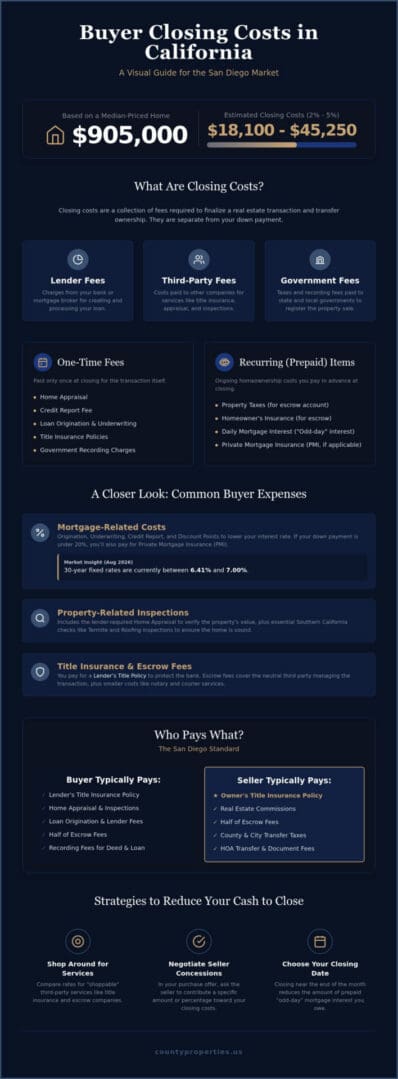
Establishing a realistic budget for closing costs for buyer in California is essential for a stress-free experience. Most experts suggest planning for a range between 2% and 5% of the purchase price. For a median-priced home in the state around $905,000, this equates to a range of $18,100 to $45,250. It’s vital to distinguish between your “closing costs” and your total “cash to close.” While closing costs represent the fees paid to complete the deal, your cash to close includes these fees plus your down payment, minus any credits or earnest money deposits you’ve already provided.
One-Time Fees vs. Recurring Prepaid Items
Your closing statement will categorize expenses into two main groups. One-time fees are transaction-specific charges that won’t happen again. These include your home appraisal, credit report fees, and recording charges. Prepaid items, on the other hand, are recurring costs you pay in advance to establish your escrow account. These include property taxes, homeowners insurance, and daily mortgage interest. Since a move often prompts a full review of your family’s protection, you may want to visit West Coast Global Insurance Services to explore additional coverage options that fit your new lifestyle. The specific day of the month you close significantly impacts your bottom line; if you close near the end of the month, you’ll pay less “odd-day” interest upfront than if you close on the 1st.
The Role of Escrow in California Transactions
Southern California real estate relies on a neutral third party called an escrow company to manage the transfer of funds and documents. Unlike the East Coast, where attorneys often lead the closing process, California uses these specialized firms to ensure every contractual obligation is met before the deed is recorded. You’ll receive a document called the Closing Disclosure (CD) at least three business days before you sign your final papers. This document provides the definitive list of closing costs for buyer in California, allowing you to compare the final numbers against the initial Loan Estimate your lender provided. Reviewing this document with an experienced guide ensures you don’t pay for unnecessary fees that can occasionally slip into the final tally.
A Detailed Breakdown of Buyer Closing Expenses
Moving beyond the initial percentage estimate, you need to look at the specific line items that populate your final closing statement. These expenses generally fall into four distinct categories: lender fees, property-related charges, title insurance, and government recording fees. Each cost plays a vital role in securing your financial safety and legal ownership. Understanding these details helps you avoid the “sticker shock” often associated with the final stages of a purchase.
Mortgage-Related Costs: What Your Lender Charges
Your mortgage broker or bank provides a Loan Estimate shortly after you apply. This document outlines origination charges and underwriting fees, which cover the administrative costs of processing your loan. One strategic choice you’ll face involves “discount points.” By paying a percentage of the loan amount upfront, you can lower your long-term interest rate. In the current August 2026 market, where 30-year fixed rates hover between 6.41% and 7.00%, this upfront investment can lead to significant savings over the life of your mortgage. If your down payment is less than 20%, you should also prepare for Private Mortgage Insurance (PMI) premiums, which are often collected at the closing table.
Title Insurance and Escrow Fees
Title insurance is a non-negotiable safeguard that protects your investment from past ownership disputes or undisclosed liens. While you’ll pay for a “Lender’s Title Policy” to protect the bank, the “Owner’s Title Policy” is what secures your own equity. Escrow service fees are typically calculated based on the home’s purchase price, covering the neutral third party’s work in managing the transaction. You’ll also see smaller, administrative costs such as notary and courier fees. While these might seem minor, they often total several hundred dollars by the time you reach the finish line. Having expert buyer representation can help you identify which of these service providers offer the best value for your specific situation.
Property Taxes and HOA Adjustments
California property taxes are pro-rated, ensuring that both the buyer and seller pay their fair share based on the exact date of the transfer. However, you must also watch for Mello-Roos assessments. These are unique California taxes used to fund infrastructure and public services in newer developments. They can add a significant amount to your annual tax bill, so it’s essential to verify if your target property sits within a Mello-Roos district. If you’re moving into a community with a Homeowners Association (HOA), you might encounter transfer fees or “capital contributions” required at closing. Calculating these closing costs for buyer in California accurately requires a deep understanding of local San Diego tax districts and community-specific requirements.
Government and Recording Fees
The state and county also take a share during the transfer of property. The standard California county documentary transfer tax is $1.10 per $1,000 of the property’s value. Additionally, the SB 2 Building Homes and Jobs Act fee typically adds $75 for recording real estate documents, though this is capped at $225 per transaction. These government charges are fixed, but knowing they’re coming allows you to finalize your 2026 budget with total confidence.
Southern California Customs: Who Pays What in San Diego?
Real estate in the Golden State follows a distinct “North-South” divide when it comes to financial responsibility. If you’ve looked at properties in San Francisco, you might expect to shoulder the majority of title and escrow fees. However, San Diego County follows a more collaborative tradition that benefits the purchaser. Understanding these regional nuances is vital for accurately forecasting your closing costs for buyer in California, as local customs often dictate thousands of dollars in potential savings.
In Southern California, the seller typically pays for the Owner’s Title Policy. This is a significant standard because title insurance is a major expense. Additionally, the customary practice in San Diego is to split escrow fees 50/50 between the buyer and the seller. While these aren’t laws, they are deeply rooted community standards that most agents follow. When you work with a seasoned mentor, you can use these customs as a baseline for your offer, ensuring you don’t overpay for services the seller traditionally covers.
San Diego County Specific Standards
The County Documentary Transfer Tax, which is $1.10 per $1,000 of the property value, is almost always a seller’s obligation in San Diego. Unlike Los Angeles, where the “Measure ULA” imposes heavy tiered taxes on high-value sales, San Diego does not currently have additional city-specific transfer taxes. Sellers also traditionally pay for the Natural Hazard Disclosure (NHD) report. This report is a mandatory disclosure that informs you about fire, flood, or seismic risks. By following these local patterns, you can keep your out-of-pocket expenses manageable and focused on your loan and inspections.
The Impact of the 2024 NAR Settlement on 2026 Buyers
The landscape of professional compensation changed significantly following the 2024 NAR settlement. As a 2026 buyer, you must be aware that buyer-broker commissions are no longer a “built-in” cost paid automatically by the seller through the Multiple Listing Service. You’ll sign a written representation agreement that clearly outlines your agent’s compensation. In some cases, you might pay your agent’s fee out-of-pocket as part of your closing costs for buyer in California. However, we often negotiate this as a “seller concession” in the purchase contract. This means the seller agrees to pay a percentage toward your total closing package, including agent fees, to make the deal work for everyone involved. This collaborative approach ensures you receive expert guidance without sacrificing your liquid cash reserves.
How to Estimate and Lower Your Buyer Closing Costs
While the initial estimate for closing costs for buyer in California can be daunting, many of these expenses are not set in stone. You have the power to influence the final amount through strategic choices and professional negotiation. By understanding which fees are “shoppable” and how to leverage market conditions, you can significantly reduce the cash required at the closing table. You deserve a partner who focuses on your financial health throughout the entire transaction.
One of the simplest ways to save is by shopping for third-party services. You aren’t always required to use the providers suggested by your lender or the seller’s agent. You can often find competitive rates for home inspections, termite reports, and even title insurance by comparing local San Diego vendors. Additionally, consider the timing of your close. Finalizing your purchase on the last day of the month minimizes the amount of prepaid interest you must pay upfront, as you’ll only owe interest for the remaining day or two of that month rather than several weeks.
Negotiating Seller Credits in a 2026 Market
In the current 2026 climate, seller concessions have become a powerful tool for buyers. You can request that the seller pays a specific percentage of your costs as part of your initial offer or as a result of inspection findings. If a roof inspection reveals necessary repairs, we often suggest requesting a closing credit rather than asking for the repair itself. This strategy effectively lowers your total closing costs for buyer in California without requiring a lower purchase price. It’s vital to stay within your loan’s limits; for example, FHA loans generally cap seller concessions at 6%, while conventional loans often limit them to 3% for buyers with low down payments. To see how these strategies apply to your specific budget, you can schedule a personalized buyer consultation with our team.
Reviewing Your Closing Disclosure for Errors
Federal law provides you with a three-day window to review your Closing Disclosure (CD) before you sign the final documents. This period is your opportunity to ensure the numbers align with your initial Loan Estimate. We meticulously review these documents with our clients to spot common errors, such as duplicate processing fees or incorrect property tax pro-rations. Even a small clerical mistake can cost you hundreds of dollars if left uncorrected. Comparing the final CD against your initial estimate ensures that your lender has remained transparent about their charges and that you aren’t paying for “junk fees” that weren’t previously disclosed.
Navigating Your Southern California Purchase with County Properties
Arnie Levine and the team at County Properties act as your seasoned mentor throughout the entire escrow process. When you’re managing the significant financial commitment of a San Diego home purchase, you need more than just a salesperson; you need a dependable guide who understands the regional fabric. We specialize in providing the clarity and reassurance required to move forward with confidence. Our approach focuses on total transparency, ensuring that the closing costs for buyer in California are never a surprise at the finish line.
Expert Guidance for Complex Transitions
We help you look beyond the initial purchase price to plan for the total cost of ownership. For many of our clients, especially those navigating a senior real estate transition, the financial move involves more than just a single transaction. As a Senior Real Estate Specialist (SRES), Arnie Levine understands the sensitivity of downsizing or moving into a supportive community. We coordinate closely with your financial advisors to ensure every dollar of your closing expenses is accounted for in your long-term plan. For a deeper look at the current market, we invite you to read our detailed article on Buying a Home in Southern California: A Realistic 2026 Guide.
Your Reliable Ally in San Diego Real Estate
Our agency values internal cooperation and a client-first ethos over individual competition. This collaborative, team-based approach means you benefit from our collective knowledge of San Diego’s local transfer tax customs and regional escrow standards. We act as your active facilitator, helping you negotiate seller concessions and review every line item on your Closing Disclosure. Finding the right partner is the most important decision you’ll make in this process. You can learn more about our philosophy in our guide on How to Find the Best Real Estate Agent Near You: A Complete Guide.
You deserve a professional ally who prioritizes your financial safety and personal goals. Contact County Properties today to receive a personalized breakdown of the projected closing costs for buyer in California for your specific target neighborhood. We’re ready to help you achieve your next significant life milestone with ease and expert care.
Take the Next Step Toward Your San Diego Home
Mastering the financial details of your home purchase is the ultimate way to ensure a smooth transition. By now, you understand that closing costs for buyer in California are not just fixed numbers; they’re flexible points of negotiation and local custom. Whether you’re leveraging San Diego’s traditional 50/50 escrow split or requesting seller concessions to protect your cash reserves, you have the tools to navigate this market with total clarity.
County Properties, led by Arnie Levine, SRES®, brings over 30 years of localized real estate experience to your side. We specialize in the specific Southern California market customs that can save you thousands of dollars at the finish line. We act as your reliable ally, ensuring every fee is legitimate and every opportunity for savings is explored. Your path to a new home should be filled with optimism rather than uncertainty.
Ready to buy in San Diego? Get your personalized closing cost estimate from County Properties. We’re here to help you achieve your next significant life milestone with expert care and dedicated service.
Frequently Asked Questions
How much are average closing costs for a buyer in California in 2026?
Average closing costs for buyer in California typically range from 2% to 5% of the home’s purchase price. For a median-priced home of $905,000 in 2026, you should budget between $18,100 and $45,250. This total includes lender fees, title insurance, and government recording charges. Your specific amount depends on your loan type and the day of the month you close. We provide detailed forecasting to ensure you have a clear financial roadmap.
Who pays for the title insurance in Southern California?
In Southern California, regional custom dictates that the seller traditionally pays for the Owner’s Title Policy. This policy protects your ownership rights and represents a significant cost saving for you. However, you’ll still be responsible for the Lender’s Title Policy, which protects the mortgage company’s investment. While these are customs rather than laws, our deep roots in San Diego help us ensure these traditional splits are maintained in your favor during negotiations.
Can I include my closing costs in my mortgage loan in California?
You generally cannot roll your closing costs into a standard conventional mortgage loan. These must be paid in liquid cash at the time of closing. However, you can utilize a lender credit where you accept a slightly higher interest rate in exchange for the lender paying your upfront fees. Another option is negotiating seller concessions. This effectively reduces the cash you need to bring to the table without increasing your total loan balance.
What is a seller concession and how does it help a buyer?
A seller concession is an agreement where the seller pays a specific dollar amount or percentage toward your transaction fees. This helps a buyer by reducing the total cash to close required on signing day. For example, if you’re short on liquid funds but the property needs minor repairs, we can negotiate a concession instead of a price reduction. This keeps more money in your pocket for immediate home improvements or moving expenses.
Are closing costs tax-deductible for California home buyers?
Most closing costs for buyer in California are not immediately tax-deductible. Instead, they’re added to the cost basis of your home, which can reduce capital gains tax when you eventually sell. The primary exceptions are mortgage points paid to lower your interest rate and pro-rated property taxes. These are often deductible in the year you purchase. You should always consult with a qualified tax professional to understand how these rules apply to your situation.
What happens if my closing costs are higher than the estimate?
Federal regulations limit how much certain fees can increase between your initial Loan Estimate and the final Closing Disclosure. Some fees have a zero tolerance for change, while others can only increase by 10%. If costs are higher than the estimate without a valid changed circumstance, the lender may be required to issue a credit to cover the difference. We meticulously review these documents to protect your financial safety and ensure lender transparency.
Do I have to pay my real estate agent’s commission at closing?
Following the 2024 NAR settlement, agent commissions are entirely negotiable. You’ll sign a representation agreement that defines your agent’s compensation. While you may be responsible for this fee at closing, we frequently negotiate for the seller to cover this cost as a concession. This ensures you receive expert, service-oriented representation without a heavy out-of-pocket burden. It keeps your long-term personal goals on track during this significant life transition and ensures professional support.
Is there a difference in closing costs between San Diego and Los Angeles?
Yes, there are notable differences, particularly regarding transfer taxes. Los Angeles imposes higher city-specific transfer taxes, including the tiered Measure ULA tax on high-value properties. In contrast, San Diego typically follows a standard county transfer tax rate of $1.10 per $1,000 of value without additional city-level mansion taxes. Understanding these regional variations is essential for accurate budgeting. Our localized expertise ensures your cost projections are tailored specifically to the San Diego neighborhood you choose.