

What if a single number could suddenly stand between you and the keys to your new home? You’ve likely spent months searching for the perfect property and finally reached an agreement, only to face the silent anxiety of a pending valuation. It’s a common fear in 2026, especially as lenders adopt more rigid data models and automated valuation tools. When that report arrives and the figures don’t align with your contract, the first question that hits is: what if my home appraisal is too low?
We understand that this moment feels like a major roadblock, but it’s actually a pivot point that we can manage together. You deserve a partner who understands the nuances of the mandatory UAD 3.6 reporting standards and how recent climate events might be skewing your local market data. This guide will show you exactly how to rescue your real estate deal by identifying errors in the report, negotiating a fair price adjustment, or successfully requesting a Reconsideration of Value. We’ll walk through the strategic steps to ensure your path to homeownership remains secure, predictable, and successful.
Key Takeaways
- Define the appraisal gap and understand why these discrepancies are increasingly common in competitive Southern California neighborhoods.
- Discover exactly what if my home appraisal is too low by utilizing the “Middle Ground” strategy to negotiate a fair compromise between buyers and sellers.
- Identify common valuation pitfalls like lagging sales data and irrelevant neighborhood “micro-climates” that often skew appraisal reports.
- Learn the precise steps to challenge a low valuation, including how to scrutinize comparable sales for similarity, distance, and recent closing dates.
- See how a dedicated real estate partner provides essential advocacy by attending the appraisal in person to protect your homeownership goals.
Understanding the “Appraisal Gap” in the 2026 Market
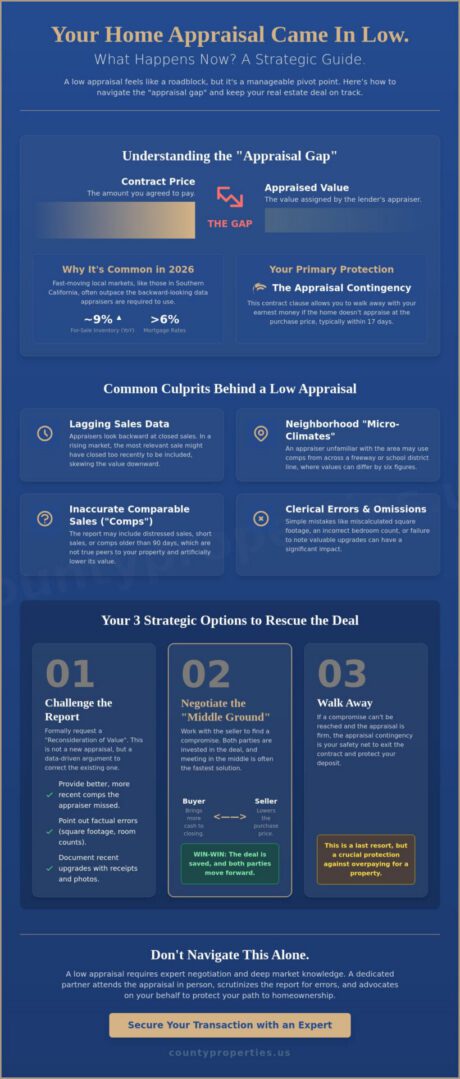
The term “appraisal gap” refers to the specific difference between the price you’ve agreed to pay for a home and the value a lender’s professional assigns to it. In a perfect transaction, these numbers match. However, the 2026 market presents unique challenges. With for-sale inventory up nearly 9% year-over-year but mortgage rates remaining above 6%, the market is in a state of delicate recalibration. If you find yourself asking, what if my home appraisal is too low, you’re experiencing a common hurdle in modern real estate. This gap isn’t a statement on the home’s emotional worth. It’s a technical discrepancy that requires a strategic, data-driven response.
This phenomenon happens frequently in competitive Southern California neighborhoods, from the coastal pockets of San Diego to the inland suburbs. Our local markets often move faster than the data can keep up. When buyers are willing to pay a premium for a specific school district or a renovated kitchen, the official real estate appraisal process might rely on “comps” from three months ago that don’t reflect today’s local demand. This creates a high-stakes moment of friction. Sellers feel their equity is being undervalued, while buyers worry their dream home is slipping away. It’s a stressful situation. We view the appraisal as a safety net for the bank’s investment, not a final verdict on your property’s potential.
The Role of the Appraisal Contingency
Your primary protection in this scenario is the appraisal contingency. This contractual clause ensures that your earnest money deposit remains safe if the property doesn’t value at the purchase price. In a standard California residential purchase agreement, you typically have a set period, often 17 days, to remove this contingency. If the numbers don’t align, you aren’t forced to overpay. The appraisal contingency serves as a financial exit ramp for buyers when values fall short of the contract price.
LTV Ratios and Lender Requirements
A low appraisal directly impacts your Loan-to-Value (LTV) ratio. Lenders generally only fund a percentage of the appraised value, not the purchase price. If the gap is wide, you might be asked to increase your down payment to maintain your loan approval. It’s also vital to distinguish between loan types. FHA and VA appraisals are notorious for “sticking” to a property for several months, meaning a new buyer can’t simply order a fresh report to get a higher number. By 2026, many lenders have moved toward “desktop appraisals” for low-risk properties. However, a full interior inspection remains the gold standard for accuracy in complex Southern California markets where every block can have a different value profile.
Common Reasons for a Low Home Appraisal
The 2026 housing market moves at a different pace than the paperwork that supports it. A common culprit for a valuation shortfall is the “lagging data” problem. While home prices are predicted to rise by a modest 1.2% to 2.2% nationally this year, appraisers are required to look backward at closed sales. If your neighborhood is experiencing a sudden surge in demand that hasn’t yet resulted in recorded closings, the appraiser might rely on older data that doesn’t reflect the current reality. You might find yourself asking, what if my home appraisal is too low simply because the most relevant sale happened yesterday and isn’t in the system yet?
Neighborhood “micro-climates” also play a significant role. An appraiser who isn’t intimately familiar with your specific block might use comparable sales from an area that looks similar on paper but carries a completely different market value. Discovering that your deal is in jeopardy is frustrating. Many homeowners face this because of simple clerical errors, such as miscalculated square footage or a failure to note unpermitted work that still adds functional value. If you suspect professional negligence or bias, you can file a complaint with the Consumer Financial Protection Bureau to ensure your transaction is treated fairly.
The “Comps” Challenge in San Diego
In San Diego, crossing a major freeway like the I-5 or the 805 can change property values by six figures. We often see reports where “cherry-picked” data includes a distressed property or a short sale from across a school district line. These properties aren’t true peers. A seasoned appraiser should adjust for these differences, but when they don’t, it creates an artificial gap. You must scrutinize the report for comps that are more than 90 days old, as these are increasingly irrelevant in a 2026 market that values recent stability over peak pricing volatility.
Condition vs. Value: What Actually Matters
It’s vital to distinguish between cosmetic issues and structural value-drivers. While a lender might not care about the color of your paint, they are now required under UAD 3.6 standards to collect details on kitchen updates and energy-efficient features. For those focusing on senior real estate needs, specialized modifications like walk-in tubs or widened doorways are often undervalued by general appraisers. Working with an experienced real estate team ensures these unique features are highlighted as vital assets rather than mere “personal preferences.”
Strategic Options for Buyers and Sellers
When an appraisal report returns a value lower than the agreed-upon purchase price, it doesn’t have to signal the end of the transaction. Instead, we view this as a moment for strategic recalibration. In the current Southern California housing market, where for-sale inventory has increased by nearly 9% year-over-year in 2026, both parties often have a shared interest in reaching the closing table. A collaborative framework is almost always more productive than a confrontational one. By working together, buyers and sellers can often find a “Middle Ground” strategy where they split the difference between the appraised value and the original offer price.
If you are a buyer wondering what if my home appraisal is too low, you might consider the “Cash Gap” solution. This involves paying the difference between the loan amount and the purchase price out of pocket. While this requires liquidity, it can be the fastest way to secure a property in a high-demand neighborhood. However, with mortgage rates projected to remain above 6% throughout 2026, buyers are understandably more cautious. If a compromise cannot be reached, the “Walk Away” option remains a valid path, especially if your contract includes the appraisal contingency discussed earlier. This exit prevents you from overextending your finances on an underwater asset.
Buyer Strategies: Bridging the Shortfall
Seller Strategies: Defending Your Price
Sellers should take a proactive stance to Bounce Back From A Low Appraisal by preparing a comprehensive “Value Package.” This document should include a detailed list of all upgrades, such as energy-efficient window installations or kitchen remodels, along with their associated costs. When what if my home appraisal is too low becomes a reality, having this data ready allows you to challenge the appraiser’s findings with facts rather than emotions. If you have backup offers in hand, use that leverage to encourage the buyer to cover more of the gap. For those selling a home in Southern California under tight deadlines, a price reduction to match the appraisal might be the most pragmatic choice to ensure a successful, on-time closing.
How to Successfully Challenge a Low Appraisal
Receiving a low valuation can feel like a sudden halt to your progress, but the report isn’t always the final word. If you’re asking, what if my home appraisal is too low, the most effective response is a methodical, data-driven challenge. Since the mandatory adoption of the Uniform Appraisal Dataset (UAD) 3.6 on November 2, 2026, appraisal reports have become significantly more detailed. This increased transparency actually works in your favor. It provides more opportunities to spot discrepancies in how your property was compared to others. To protect your interests, follow these five essential steps to challenge the findings.
- Step 1: Request the full report. You have a legal right to a copy of the appraisal from your lender. Obtain it immediately to begin your review.
- Step 2: Scrutinize the comparable sales. Check if the appraiser used homes from outside your immediate neighborhood or included “distressed” sales that don’t reflect your property’s condition.
- Step 3: Identify factual errors. Look for incorrect room counts, understated square footage, or missing features like a finished basement or a new HVAC system.
- Step 4: Compile superior comps. Find 3-4 homes that sold within the last 90 days that are more similar to yours than the ones used in the report.
- Step 5: Submit a formal Reconsideration of Value (ROV). Present your findings to the lender in a structured format to request a formal review.
If you need an advocate to help you review a confusing report and identify these hidden errors, contact our expert team today for professional guidance.
Drafting the Rebuttal Letter
When you write your rebuttal, maintain a strictly professional tone. Avoid emotional language about how much you love the home or how “unfair” the value seems. Instead, focus on USPAP (Uniform Standards of Professional Appraisal Practice) compliance. Point out where the appraiser may have missed the 2026 market’s emphasis on energy-efficient upgrades or broadband availability, which are now required data points. A successful rebuttal relies on hard data and superior comparable sales rather than opinions on the market.
When to Request a Second Appraisal
Sometimes a rebuttal isn’t enough, and you may need to request a completely new appraisal. Lenders typically only grant this if you can prove the first report was fundamentally flawed or that the appraiser lacked local geographic competency. In 2026, the average cost for a standard appraisal is approximately $368, with a typical range between $314 and $554. You’ll likely have to cover this cost again. Be aware that a second appraisal is a gamble. There’s always a risk the new value could come in even lower than the first, which would further complicate your loan approval.
Navigating Complex Transactions with County Properties
At County Properties, we believe that a real estate transaction is more than a legal exchange; it’s a significant life milestone that deserves a steadfast professional ally. When the question of what if my home appraisal is too low arises, it often feels like a threat to your future security. Our collaborative, service-centric approach is designed to bridge the gap between buyers and sellers in the San Diego market by fostering transparent communication and data-driven solutions. We don’t just provide a service. We act as your dependable guide through every market cycle and regulatory shift, ensuring that your goals remain within reach.
One of the most effective ways we protect your interests is by being present when it matters most. Having an experienced real estate agent near you who attends the appraisal in person can change the entire trajectory of your deal. We arrive prepared with a comprehensive data packet for the appraiser, highlighting the specific upgrades and neighborhood nuances that automated models often miss. This proactive advocacy ensures that the unique value of your property is presented clearly and professionally before the report is even written. Our team excels in specialized situations, from distressed property sales to complex equity divisions, providing the seasoned expertise you need in a high-stakes environment.
Tailored Support for Seniors and Families
We understand that a low appraisal carries a heavy emotional weight, particularly during a senior real estate transition or a family estate sale. These moments are often fraught with stress and uncertainty. Our team coordinates closely with family members, trustees, and legal professionals to ensure a secure financial outcome that respects the legacy of the home. We provide turn-key solutions that go far beyond the standard transaction. By managing the technical hurdles of a valuation shortfall, we allow you to focus on your family’s needs while we secure the financial integrity of the sale. You don’t have to carry the burden of complex lender requirements alone.
Your Next Steps to Secure the Sale
Immediate action is required the moment a low appraisal is reported. Delaying your response can lead to missed contingency deadlines or a total breakdown in negotiations. If you are currently facing a valuation gap, the first step is to gather your documentation and seek a professional review of the report. We invite you to schedule a consultation to review your specific appraisal challenges and develop a custom rebuttal strategy. Our veteran team has navigated decades of market shifts and we are ready to put that experience to work for you. We navigate these market cycles so you don’t have to, providing a clear path to a successful closing even when the initial numbers fall short. Reach out today to ensure your 2026 real estate goals stay on track.
Securing Your Real Estate Success in 2026
A valuation shortfall doesn’t have to be the end of your homeownership journey. By understanding the technical nuances of the 2026 market and utilizing a structured rebuttal process, you can turn a low appraisal into a manageable negotiation. We’ve explored how to identify factual errors and the importance of using hyper-local comparable sales to bridge the gap between contract price and lender requirements. You now have the strategic tools to defend your price and protect your earnest money.
If you’re still concerned about what if my home appraisal is too low, remember that you don’t have to face these complex lender standards alone. Led by SRES® specialist Arnie Levine, our team brings seasoned expertise in San Diego neighborhood micro-markets and specialized resources for short sales or distressed properties. We act as your reliable professional ally, providing the advocacy needed to protect your equity and your future. Contact County Properties for a Professional Valuation Defense to ensure your transaction stays on track. Your path to a successful closing is clear when you have a dedicated mentor by your side. You’ve worked hard for this milestone, and we’re here to help you achieve it.
Frequently Asked Questions
Can a seller back out if the appraisal is low?
A seller can’t typically cancel the contract solely because of a low appraisal, but they can refuse to lower the purchase price. If the buyer is unwilling to pay the difference and the appraisal contingency is still in place, the deal may fall through. In the 2026 market, sellers often prefer to negotiate a compromise rather than returning to the market with a property that has already failed to value at the original price.
How much does it cost to challenge an appraisal?
Filing a formal Reconsideration of Value (ROV) with your lender usually doesn’t involve a direct fee. However, if you choose to order a completely new appraisal to support your case, you’ll likely pay the 2026 industry average of approximately $368. Costs for standard appraisals typically range between $314 and $554, depending on the complexity and location of the property. You should always verify these costs with your specific lender first.
Does a low appraisal affect my down payment?
Yes, a low appraisal can significantly increase your required cash at closing. Lenders determine your loan amount based on the appraised value rather than the contract price. If you’re asking what if my home appraisal is too low, you must prepare for the possibility of a higher out-of-pocket down payment. This extra cash covers the “appraisal gap” to ensure your Loan-to-Value ratio stays within the lender’s strict 2026 requirements.
What happens if the appraisal is low on a VA or FHA loan?
Government-backed loans have unique protections, such as the VA’s “Tidewater Initiative,” which allows agents to provide additional comps before the final value is set. FHA and VA appraisals are also tied to the property for several months, making it harder for a seller to find a new buyer at a higher price. If the value falls short, the buyer has the right to walk away with their earnest money intact unless the seller lowers the price.
How long do I have to respond to a low appraisal?
Your timeline is strictly governed by the appraisal contingency period in your California Residential Purchase Agreement, which is traditionally 17 days. Once you receive a low report, you should act within 24 to 48 hours to initiate a rebuttal or price negotiation. Waiting too long can put your earnest money deposit at risk if the contingency period expires before you’ve reached a written agreement with the seller.
Can I get a second appraisal from a different company?
You can pay for a second appraisal, but your lender isn’t required to use it for your loan approval. Lenders generally only permit a second look if you can prove the first appraiser committed a fundamental error or lacked local geographic competency. In 2026, most lenders prefer to stick with the original report unless a formal Reconsideration of Value process identifies significant discrepancies in the comparable sales used.
Will a low appraisal lower my property taxes in California?
A lender’s appraisal for a home purchase doesn’t automatically reduce your property tax bill. Under California’s Proposition 13, your initial tax assessment is based on the actual purchase price of the home. However, if the market value of your property drops significantly below your purchase price in the future, you can file a formal appeal with the County Assessor’s office to request a temporary reduction in your assessed value.
Is the appraised value the same as the market value?
The appraised value and market value are often different figures. Market value is what a buyer is willing to pay in a competitive environment, while the appraised value is a conservative estimate used by lenders to protect their investment. When you’re worried what if my home appraisal is too low, it’s often because the local San Diego market is moving faster than the closed sales data available to the appraiser.