

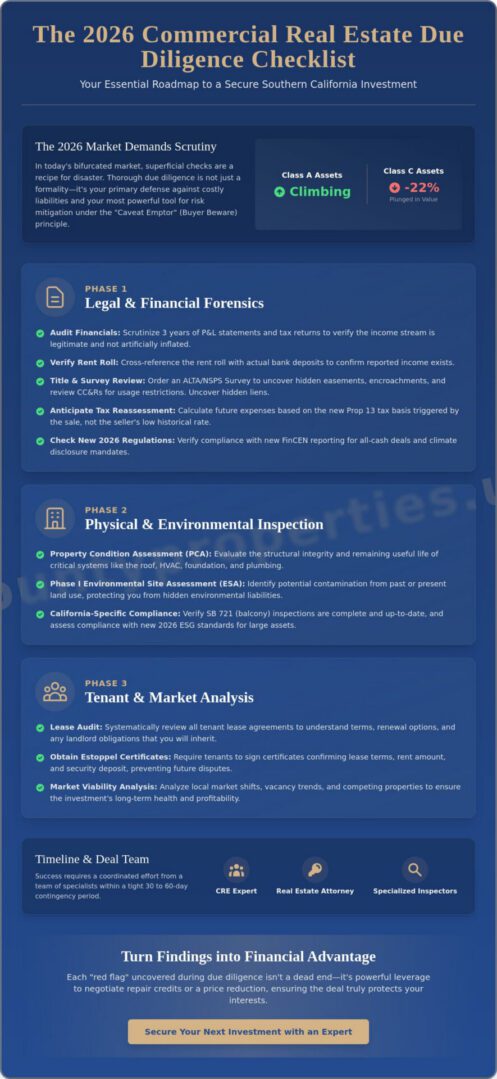
In 2026, a simple walkthrough and a quick glance at the books won’t protect your capital in a market where Class C values have plunged 22 percent while Class A assets continue to climb. You likely realize that Southern California real estate offers incredible rewards, but the fear of a hidden environmental liability or a missed SB 721 balcony inspection deadline can keep any seasoned investor up at night. The rising complexity of California’s new ESG standards and the 2025 federal tax shifts means the margin for error is thinner than ever.
We’ve developed this comprehensive due diligence checklist for commercial property to provide the exact roadmap you need to verify every physical and financial detail before your contingency period expires. You’ll find a step-by-step breakdown of essential 2026 regulatory updates, including new FinCEN reporting requirements for all-cash entity purchases and climate disclosure mandates for large-scale assets. This process ensures you have the leverage to negotiate a deal that truly protects your interests and secures your financial future with total confidence.
Key Takeaways
- Learn how to audit three years of financial records and title commitments to uncover hidden liens or income discrepancies before they become your liability.
- Identify critical physical defects and environmental risks using a Phase I ESA, ensuring your Southern California investment meets strict 2026 safety and structural standards.
- Use our comprehensive due diligence checklist for commercial property to systematically verify tenant lease terms through Estoppel Certificates and SNDA agreements.
- Discover how to transform inspection red flags into powerful negotiation leverage for repair credits without jeopardizing the entire acquisition.
What is Commercial Real Estate Due Diligence & Why It’s Your Best Insurance Policy
At its core, What is Commercial Real Estate Due Diligence represents the exhaustive process of verifying a property’s financial, legal, and physical health before a sale becomes final. In the commercial sector, the burden of discovery rests almost entirely on you. This “Caveat Emptor” or buyer beware reality means that if you fail to spot a structural crack or a lien on the title during the inspection period, you inherit that problem the moment you close. Think of this phase not as a hurdle, but as your most powerful tool for risk mitigation.
The 2026 market landscape makes this verification more critical than ever. With a stark bifurcation between high-performing Class A properties and struggling Class C assets, which have dropped 22 percent in value since 2024, you can’t afford to take a seller’s word at face value. A thorough due diligence checklist for commercial property provides the objective data needed to justify the purchase price or walk away entirely. This period functions as a vital “get out” clause, allowing you to cancel the contract without losing your earnest money deposit if the findings don’t align with the initial offering.
The Three Pillars of a Successful Investigation
A comprehensive investigation rests on three distinct areas of expertise. First, financial verification involves auditing the last three years of profit and loss statements and tax returns to ensure the reported income stream is legitimate. Second, the physical pillar requires a Property Condition Assessment to evaluate the roof, HVAC, and foundation. Finally, the legal and title pillar ensures the seller actually has the right to transfer the property and that no hidden encumbrances or easements will restrict your future use of the land.
Setting Your Timeline and Deal Team
In California, the regulatory environment is dense. You’ll typically need a 30 to 60-day window to navigate complex requirements like SB 721 balcony inspections and new 2026 ESG standards for large buildings. Success depends on the quality of your advisors. You should assemble a team that includes a real estate attorney, specialized inspectors, and a commercial real estate Southern California expert who understands local market shifts and vacancy trends. The due diligence contingency is the buyer’s primary protection against earnest money loss. Using a disciplined due diligence checklist for commercial property keeps your team on track during these tight windows.
Phase 1: Legal and Financial Documentation (The Paperwork Trail)
Success in a commercial acquisition starts with a forensic look at the numbers. You can’t rely on a glossy marketing brochure; you need to see the raw data. A thorough due diligence checklist for commercial property begins with an audit of the last three years of profit and loss statements and federal tax returns. Comparing these documents reveals whether the reported income stream is consistent or artificially inflated. With the “One Big Beautiful Bill Act” (OBBBA) restoring 100 percent bonus depreciation for 2026, you must also verify how the current owner has managed asset depreciation to understand your future tax benefits.
California’s Proposition 13 creates a specific trap for the unwary. While the seller might pay a low tax rate based on an assessment from a decade ago, your purchase will trigger a reassessment at the current market value. You should calculate your 2026 operating expenses using the new projected tax basis rather than the seller’s historical costs. Additionally, perform a line-by-line audit of the Rent Roll. Cross-referencing tenant payments with actual bank deposits is the only way to confirm that the income you’re buying actually exists. If you find discrepancies in these records, it’s often wise to connect with an expert buyer representative who can help you navigate these financial complexities.
Title and Survey Verification
Boundary disputes and “unrecorded” easements can derail your plans for a property. You should always insist on an ALTA/NSPS Land Title Survey. This high-standard survey identifies encroachments, such as a neighbor’s fence or a utility line, that a standard plot map might miss. Review the Covenants, Conditions, and Restrictions (CC&Rs) carefully; these documents often contain hidden limitations on how you can renovate or use the space. Ensuring the title is clear of mechanic’s liens or undisclosed debts is your primary defense against future legal battles.
Zoning and Entitlement Compliance
Never assume a property is legally compliant just because it’s currently occupied. You need to obtain a Zoning Comfort Letter from the local municipality to confirm the building is in legal, conforming use. This protects you from inheriting old code violations that could lead to forced closures or expensive retrofits. In California, ADA (Americans with Disabilities Act) compliance is a massive litigation risk. Your due diligence checklist for commercial property must include a professional accessibility audit of parking lots, ramps, and restrooms. Addressing these issues during the contingency period gives you the leverage to demand repairs or price concessions before you’re legally committed to the deal.
Finally, keep in mind that as of March 1, 2026, all-cash purchases made through entities like LLCs must comply with new FinCEN reporting requirements. This federal mandate requires disclosure of beneficial ownership information to combat money laundering. Ensuring your paperwork trail is transparent and compliant with these 2026 standards is essential for a smooth closing process.
Phase 2: Physical Inspections and Environmental Risks in Southern California
Once you’ve verified the financial records, you must step onto the pavement to assess the physical reality of the asset. In the Southern California market, the environment is as much a liability as it is an amenity. A professional due diligence checklist for commercial property must prioritize a Phase I Environmental Site Assessment (ESA). This report identifies “Recognized Environmental Conditions” (RECs) such as past chemical spills or underground storage tanks that could cost millions in remediation. If the Phase I flags a potential issue, you’ll need to move to Phase II testing, which involves actual soil and groundwater sampling to determine the extent of the contamination.
Beyond the soil, you need a comprehensive Property Condition Assessment (PCA). This isn’t a standard home inspection; it’s a deep dive into the building’s skeleton and vital organs. You’re looking for the remaining useful life of expensive components like the foundation and industrial HVAC units. In 2026, checking for compliance with SB 721 is non-negotiable for buildings with three or more units. The final deadline for these “Exterior Elevated Element” safety inspections was January 1, 2026, so you must confirm that the current owner has a valid inspection on file to avoid immediate legal and safety liabilities.
Structural Integrity and Systems Audit
Roofing issues are one of the most common reasons commercial deals fail during the contingency period. You should always demand a roof certification for retail or industrial acquisitions to ensure the structure can handle the weight of modern HVAC units or solar arrays. Your team must also test the Mechanical, Electrical, and Plumbing (MEP) systems to forecast capital expenditures over the next five to ten years. In California, a PML score above 20% often requires immediate structural retrofitting for financing, which can drastically alter your initial investment calculations.
Environmental and Energy Compliance
Energy efficiency is no longer optional for large-scale investments. As of 2026, commercial properties over 20,000 square feet must comply with updated ESG standards, including strict energy benchmarking and indoor air quality reporting. You also need to verify Title 24 compliance for lighting and climate control systems. For properties built before 1978, your due diligence checklist for commercial property should include specific testing for asbestos and lead-based paint to prevent future litigation or expensive abatement during renovations.
Finally, don’t overlook the impact of wildfire zones on your bottom line. In 2026, insurance availability in high-risk regions has tightened significantly. You must obtain an insurance quote during your due diligence window to ensure the property is actually insurable and that the premiums won’t erase your projected cash flow. This physical and environmental audit is your best defense against the “hidden” costs of Southern California ownership.
Phase 3: Tenant Lease Audits and Market Viability Analysis
Verifying the physical structure is only half the battle. You are ultimately buying a stream of income, which means your due diligence checklist for commercial property must treat the tenants with as much scrutiny as the foundation. The Estoppel Certificate is your primary truth serum in this process. By requiring tenants to sign a written statement confirming their current rent, lease expiration, and any verbal promises made by the seller, you prevent costly disputes after the keys change hands. If a tenant claims they are owed three months of free rent that wasn’t in the lease, the Estoppel Certificate flushes that issue out before you close.
Lenders also require protection through SNDA (Subordination, Non-Disturbance, and Attornment) agreements. These documents ensure the lease remains valid even if the property faces foreclosure, providing security for both the bank and the tenant. Beyond the paperwork, you must evaluate the actual creditworthiness of the people paying the bills. In 2026, we see a massive performance gap where Class A properties thrive while Class C assets struggle with a 22 percent drop in value. Analyzing a tenant’s history of delinquencies or late payments is essential to determine if that 7 percent cap rate is a reality or a mirage. If you’re ready to audit a potential acquisition, request a professional buyer consultation to ensure your income stream is secure.
The Lease Audit Process
Don’t assume the square footage listed in the lease is accurate. You should use BOMA (Building Owners and Managers Association) standards to measure the physical space and compare it to the rentable square footage cited in the contract. Discrepancies here can lead to overpaying for years. You must also hunt for rights of first refusal or options to terminate that could block you from selling the building later or leasing to a better tenant. Finally, verify that all security deposits and prepaid rents are accounted for and will be credited to you at the close of escrow.
San Diego and Southern California Market Context
Market viability depends on the neighborhood’s future, not just its past. In early 2026, the Los Angeles office market hit a vacancy rate of 25.5 percent, while industrial spaces showed more resilience with a 5.4 percent vacancy rate. You need to know if new supply is opening down the street that will cannibalize your tenants. Consulting with a real estate agent near me helps you identify these hyper-local trends. This analysis determines the Highest and Best Use for the property, ensuring you aren’t trying to run a traditional office in a submarket that is shifting toward medical or owner-user industrial needs.
Final Review: Turning Your Checklist Findings into Negotiation Leverage
Information is only as good as the action it inspires. You’ve spent weeks digging through paperwork and walking the site; now it’s time to transform that data into financial results. Your completed due diligence checklist for commercial property is no longer just a list of facts. It is your primary tool for final negotiations. If your inspections revealed a roof nearing the end of its life or an HVAC system that doesn’t meet 2026 ESG standards, you have the objective proof needed to request a “Repair and Credit” list. This document outlines every physical or financial discrepancy and assigns a dollar value to the fix.
Presenting these red flags to a seller requires a steady, professional hand. You don’t want to kill a potentially lucrative deal over minor cosmetic issues. Instead, focus on “deal breakers” that affect the property’s net operating income or long term safety. In the 2026 market, where Class C properties have seen a 22 percent drop in value, buyers often have significant leverage. You must decide whether to demand a direct price reduction, ask the seller to pay for repairs before closing, or simply walk away. A price reduction is usually preferable because it gives you control over the quality of the repairs after you take ownership.
Quantifying the Risks
Vague estimates won’t win a negotiation. You should obtain at least two independent contractor bids for every major defect found during the Property Condition Assessment. If your Phase I ESA suggested the need for Phase II soil testing, you must estimate those remediation costs immediately. These numbers are vital because they directly impact your loan-to-value ratio. If the found issues lower the property’s appraised value, your lender might reduce your loan amount, requiring you to bring more cash to the table or negotiate a lower purchase price to bridge the gap.
The ‘Go/No-Go’ Decision
The final step is the most difficult: deciding whether to sign on the dotted line. You should review your entire file with a trusted real estate partner who can provide an objective perspective on the deal’s long term viability. Ensure that every “Condition Precedent” in your purchase agreement, such as clear title or environmental clearance, has been fully met or formally waived. If the risks outweigh the rewards, don’t be afraid to exercise your contingency and protect your capital. If you move forward, begin preparing for a smooth management handover by finalizing the closing statement and ensuring all tenant security deposits and prorated rents are correctly transferred on the day of closing.
Secure Your Southern California Investment with Confidence
Success in the 2026 commercial landscape requires more than just a keen eye for opportunity; it demands a disciplined investigative process. By following a rigorous due diligence checklist for commercial property, you transform potential liabilities into actionable negotiation leverage. You’ve learned how to audit complex financial trails, navigate strict California environmental mandates, and verify the creditworthiness of your income stream. These steps are the only way to ensure your capital is protected in an increasingly bifurcated market where asset quality determines long term survival.
At County Properties, we bring 36 years of Southern California real estate experience to every transaction. Our collaborative team approach provides specialized expertise in complex commercial acquisitions, helping you mitigate risk before it impacts your bottom line. We serve as your steady guide through the entire verification process, ensuring no detail is overlooked and every contingency is managed with care. Maximize your investment with expert guidance from County Properties; contact us today. We look forward to helping you build a secure and prosperous portfolio in the years ahead.
Frequently Asked Questions
How long does the due diligence period usually last for commercial property?
A standard due diligence period typically lasts between 30 and 60 days. This window provides enough time to coordinate with third party inspectors and review complex legal filings. However, for large Southern California assets requiring detailed ESG reporting or structural seismic audits, you may need to negotiate a longer extension. Your purchase agreement should clearly define these dates to avoid missing critical deadlines.
What is the difference between a Phase I and Phase II Environmental Assessment?
A Phase I Environmental Site Assessment involves a historical review of the property’s past uses and a visual inspection to identify potential contamination. It doesn’t include physical sampling. If the Phase I report flags a “Recognized Environmental Condition,” you must proceed to a Phase II assessment. This second phase involves laboratory testing of soil or groundwater to determine the actual presence and concentration of hazardous materials.
Can I back out of a commercial deal during the due diligence period?
You can back out of a deal if your purchase agreement includes a specific feasibility or inspection contingency. This clause allows you to cancel the contract based on your findings related to the property’s condition. As long as you provide written notice before the contingency period expires, you can typically terminate the transaction and receive a full refund of your earnest money deposit without legal penalty.
Who pays for the inspections and reports during due diligence?
The buyer almost always pays for the inspections and reports required by their due diligence checklist for commercial property. This includes the costs for structural engineers, environmental consultants, and ALTA surveys. While these expenses can be significant, they represent a vital investment in risk mitigation. Independent verification ensures the findings are objective and not biased toward the seller’s interests or previous marketing claims.
What is an Estoppel Certificate and why is it mandatory?
An Estoppel Certificate is a legally binding document where a tenant confirms the current terms of their lease in writing. It’s mandatory because it prevents the seller or tenant from making conflicting claims after the sale is complete. By verifying the rent amount, security deposits, and lease expiration dates directly with the occupants, you protect yourself from inheriting undisclosed verbal agreements or hidden financial disputes.
Is an ALTA survey required for all commercial acquisitions?
While not legally required for every sale, most lenders and title insurance companies insist on an ALTA/NSPS survey for commercial acquisitions. A standard boundary survey often misses critical details like utility easements or minor encroachments. An ALTA survey provides a much higher level of precision, identifying potential boundary issues that could affect your title insurance coverage or future development plans for the site.
What happens if a seller refuses to provide the requested documents?
If a seller refuses to provide requested documents, it’s often a major red flag that indicates hidden liabilities or poor record keeping. You should first check your purchase agreement to see if the seller is contractually obligated to produce those records. If they continue to withhold information, you have the right to terminate the deal under your contingency or request a formal extension until the documents are delivered.
How does Prop 13 impact property taxes on a newly acquired commercial building in California?
Under California’s Proposition 13, a change in ownership triggers a property tax reassessment at the current market value. While the seller might have enjoyed a low tax basis for decades, your new bill will be based on the 2026 purchase price. You should always factor this increased operating expense into your financial models. It’s a common mistake to calculate future cash flow using the seller’s historical tax payments.