

While some investors wait for the perfect listing, the most successful buyers in 2026 are busy decoding the 134 new amendments in San Diego’s latest Land Development Code update. You might think securing a property with a 5.16% cap rate is just about the numbers, but in this market, your success depends on how well you handle local regulatory friction. Learning how to buy commercial real estate in San Diego requires more than a search engine; it demands a deep dive into new laws like SB 79 that are currently reshaping transit corridors.
It’s natural to feel uneasy about navigating complex zoning laws or overpaying in a market where the average price has reached $653 per square foot. We understand the pressure of finding transparency in off-market deals while managing a 1.25% effective property tax rate. This guide provides a clear, step-by-step framework to master these complexities, ensuring you build a portfolio designed for sustainable success. We’ll explore the latest 2026 permit fees, the shift to Opportunity Zones 2.0, and how to partner with local experts who know the ground as well as the data.
Key Takeaways
- Identify high-growth sectors like biotech industrial and experiential retail to align your portfolio with San Diego’s 2026 market demand.
- Master how to buy commercial real estate in San Diego using a strategic five-step framework designed to uncover off-market deals and secure competitive cap rates.
- Navigate the 2026 Land Development Code update and the “Complete Communities” initiative to maximize property value through local zoning incentives.
- Benefit from a collaborative “team concept” that leverages 36 years of local experience to provide the transparency and expert guidance needed for sustainable success.
The San Diego Commercial Real Estate Landscape in 2026
San Diego commercial real estate (CRE) encompasses a diverse range of assets including office buildings, retail centers, industrial warehouses, and multi-family complexes. It is a high-barrier-to-entry market that rewards long-term holders with significant equity growth and reliable cash flow. Understanding how to buy commercial real estate in San Diego begins with recognizing that this isn’t just about owning land; it’s about owning a piece of a supply-constrained coastal economy that consistently outpaces national averages.
The 2026 outlook remains robust, primarily because the tech and life science sectors continue to anchor demand. While other California cities have seen a decline in office occupancy, San Diego’s specialized R&D hubs in Sorrento Valley and Torrey Pines remain vital. This resilience is a direct result of San Diego’s economic landscape, which is uniquely supported by federal defense spending, a world-class biotechnology cluster, and a thriving international trade gateway. Investors who focus on these fundamental drivers are finding that San Diego offers a level of stability rarely found in other major metropolitan areas.
Why Invest in San Diego Now?
International trade through the Port of San Diego continues to fuel a massive need for industrial and logistics space. Even with industrial vacancy rates reaching a historic high of 7.3% to 9.2% in Q1 2026, the market is seeing a healthy correction that allows savvy investors to negotiate better terms. We’re also seeing a “Work-from-Near-Home” trend. This has sparked the rise of suburban office hubs in North County, where professionals prefer shorter commutes to localized, high-quality workspaces. While the office sector shows a vacancy rate between 13.6% and 15.4%, the flight to quality means that upgraded, well-located assets are still seeing positive net absorption.
Commercial vs. Residential: The Key Differences
If you’re moving from residential rentals to commercial property, the lease structures will be your biggest shift. Most commercial deals utilize Triple Net (NNN) leases, where the tenant covers property taxes, insurance, and maintenance. This creates a much more passive income stream than a residential “Gross” lease. Financing is also more rigorous. Lenders typically look for a Debt Service Coverage Ratio (DSCR) of 1.25 or higher, meaning the property must generate 25% more income than the annual debt payments. While residential deals focus on your personal credit, commercial lenders focus on the property’s ability to produce revenue. This shift in focus is why longer commercial leases, often spanning 5 to 10 years, provide a layer of stability that residential investments simply can’t match.
Successful acquisition in this market requires balancing immediate yield with long-term appreciation. With the average cap rate currently sitting at 5.16% and the average sale price at $653 per square foot, San Diego offers a dual-benefit. You get the monthly income necessary to service debt today while holding an asset in a geography where new development is physically limited by the Pacific Ocean and the mountains. It’s a strategy built for those who value wealth preservation as much as monthly returns.
Choosing the Right Property Type for Your Portfolio
Your choice of asset class dictates your daily management responsibilities and your long term wealth trajectory. In 2026, San Diego’s commercial market isn’t a monolith; different sectors are reacting uniquely to the current economic environment. Understanding how to buy commercial real estate in San Diego requires matching your risk tolerance with the specific growth patterns of our local neighborhoods. Whether you’re seeking the stability of multi-family housing or the high-growth potential of biotech flex space, each property type offers a different path to financial security.
Industrial and flex spaces are currently the “gold rush” of the region. While industrial vacancy rates reached a historic high between 7.3% and 9.2% in early 2026, this shift has actually opened doors for private investors who were previously priced out by institutional giants. Flex space is our top recommendation for 2026 because it accommodates both office and warehouse needs, making it highly resilient. Meanwhile, retail is seeing a transformation. With a low 5.5% vacancy rate, experiential retail in neighborhoods like Hillcrest and North Park is thriving as consumers prioritize dining and localized services over traditional big-box shopping.
San Diego Property Type Comparison Table
| Property Type | Risk Level | Potential ROI | Management Intensity |
|---|---|---|---|
| Industrial / Flex | Low to Medium | High | Low |
| Retail (Experiential) | Medium | Medium to High | Medium |
| Office (High-Amenity) | High | Variable | High |
| Multi-Family | Low | Consistent | High |
Flex space remains a standout because it benefits from San Diego’s economic development initiatives that support small-scale manufacturing and tech startups. Additionally, multi-family and mixed-use projects are currently benefiting from citywide density bonuses under the “Complete Communities” program, which allows for increased floor area ratios in exchange for affordable housing contributions.
Identifying Your Investment Goal
Are you an owner-user looking to house your own business, or a passive investor seeking a “mailbox money” experience? Owner-users often benefit from specialized financing, while passive investors typically prefer Triple Net (NNN) leases to minimize management headaches. To evaluate any deal, you must master the Cap Rate calculation: divide the property’s Net Operating Income (NOI) by its purchase price. With the average San Diego cap rate at 5.16% in May 2026, properties performing significantly above this may signal higher risk or a “Value-Add” opportunity. Value-add properties, which require physical or operational improvements, are particularly attractive in today’s high-interest rate environment as they allow you to manufacture equity through smart renovations. If you’re unsure which asset class fits your goals, our team can help you analyze specific submarkets to find the best fit for your portfolio.
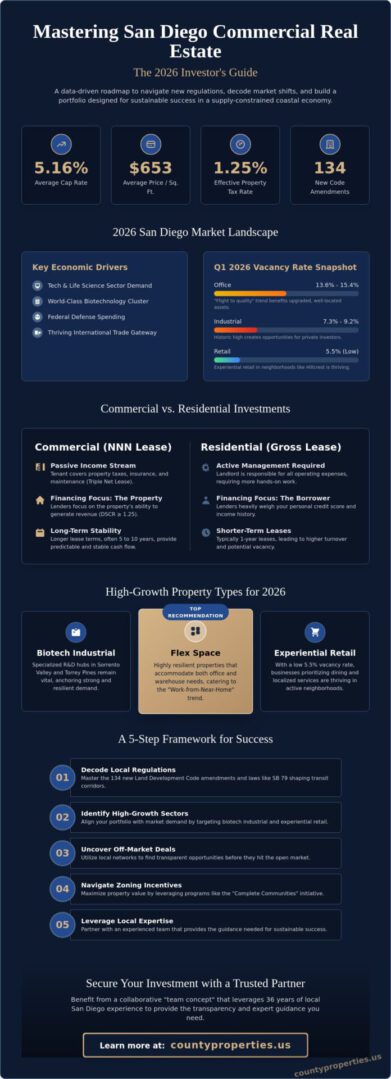
Navigating the San Diego Buying Process: A 5-Step Framework
Finding a building is only half the battle. The real work begins when you move from browsing listings to executing a professional acquisition strategy. Mastering how to buy commercial real estate in San Diego involves a structured approach that minimizes risk while maximizing your speed to close. In a market where high quality assets move quickly, having your “family of friends” team ready to act is your greatest competitive advantage.
Your journey begins with Step 1: Financial Pre-Approval and Team Assembly. Before touring properties, you must secure a lender, a commercial attorney, and a seasoned broker. With commercial mortgage rates in May 2026 starting as low as 5.33% for multifamily and 6.39% for general CRE, knowing your exact borrowing power allows you to submit offers with confidence. Step 2 involves Property Sourcing. In San Diego, the best deals often happen off-market. Accessing these requires deep roots in the local community and a network that hears about opportunities before they hit public portals.
Once you’ve identified a candidate, Step 3 is the Letter of Intent (LOI). This document outlines your price, deposit amounts, and the length of your due diligence period. A winning LOI in 2026 should be clear and professional, signaling to the seller that you’re a serious closer. Step 4 is the Due Diligence window, typically lasting 60 to 90 days. This is your time to verify every claim made by the seller. Finally, Step 5 is Closing and Post-Acquisition Management. This stage includes paying the documentary transfer tax of $1.10 per $1,000 of value and settling escrow fees, which usually cost $2 per $1,000 of the purchase price plus a $250 base fee per party.
The Critical Importance of Due Diligence
Due diligence is where you protect your capital from hidden liabilities. A Phase I Environmental Site Assessment (ESA) is non-negotiable in California to ensure the land isn’t contaminated from previous uses. You must also audit existing leases and request Estoppel Certificates. These documents are signed by tenants to confirm their current rent and lease terms, preventing surprises after the sale. Physical inspections are just as vital. Even if a property is sold “as-is,” you need a professional assessment of the HVAC, roofing, and structural integrity. During this window, you must verify that your intended use aligns with current San Diego zoning regulations to avoid costly permit delays later.
Structuring the Deal for Success
Your financing choice depends on your long-term goals. Owner-users should look into SBA 504 loans, which offer low down payments and long-term fixed rates. Passive investors typically utilize conventional commercial loans with 5 to 10 year terms. While the emotional stakes are high when buying a home in Southern California, commercial transactions are driven by strict financial performance and contractual obligations. Expect a typical San Diego commercial escrow to last between 60 and 120 days total, providing ample time for your team to ensure every detail is perfect before you take ownership.
San Diego Specifics: Zoning, Permits, and Opportunity Zones
Understanding how to buy commercial real estate in San Diego means looking past the building and into the municipal code. The City of San Diego is currently implementing its 2026 Land Development Code Update, which includes 134 citywide amendments designed to streamline production. One of the most powerful tools for investors is the “Complete Communities” initiative. This program offers significant density bonuses and floor area ratio (FAR) incentives for properties located near transit, often doubling or tripling the potential buildable square footage. These regulatory shifts can instantly boost a property’s underlying value if you know how to leverage them before the rest of the market catches up.
San Diego’s “Transit Priority Areas” allow for reduced parking requirements, which significantly lowers construction costs for developers and repurposing projects. This is especially relevant under new state laws like SB 79, effective July 1, 2026, which promotes housing development on commercially zoned land. If you’re looking at coastal assets, you’ll need to account for the California Coastal Commission’s oversight. Permits in the coastal zone often require additional environmental reviews and public hearings, which can extend your project timeline by 12 to 18 months. We always recommend a thorough permit audit during your due diligence period to avoid these “hidden” schedule killers.
Navigating San Diego Zoning Codes
Investors should use the City’s online Zoning Grid to verify the “Permitted Uses” for any potential acquisition. While a lot might look perfect for a warehouse, it could be restricted to specific light industrial uses. If your business requires a Conditional Use Permit (CUP), be prepared for a process that typically takes 6 to 12 months for approval. Additionally, the recent 3.7% increase in Development Impact Fees (DIFs) and the May 11, 2026, increase in school district developer fees to $0.87 per square foot for commercial projects must be factored into your renovation budget. These costs are essential to track when comparing commercial real estate Southern California trends against localized San Diego requirements.
San Diego Neighborhood Watch 2026
Kearny Mesa has emerged as the primary hub for flex and industrial redevelopment due to its central location and updated community plan. We’re also seeing a major revitalization of the “C Street” corridor in Downtown San Diego, where older office buildings are being repurposed into creative mixed-use spaces. For those seeking tax advantages, 2026 is a critical transition year for Opportunity Zones. The mandatory gain recognition date for original “OZ 1.0” deferrals is December 31, 2026, and governors will begin nominating a new map of eligible census tracts on July 1, 2026. This creates a unique window for long-term investors to lock in capital gains benefits in emerging corridors. If you need help identifying which neighborhoods offer the best regulatory upside, contact our local experts today for a personalized submarket analysis.
Securing Your Investment with a Trusted San Diego Partner
Buying commercial property isn’t a solo sport. Large institutional firms often treat you like a line item on a spreadsheet, but we do things differently. Our “Team Concept” ensures that when you learn how to buy commercial real estate in San Diego, you have the collective brainpower of our entire office rather than a single agent’s limited perspective. This collaborative environment prioritizes your success over individual marketing egos, creating a seamless experience from the first tour to the final signature at the close of escrow.
Arnie Levine brings 36 years of experience to the table, dating back to the company’s roots in 1995. This deep historical perspective is invaluable in a market currently navigating the 2026 Land Development Code updates and shifting Opportunity Zone maps. We’ve seen every market cycle, permit hurdle, and zoning change the city has faced over the last three decades. We leverage these long-standing local relationships to uncover off-market opportunities that never see a public listing. For a first-time commercial buyer, this personalized, step-by-step guidance is the difference between a high-performing asset and a costly mistake.
Beyond the Transaction: A Holistic Approach
We don’t just close deals; we protect your financial security through rigorous property vetting. Our “Family of Friends” philosophy means we treat your investment as if it were our own. This relational approach is why our clients stay with us for decades, often transitioning through various life stages and portfolio shifts. For example, legacy planning is a major part of commercial ownership as you look toward the future. Understanding why you need a senior real estate specialist can be vital for legacy commercial planning and ensuring a smooth transition for future generations. We look at your portfolio holistically, ensuring every acquisition aligns with your long-term wealth goals.
Your Next Steps in San Diego Commercial Real Estate
Ready to move forward? Your first step is to schedule a no-obligation consultation with our commercial team. During this session, we’ll help you prepare a professional “Buyer Profile.” In a competitive market where the average price per square foot reached $653 in May 2026, having a clear profile showing your financial readiness and investment criteria makes you far more attractive to the best sellers. We’ll analyze your specific goals, discuss current cap rates, and start the search for your next high-yield property. Contact County Properties today to start your commercial property search with a trusted partner who puts your interests first.
Your Path to Sustainable Commercial Success
The San Diego market in 2026 is no longer about chasing the highest listing; it’s about leveraging regulatory updates and local intelligence to manufacture value. From the 134 citywide amendments in the latest Land Development Code to the evolving map of Opportunity Zones 2.0, the landscape rewards those who move with precision. Mastering how to buy commercial real estate in San Diego requires balancing these complex data points with a proactive acquisition strategy. You don’t have to navigate these 60 to 90 day due diligence windows alone.
With 36 years of local market experience and a collaborative team-based approach, County Properties provides the specialized expertise in complex zoning and permits you need to secure high quality assets. We prioritize your financial security by uncovering off-market deals that institutional firms often overlook. Whether you’re targeting high-amenity office space or the biotech flex units currently driving demand, we’re here to guide every step of your journey. Start Your San Diego Commercial Property Search with a Trusted Expert today. Your vision for a strong Southern California portfolio is well within reach.
Frequently Asked Questions
Is commercial real estate in San Diego a good investment in 2026?
San Diego commercial real estate remains a strong investment in 2026 due to the region’s unique geography and high-tech economic anchors. While other markets face headwinds, San Diego’s 2026 Land Development Code update provides new pathways for property densification and value creation. This regulatory support combined with a limited supply of coastal land creates a resilient environment for long term wealth preservation.
How much down payment is required for a commercial building in California?
Conventional lenders usually require a 20% to 35% down payment, though SBA programs offer lower entry points for eligible buyers. For owner-users, an SBA 504 loan can reduce the down payment to just 10% of the purchase price. With commercial mortgage rates starting at 5.33% for multifamily and 6.39% for general CRE as of May 2026, your down payment choice significantly impacts your monthly debt service coverage.
What is a ‘Triple Net’ (NNN) lease and how does it work?
A Triple Net (NNN) lease is a structure where the tenant pays for property taxes, insurance, and all maintenance costs in addition to base rent. This shifts the burden of San Diego’s 1.25% effective property tax rate and rising maintenance costs onto the tenant. It’s a preferred structure for passive investors who want to minimize management intensity while securing a predictable, stable income stream.
Can I use an SBA loan to buy commercial property in San Diego?
Yes, owner-users can utilize SBA 504 or 7(a) loans to purchase property if they occupy at least 51% of the building’s total square footage. These loans are excellent for local business owners who want to lock in their occupancy costs and build equity. Learning how to buy commercial real estate in San Diego often starts with these programs because they offer 10 to 25 year fixed rates that provide long term financial stability.
What are the most profitable neighborhoods for commercial investment in San Diego?
Kearny Mesa and Sorrento Valley are currently the most profitable areas for industrial and life science investments due to high tenant demand. Kearny Mesa is benefiting from extensive redevelopment under its updated community plan, while Sorrento Valley remains the heart of the region’s biotech cluster. Downtown’s “C Street” corridor also offers high upside for those focused on repurposing older office assets into creative mixed-use spaces.
How long does the commercial buying process typically take in San Diego?
The typical commercial transaction in San Diego takes between 120 and 180 days from the signed Letter of Intent to the final closing. This timeline includes a 60 to 90 day due diligence window for environmental assessments and zoning verification. You’ll also need roughly 30 days for loan processing and settling escrow fees, which typically cost $2 per $1,000 of the purchase price plus a base fee.
What is the average cap rate for San Diego retail properties right now?
The average cap rate for San Diego commercial properties is currently 5.16% as of May 2026. Retail properties often see slightly higher yields depending on the neighborhood’s vacancy rate, which sits at a healthy 5.5% for the retail sector. Well-located experiential retail assets in North Park or Hillcrest often command premium pricing because they maintain consistent consumer demand regardless of broader economic shifts.
Do I need a specific commercial real estate agent or can my residential agent help?
You need a commercial specialist because these deals involve distinct legal requirements and financial metrics like the Debt Service Coverage Ratio (DSCR). A residential agent may not be familiar with navigating complex NNN leases or the 134 amendments in the new Land Development Code. how to buy commercial real estate in San Diego successfully requires a partner with specialized local knowledge and a collaborative team approach to uncover off-market opportunities.